

TL;DR:
- Determiner and article errors are the most common grammatical mistakes, representing nearly 29% of all errors in recent research. Non-native speakers struggle most with articles, prepositions, and verb tense due to first-language transfer, while native speakers often confuse homophones and contractions. Targeted micro-drills on high-frequency errors and understanding their patterns significantly improve writing accuracy over broad corrections alone.
A common grammatical error is a repeated mistake in English usage that reduces clarity or correctness, typically involving determiners, verb forms, or prepositions. These are not random slips. Linguistic research from 2025 shows that determiner errors alone account for 28.8% of all recorded grammatical mistakes, making them the single largest category of error in written English. That figure means nearly one in three grammar mistakes comes from misusing words like "a," "an," and "the." For students, writers, and non-native speakers, understanding which errors occur most often is the fastest route to cleaner, more credible writing. Tools like Inspirowrite and Grammarly can flag these mistakes automatically, but knowing why they happen gives you the ability to stop making them in the first place.
What is a common grammatical error in English?
The formal term for this field of study is error analysis, a branch of applied linguistics that catalogues and categorises recurring mistakes in written and spoken language. A common grammatical error, in practical terms, is any deviation from standard English grammar rules that appears with enough frequency across different writers or speakers to form a recognisable pattern. The distinction matters because not every mistake is a common one. Dropping a comma in one unusual sentence is a slip. Consistently omitting "the" before countable nouns is a pattern, and patterns are what error analysis targets.
Corpus-driven research from 2024 identifies five dominant error categories for English as a Foreign Language (EFL) learners: verb conjugation, prepositions, articles, grammatical number, and voice. Each of these categories reflects a structural feature of English that either does not exist in other languages or works very differently. That mismatch between English and a learner's first language is the root cause of most frequent grammar errors, a point explored in detail below.
Pro Tip: When reviewing your own writing, do not try to catch every possible mistake at once. Focus your first pass exclusively on determiners and verb forms, since these two categories account for the majority of errors in most learner writing.
What are the most frequent types of grammatical errors?
Research published in Nature in 2025 recorded 2,780 total errors across a large sample of English writing. The breakdown by category reveals a clear hierarchy of frequency.
| Error category | Errors recorded | Share of total |
|---|---|---|
| Determiners and articles | 800 | 28.8% |
| Verb conjugation and tense | High frequency | Second most common |
| Prepositions | High frequency | Third most common |
| Punctuation mistakes | 379 | 14.1% |
| Subject-verb agreement | Moderate frequency | Fifth most common |
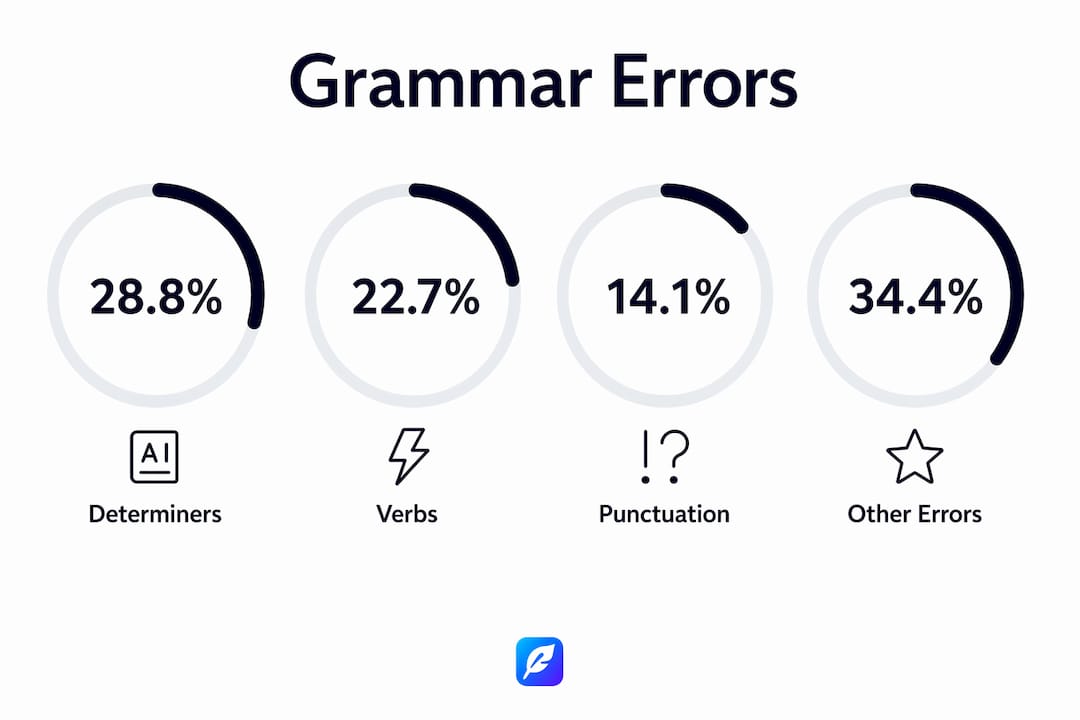
Determiner errors sit at the top because English article rules are genuinely complex. "The" signals a specific, known noun. "A" or "an" signals something introduced for the first time. Many languages, including Mandarin, Japanese, and Russian, have no direct equivalent, so speakers of those languages must learn a system that has no analogue in their mother tongue.
Verb conjugation errors come second. English tense marking requires writers to track time, aspect, and sometimes mood simultaneously. A sentence like "She has gone to the market yesterday" contains a tense error that feels natural to many learners because the past time marker "yesterday" seems to do the job on its own. It does not. The present perfect cannot be used with a specific past time reference, and that rule is not intuitive.
Punctuation errors in compound sentences make up 14.1% of total errors, which is a significant share for something often dismissed as minor. A missing comma before a coordinating conjunction, or a misplaced semicolon, can change the meaning of a sentence entirely.
Why do these errors occur, especially for non-native speakers?
The primary cause of most frequent grammar errors in non-native writing is negative transfer, the process by which rules from a speaker's first language interfere with their use of a second language. Chinese English learners, for example, show consistent patterns of tense, subject-verb agreement, and article errors that are directly traceable to the structural differences between Mandarin and English. This is not a matter of intelligence or effort. It is a predictable consequence of how the brain maps new language rules onto existing ones.
Several factors compound the problem:
- Article and determiner rules are heavily context-dependent and differ radically across languages, making them resistant to simple memorisation.
- Preposition collocations in English are largely arbitrary. You say "interested in" but "good at," and no logical rule explains the difference.
- Verb tense systems in English encode distinctions, such as the difference between simple past and present perfect, that many languages express differently or not at all.
- Cognitive load during writing means that even learners who know the rules consciously will revert to first-language patterns under pressure.
- Instructional gaps in formal grammar teaching often leave learners with incomplete rule knowledge, particularly for edge cases in article and preposition use.
Many grammar errors reflect predictable patterns rather than random slips, which is actually good news. Predictable patterns can be taught and corrected systematically. A learner who consistently drops "the" before specific nouns needs targeted practice on that one rule, not a general grammar review.
How to identify and correct frequent grammatical errors in your writing
Systematic correction works better than hoping a general read-through will catch everything. The following steps give you a structured method for reducing your error rate.
-
Audit your last three pieces of writing. Look specifically for determiner and verb form errors. Mark every instance where you used or omitted "a," "an," or "the," and check whether each choice was correct. Do the same for every verb, confirming that tense and aspect are consistent throughout.
-
Build a personal error log. Write down the specific mistakes you find repeatedly. If you consistently write "I am agree" instead of "I agree," that is a verb form error worth drilling. A log turns vague awareness into a concrete correction target.
-
Use targeted micro-drills. Focused micro-drill practice on verb tense transformations and preposition collocations produces better results than unfocused correction. A set of ten tense transformation exercises and ten preposition collocation exercises, done daily for two weeks, will reduce errors in those categories measurably.
-
Run your text through a grammar checker. Tools like Grammarly or Inspirowrite will flag surface-level errors quickly. Use these as a second pass, not a first. If you rely on them before doing your own audit, you miss the chance to learn from your mistakes.
-
Seek targeted feedback. Ask a teacher, editor, or writing partner to focus specifically on your highest-frequency error categories. General feedback like "your grammar needs work" is far less useful than "you consistently omit articles before countable nouns."
Pro Tip: When writing digital content, grammar accuracy directly affects how readers perceive your authority. For practical guidance on reducing errors in blog and SEO writing, the advice on avoiding common writing mistakes in digital content is worth reviewing.
Native versus non-native speakers: how do their errors compare?
The assumption that native speakers do not make grammar mistakes is wrong. Native speakers make different mistakes, and some of them are just as persistent.
| Error type | Native speakers | Non-native speakers |
|---|---|---|
| Homophone confusion | Very common ("your" vs "you're," "its" vs "it's") | Less common |
| Article and determiner errors | Rare | Most frequent category |
| Preposition errors | Occasional | Consistently high frequency |
| Verb tense errors | Rare in writing | Second most common category |
| Contraction misuse | Common in informal writing | Occasional |
Native speakers frequently confuse homophones and contractions, producing errors like "your welcome" or "its raining" that persist even in edited writing. These mistakes are not caused by ignorance of grammar rules. They are caused by the speed of writing and the brain's tendency to substitute phonetically identical words. Autocorrect tools often make this worse by confirming the wrong choice.
Non-native speakers, by contrast, struggle most with the structural features of English that have no equivalent in their first language. Articles, prepositions, and verb tense systems are the consistent trouble spots. The overlap between the two groups is smaller than most people assume, which has a practical implication: a correction strategy designed for native speakers will not serve a non-native speaker well, and vice versa. Tailoring correction approaches to learner background produces measurably better results than applying a universal error checklist.
Key takeaways
Fixing common grammatical errors requires targeting the highest-frequency categories first, particularly determiners and verb forms, rather than attempting broad correction across all possible mistakes.
| Point | Details |
|---|---|
| Determiners top the error list | Determiner and article errors account for 28.8% of all recorded grammar mistakes in recent corpus research. |
| Verb and preposition errors follow closely | EFL learners consistently show high error rates in verb conjugation and preposition use across multiple studies. |
| Negative transfer drives most non-native errors | First-language interference explains the predictable patterns seen in learner writing from specific language backgrounds. |
| Micro-drills outperform general correction | Targeted practice sets of ten verb tense and ten preposition exercises reduce errors more effectively than unfocused review. |
| Native and non-native errors differ significantly | Native speakers err most on homophones and contractions; non-native speakers err most on articles, prepositions, and tense. |
What I have learned from watching writers fix their grammar
After years of working with writers at every level, from university students to published authors, the pattern I see most often is this: people try to fix everything at once and end up fixing nothing reliably. They run a grammar checker, accept the suggestions, and submit. The same errors reappear in the next draft.
The research backs up what I have observed. Determiner and verb form consistency are the two areas where targeted attention produces the fastest, most visible improvement. Yet most writers skip them because they feel like small, unglamorous details. They are not. A missing "the" or a wrong tense can make a sentence feel foreign or untrustworthy to a native-speaking reader, even if they cannot articulate exactly why.
What I advocate for is a personal error profile. Before you try to improve your grammar broadly, spend thirty minutes identifying your three most frequent error types. Then practise only those. Ignore everything else for two weeks. The specificity of that approach feels counterintuitive, but it works because it matches how the brain actually builds new language habits. Broad correction attempts spread your attention too thin. Narrow, repeated practice builds the automatic recognition you need to stop making the same mistake twice.
I would also push back on the idea that grammar tools replace this process. They are useful for catching surface errors quickly, especially under deadline pressure. But they do not teach you why something is wrong, and without that understanding, you will keep making the same mistakes and keep relying on the tool to catch them. Use the tool as a safety net. Build the knowledge underneath it.
— Mike
How Inspirowrite helps you write with greater accuracy
Inspirowrite is an AI-powered proofreading and translation tool built for students, writers, and non-native speakers who need fast, accurate feedback on their writing. It identifies grammar errors across all the high-frequency categories covered in this article, including determiner use, verb tense consistency, and preposition choice, and returns corrections within seconds. Unlike many general-purpose tools, Inspirowrite keeps your content private and does not use your text to train AI models. For anyone working on improving their grammar accuracy without sacrificing speed or confidentiality, try Inspirowrite as your next proofreading step.
FAQ
What is the most common grammatical error in English?
Determiner and article errors are the most frequent grammatical mistakes, accounting for 28.8% of all recorded errors in a 2025 corpus study. Misuse of "a," "an," and "the" tops the list across both native and non-native writing samples.
Why do non-native speakers make more article and preposition errors?
Non-native speakers make more article and preposition errors because many languages lack direct equivalents for these structures. First-language negative transfer causes learners to apply their mother-tongue rules to English, producing predictable and recurring mistakes.
Do native English speakers make grammatical errors too?
Yes. Native speakers frequently misuse homophones such as "your" versus "you're" and "its" versus "it's," particularly in informal and fast-paced writing. These errors differ from non-native mistakes but are equally persistent.
What is the fastest way to reduce grammar errors in my writing?
The fastest method is to identify your three most frequent error types and practise only those through targeted micro-drills. Focused tense and preposition drills produce better results than broad correction attempts across all grammar categories.
Are grammar checkers enough to fix common writing errors?
Grammar checkers catch surface errors quickly but do not explain why a mistake occurs. Using a tool like Inspirowrite alongside deliberate self-review gives you both speed and the understanding needed to stop repeating the same errors.