
Most writers think proofreading means catching typos. That belief is costing them readers, credibility, and opportunities they never see disappear. The role of proofreading in writing runs far deeper than fixing a misplaced comma or a misspelled word. It is the final act of respect you show your audience before they read your work. Whether you are a student submitting a thesis, a professional sending a proposal, or a writer publishing online, proofreading is the difference between writing that earns trust and writing that quietly undermines it.
Table of Contents
- Key Takeaways
- What the role of proofreading in writing actually means
- How proofreading builds credibility and improves clarity
- Proofreading in the age of AI writing tools
- Practical proofreading strategies that actually work
- Weighing the benefits against the challenges
- My take on proofreading as a professional habit
- Polish your writing with Inspirowrite
- FAQ
Key Takeaways
| Point | Details |
|---|---|
| Proofreading is not editing | Proofreading targets surface errors after editing is complete, not content or structure. |
| Credibility depends on clean copy | Errors signal carelessness to readers and damage your professional reputation immediately. |
| AI tools have real limits | Automated tools miss nuance, tone, and context that only a careful human review catches. |
| Strategy beats speed | Reading aloud and reviewing after rest catches far more errors than a quick scan does. |
| Benefits outweigh the time cost | Polished writing reduces revisions, builds trust, and improves reader comprehension consistently. |
What the role of proofreading in writing actually means
People use "proofreading," "editing," and "revising" interchangeably, and that confusion leads to skipping the step entirely. They are not the same thing, and treating them as identical is one of the most common mistakes writers make.
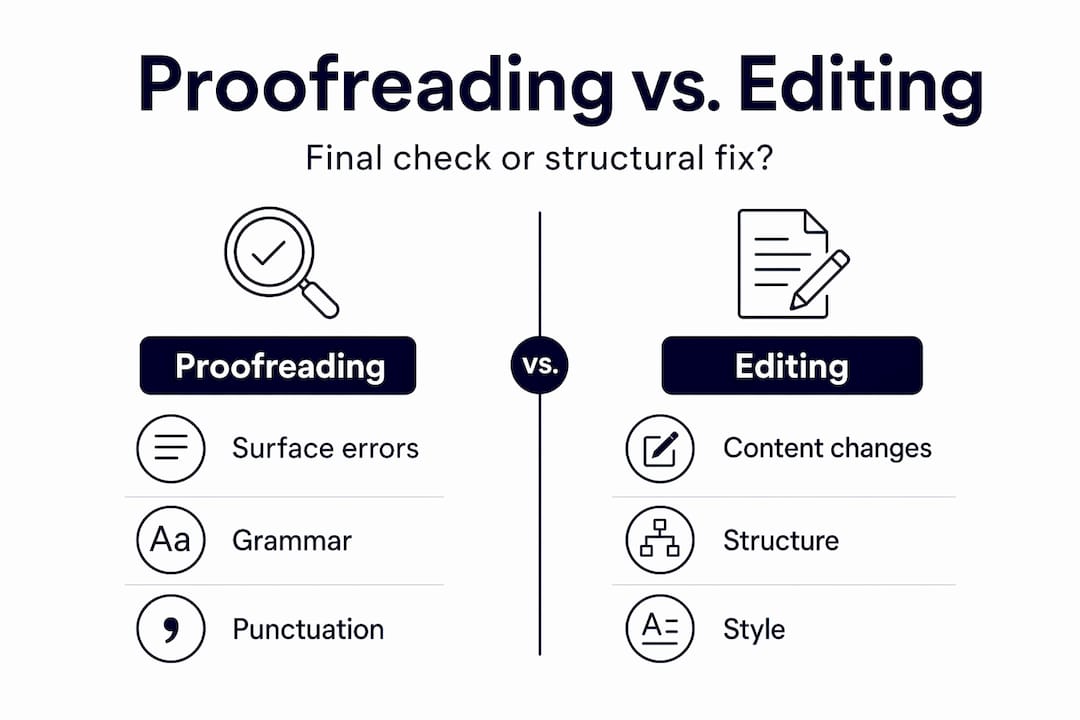
Revising happens early. It is the big-picture pass where you rethink arguments, restructure paragraphs, and cut sections that do not serve the piece. Editing comes next, focusing on sentence-level clarity, word choice, and style. Proofreading is the final check. According to the USC Writing Guide, proofreading is the last essential step to catch surface-level errors before a document reaches its audience. It is not supposed to improve your voice or restructure your argument. That work is already done.
What does proofreading actually catch? The list is more specific than most people realize:
- Spelling errors, including correctly spelled words used in the wrong context ("their" vs. "there")
- Grammatical mistakes such as subject-verb disagreement and misplaced modifiers
- Punctuation errors including missing commas, incorrect apostrophes, and run-on sentences
- Inconsistent formatting like mixed heading styles, irregular spacing, or mismatched font sizes
- Typographical errors that spell-check tools routinely miss
- Broken sentence structure that survived the editing phase
As research confirms, proofreading and editing are genuinely distinct processes. Proofreading is the final check after editing, not a substitute for it.
Pro Tip: Never proofread immediately after writing. Your brain reads what it intended to write, not what is actually on the page. Even a 30-minute break changes what you catch.
How proofreading builds credibility and improves clarity
Here is a truth most writing guides skip: readers judge your intelligence and competence based on your grammar before they evaluate your ideas. A brilliant argument buried under sloppy punctuation loses before it starts.

The importance of proofreading is backed by real professional standards. Error-free text significantly increases professional trust, while errors consistently signal carelessness to the reader. That is not a stylistic preference. It is how human cognition works. When a reader trips over an error, their attention shifts from your message to your mistake.
The benefits of proofreading go beyond just fixing what is broken. Meticulous review eliminates ambiguities and awkward phrasing, which directly improves how well readers understand your writing. Consider a sentence like: "The report, which the manager reviewed, it was approved." A proofreader catches the redundant pronoun. The reader never has to pause and re-read. That uninterrupted flow is what separates writing that feels effortless from writing that feels like work.
Consistency matters just as much as correctness. If your document uses "email" in one paragraph and "e-mail" in the next, it creates a subtle sense of disorder. Proofreading for clarity means standardizing these choices so the reader's experience stays smooth from the first sentence to the last.
From a professional standpoint, error-free documents reduce revisions and improve client satisfaction by minimizing costly post-submission fixes. In legal, academic, and business contexts, a single uncorrected error can carry real consequences. A misplaced decimal in a financial report or a wrong date in a contract is not just embarrassing. It is expensive.
Proofreading in the age of AI writing tools
Automated grammar checkers have gotten genuinely good. They catch more errors faster than any human can at first pass. So why does the role of proofreading in writing still require human judgment?
Because AI tools are pattern matchers, not meaning readers. They flag what looks statistically wrong, not what communicates poorly. A sentence can be grammatically perfect and still be confusing, condescending, or completely off-tone for its audience. Human proofreaders catch nuance that AI misses, and authentic imperfections can actually build reader trust in ways that machine-polished text cannot.
There is also the homogenization problem. When every piece of writing passes through the same AI correction engine, the output starts to sound the same. The rise of AI tools has actually increased the need for human proofreaders who can preserve authentic tone and prevent the robotic sameness that automated tools tend to produce.
The practical answer is to use both. Let an AI tool handle the first pass for obvious errors. Then do a focused human review for tone, voice, and the errors the tool missed. That combination gives you speed without sacrificing quality.
Pro Tip: After running your draft through an AI grammar tool, read the corrected version aloud. Your ear will catch what the tool fixed incorrectly or made worse.
Practical proofreading strategies that actually work
Knowing you should proofread is not the same as knowing how to do it well. These strategies separate writers who catch most errors from those who catch nearly all of them.
-
Step away before you start. Distance from your own writing is the single most effective proofreading technique. Your brain fills in missing words and smooths over errors when the text is fresh. A few hours, or ideally overnight, resets your perception.
-
Read aloud, slowly. This technique forces your brain to process every word individually rather than skimming for meaning. Professional proofreading advice consistently emphasizes reading aloud as one of the most reliable methods for catching hidden errors, especially missing words and awkward phrasing.
-
Read backward for spelling. Start from the last sentence and work toward the first. This breaks the narrative flow so your brain cannot predict what comes next, making individual word errors easier to spot.
-
Proofread in multiple passes. One pass for grammar, one for punctuation, one for formatting. Trying to catch everything at once splits your attention and reduces accuracy.
-
Print it out. Reading on paper genuinely catches different errors than reading on a screen. The change in format disrupts familiarity and forces slower reading.
-
Know your personal error patterns. If you consistently confuse "affect" and "effect," or habitually drop the Oxford comma, build a personal checklist. Targeted review of your known weaknesses is more efficient than a generic scan.
The biggest pitfall in proofreading is over-familiarity. Writers who miss errors are usually too close to their own text. Setting clear guidelines and using structured passes helps maintain the objectivity that effective proofreading requires.
Pro Tip: Change the font or font size of your document before proofreading. The visual change makes the text look unfamiliar, which helps you read what is actually there instead of what you expect to see.
Weighing the benefits against the challenges
Proofreading takes time. That is the honest trade-off. Here is how the advantages and challenges actually stack up:
| Advantage | Challenge |
|---|---|
| Improved clarity and reader comprehension | Requires dedicated time separate from writing |
| Stronger professional credibility | Familiarity with your own text reduces objectivity |
| Fewer costly revisions after submission | Over-editing can flatten your natural voice |
| Consistent formatting and style throughout | Difficult to catch all errors without a second reader |
| Higher reader trust and engagement | Proofreading fatigue reduces accuracy in long documents |
The challenges are real but manageable. Planning proofreading time into your writing schedule, rather than treating it as optional, solves the time problem. Using a checklist addresses the objectivity issue. And knowing when to stop, meaning once errors are corrected rather than rewriting sentences, protects your voice.
In professional and academic contexts, the benefits of proofreading consistently outweigh the costs. Court reporters and legal professionals treat proofreading as a non-negotiable discipline precisely because the stakes of an uncorrected error are too high to risk.
My take on proofreading as a professional habit
I have reviewed thousands of pieces of writing over the years, and I can tell within the first paragraph whether the writer proofreads. Not because the errors jump out, but because the absence of errors creates a confidence in the reading experience that you feel before you consciously notice it.
What I have learned is that proofreading is not a task you do at the end. It is a habit that shapes how you write from the start. Writers who know they will proofread carefully tend to write more boldly in their drafts, because they trust the process to clean up what needs cleaning. That freedom produces better first drafts, not worse ones.
I also think the professional identity built through proofreading is underrated. There is a real pride in submitting work that is clean. It signals that you respect the reader's time and that you take your craft seriously. In my experience, that reputation compounds. Editors remember writers who do not create extra work for them. Clients return to professionals whose documents do not need to be fixed.
My honest advice: treat proofreading as the final signature on your work. Not a chore. Not an optional polish. The last thing you do before you let it go.
— Mike
Polish your writing with Inspirowrite
If you have spent time on a piece of writing, it deserves a final review that matches that effort. Inspirowrite offers AI-powered proofreading and translation built for writers, students, and professionals who need fast, accurate results without sacrificing privacy. Your content stays confidential and is never used to train AI models.
Unlike generic grammar tools, Inspirowrite delivers targeted feedback on grammar, style, and translation accuracy within seconds. Whether you are polishing an academic paper, a business proposal, or a multilingual document, Inspirowrite gives you the confidence that your writing is ready. Try it and see the difference a focused, privacy-first proofreading tool makes on your next draft.
FAQ
What is proofreading in writing?
Proofreading is the final review of a written document to catch surface-level errors including spelling, grammar, punctuation, and formatting mistakes. It occurs after editing and focuses on correctness rather than content or structure.
Why does proofreading matter for credibility?
Errors signal carelessness to readers and reduce trust in the writer's message before the content is even evaluated. Error-free writing consistently increases professional credibility and reader confidence.
How is proofreading different from editing?
Editing addresses content, structure, and style, while proofreading focuses exclusively on surface errors in the final draft. Proofreading is the last step in the writing process, not a substitute for editing.
Can AI tools replace human proofreading?
AI tools catch basic errors quickly but miss nuance, tone, and context-specific mistakes. Human proofreading remains necessary to preserve authentic voice and catch errors that automated tools overlook.
What are the most effective proofreading techniques?
Reading aloud, stepping away before reviewing, and proofreading in multiple focused passes are among the most reliable methods. Knowing your personal error patterns and using a checklist further improves accuracy.