

TL;DR:
- Subtle translation errors, such as inconsistent terminology and cultural tone mismatches, can severely damage business reputation and legal compliance. Proper process management, skilled industry-specific translators, and human oversight are essential to prevent these costly mistakes. AI-assisted tools like Inspirowrite help identify errors early, reducing risks before content reaches international audiences.
Subtle translation mistakes have ended marketing campaigns, triggered legal disputes, and permanently damaged brand reputations in new markets. The types of business translation errors that cause the most harm are rarely dramatic blunders. They are the quiet, compounding failures: a term used inconsistently across documents, a tone that reads as cold when warmth was intended, or a machine-generated sentence that is technically accurate but culturally tone-deaf. In professional translation practice, these errors are often categorised as linguistic, terminological, cultural, and process-related failures. Understanding each category is the first step towards protecting your business communications internationally.
Table of Contents
- Key takeaways
- 1. Literal translation errors
- 2. Mistranslation of industry-specific terminology
- 3. Terminology inconsistency across documents
- 4. Context neglect in technical and financial texts
- 5. Cultural and tonal mismatches in localisation
- 6. Machine translation errors and hallucinations
- 7. Skipping review processes and choosing providers on price alone
- My honest view on where business translations actually go wrong
- How Inspirowrite helps you avoid costly translation errors
- FAQ
Key takeaways
| Point | Details |
|---|---|
| Literal translation fails business content | Word-for-word translation of idioms and industry terms regularly produces incorrect or misleading meaning. |
| Terminology must stay consistent | Using different translated terms for the same product feature across documents confuses readers and weakens brand clarity. |
| Cultural tone matters more than grammar | Tone-related localisation failures account for 23% of errors, outranking mistranslated technical terms. |
| Machine translation needs human oversight | AI translation accuracy sits between 85% and 92%, making human post-editing non-negotiable for customer-facing content. |
| Process gaps cause most errors | The majority of preventable business translation mistakes originate from missing review steps, not translator incompetence. |
1. Literal translation errors
Literal, word-for-word translation is one of the most persistent common translation errors in business content, and it is also one of the most misunderstood. Many businesses assume that if every word is correctly translated, the sentence is correct. It is not.
Consider the English phrase "we hit the ground running." Translated literally into German, Spanish, or Mandarin, it produces nonsense or, worse, an unintentionally alarming image. The same problem appears in product catalogues, where industry-specific idioms get rendered word-for-word and lose all technical precision.
The risks extend beyond embarrassment:
- Legal documents that use literal translations of contractual terms can create ambiguity that voids clauses or misrepresents obligations.
- Marketing copy with literal idiom translations reads as unnatural or juvenile to native speakers, eroding trust immediately.
- Technical manuals that translate measurement or process terms literally may produce safety risks if units or procedures are misrepresented.
Pro Tip: When briefing a translator, always provide the source document alongside a glossary of industry terms and a short explanation of the intended audience. Context prevents literal errors before they start.
2. Mistranslation of industry-specific terminology
Mistranslation of specialist vocabulary is a distinct category from literal errors. Here, the translator understands the sentence structure but selects the wrong term within a specialised field. A "debenture" in financial translation is not interchangeable with a "bond" in every jurisdiction. A "clinical trial" in pharmaceutical content carries regulatory weight that a generic phrase like "medical test" does not.

These translation error examples are particularly damaging in regulated industries. A mistranslated term in a pharmaceutical submission, a financial prospectus, or a data privacy notice can trigger compliance failures with real financial penalties. The error is not visible to a general reader, which is precisely what makes it dangerous. It passes basic review and only surfaces when a subject-matter expert or regulator examines the document.
The mitigation is straightforward but requires investment: use translators who specialise in your industry, not generalists who are comfortable across all topics.
3. Terminology inconsistency across documents
Inconsistent terminology across translated documents is a business document translation issue that compounds over time. Imagine a software company that translates "dashboard" as three different words across its user manual, website, and customer support articles in French. Each translation is technically defensible. Together, they create confusion about whether these are the same feature or different ones.
This matters enormously for brand clarity. Users who encounter inconsistent terms lose confidence in the product and the company behind it. For enterprise clients reviewing contracts or technical specifications, inconsistency signals a lack of rigour.
Pro Tip: Build a translation memory and a brand-approved glossary before commissioning any multilingual content. Tools that enforce terminology consistency across projects will save significant correction costs later.
The solution is terminology management: a centralised, approved glossary that all translators and editors reference. This is standard practice in professional translation management systems, and it is the single most cost-effective investment a business can make in translation quality.
4. Context neglect in technical and financial texts
Ignoring document context produces a specific type of error where the translator selects a term that is linguistically valid but contextually wrong. The word "charge" in English means something entirely different in a legal contract, an electrical engineering manual, and a retail pricing document. Without understanding which context applies, a translator will default to the most common usage, which is frequently incorrect.
This is particularly acute in financial and technical translation. A term like "leverage" in a corporate finance document has a precise meaning that differs from its use in general business writing. Translating it without understanding the document's purpose and audience produces a version that misleads readers who know the subject.
Contextual review requires translators to read the entire document before beginning, understand the document type and its intended audience, and flag ambiguities to the client before proceeding. Businesses that rush translation projects by providing only excerpts or individual paragraphs are actively creating the conditions for this error.
5. Cultural and tonal mismatches in localisation
Translation and localisation are not the same process. Translation converts words. Localisation adapts meaning, tone, cultural references, and emotional register for a specific audience. The gap between the two is where brand embarrassment happens most frequently.
Nearly 29% of marketers have experienced brand backlash from poor translations, and more than one-third regret not testing content with native speakers before launch. The errors that cause this damage are rarely grammatical. They are tonal and cultural.
Consider these common localisation failures:
- Humour that does not transfer. A witty tagline in British English often relies on understatement or irony that reads as confusing or rude in direct-communication cultures.
- Colour and imagery associations. A campaign built around white as a symbol of purity will land very differently in markets where white is associated with mourning.
- Formal versus informal register. Using the informal "you" equivalent in German or French with a B2B audience signals a lack of professionalism that formal English does not convey.
- Missed cultural references. A campaign referencing a British cultural touchstone means nothing to a Brazilian audience and can feel alienating.
"Localised marketing demands more than grammatical correctness. Each small decision around tone, register, and idiomatic phrasing accumulates to affect brand perception heavily."
Tone-related localisation failures account for 23% of all localisation errors, outranking terminology mistranslations at 21%. The practical implication is clear: native speaker review of tone and cultural fit is not optional for customer-facing content.
6. Machine translation errors and hallucinations
Machine translation accuracy typically ranges between 85% and 92%, which sounds reassuring until you consider that a 10% error rate in a 500-word product description means 50 words are wrong. Approximately 40% of AI translation errors involve incorrect lexical choices and around 30% involve syntactic errors such as word order and verb conjugation.
AI translation also produces what practitioners call "hallucinations": confident-sounding output that is factually or semantically incorrect. In a legal contract, a hallucinated clause is a liability. In a medical document, it is a safety risk.
| Content type | Recommended translation approach |
|---|---|
| Internal communications | Raw machine translation acceptable |
| Product descriptions | Light post-editing minimum |
| Marketing and brand copy | Full post-editing or human translation |
| Legal and compliance documents | Full human translation with expert review |
| Medical and pharmaceutical content | Full human translation with subject-matter expert sign-off |
ISO 18587 distinguishes between light and full machine translation post-editing (MTPE). Full MTPE produces output indistinguishable from human translation and is the minimum standard for any external or customer-facing business content. Skilled post-editors catch subtle meaning distortions and terminology inconsistencies that AI consistently misses.
Pro Tip: Categorise your content by business impact before choosing a translation workflow. Internal memos can tolerate raw machine translation. Anything a customer, regulator, or partner reads should have human post-editing at minimum.
7. Skipping review processes and choosing providers on price alone
Skipping revision steps and selecting translation providers based solely on cost is among the most predictable sources of persistent business translation mistakes. The logic is understandable: translation feels like a commodity, and lower prices appear to deliver the same output. They do not.
Providers who compete on price alone typically cut corners in specific, consequential ways:
- No terminology management. Each project is translated in isolation, producing the inconsistency errors described above.
- Single-translator workflows. No independent review means errors are never caught before delivery.
- No subject-matter specialists. Generalist translators handle technical, legal, and medical content without the domain knowledge required.
- Poor communication standards. Ambiguities in source documents are guessed at rather than flagged, producing confident but incorrect translations.
The cost of correcting a poor translation after publication, managing a brand crisis, or resubmitting a regulatory document far exceeds the savings from choosing the cheapest provider. Quality assurance documentation, revision processes, and clear communication protocols are the minimum standards to require from any translation partner.
My honest view on where business translations actually go wrong
I've reviewed enough multilingual business content to say with confidence that the most damaging translation failures are almost never the translator's fault. The errors that cost businesses money and reputation are process failures: no glossary provided, no context given, no native speaker review commissioned, no time allowed for revision.
What I find consistently underestimated is the tonal dimension. Businesses invest heavily in getting terminology right, and rightly so, but they treat tone as a secondary concern. In my experience, a technically accurate translation that sounds cold, aggressive, or overly casual in the target language does more damage than a minor terminology slip. Customers feel tone before they analyse vocabulary.
The other thing I've learned is that machine translation is genuinely useful when used correctly. The problem is not the technology. It is the assumption that machine output is finished output. Categorising content by impact and applying the right level of human oversight to each type is the most practical framework I have seen for managing translation quality at scale.
Most preventable translation problems come from process gaps, not translator incompetence. Fix the process and the quality follows.
— Mike
How Inspirowrite helps you avoid costly translation errors
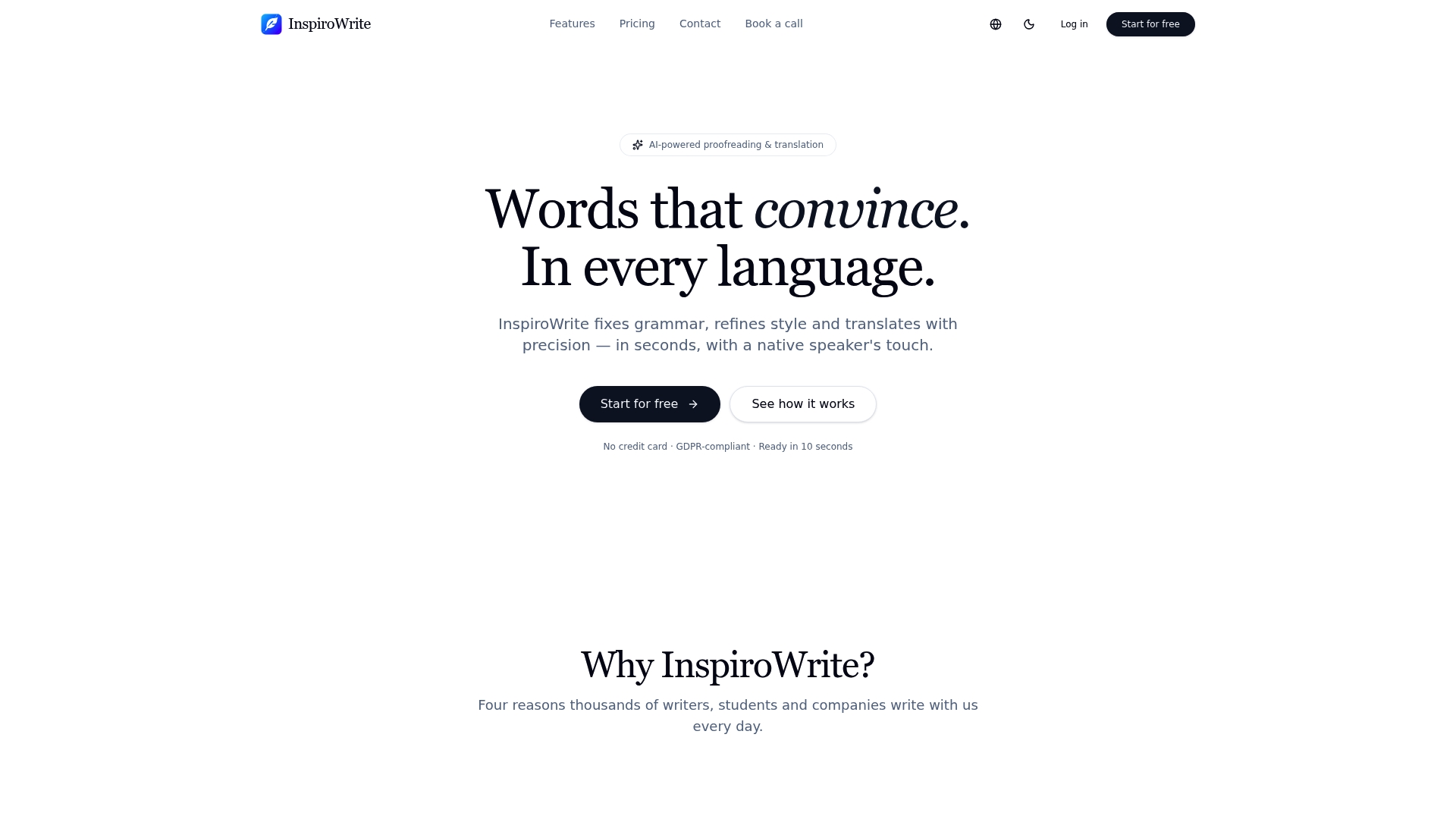
Business translation mistakes rarely announce themselves before they cause damage. Inspirowrite is built for exactly this problem. Its AI-assisted translation correction identifies terminology inconsistencies, flags tonal mismatches, and surfaces ambiguous phrasing before your content reaches an international audience. Unlike generic tools, Inspirowrite processes your content without storing or using it for model training, so confidential business documents stay confidential.
Whether you are reviewing a multilingual marketing campaign, a regulatory submission, or a product catalogue, Inspirowrite's translation tools deliver precise corrections within seconds. For businesses that cannot afford the reputational and financial cost of poor translations, it is the kind of professional support that pays for itself on the first document it catches.
FAQ
What are the most common types of business translation errors?
The most common types are literal translation failures, terminology inconsistency, context neglect, cultural and tonal mismatches, and machine translation errors without human post-editing. Each affects business communication and brand perception differently.
How do cultural translation errors damage brand reputation?
Cultural and tonal mismatches cause brand embarrassment for nearly 29% of marketers who have experienced backlash from poor localisation. Tone errors alone account for 23% of all localisation failures, outranking terminology mistakes.
When is machine translation safe to use for business content?
Machine translation without post-editing is acceptable only for low-stakes internal communications. Customer-facing, legal, and marketing content requires full post-editing per ISO 18587 standards to meet business quality requirements.
How can businesses prevent terminology inconsistency in translations?
Build a centralised, brand-approved glossary before commissioning any multilingual content and require all translation providers to use it. Translation memory tools that enforce consistency across projects are the most reliable method.
Why does skipping translation review cause persistent errors?
Without an independent revision step, errors introduced during translation are never caught before publication. Single-translator workflows with no review produce inconsistent quality and allow terminology, tonal, and contextual errors to reach the final document.