

A single misplaced comma can change a sentence's meaning entirely. A wrong verb tense can make a business email seem unprofessional. If you want to understand English writing conventions, you need more than a list of grammar rules. You need to see how those rules work together to create writing that is clear, credible, and appropriate for its context. This guide breaks down the core conventions across academic, business, and everyday writing, with concrete examples and practical fixes for the mistakes that trip up students, professionals, and non-native speakers most often.
Table of Contents
- Key takeaways
- Understanding English writing conventions: the foundations
- Academic writing conventions and style
- Business and professional writing conventions
- Common mistakes and how to fix them
- My take on mastering writing conventions
- Polish your writing with Inspirowrite
- FAQ
Key takeaways
| Point | Details |
|---|---|
| Conventions shape credibility | Small errors in grammar or punctuation can undermine trust in academic and professional writing. |
| Context determines style | Academic, business, and casual writing each follow distinct conventions that you must recognize and apply. |
| Consistency is the core rule | Whether you choose American or British spelling, formal or informal tone, staying consistent matters most. |
| Common errors are fixable | Comma splices, subject-verb disagreement, and wordiness are frequent but straightforward to correct with practice. |
| Tools accelerate improvement | Grammar checkers and AI proofreading tools help you catch errors faster and learn from them in real time. |
Understanding English writing conventions: the foundations
Before you can write well, you need to understand the building blocks. English writing conventions cover grammar, punctuation, spelling, and capitalization. Together, they form the system that makes written communication predictable and readable.
Grammar: the rules that hold sentences together
Three grammar rules cause the most trouble for writers at every level.
- Subject-verb agreement: The subject and verb must match in number. "The team is ready" is correct; "The team are ready" follows British convention but sounds wrong in American English.
- Pronoun-antecedent agreement: A pronoun must match its noun in number and gender. "Each student should submit their paper" is now widely accepted in formal American English.
- Verb tense consistency: Do not shift tenses without a reason. If you start a paragraph in the past tense, stay there unless the timeline genuinely changes.
English grammar rules work best when you understand the logic behind them rather than memorizing them as rigid laws. Once you see why subject-verb agreement exists (to avoid ambiguity about who is doing what), the rule becomes intuitive.
Punctuation: structure, not just pauses
Most people learn punctuation as a guide for where to breathe when reading aloud. That is not how it actually works. Punctuation defines syntactic structure, not pauses, and misuse creates real confusion.
The comma splice is the single most common punctuation error. It happens when you join two independent clauses with only a comma: "I finished the report, it was due Friday." The fix is simple: use a period, a semicolon, or add a conjunction. Apostrophes are another consistent trouble spot. Use them for contractions ("it's" = "it is") and possessives ("the manager's report"), but never for simple plurals.
One rule that catches even experienced writers: paired punctuation around interrupters must match. If you open with a comma, close with a comma. If you open with a parenthesis, close with a parenthesis. Mixing them is an error.
Spelling and capitalization
American English spelling differs from British English in consistent patterns. Use "color," "organize," "center," and "license" throughout your document. Mixing "colour" and "color" in the same piece signals carelessness, even if each word is technically correct in its own dialect.
Capitalization rules are straightforward: capitalize the first word of a sentence, all proper nouns, and the main words in titles. Do not capitalize common nouns just because they seem important.

Pro Tip: Keep a personal style sheet for any long writing project. List your spelling choices, capitalization decisions, and formatting preferences at the top of your document. It takes five minutes to create and saves hours of inconsistency later.
Academic writing conventions and style
Academic writing has its own set of expectations, and violating them can cost you grades, credibility, or both. Contractions are largely prohibited in formal academic contexts. Write "do not" instead of "don't," and "it is" instead of "it's." The reasoning is simple: contractions signal informality, and academic writing signals precision.
Structure matters as much as grammar. Good academic writing prioritizes efficiency, clarity, and logical flow supported by signposting phrases like "This section argues..." or "As the data shows..." Each paragraph should carry one clear idea, open with a topic sentence, and close with a link to what comes next.
"Each sentence should serve the broader analytical goal. Avoid wordiness." — University of Strathclyde guidance on academic writing
Common pitfalls in academic writing include:
- Comma splices: Joining two full sentences with only a comma
- Dangling modifiers: "Having read the study, the results were surprising" (who read the study? The results cannot read)
- Wordiness: Phrases like "due to the fact that" should simply be "because"
- Inconsistent citation style: Failing to match institutional citation styles can lead to significant grade deductions
Compare these two sentences:
Weak: "It can be seen that there are a number of factors that have an effect on the outcome of the experiment."
Strong: "Three factors affected the experimental outcome."
The second version says the same thing in six words instead of twenty. That is what academic readers and professors want.
Pro Tip: Read your academic writing out loud before submitting. If you stumble over a sentence, your reader will too. Awkward rhythm almost always signals a grammar or structure problem.
Scientific reports follow the IMRaD structure (Introduction, Methods, Results, and Discussion), and abstracts typically run 150 to 250 words. Knowing these structural conventions is just as important as knowing the grammar rules.
Business and professional writing conventions
Business writing follows different rules than academic writing. Where academic writing values depth and citation, professional writing values speed and clarity. Your reader is busy. Get to the point.
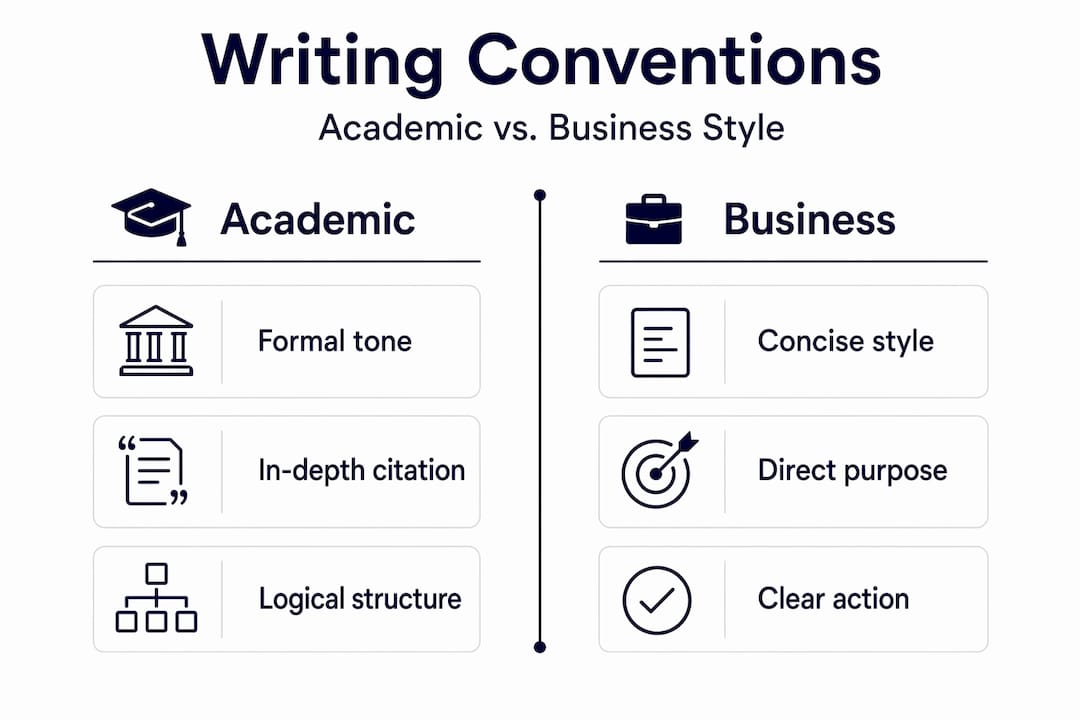
The biggest difference is conciseness. Delete redundancies wherever possible: cut "in order to" down to "to," and remove "the fact that" entirely by restructuring the sentence. Every extra word costs your reader time and dilutes your message.
Here is a practical framework for professional writing:
- State your purpose in the first sentence. Do not bury the main point in the third paragraph.
- Use active voice. "The team completed the audit" beats "The audit was completed by the team."
- Choose formal but approachable tone. Avoid slang, but also avoid language so stiff it sounds robotic.
- Use bullet points for lists of three or more items. They are faster to scan than embedded lists in prose.
- Close with a clear next step. Every email, memo, or report should tell the reader what happens next.
Business writing also handles possessives differently than casual writing. In formal contexts, using "of" for inanimate objects improves professionalism. "The results of the analysis" reads more formally than "the analysis's results."
Common mistakes and how to fix them
Most writing errors fall into a small number of categories. Recognizing them is half the battle.
| Error type | Example of the mistake | Corrected version |
|---|---|---|
| Comma splice | "She wrote the report, it took three hours." | "She wrote the report. It took three hours." |
| Subject-verb disagreement | "The data shows conflicting results." | "The data show conflicting results." (data is plural) |
| Dangling modifier | "Running to the meeting, my notes were left behind." | "Running to the meeting, I left my notes behind." |
| Wordiness | "At this point in time, we need to..." | "Now, we need to..." |
| Inconsistent tense | "She walks in and said hello." | "She walked in and said hello." |
Proofreading is a skill, not just a habit. Read your draft once for content, once for sentence structure, and once specifically for punctuation. Each pass catches different types of errors.
Paragraph coherence depends on clear topic sentences and smooth transitions. If a reader cannot identify the main point of a paragraph in the first sentence, the paragraph needs restructuring.
One advanced skill worth developing: knowing when to break the rules deliberately. Sentence fragments used for emphasis are a legitimate stylistic choice in professional and creative writing. "Simple. Fast. Effective." works as a headline precisely because it breaks the complete-sentence rule. The key is doing it on purpose, not by accident.
Pro Tip: Keep an error log. Every time a teacher, editor, or grammar checker flags a mistake, write it down. After a month, patterns emerge. Fixing your top three recurring errors will improve your writing more than any single grammar lesson.
My take on mastering writing conventions
I have worked with writers at every level, from students submitting their first academic essays to professionals drafting board-level reports. Here is what I have learned: the writers who improve fastest are not the ones who memorize every rule. They are the ones who stop treating conventions as arbitrary restrictions and start seeing them as tools for getting their meaning across precisely.
Non-native speakers often have an advantage here that they do not recognize. Because they learned English consciously rather than by absorption, they tend to think more carefully about sentence structure. The challenge is usually not understanding the rules. It is building enough confidence to apply them without second-guessing every sentence.
What actually holds most writers back is inconsistency. They know the rule for comma placement but apply it selectively. They know contractions are informal but use them in academic papers out of habit. Consistency is the primary marker of quality, especially when bridging informal and formal styles.
My honest advice: stop trying to write perfectly on the first draft. Write freely, then revise with the conventions in mind. The revision stage is where conventions do their real work. And if you want faster feedback on whether your writing meets the standard, use a tool that checks in real time rather than waiting for a teacher or editor to respond days later.
— Mike
Polish your writing with Inspirowrite
If you have spent time working to understand English writing conventions, you deserve a tool that keeps up with your pace.
Inspirowrite is an AI-powered proofreading and translation service built for exactly this audience: students who need their academic essays to meet formal conventions, professionals who want crisp and credible business writing, and non-native speakers who want real-time feedback without worrying that their drafts are being stored or used to train AI models. Inspirowrite processes your text in seconds, flags grammar and style issues with clear explanations, and keeps your content completely private. Whether you are fixing a comma splice in an essay or tightening a business email, Inspirowrite gives you the feedback you need to submit with confidence.
FAQ
What are English writing conventions?
English writing conventions are the agreed-upon rules for grammar, punctuation, spelling, capitalization, and style that make written communication clear and consistent. They vary slightly across academic, professional, and casual contexts.
Why do writing conventions matter in professional settings?
In professional settings, writing conventions signal competence and attention to detail. Errors in grammar or punctuation can reduce your credibility with colleagues, clients, and employers, even when your core ideas are strong.
What is the most common writing mistake in English?
The comma splice is one of the most frequently flagged errors in both academic and professional writing. It occurs when two independent clauses are joined with only a comma instead of a period, semicolon, or conjunction.
How is academic writing different from business writing?
Academic writing prioritizes depth, citation, formal tone, and logical structure. Business writing prioritizes brevity, clarity, and direct action. Both follow English writing rules, but they apply them differently based on audience and purpose.
How can non-native speakers improve their writing conventions faster?
Non-native speakers improve fastest by reading widely in their target genre, keeping an error log of recurring mistakes, and using real-time grammar tools that explain corrections rather than just flagging them.