

TL;DR:
- The direction of a language pair determines the entire translation process, affecting resources, quality, and qualified translators. Reversing the pair's flow creates a fundamentally different task, with variations in machine and human translation performance. Accurate specification of source and target languages before starting is essential for consistent, high-quality results.
Most people assume that translating between two languages is a two-way street. If someone can translate English into Spanish, surely they can do the reverse just as well? This is one of the most persistent misconceptions in translation, and it matters more than you might expect. Understanding what is a language pair translation, and specifically why direction defines the entire process, changes how you approach any translation project. Whether you are a student studying linguistics or someone commissioning a translation for the first time, this guide covers everything you need to know.
Table of Contents
- Key takeaways
- What is a language pair translation?
- Common language pairs and why direction matters
- Terminology management and language pair specificity
- How pair direction shapes translator selection
- Practical tips for working with language pairs
- My perspective on language pair misconceptions
- Improve your translations with Inspirowrite
- FAQ
Key takeaways
| Point | Details |
|---|---|
| Direction defines the pair | A language pair specifies source and target; reversing the order creates a fundamentally different translation task. |
| Quality varies by direction | Translator availability and machine translation accuracy differ significantly depending on which way the pair runs. |
| Terminology tools are pair-specific | Glossaries and termbases are built around a fixed source-to-target direction and break down when that direction is inconsistent. |
| Translator selection depends on direction | Professional translators typically work into their native language, so pair direction determines who is qualified for the job. |
| Common pairs dominate the market | English paired with Spanish, French, or German represents the highest-resource combinations for both human and machine translation. |
What is a language pair translation?
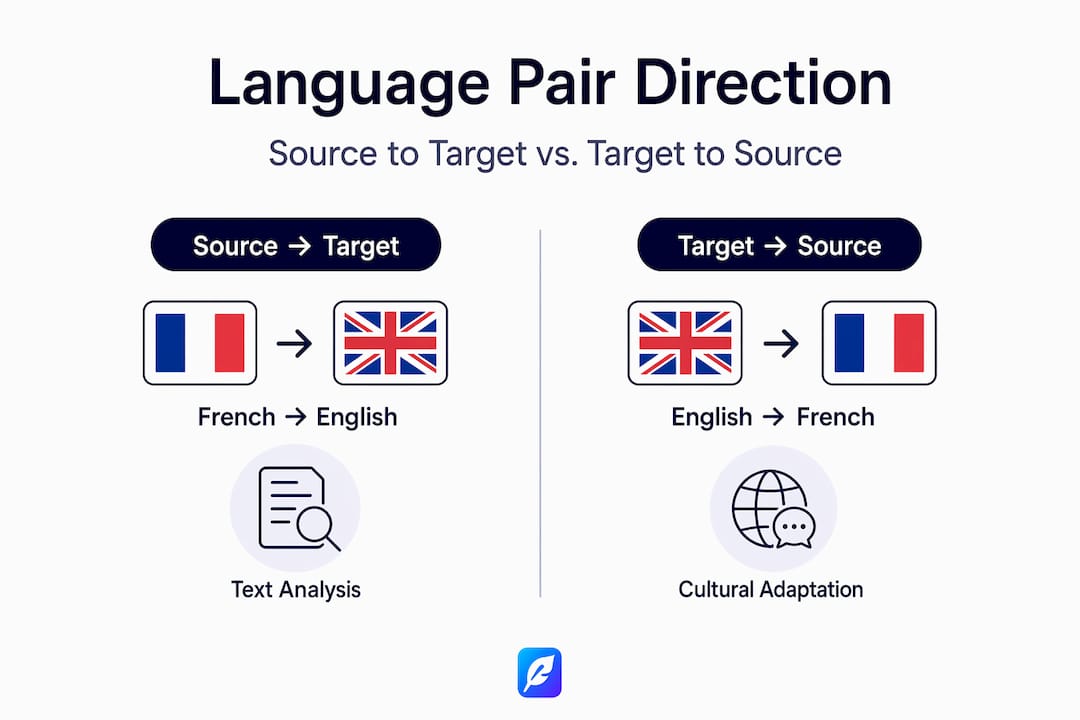
The term "language pair" refers to the specific combination of a source language and a target language in any translation task. The source language is the one you are translating from, and the target language is the one you are translating into. The industry standard term you will encounter in professional settings is simply "language pair," though "translation pair" is also used informally to mean the same thing.
Here is where the language pair definition gets genuinely interesting: direction is not interchangeable. English into Mandarin (EN→ZH) and Mandarin into English (ZH→EN) are treated as two entirely separate language pairs. They draw on different translator pools, different machine translation models, and different quality benchmarks. Treating them as the same thing is like assuming a road works equally well in both directions when one side has a motorway and the other has a dirt track.
In practical terms, the language pair definition shapes almost every decision in a translation project:
- Project scoping: The pair determines which translators, tools, and processes are applicable.
- Pricing: Rare or low-resource pairs typically cost more due to limited specialist availability.
- Resourcing: Some directions have far fewer qualified translators than others.
- Technology: Translation management systems and machine translation engines require an explicit source-to-target pair before they can function.
Pro Tip: When briefing a translator or setting up a translation tool, always write the pair with an arrow, such as FR→EN or EN→DE. This eliminates ambiguity from the start and prevents costly errors later.
Understanding how does a language pair work also means recognising that the pair is not just a label. It is a specification that locks in the entire workflow before a single word is translated.
Common language pairs and why direction matters
Not all language pairs are created equal. English paired with Spanish, French, and German represents the most well-resourced combinations in both human and machine translation. These pairs benefit from decades of training data, large translator communities, and extensive terminology databases.
Here is a quick comparison of how direction can affect translation quality across some of the most common pairs:
| Language pair | Direction | Translator availability | Machine translation quality |
|---|---|---|---|
| English / Spanish | EN→ES | Very high | Excellent |
| English / Spanish | ES→EN | High | Excellent |
| English / Mandarin | EN→ZH | Moderate | Good |
| English / Mandarin | ZH→EN | Moderate | Good |
| English / Arabic | EN→AR | Moderate | Moderate |
| English / Arabic | AR→EN | Lower | Moderate |
| English / Swahili | EN→SW | Low | Limited |
| English / Swahili | SW→EN | Very low | Limited |
The pattern is clear. High-resource pairs perform consistently well in both directions because there is simply more data and more qualified people available. Low-resource pairs, such as those involving minority or regional languages, suffer in both quality and availability, and the less common direction is almost always the weaker one.
Machine translation accuracy varies by direction for a specific reason: models are trained on parallel text corpora, and those corpora are far larger for dominant global languages. A model trained on millions of English-French sentence pairs will perform better than one trained on a fraction of that volume for a less common combination.
A few other points worth knowing about language pair translation examples in practice:
- High-resource pairs such as EN→DE or EN→FR benefit from extensive human-reviewed training data, which improves both fluency and accuracy.
- Low-resource pairs may require post-editing by a human specialist to reach an acceptable standard, adding time and cost.
- Rare pairs sometimes require a pivot language, where a text is translated through an intermediate language before reaching the target. This introduces additional risk at every step.
For students exploring multi-language translation workflows, understanding which pairs are well-supported helps you set realistic expectations about quality and turnaround time.
Terminology management and language pair specificity
One of the less obvious but genuinely consequential aspects of language pairs in translation is how they govern terminology management. Every professional translation project relies on controlled vocabulary, and that vocabulary is always tied to a specific source-to-target direction.
Here is how terminology tools work in relation to language pairs:
- Glossaries are simple reference lists that map approved source terms to their approved target equivalents. They are always directional: a glossary built for EN→FR will not function correctly if you attempt to use it in the FR→EN direction.
- Termbases go further. Termbases actively suggest approved translations as a translator works, flagging terms that deviate from approved vocabulary. They are integrated directly into translation tools and operate on a fixed source-target pair.
- Translation memories store previously approved sentence segments, again mapped to a specific pair direction. Mixing directions corrupts the memory and produces unreliable suggestions.
- Quality checks in professional translation software validate output against the termbase and memory for the correct pair. If the pair direction is mislabelled, those checks pass silently while the content remains wrong.
The risk of getting this wrong is subtle but serious. Mislabelling pair direction does not produce obvious errors. Instead, it produces translations that are internally consistent but systematically incorrect, because every term has been drawn from the wrong directional mapping. You might not notice until a client or subject-matter expert reviews the final text.
Pro Tip: Before starting any translation project, confirm the exact source and target language, including regional variants such as EN-GB versus EN-US or ES-ES versus ES-MX. Regional differences affect terminology, spelling conventions, and even legal terminology.
Terminology consistency improves significantly when the language pair is defined up front and locked throughout the project. This single step prevents the majority of terminology-related quality issues.
How pair direction shapes translator selection
Understanding the language pair definition is one thing. Knowing how it affects who you hire and how a project runs is where that knowledge becomes genuinely useful.

Professional translators work into their native language as a general rule. A native German speaker translating from English into German will almost always produce more natural, idiomatic output than a native English speaker working in the same direction. This is not a rigid rule, but it reflects how fluency, cultural nuance, and idiomatic expression work in practice.
Here is what this means for project design:
- Translator assignment is direction-dependent. You cannot simply find a bilingual person and assume they are equally qualified in both directions.
- Specialist knowledge compounds the issue. A legal translator working EN→DE needs native-level German and expertise in German legal terminology. Finding that combination is harder than finding either quality alone.
- Wrong direction, wrong output. Choosing the wrong pair direction when briefing a project leads to output that may be grammatically acceptable but lacks the register, tone, and precision the target audience expects.
- Technology mirrors this logic. Real-time translation systems require the language pair to be locked before processing begins. Incorrect pair configuration causes output degradation or language misrouting.
The importance of language pairs in translation is not just theoretical. Every pricing quote, every deadline, and every quality guarantee a professional agency gives you is calculated against a specific directional pair. Change the direction and you change the entire equation.
For students using translation apps to practise or verify their work, choosing the right translator app means understanding which pairs the tool handles well, and in which direction.
Practical tips for working with language pairs
Whether you are studying translation or working on a personal project, a few practical habits will save you significant time and frustration.
- Always specify direction explicitly. Never write "English and French translation." Write "EN→FR" or "FR→EN." The difference matters enormously for cost, quality, and who you need.
- Do not assume symmetry. A tool or translator that performs well in one direction may perform poorly in the other. Test both directions if you need bidirectional output.
- Check regional variants. Spanish from Spain (ES-ES) and Spanish from Latin America (ES-LA) are treated as separate target languages in professional workflows. The same applies to French, Portuguese, and Arabic.
- Evaluate machine translation by direction. If you are using an AI translation tool for study or drafting, test it specifically on your required pair direction. Quality varies by direction even within the same language combination.
- Define your pair before building any resources. If you are creating a glossary, a wordlist, or a style guide, label it with the exact source-to-target direction from the outset.
Pro Tip: If you are a student practising translation, keep a separate vocabulary notebook for each direction you work in. The vocabulary and phrasing you need for EN→FR is genuinely different from what you need for FR→EN, and mixing them slows your development.
The importance of language pairs becomes most apparent when something goes wrong. A mistranslated legal document, a product name that means something offensive in the target language, or a medical instruction that loses precision in translation: these failures almost always trace back to a poorly specified or incorrectly assumed pair direction.
My perspective on language pair misconceptions
I've spent a long time watching students and first-time translation buyers make the same mistake: they treat language pairs as labels rather than specifications. They write "I need a Spanish-English translation" and assume the professional on the other end will figure out the rest. In my experience, that assumption is where quality problems begin.
What I've learned is that the direction of a translation pair is not a minor administrative detail. It defines the entire project. The translator you need, the tools you use, the terminology resources you build, and the quality you can realistically expect are all determined by that arrow between the two language codes. Ignore it and you are building on an unstable foundation.
The other thing I've noticed is that students often underestimate how much their own learning depends on getting this right. If you are practising translation into a language that is not your strongest, you will improve faster by acknowledging the asymmetry rather than pretending it does not exist. Work in the direction that challenges you deliberately, not accidentally.
My honest advice: treat the language pair as the first and most important decision in any translation task. Get it right before anything else, and everything downstream becomes significantly easier.
— Mike
Improve your translations with Inspirowrite
If you are exploring translation concepts or working on your first real translation project, having the right tools makes a genuine difference.
Inspirowrite offers AI-powered translation and proofreading that works across multiple language pairs, delivering results in seconds while keeping your content completely private. Unlike many tools that use your text to train their models, Inspirowrite treats your content as yours alone. For students and individuals who need accurate, fast feedback on translated text, it removes the guesswork from the process. Whether you are checking a draft translation or refining a piece of writing in a second language, Inspirowrite gives you the kind of immediate, reliable feedback that used to require a professional editor.
FAQ
What is a language pair in translation?
A language pair in translation refers to the specific combination of a source language (the language you translate from) and a target language (the language you translate into). Direction matters: EN→FR and FR→EN are treated as two separate pairs with different requirements.
Why does language pair direction matter?
Translation is not symmetrical. The direction of a language pair affects which translators are qualified, how machine translation models perform, and how terminology resources function. Reversing the direction changes the entire project scope.
What are some common language pair translation examples?
The most common pairs include English into Spanish (EN→ES), English into French (EN→FR), and English into German (EN→DE). These are considered high-resource pairs because they have large translator communities and extensive machine translation training data.
How does a language pair affect translation quality?
Quality varies by pair direction because translator availability and training data differ. High-resource pairs consistently produce better output than low-resource ones, and the less common direction within any pair is typically the weaker one.
What is a translation pair used for in terminology management?
A translation pair defines the direction in which glossaries, termbases, and translation memories operate. These tools are built around a fixed source-to-target direction, and mislabelling that direction can cause systematic but undetected terminology errors throughout a project.