
TL;DR:
- Bilingual proofreading involves comparing source and translated texts to verify accuracy, meaning, and terminology consistency. It differs from monolingual proofreading by focusing on faithfulness to the original, which is essential for high-stakes, regulated, or technical documents. Following ISO 17100 standards, independent bilingual revision enhances translation quality and reduces costly errors.
Most people assume proofreading means fixing spelling and grammar. When a second language enters the picture, that assumption becomes a costly mistake. What is bilingual proofreading, exactly? It is a specialised quality control process where a reviewer compares a translated text against its original source to verify accuracy, terminology, and meaning. This is fundamentally different from checking a finished document for typos. The industry standard term for this process is bilingual revision, though "bilingual proofreading" is widely used by those seeking to understand it. Both terms are used throughout this guide.
Table of Contents
- Key takeaways
- What bilingual proofreading really involves
- Bilingual proofreading vs monolingual proofreading vs editing
- Why bilingual proofreading matters
- How to proofread bilingual texts effectively
- Choosing bilingual proofreading services
- My honest take on bilingual proofreading
- Get accurate bilingual results with Inspirowrite
- FAQ
Key takeaways
| Point | Details |
|---|---|
| Bilingual proofreading defined | It involves comparing source and target texts to verify meaning, not just surface language errors. |
| Distinct from monolingual proofreading | Monolingual checks focus on spelling and grammar; bilingual revision checks faithfulness to the original. |
| ISO 17100 sets the standard | This international standard mandates an independent bilingual revision as part of any professional translation workflow. |
| Scope varies by provider | Always confirm whether a service includes source-to-target comparison or is limited to target-text checks only. |
| Right tools matter | Access to both texts, plus glossaries and style guides, is necessary for accurate bilingual review. |
What bilingual proofreading really involves
Bilingual proofreading, or bilingual revision, is the process of reviewing an already-translated text by comparing target against source to verify accuracy, consistency, and faithfulness of meaning. A reviewer reads both documents in parallel, checking that nothing has been omitted, distorted, or mistranslated. This is not a casual read-through. It is a structured, methodical comparison.
The tasks involved go well beyond catching typos:
- Accuracy checking: Does the translated text convey the same meaning as the source? Every claim, instruction, or nuance must transfer intact.
- Terminology consistency: Are specialist terms translated the same way throughout? A legal document that uses "agreement" in one paragraph and "contract" in the next creates ambiguity.
- Register and tone: Does the translated text speak to its audience the way the original does? A formal technical manual should not become casual in translation.
- Omission detection: Has any sentence, clause, or key phrase been accidentally dropped?
- Mistranslation correction: Are there places where the translator chose a plausible but incorrect equivalent?
Under ISO 17100, the international quality standard for translation services, an independent bilingual revision by a second qualified linguist is not optional. It is a mandatory step in any compliant translation workflow. This protects quality by adding a fresh pair of eyes that never worked on the original translation and is therefore less likely to overlook errors.
Pro Tip: If you are reviewing your own translation, wait at least 24 hours before conducting the bilingual revision. Distance from the original text helps you read what is actually there rather than what you intended to write.
Bilingual proofreading vs monolingual proofreading vs editing
These three processes are frequently confused, and mixing them up leads to either overspending on unnecessary services or underscoping quality checks. Here is how they differ and when each is appropriate.
Monolingual proofreading is a surface-level check: spelling, grammar, punctuation, and styling within the target text only. The reviewer never consults the source document. This is perfectly adequate for original content written in one language. For translated texts, however, it cannot catch a mistranslation because the reviewer has no frame of reference for what the original said.
Bilingual proofreading sits a step above. The reviewer holds both texts simultaneously, checking that the meaning conveyed in the target language faithfully mirrors the source. It catches different classes of errors: meaning distortions, omissions, and terminology mismatches that a monolingual check would never find.
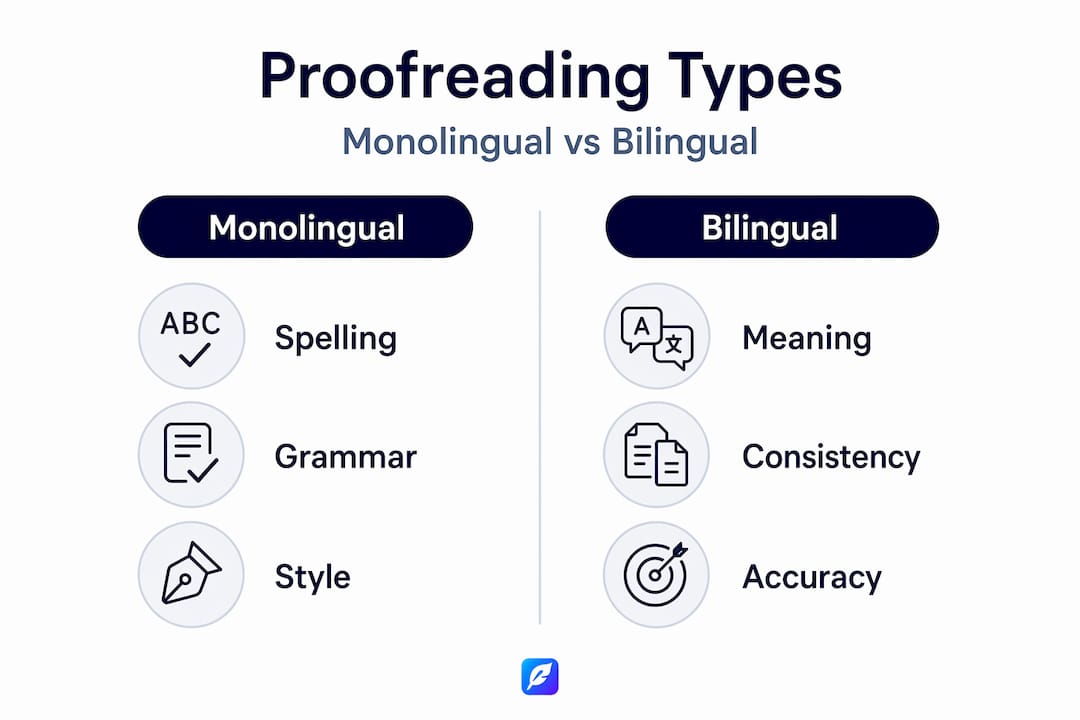
Bilingual editing, sometimes called bilingual post-editing or revision, goes further still. Beyond accuracy, an editor assesses tone, style, cultural adaptation, and whether the text reads naturally in the target language. This is the most thorough of the three processes.
| Process | Source text consulted | Focus areas | Best suited for |
|---|---|---|---|
| Monolingual proofreading | No | Spelling, grammar, punctuation | Original content in one language |
| Bilingual proofreading | Yes | Accuracy, meaning, terminology | Translated documents needing fidelity checks |
| Bilingual editing | Yes | Accuracy, style, tone, naturalness | High-stakes or published translations |
Understanding which process your document actually needs prevents both wasted budget and quality gaps. A medical leaflet translated from German into English needs bilingual revision at minimum. A blog post written originally in English needs only monolingual proofreading.
Why bilingual proofreading matters
The importance of bilingual proofreading is easiest to grasp through the categories of content where errors carry real consequences.

In legal and regulated documents, an incorrectly translated clause can change the meaning of a contract or expose a business to liability. In healthcare and pharmaceutical materials, meaning distortions in translated content can have serious safety implications. Surface proofreading simply cannot catch these kinds of errors because it never looks at what the original text actually said.
Technical documentation presents its own risks. A translated user manual that omits a safety step, or substitutes a near-equivalent technical term that means something slightly different, can cause equipment damage or user injury. Academic translations intended for journal submission must be faithful to the research findings; a paraphrased conclusion that changes the author's actual claim is a serious problem.
Beyond safety and legal risk, there is the commercial argument. A marketing campaign translated into Spanish for a Latin American audience may be grammatically correct yet culturally off-register, undermining the brand's message entirely. Bilingual review catches these issues before they reach the audience.
Pro Tip: For casual content with low stakes, such as internal team updates or informal correspondence, a monolingual proofread is usually sufficient. Save the bilingual revision budget for documents where meaning accuracy is non-negotiable.
The practical case for building bilingual proofreading into workflows includes:
- Compliance with ISO 17100 translation quality requirements.
- Reduced risk of costly reprints, legal disputes, or product recalls caused by translation errors.
- Stronger brand credibility in international markets.
- Improved reader trust in technical or academic content.
How to proofread bilingual texts effectively
Whether you are developing bilingual proofreading skills or checking your own translated work, a structured approach makes an enormous difference. Without it, even experienced reviewers miss errors that a methodical process would catch.
-
Gather all reference materials first. Effective bilingual proofreading requires both source and target documents, plus any approved glossaries, style guides, and project-specific terminology decisions. Without these, you cannot reliably verify consistency or fidelity.
-
Read the target text through once without the source. This first read reveals whether the text flows naturally and reads like an original rather than a translation. Note anything that sounds awkward or unclear.
-
Work through both texts in segments. Read a paragraph or section in the source, then read the corresponding passage in the target. Check for omissions, additions, and meaning shifts. Do not rush this stage.
-
Focus on meaning, not just language. The most common pitfall in bilingual text correction is spending too much time on phrasing and not enough on whether the translated meaning is correct. A grammatically perfect sentence that says the wrong thing has failed.
-
Check terminology systematically. If a glossary exists, verify every key term against it. Inconsistent terminology is one of the most frequent errors in translated technical content.
-
Mark issues clearly. Use comments or tracked changes to flag each error by type: mistranslation, omission, terminology inconsistency, or register issue. This helps translators understand and learn from corrections.
-
Conduct a final read of the target text alone. After all corrections, read the target text as a standalone document to confirm it reads fluently and professionally.
Common tools that support this workflow include content style guides for managing terminology, and translation memory platforms such as SDL Trados or memoQ, which display source and target text in parallel columns.
Choosing bilingual proofreading services
One of the most confusing aspects of hiring bilingual proofreading services is that provider terminology varies widely. One agency's "proofreading" is another's "revision." Some providers offer only monolingual target-text checks under the label of proofreading. Others include full source comparison. Before you commission any service, you need clarity on exactly what is included.
Key questions to ask any provider:
- Does the review include comparison against the source document, or is it limited to the target text only?
- Is the reviewer a different linguist from the original translator?
- Do they follow ISO 17100 or another recognised quality standard?
- What qualifications does the reviewing linguist hold?
Pricing typically reflects the scope of the work. A bilingual revision confirming ISO compliance costs more than a monolingual proofread because it requires more time and a second qualified linguist. Budget accordingly, and resist the temptation to choose the cheapest option for regulated or high-accuracy content.
Verifying qualifications matters. Look for reviewers with relevant academic credentials, membership of professional bodies such as the Chartered Institute of Linguists, and demonstrable subject matter expertise in your field.
My honest take on bilingual proofreading
I have seen writers and project managers consistently underestimate this process, and the consequences are rarely trivial. The most persistent misconception I encounter is the belief that a good translation automatically reduces the need for bilingual revision. In practice, the opposite is often true. A confident, fluent translator can introduce meaning shifts that are harder to spot precisely because the text reads so well.
What I find most striking is how often clients conflate "grammatically correct" with "accurate." A translated text can be polished, natural, and entirely wrong about what the source said. That gap between surface quality and true fidelity is exactly where bilingual revision earns its place.
The terminology confusion around what proofreading involves in translation contexts genuinely costs people money. Clients who pay for monolingual proofreading on a legal contract because someone called it "proofreading" are not getting what they actually need. And professionals who underspecify the scope of their work damage client relationships when errors slip through.
My advice is straightforward: treat bilingual proofreading as a non-negotiable step for anything that matters, learn the difference between the processes, and ask direct questions before commissioning any service. The rigour you bring to this process is directly proportional to the quality of the result.
— Mike
Get accurate bilingual results with Inspirowrite
If you are working with translated texts and need fast, reliable accuracy checks, Inspirowrite can help. Whether you are a student submitting work in a second language, a writer polishing a translation, or a professional preparing multilingual documents, Inspirowrite's AI-assisted proofreading and translation tools deliver results in seconds without compromising your privacy.
Your content stays confidential. Inspirowrite does not use your text to train its AI models, which matters when working with sensitive academic or professional material. From bilingual text correction to full translation support, explore Inspirowrite's tools and see how quickly your multilingual writing can reach the standard it deserves.
FAQ
What is bilingual proofreading?
Bilingual proofreading, also called bilingual revision, is the process of comparing a translated text against its original source document to verify accuracy, meaning, and terminology consistency. It goes beyond spelling and grammar checks to catch mistranslations and omissions.
How does bilingual proofreading differ from monolingual proofreading?
Monolingual proofreading reviews only the target text for surface errors like spelling and grammar, with no reference to the source. Bilingual proofreading consults both texts to confirm the translation accurately reflects the original meaning.
Is bilingual proofreading required for professional translations?
Under ISO 17100, an independent bilingual revision by a second qualified linguist is a mandatory step in compliant professional translation workflows. It is not optional for projects that require certified quality standards.
What documents need bilingual proofreading most?
Legal contracts, medical materials, technical manuals, academic translations, and regulated content all require bilingual revision because meaning errors in these documents carry serious practical, legal, or safety consequences.
How do I choose a reliable bilingual proofreading service?
Ask providers directly whether their service includes source-to-target comparison and whether the reviewer is a different linguist from the original translator. Verify their qualifications and check whether they work to ISO 17100 or equivalent standards.