

Most sentence structure errors fall into six families: fragments, run-ons and comma splices, misplaced or dangling modifiers, subject-verb agreement and pronoun problems, faulty parallelism, and punctuation faults that quietly change meaning. Each one has a recognisable shape once you know what to look for, and each has a repair that takes seconds once you know the rule.
This article walks through every major category with an incorrect example, a corrected revision, and a one-line fix rule you can actually remember. You'll see:
- Sentence fragments
- Run-on (fused) sentences
- Comma splices
- Misplaced and dangling modifiers
- Subject-verb agreement errors
- Pronoun reference and pronoun-case errors
- Faulty parallelism
- Sentence sprawl and choppy sentences
- Punctuation mistakes affecting structure
- Confused words and word-choice errors
- Incomplete comparisons
- Conjunction and connector misuse
Writing centres at institutions like Northern Illinois University and the University of Wisconsin teach these exact categories, and tools like Inspirowrite catch most of them automatically during a draft review. Read on for the definitions, the examples, and the checklist at the end that ties it all together.
Key Takeaways
Fixing sentence structure errors comes down to knowing six error families and applying one specific repair rule to each.
| Point | Details |
|---|---|
| Fragments need a subject and verb | Attach the fragment to a nearby sentence or supply the missing element. |
| Run-ons need separation or connection | Use a period, semicolon, coordinating conjunction, or subordinating conjunction based on the relationship. |
| Modifiers must sit near their target | Move the modifier or add a clear subject so the sentence names who's doing the action. |
| Parallel items need matching forms | Convert every item in a list or comparison to the same grammatical structure. |
| Read aloud before you submit | Reading aloud exposes fused sentences, choppy rhythm, and awkward pauses that silent reading misses. |
| Automated tools speed up detection | Inspirowrite flags fragments, agreement errors, and punctuation faults instantly while keeping drafts private. |
Table of Contents
- What are sentence fragments and how do you fix them?
- What's the difference between a run-on sentence and a comma splice?
- Why is a comma splice not a proper sentence fix?
- How do you spot a misplaced or dangling modifier?
- How do subject-verb agreement errors happen?
- What are pronoun reference and pronoun-case errors?
- What is faulty parallelism and why does it matter?
- How do you fix sentence sprawl and choppy sentences?
- Which punctuation mistakes actually change sentence structure?
- Which confused words create structural misunderstandings?
- How do you edit your own writing for these errors?
- Why do incomplete comparisons cause sentence errors?
- How do conjunction and connector errors affect sentence clarity?
- What's the difference between connectors and true conjunctions?
- How does dialogue punctuation cause sentence boundary errors?
- Author's note on learning sentence structure and practical next steps
- Optional help: using an AI proofreading tool to catch and fix these errors
- Sources
- FAQ
What are sentence fragments and how do you fix them?
A fragment is an incomplete thought punctuated as if it were a full sentence. It's missing a subject, missing a main verb, or it's a dependent clause standing in for an independent one. The Northern Illinois University writing tutorial identifies these three causes as the most common source of fragment errors, and once you can name the cause, the fix is usually obvious.
Here are three typical fragments and their corrections:
- Missing subject. Incorrect: "Walked to the shop and bought milk." There's no subject doing the walking. Corrected: "She walked to the shop and bought milk."
- Missing verb. Incorrect: "The report, which took three weeks to write." There's a subject (report) but no main verb telling us what it does. Corrected: "The report, which took three weeks to write, impressed the board."
- Lone dependent clause. Incorrect: "Because the flight was delayed." This clause depends on something else to complete it. Corrected: "Because the flight was delayed, we missed the connection."
You have three practical repair routes: attach the fragment to a nearby sentence, add whatever element is missing (subject or verb), or rebuild the clause so it can stand alone. The fix rule worth memorising: every sentence needs a subject and a verb, and a dependent clause can never be the whole story.
Pro Tip: Read the sentence aloud and stop right after it. If it feels like you're waiting for more information, it's a fragment, not a sentence.
What's the difference between a run-on sentence and a comma splice?
A run-on, or fused sentence, happens when two independent clauses are jammed together with no punctuation at all separating them. That's different from a comma splice, where a comma sits between the clauses but no coordinating conjunction backs it up. LibreTexts' guide to common sentence errors treats these as distinct errors precisely because the fixes differ slightly depending on which one you're dealing with.
Take this fused sentence: "The meeting ran late. Everyone left frustrated." You can fix it four different ways, depending on how closely the two ideas relate:
- Period: "The meeting ran late. Everyone left frustrated." (Best when the ideas are only loosely connected.)
- Semicolon: "The meeting ran late; everyone left frustrated." (Best when the ideas are tightly linked.)
- Coordinating conjunction: "The meeting ran late, so everyone left frustrated." (Best when you want to show a relationship like cause or contrast.)
- Subordinating conjunction: "Because the meeting ran late, everyone left frustrated." (Best when one clause clearly causes or explains the other.)
The same four-way toolkit works on a second fused example: "I finished the draft, and I sent it to my editor." Turn it into "I finished the draft, and I sent it to my editor" or "After I finished the draft, I sent it to my editor," depending on the emphasis you want.
Pro Tip: Read the sentence aloud. If your voice wants to pause naturally between the two ideas, that's your cue for a period or semicolon. If one idea explains the other, reach for a subordinating conjunction instead.
Why is a comma splice not a proper sentence fix?
A comma alone can't join two independent clauses. It's a punctuation mark for pauses and lists, not a substitute for a conjunction or a full stop, and using it that way is one of the most frequent errors flagged in university writing-centre resources like the University of Wisconsin's handbook.
Incorrect: "The presentation went well. The client signed the contract the next day." Corrected (four ways):
- "The presentation went well, and the client signed the contract the next day."
- "The presentation went well; the client signed the contract the next day."
- "The presentation went well. The client signed the contract the next day."
- "Because the presentation went well, the client signed the contract the next day."
A second example: "It was raining, so we cancelled the picnic." Fix it with "It was raining, so we cancelled the picnic" or simply split it into two sentences.
The rule to keep: never join two independent clauses with just a comma. If you're unsure whether a clause is independent, ask if it could stand alone as a full sentence.
Pro Tip: Swap the comma for a full stop and read both halves separately. If both make complete sense on their own, you had a comma splice.
How do you spot a misplaced or dangling modifier?
A misplaced modifier attaches to the wrong word, usually because it's sitting too far from the word it's meant to describe. A dangling modifier is worse: there's no word in the sentence for it to attach to at all. Writing Commons frames both errors as a placement problem, and the fix almost always involves moving the modifier or supplying the missing actor.
- Misplaced modifier. Incorrect: "She served sandwiches on paper plates to the guests." (Were the guests on paper plates?) Corrected: "She served sandwiches to the guests on paper plates."
- Dangling modifier, no actor. Incorrect: "Walking through the park, we thought the flowers looked beautiful." (Flowers can't walk.) Corrected: "Walking through the park, we thought the flowers looked beautiful."
- Misplaced modifier, ambiguous scope. Incorrect: "I ate only vegetables for dinner." (Does "only" limit the eating, or the vegetables?) Corrected: "I ate only vegetables for dinner."
- Dangling modifier, missing subject. Incorrect: "After finishing the report, I found the printer had jammed." (The printer didn't finish the report.) Corrected: "After finishing the report, I found the printer had jammed."
Three repair strategies cover almost every case: move the modifier next to the word it describes, add or rename the subject so there's someone to do the action, or convert the modifier into its own clause (see Corrections · Glitchive). Before you submit anything, check every opening phrase against the very next word. If that word isn't the one performing the action, rewrite it.
How do subject-verb agreement errors happen?
The verb has to match its subject in number, and the trap almost always lies in what sits between them. Writing Commons and other grammar resources point to compound subjects, indefinite pronouns, and intervening phrases as the three biggest culprits.
- Compound subjects. Incorrect: "Neither the manager nor the staff were informed." When "nor" joins two subjects, the verb agrees with the nearer one. Since "staff" is plural here in meaning, it should read "Neither the manager nor the staff was informed."
- Indefinite pronouns. Incorrect: "Everyone in the offices has a badge." "Everyone" is singular. Corrected: "Everyone in the offices has a badge."
- Intervening phrases. Incorrect: "The box of files was left on the desk." The subject is "box," not "files." Corrected: "The box of files was left on the desk."
- Collective nouns. Incorrect: "The committee is meeting tomorrow" (in standard usage where the committee acts as one unit). Corrected: "The committee is meeting tomorrow."
The decision rule is simple once you strip the sentence down: find the true subject, ignore every prepositional phrase and clause sitting between subject and verb, then choose the verb form that matches what's left.
Pro Tip: Delete every phrase between the subject and the verb in your head. "The box [of files] was left on the desk" becomes "The box was left." That's your answer.
What are pronoun reference and pronoun-case errors?
Two separate problems hide under this heading. The first is an unclear referent: a pronoun that could point to more than one noun. The second is pronoun case: using the wrong form of "I/me," "she/her," or "who/whom."
- Ambiguous reference. Incorrect: "When Sarah spoke to Anna, Anna seemed upset." (Who was upset, Sarah or Anna?) Corrected: "When Sarah spoke to Anna, Anna seemed upset."
- Ambiguous reference with "it" or "this." Incorrect: "The team's repeated failure to meet the deadline frustrated management." ("Which" has no clear single noun to point to.) Corrected: "The team's repeated failure to meet the deadline frustrated management."
Pronoun case slips up even confident writers:
- Wrong case after a preposition. Incorrect: "Between you and me, the budget won't stretch." Prepositions take the object form. Corrected: "Between you and me, the budget won't stretch."
- Wrong case in a predicate. Incorrect: "It was she who called." Formal usage takes the subject form after "to be." Corrected: "It was she who called."
The diagnostic trick for case errors: drop the other noun and read the pronoun alone. "Between you and I" becomes "between I," which sounds obviously wrong. For unclear references, the fix is usually to name the noun again rather than trust the reader to guess correctly.
What is faulty parallelism and why does it matter?
Items joined in a list, series, or comparison need to share the same grammatical form. When they don't, the sentence reads as lopsided even if every individual word is spelled correctly. The Excelsior OWL guide to faulty sentence structure treats this mismatch as one of the clearest, most fixable structure errors in everyday writing.
Incorrect: "She likes hiking, swimming, and reading." Three items, three different forms. Corrected: "She likes hiking, swimming, and reading."
Incorrect: "The manager was praised for her leadership, organisation, and clear communication." Corrected: "The manager was praised for her leadership, organisation, and clear communication."
A short checklist fixes almost every parallelism problem:
- Convert every item in the list to the same grammatical form: all nouns, all -ing forms, or all verb phrases.
- Check comparisons the same way ("better than running" needs to match "swimming," not "to swim").
- Read the sentence with only the first and last items, dropping the middle, and see if it still sounds balanced.
The one-line trick: finish each list item as if it followed "She likes..." on its own. If one version sounds clumsy, that's the item breaking the pattern.
How do you fix sentence sprawl and choppy sentences?
Sprawl and choppiness sit at opposite ends of the same problem: sentence length that's stopped serving the reader. A sprawling sentence stacks so many clauses that the reader loses track of the main point. A choppy passage does the reverse, chopping every idea into a short, flat sentence until the prose feels robotic.
Sprawl example: "The company launched the product last spring after two years in development. Critics praised it, though some customers complained about the price, which the company later adjusted." That's five ideas fighting for one sentence. Tightened: "The company launched the product last spring after two years in development. Critics praised it, though some customers complained about the price, which the company later adjusted."
Choppy example: "The team met to discuss the budget but left frustrated after failing to reach a decision." Merged: "The team met to discuss the budget but left frustrated after failing to reach a decision."
Three fixes cover most sprawl and choppiness:
- Split overloaded sentences at the natural break between ideas, usually where a comma or conjunction already sits.
- Combine short, related sentences using a conjunction or a subordinate clause.
- Put the subject and verb early in each sentence so the reader isn't hunting for the main action.
Short sentences aren't always a flaw. Used deliberately, a short sentence after a longer one creates emphasis. The problem is only when every sentence is the same length regardless of the content.
Which punctuation mistakes actually change sentence structure?
Punctuation isn't decoration. Get it wrong and the sentence structure itself shifts, sometimes into nonsense, sometimes into a different meaning entirely.
- Omitted comma changing meaning. Incorrect: "Let's eat, grandma." Corrected: "Let's eat, grandma." (The comma is the difference between an invitation and a threat.)
- Superfluous comma breaking flow. Incorrect: "The manager decided to approve the request." There's no reason for a comma between subject and verb. Corrected: "The manager decided to approve the request."
- Apostrophe misuse for plurals. Incorrect: "We sell apples and pears." Apostrophes mark possession or contraction, never plurals. Corrected: "We sell apples and pears."
- Apostrophe confusion, its/it's. Incorrect: "The company lost its biggest client." Corrected: "The company lost its biggest client."
Two rules cover almost every case: use a comma to separate clauses or list items when a natural pause exists, and never use an apostrophe to make a word plural. For structure-related punctuation issues in longer documents, a fuller guide to punctuation mistakes in essays walks through more edge cases.
Pro Tip: Read the sentence aloud and mark every place your voice pauses naturally. If there's no comma at that spot, or there's one where your voice doesn't pause at all, that's your signal to fix the punctuation.
Which confused words create structural misunderstandings?
Wrong word choice can look like a spelling slip but actually break the sentence's logic. Pairs like its/it's, affect/effect, their/there/they're, and imply/infer are the most frequent offenders in everyday writing, and mixing them up doesn't just look sloppy, it can flip the meaning.
Take this example: "The data implies that customers are unhappy," written by someone reporting on a survey, versus "The researcher infers that customers are unhappy" after reading the same data. The data implies; the person infers. Swap them and you've assigned agency to the wrong party in the sentence, which is a structural error dressed up as a vocabulary slip.
A quick list worth keeping on hand:
- Its (possessive) vs it's (it is)
- Affect (usually a verb, to influence) vs effect (usually a noun, the result)
- Their (possessive) vs there (place) vs they're (they are)
- Imply (the speaker suggests) vs infer (the listener concludes)
Use your word processor's find-and-replace to search for these pairs one at a time in a finished draft, then check each instance in context rather than trusting your first instinct. Getting the right word matters as much as getting the right structure. A guide covering common English grammar mistakes non-native speakers make has a longer list if this is a recurring issue in your writing.
How do you edit your own writing for these errors?
Editing works best in a fixed order, catching the errors that change meaning before you worry about polish. Here's a checklist that prioritises impact:
- Check sentence boundaries first. Look for fragments, run-ons, and comma splices, since these affect whether the sentence works at all.
- Check subject-verb agreement. Isolate the subject and verb in every sentence longer than one clause.
- Check pronoun clarity. Make sure every "it," "this," and "they" points to one clear noun.
- Check modifier placement. Confirm every opening phrase sits next to the word it describes.
- Check parallelism. Scan every list and comparison for mismatched grammatical forms.
- Check punctuation last. Commas and apostrophes are easiest to fix once the bigger structural issues are sorted.
Three habits make this checklist faster over time: read your draft aloud, since reading aloud exposes rhythm problems that silent reading misses; reduce complicated sentences to just subject and verb to test whether they still make sense; and replace pronouns with the actual noun they refer to as a quick clarity check.
Try this on three sentences, each hiding a different error:
- "Running late, the bus was missed by him." (dangling modifier and passive construction)
- "The team were confident, they submitted early." (comma splice)
- "She enjoys writing, to edit, and publishing." (faulty parallelism)
Corrected: "Running late, he missed the bus." / "The team was confident, so they submitted early." / "She enjoys writing, editing, and publishing."
Pro Tip: Give yourself a fixed ten minutes per editing pass rather than an open-ended scroll through the document. A timer keeps you focused on one error type at a time instead of skimming everything at once.
Pro Tip: Keep a running log of the errors you make most often. Most writers repeat the same two or three mistakes across every draft, and a log turns proofreading from guesswork into pattern recognition.
Why do incomplete comparisons cause sentence errors?
A comparison needs both sides stated clearly, or the sentence leaves the reader guessing what's actually being measured against what. Incorrect: "Her results were better than the other team." Better than the other team's what, exactly? Their results, their effort, their budget? Corrected: "Her results were better than the other team's results."
Another common version drops a key word entirely. Incorrect: "This model is more efficient." More efficient than what? Corrected: "This model is more efficient than the previous version."
A third pattern uses ambiguous comparative structure. Incorrect: "I like coffee more than my colleague." Does that mean you like coffee more than you like your colleague, or more than your colleague likes coffee? Corrected: "I like coffee more than my colleague does."
The fix rule is consistent across all three: state both halves of the comparison explicitly, even if it feels repetitive. "Better than X" needs an X that matches grammatically and logically with whatever's being compared. If dropping a word would leave a reasonable person unsure what's being measured, put the word back in.
How do conjunction and connector errors affect sentence clarity?
Coordinating conjunctions (and, but, or, so, yet, nor, for) join equal grammatical elements. Subordinating conjunctions (because, although, since, while) create a dependent relationship between clauses. Mixing them up, or using the wrong one for the logical relationship intended, muddies meaning even when the grammar is technically fine.
Incorrect: "Although the report was late, the client accepted it anyway." Using both "although" and "but" doubles up the contrast signal and creates a grammatically confused sentence. Corrected: "Although the report was late, the client accepted it anyway."
Incorrect: "She studied hard because she wanted to pass." Here "because" is correct logically, but adding a comma before a short subordinating clause like this is often unnecessary and disrupts the sentence's flow. Corrected: "She studied hard because she wanted to pass."
Transition words cause a related problem. Words like however, therefore, moreover are connectors, not conjunctions, and they can't join two independent clauses with just a comma. Incorrect: "The plan was solid; however, the budget fell through." Corrected: "The plan was solid; however, the budget fell through," or split into two sentences.
The underlying rule: pick the conjunction that matches the actual logical relationship (contrast, cause, addition), and never use two conjunctions to signal the same relationship twice in one sentence.
What's the difference between connectors and true conjunctions?
Sentence connectors, sometimes called conjunctive adverbs, include words like however, therefore, meanwhile, consequently, and furthermore. They signal a relationship between ideas but, unlike coordinating conjunctions, they can't glue two independent clauses together on their own.
Incorrect: "Sales dropped in March; therefore, the team revised the forecast." A comma alone before "therefore" creates the same problem as a comma splice, because "therefore" isn't strong enough grammatically to join two full clauses that way. Corrected: "Sales dropped in March; therefore, the team revised the forecast." Or simply: "Sales dropped in March. Therefore, the team revised the forecast."
A second frequent error is stacking connectors that mean roughly the same thing. Incorrect: "On the other hand, the results improved." Pick one. Corrected: "On the other hand, the results improved."
A third issue is placing the connector where it doesn't logically belong. Incorrect: "The proposal was rejected because it lacked sufficient data." "Meanwhile" signals simultaneous timing, not causation. Corrected: "The proposal was rejected because it lacked sufficient data."
Treat connectors as punctuation-dependent words: they usually need a semicolon or full stop before them and a comma after, never a comma alone doing both jobs.
How does dialogue punctuation cause sentence boundary errors?
Quotations and dialogue introduce their own sentence-boundary traps, mostly around where punctuation sits relative to the quotation marks and how a quoted sentence connects to the sentence reporting it.
Incorrect: ""I'll be there by six," she said. There's no comma separating the quotation from the reporting clause, which creates a run-on-style fusion between two elements that need punctuation between them. Corrected: "I'll be there by six," she said.
Incorrect: She said, "I'll be there by six." Missing the comma before the quotation causes the same fusion in reverse. Corrected: She said, "I'll be there by six."
A subtler error involves quoting a full sentence and then continuing your own sentence around it without adjusting capitalisation or punctuation. Incorrect: "The results were disappointing," the manager admitted. Corrected: "The results were disappointing," the manager admitted.
Split quotations cause similar trouble. Incorrect: "I think," she said, "we should wait." Corrected: "I think," she said, "we should wait." Every piece of dialogue needs its own complete punctuation before the narrative resumes, and the reporting clause ("she said," "he admitted") is not a stand-alone sentence, so treat it as connective tissue rather than a full stop.
Author's note on learning sentence structure and practical next steps
Learning to spot these errors isn't about memorising grammar terminology. It's about noticing the same handful of patterns repeat across almost everything you write, once you've trained your eye to look for them. Editing a draft, reading it aloud, then editing again is a slower process than most people expect, but it's also the only one that actually works.
Two habits make the biggest difference. First, spend ten minutes a day editing something you've already written rather than drafting something new. Second, keep a short log of the errors you catch yourself making, because most writers repeat the same two or three mistakes across every piece they write, not a random assortment. Tools like Inspirowrite can flag these patterns automatically as you write, which speeds up the noticing part, but the judgement about what actually reads clearly still comes from practice.
Optional help: using an AI proofreading tool to catch and fix these errors
Reading through everything above is the manual method, and it works, but it takes time you might not have when a deadline is an hour away. This is where automated proofreading earns its place: it scans for fragments, agreement slips, modifier placement, punctuation faults, and parallelism breaks in seconds, then explains the fix rather than just flagging the problem.
Inspirowrite does exactly that, with three advantages worth knowing about:
- Speed. You get corrections and explanations back almost instantly, rather than waiting on a colleague or a tutor to mark up your draft.
- Consistent explanations. Every correction comes with a plain-language reason, so you're learning the rule, not just accepting a red squiggle.
- Privacy-first processing. Your text is never used to train AI models, which matters if you're working on something confidential or unpublished.
If you've been nodding along at the examples above and recognising your own sentences in them, that's the moment to try it. Head to the Inspirowrite homepage, paste in your draft, and see which of these twelve error types show up first.
Sources
- Northern Illinois University — Writing tutorial: sentence fragments
- Writing Commons — Sentence errors (modifiers)
- Excelsior OWL — Faulty sentence structure (parallelism)
- University of Wisconsin — The Writing Center: common errors
FAQ
What are the common types of sentence structure errors?
The main categories are fragments, run-on sentences, comma splices, misplaced or dangling modifiers, subject-verb agreement errors, pronoun reference and case errors, faulty parallelism, and punctuation mistakes that alter meaning.
What are five types of errors with examples?
Fragments ("Because it rained."), run-ons ("It rained we stayed in."), comma splices ("It rained, we stayed in."), dangling modifiers ("Walking home, the rain started."), and faulty parallelism ("I like reading, to write, and cooking.") cover five of the most frequent categories.
What are the most common writing mistakes to watch for?
Beyond sentence structure, writers commonly slip on confused words like its/it's and affect/effect, inconsistent punctuation around quotations, and vague pronoun references. Most of these overlap directly with the structural errors covered above, since word choice and punctuation both shape how a sentence's meaning holds together.
What are the four types of sentence structures?
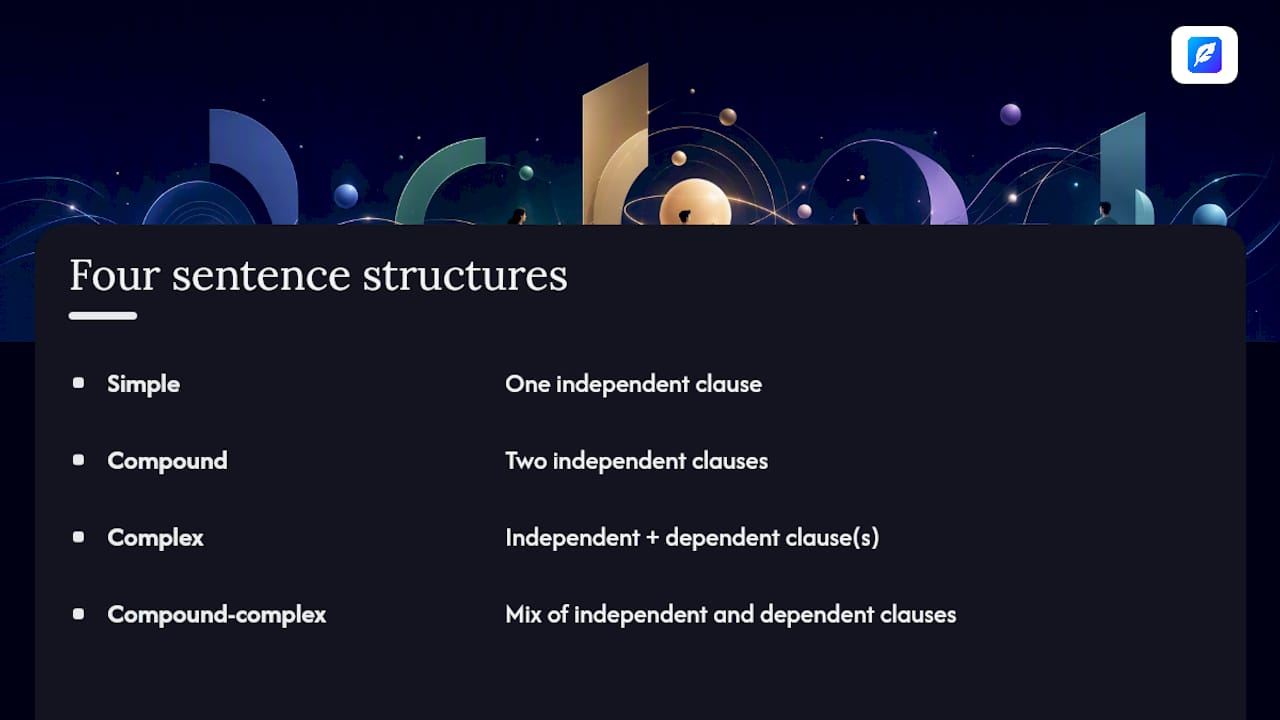
The four traditional sentence types are simple (one independent clause), compound (two independent clauses joined by a conjunction), complex (an independent clause plus one or more dependent clauses), and compound-complex (a mix of both). Errors like run-ons and fragments usually happen when a writer attempts a compound or complex sentence without the right connecting punctuation.
Can an AI tool actually catch these sentence structure errors?
Yes. Tools like Inspirowrite are built to detect fragments, agreement mismatches, modifier placement issues, and punctuation faults automatically, and they explain the reasoning behind each suggested correction rather than just marking the text.