

The most common punctuation mistakes in essays are comma splices, apostrophe errors, semicolon misuse, quotation mark confusion, and hyphen or dash mix-ups. Each one chips away at your argument's clarity before a reader even reaches your ideas. Here is a quick map of what you are likely doing wrong:
- Comma splice: joining two complete sentences with only a comma ("She studied hard, she passed with distinction.")
- Apostrophe error: writing "its" when you mean "it's," or adding an apostrophe to a plain plural ("student's" instead of "students")
- Semicolon misuse: treating a semicolon like a comma, or using it before a conjunction
- Colon confusion: placing a colon after "including" or "such as," where none belongs
- Quotation mark errors: putting commas outside closing quotation marks, or using double quotes for a quote within a quote
- Hyphen and dash mix-ups: using a hyphen where an en dash or em dash is needed, or vice versa
- Run-on sentences: fusing two independent clauses with no punctuation at all
Every one of these errors signals to a marker that the writer has not yet mastered sentence control. Correcting them is not pedantry; it is the difference between an argument that lands and one that loses the reader halfway through.
Table of Contents
- Common comma mistakes in essays
- How to use semicolons and colons correctly
- Frequent apostrophe errors and how to avoid them
- Quotation marks in academic writing: what goes where
- Hyphens, en dashes, and em dashes: which one do you need?
- Why accurate punctuation shapes how readers understand your argument
- Punctuation rules for APA, MLA, and Chicago styles
- Inspirowrite: instant punctuation feedback for your essays
- FAQ
- Key takeaways
Common comma mistakes in essays
Commas are the most misused mark in academic writing, and the root cause is almost always the same: writers place them where they would pause for breath in speech. Relying on spoken pauses leads directly to misplaced commas, because grammatical units do not map neatly onto spoken rhythm.
The three errors that appear most often:
- Comma splice: Two independent clauses joined by a comma alone. "Japan will design the aircraft, the United States will provide the technology" is a classic comma splice. Fix it with a full stop, a semicolon, or a comma plus coordinating conjunction ("and," "but," "so").
- Missing comma after an introductory phrase: "After reading the report the committee voted" needs a comma after "report."
- Omitting the Oxford comma: "I would like to thank my parents, God and President Obama" reads as though God and the President are the writer's parents. A serial comma before "and" removes the ambiguity.
Conjunctive adverbs such as "however" and "therefore" catch students out repeatedly. They are not conjunctions. Writing "The team struggled, however the new coach improved results" is a comma splice. The correct form uses a semicolon: "The team struggled; however, the new coach improved results."
Pro Tip: Before placing a comma, ask whether each side of it could stand as its own sentence. If both sides can, you need more than a comma.

How to use semicolons and colons correctly
Semicolons and colons are not interchangeable, and they are not fancy commas. Getting them right adds real precision to academic prose.
- Semicolon between independent clauses. Use it when two related sentences belong together but you want a stronger pause than a comma allows. "Night was falling; he knew all was lost" works because both clauses are complete and closely related.
- Semicolon in complex lists. When list items contain internal commas, semicolons prevent confusion. Recent Olympic host cities include Athens, Greece, Salt Lake City, Utah, and Sydney, Australia.
- Colon to introduce a list or explanation. The clause before the colon must be grammatically complete. "An essay includes the following components: an introduction, a body, and a conclusion" is correct. "An essay includes: an introduction, a body, and a conclusion" is not, because "includes" cannot end an independent clause.
- Colon as a hinge. A colon can link two thematically connected sentences: "The results were unambiguous: the policy needed to change."
Pro Tip: Never place a colon directly after "including," "such as," or "for example." Remove the colon or remove the introductory phrase.
Frequent apostrophe errors and how to avoid them
Incorrect apostrophe use is one of the most common mistakes in students' writing, and it can genuinely alter meaning. The rules are simpler than they seem once you separate the three functions.
- Contraction: The apostrophe replaces missing letters. "It's" means "it is." "Won't" means "will not."
- Possession: The apostrophe shows ownership. "Einstein's theory." For plural nouns already ending in "s," the apostrophe follows the "s": "the students' essays."
- Plain plurals never take an apostrophe. "The 1960s" is correct. "The 1960's" is wrong unless you mean something belonging to that decade.
| Incorrect | Correct | Reason |
|---|---|---|
| The librarys open | The library's open | Contraction of "library is" |
| Its a difficult question | It's a difficult question | Contraction of "it is" |
| The students essays | The students' essays | Plural possessive |
| The team improved it's record | The team improved its record | Possessive pronoun, no apostrophe |
| — | — | Plain plural, no apostrophe |
The "its" versus "it's" confusion is the single most common apostrophe error in academic essays. A reliable test: substitute "it is" into the sentence. If the sentence still makes sense, use "it's." If it does not, use "its."
Quotation marks in academic writing: what goes where
British English has its own conventions for quotation marks, and they differ from American usage in ways that trip up students who read widely online.
- In British English, single quotation marks are the default for direct speech and quotations. Double marks are reserved for a quotation within a quotation.
- Commas and full stops go outside the closing quotation mark in British English, unless they are part of the quoted material itself.
- Quotation marks should not be used to dress up slang or hedged claims. Writing "the 'interesting' argument" signals uncertainty rather than authority.
- For a quote within a quote: The director said, "The policy was 'ready for implementation'." The inner quote uses single marks; the outer uses double only when the whole passage is already in single marks.
Avoid using quotation marks with indirect speech. "She said that the results were promising" needs no quotation marks at all. Adding them creates a grammatical error, not emphasis.
Hyphens, en dashes, and em dashes: which one do you need?
These three marks look similar but serve entirely different purposes. Mixing them up is one of those common punctuation errors that markers notice immediately.
- Hyphen (-): Links words in compound modifiers before a noun ("well-known author," "up-to-date research") and joins prefixes to proper nouns ("post-Brexit policy").
- En dash (–): Indicates ranges between numbers (pages 45–60, the years 2020–2026) and connects compound adjectives where one element is already hyphenated or is a proper noun.
- Em dash (—): Marks a sharp interruption or adds emphasis within a sentence. Use sparingly in academic writing; overuse reads as informal.
Common errors to avoid:
- Using a hyphen where an en dash is needed in a number range ("pages 45-60" should be "pages 45–60").
- Hyphenating compound modifiers that follow the noun ("a well-known author" is correct; "the author is well known" needs no hyphen).
- Using an em dash as a general-purpose pause instead of a comma or semicolon.
Pro Tip: In Microsoft Word, typing a word, two hyphens, and another word without spaces automatically converts to an em dash. For an en dash, use the keyboard shortcut Ctrl + minus on the numeric keypad.
Why accurate punctuation shapes how readers understand your argument
Punctuation functions as 'road signs' guiding readers through your argument. When it is correct, it disappears from conscious notice entirely, and the reader focuses on your ideas. When it is wrong, the reader stops at the error and loses the thread of your reasoning.
Markers are trained to notice punctuation errors, and those errors carry real weight in grading. A comma splice or a run-on sentence does not just look careless; it suggests the writer cannot distinguish between a complete thought and an incomplete one. That is a structural problem, not a cosmetic one.
Extensive reading is the most reliable long-term method for absorbing correct punctuation. Writers who read widely in their discipline internalise the rhythms and conventions of academic prose far more effectively than those who rely on correction tools alone. A thorough essay proofreading checklist helps bridge the gap while those habits develop.
Punctuation rules for APA, MLA, and Chicago styles
Each major citation style has specific punctuation conventions, and mixing them up in a single essay is a common error in academic writing.
APA (American Psychological Association) uses the serial (Oxford) comma consistently. In-text citations follow the author-date format: (Smith, 2023). A comma always separates author and year. Block quotations of 40 words or more are indented and carry no quotation marks.
MLA (Modern Language Association) also uses the Oxford comma. In-text citations use author and page number with no comma between them: (Smith 45). Titles of short works (articles, poems, chapters) appear in quotation marks; longer works are italicised.
Chicago offers two systems: notes-bibliography (common in humanities) and author-date (common in sciences). In notes-bibliography, footnote numbers appear after the closing punctuation mark. Chicago permits the Oxford comma and uses it consistently in its own style manual.
The rule that cuts across all three styles: punctuation belongs inside quotation marks when it is part of the quoted material, and outside when it is not part of the quotation but belongs to the surrounding sentence. Getting this right in your chosen style is a straightforward way to avoid dropping marks on presentation. Pairing your style guide with a reliable grammar mistakes guide helps you catch the errors that style manuals alone do not flag. You can also find detailed guidance on how academic writing technology supports punctuation accuracy alongside broader essay quality.
Inspirowrite: instant punctuation feedback for your essays
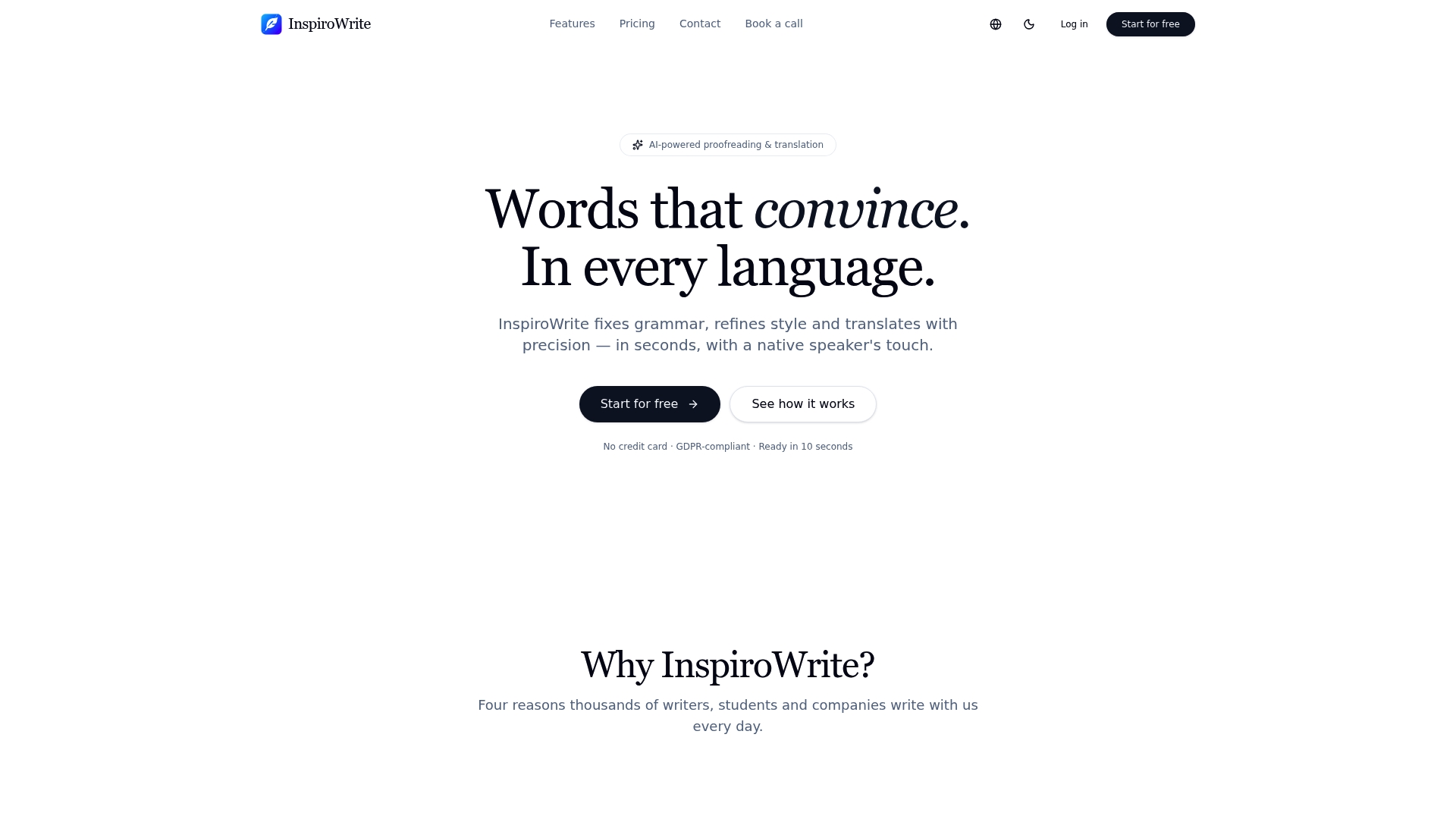
Spotting every punctuation error in your own writing is genuinely hard. You read what you meant to write, not what is on the page. Inspirowrite gives you a second pair of eyes in seconds, flagging comma splices, apostrophe errors, and misplaced quotation marks the moment you paste in your text. Unlike slower tools, Inspirowrite processes your draft immediately and keeps your content entirely private: nothing you submit is stored or used to train AI models, which matters when your essay contains original research or unpublished arguments. Students and academic writers get specific, contextual suggestions rather than generic alerts, so you understand why a correction is needed, not just that something is wrong. Try Inspirowrite at inspirowrite.com and see the difference a clean punctuation check makes before you submit.
FAQ
What are the most common punctuation mistakes in essays?
Comma splices, apostrophe errors (especially "its" versus "it's"), semicolon misuse, and incorrect quotation mark placement are the errors that appear most frequently in student essays. Each disrupts sentence structure and can cost marks on presentation.
How does wrong punctuation affect your writing?
Incorrect punctuation obscures meaning and forces readers to reread sentences to extract the intended sense. In academic writing, this undermines the clarity of your argument and signals weak sentence-level control to markers.
What is a comma splice and how do you fix it?
A comma splice occurs when two independent clauses are joined by only a comma without a coordinating conjunction. Fix it by replacing the comma with a full stop, a semicolon, or a comma plus "and," "but," or "so."
Do punctuation rules differ between APA, MLA, and Chicago?
Yes. APA and MLA both use the Oxford comma and differ mainly in citation format; Chicago adds footnote conventions and places punctuation after superscript numbers. Always check your institution's required style guide before submitting.
Can Inspirowrite catch punctuation errors automatically?
Inspirowrite checks your text for punctuation errors instantly and privately, making it a practical tool for a final punctuation check before submission without sharing your work with third parties.
Key takeaways
Comma splices, apostrophe errors, and semicolon misuse are the punctuation mistakes most likely to cost you marks in an academic essay.
| Point | Details |
|---|---|
| Comma splices are serious errors | Joining two independent clauses with only a comma misidentifies sentence structure; fix with a full stop, semicolon, or conjunction. |
| Apostrophes follow three rules | Use them for contractions, possession, and nothing else; plain plurals never take an apostrophe. |
| Punctuation guides comprehension | Correct punctuation disappears from notice and lets readers focus on your argument rather than your mechanics. |
| Style guides differ on specifics | APA, MLA, and Chicago each have distinct citation punctuation conventions; mixing them in one essay is a common error. |
| Inspirowrite checks your draft instantly | Inspirowrite flags punctuation errors in seconds while keeping your content private and unused for AI training. |