

TL;DR:
- Non-native speakers frequently make grammar mistakes such as verb tense errors, article misuse, and preposition confusion. Correcting these predictable errors is crucial for enhancing professionalism and credibility in writing. Focused practice, error logging, and understanding language transfer patterns lead to faster, lasting improvement.
The most common English grammar mistakes non-native speakers make are verb tense errors, article misuse, subject-verb disagreement, and preposition confusion. These are not random slips. They are predictable patterns rooted in how your first language works. Grammar errors reduce perceived professional credibility by up to 40% in workplace contexts. That figure alone makes fixing these errors worth your time. This article names each mistake clearly, shows you what it looks like, and tells you exactly how to correct it.
1. which verb tense mistakes do non-native speakers make most?

Incorrect verb tense usage is one of the most frequent grammar errors among ESL learners. The most common confusion is between the present perfect and the simple past. These two tenses look similar but carry different meanings.
The present perfect ("I have eaten") describes an action with a connection to the present. The simple past ("I ate") describes a completed action at a specific time. Many learners use them interchangeably, which changes the meaning of a sentence without the writer realising it.
Common verb tense errors include:
- Using simple past when present perfect is needed: "I already finished the report" instead of "I have already finished the report."
- Mixing tenses within a single paragraph, which makes writing feel inconsistent and hard to follow.
- Misusing irregular verbs: writing "I goed" instead of "I went" or "She has went" instead of "She has gone."
- Omitting the auxiliary verb in perfect tenses: "I been working here for two years" instead of "I have been working here for two years."
Tense inconsistency is particularly damaging in professional writing. A reader who notices a tense shift mid-paragraph loses confidence in the writer's authority. Correcting this requires conscious attention, not just spell-checking.
Pro Tip: Focus on one tense rule per week. Write five sentences using it correctly each day. This deliberate practice builds the habit faster than studying grammar tables.
2. how subject-verb agreement errors affect your writing
Subject-verb agreement errors occur when the verb does not match the subject in number. A classic example is "She go to school" instead of "She goes to school." This error is common because many languages do not change the verb form based on the subject.
The problem becomes subtler in longer sentences. When a phrase separates the subject from the verb, writers often match the verb to the nearest noun rather than the actual subject.
Consider this example: "The list of requirements are long" is incorrect. The subject is "list" (singular), not "requirements" (plural). The correct form is "The list of requirements is long."
Common subject-verb agreement pitfalls include:
- Treating collective nouns incorrectly: in British English, "The team are playing well" is acceptable, but "The team is playing well" is also correct.
- Confusing indefinite pronouns: "Everyone have their opinion" should be "Everyone has their opinion."
- Misidentifying the subject in inverted sentences: "There is many reasons" should be "There are many reasons."
Native language interference is the main cause here. If your first language does not conjugate verbs by person or number, English subject-verb rules will feel unnatural at first. The fix is to identify the core subject of every sentence before choosing the verb form.
3. why english articles (a, an, the) confuse non-native speakers
Misuse and omission of articles is a widespread problem because many languages do not use articles at all. Russian, Japanese, Chinese, and Arabic speakers often omit articles entirely or insert them where they do not belong.
The rules for English articles follow a clear logic once you know them:
- Use "a" or "an" when introducing something for the first time or when referring to one of many: "I saw a dog."
- Use "the" when referring to something specific or already mentioned: "The dog was friendly."
- Use no article with uncountable nouns used in a general sense: "Water is essential" not "The water is essential" (unless referring to specific water).
- Use no article with plural nouns in a general sense: "Cats are independent" not "The cats are independent."
A typical mistake looks like this: "I went to hospital" (British English, correct) versus "I went to the hospital" (American English, also correct but different in meaning). These distinctions trip up even advanced learners.
Pro Tip: When you are unsure about an article, ask yourself: is this specific or general? Specific things take "the." New or general things take "a" or no article.
4. why preposition errors are so common in english
Preposition mistakes are common because English prepositions do not follow a consistent logical system. They are largely idiomatic, meaning the correct choice depends on convention rather than translation.
Consider these frequent errors:
- "Married with" instead of "married to"
- "Arrive to" instead of "arrive at" or "arrive in"
- "Depend of" instead of "depend on"
- "Interested about" instead of "interested in"
- "Good in" instead of "good at" (for skills)
The reason these errors persist is that direct translation from another language produces the wrong preposition almost every time. In Spanish, for example, "casado con" translates literally as "married with," which is incorrect in English.
The most effective strategy for learning prepositions is to memorise them as part of fixed phrases rather than as standalone words. Learn "interested in," not just "interested." Learn "responsible for," not just "responsible." Reading widely in English also builds an instinct for which prepositions sound right in context. You can find more on this in this guide to writing naturally in English.
5. how direct translation creates grammar mistakes
Direct translation leads to structural errors such as word order mistakes and unnatural grammar. This is called language transfer, and it affects every non-native speaker regardless of their proficiency level.
The table below shows how literal translation produces incorrect English:
| First Language Thought | Literal Translation | Correct English |
|---|---|---|
| French: "J'ai 30 ans" | "I have 30 years" | "I am 30 years old" |
| German: "Ich bin hungrig" | "I am hungry" (correct here) | "I am hungry" |
| Spanish: "Me gusta mucho" | "It pleases me much" | "I really like it" |
| Arabic: "Ana fi al-bayt" | "I in the house" | "I am in the house" |
| Chinese: "Wo chi fan le" | "I eat rice already" | "I have already eaten" |
Language transfer is not a sign of low intelligence. It is a natural cognitive process. Your brain uses what it already knows to fill gaps in a new language. The problem is that English sentence structure, verb forms, and word order differ significantly from most other languages.
The fix is to recognise language transfer patterns in your own writing. Keep an error log. Each time you make a transfer error, write down the incorrect version and the correct version. Review this log weekly. Over time, you will notice your most habitual errors and correct them before they reach the page.
6. misplaced commas, tense shifts, and sentence fragments
Common grammar errors in professional writing by non-native speakers include misplaced commas, tense shifts, and sentence fragments. These errors are often habitual, which means they require conscious correction rather than passive editing.
A sentence fragment is an incomplete sentence. "Because I was tired." is a fragment. It has a subject and a verb, but it does not express a complete thought. The correct version is "I left early because I was tired."
Tense shifts happen when a writer changes tense mid-paragraph without reason. "She walked into the room and says hello" mixes past and present. Choose one tense and stay with it throughout a passage.
Misplaced commas often appear before relative clauses that should not be separated from the main sentence. "The report, that I submitted yesterday, was approved" is incorrect. "The report that I submitted yesterday was approved" is correct because the relative clause is defining (it tells us which report).
Effective proofreading uses three separate passes: one for structure and logic, one for sentence clarity, and one for surface grammar and punctuation. This approach catches errors that a single read-through misses entirely.
7. how to use grammar tools without becoming dependent on them
Grammar checkers like Grammarly catch obvious errors but must be supplemented with personal judgement and revision strategies. Tools improve accuracy, but they do not understand context the way a human reader does.
The risk of over-relying on grammar tools is that you stop learning from your mistakes. The tool corrects the error, you accept the suggestion, and the same error appears again next week. You have not built any understanding of why the original sentence was wrong.
Use grammar tools as a first pass, not a final one. After running your text through a checker, read the suggestions carefully and ask yourself why each correction was made. This turns a passive correction into an active learning moment. Reading your work aloud is another technique that catches errors no software will flag, particularly awkward phrasing and unnatural rhythm.
Focused error analysis combined with daily short practice produces faster improvement than sporadic intensive study. Fifteen minutes of deliberate grammar practice each day outperforms a three-hour grammar session once a fortnight.
Key takeaways
The most effective way to fix frequent grammar mistakes is to identify your specific error patterns and practise correcting them deliberately, one rule at a time.
| Point | Details |
|---|---|
| Verb tense errors are most frequent | Confusing present perfect and simple past is the top mistake; learn each tense in context. |
| Subject-verb agreement needs attention | Always identify the core subject before choosing the verb form, especially in long sentences. |
| Articles require a specific or general test | Ask whether a noun is specific or general to decide between "the," "a/an," or no article. |
| Prepositions must be learnt as fixed phrases | Memorise collocations like "interested in" and "responsible for" rather than prepositions alone. |
| Error logging accelerates improvement | Writing down mistakes and correct versions weekly builds lasting grammar habits. |
What i have learnt from watching non-native speakers improve their writing
After years of working with writers whose first language is not English, one pattern stands out above all others. The learners who improve fastest are not the ones who study the most grammar rules. They are the ones who study the right rules at the right time.
Most non-native speakers carry a small set of habitual errors. They make the same five or six mistakes repeatedly across every piece of writing. The moment they identify those specific errors and focus on them exclusively, their writing improves at a rate that surprises even them.
The mistake I see most often is trying to fix everything at once. A learner reads a grammar book, feels overwhelmed by the volume of rules, and gives up or reverts to old habits. Concentrating on one grammar rule at a time is not a shortcut. It is the most direct route to lasting improvement.
Grammar tools are genuinely useful, but I have seen writers become passive about their own errors because a tool always catches them. The writers who develop real confidence are those who understand why a sentence is wrong, not just that it is wrong. Use tools to check your work. Do not use them to replace your thinking.
One more thing: grammatical precision builds credibility in ways that go beyond correctness. Readers follow a well-constructed argument more easily. They trust the writer more. That trust is worth every minute you invest in getting the grammar right.
— Mike
Polish your english writing with Inspirowrite
Grammar errors in professional writing cost you credibility before your reader reaches your main point. Inspirowrite is an AI-powered proofreading tool built for exactly this situation. It delivers fast, accurate grammar feedback while keeping your content completely private. Your text is never used to train AI models, which matters when you are working on sensitive documents.
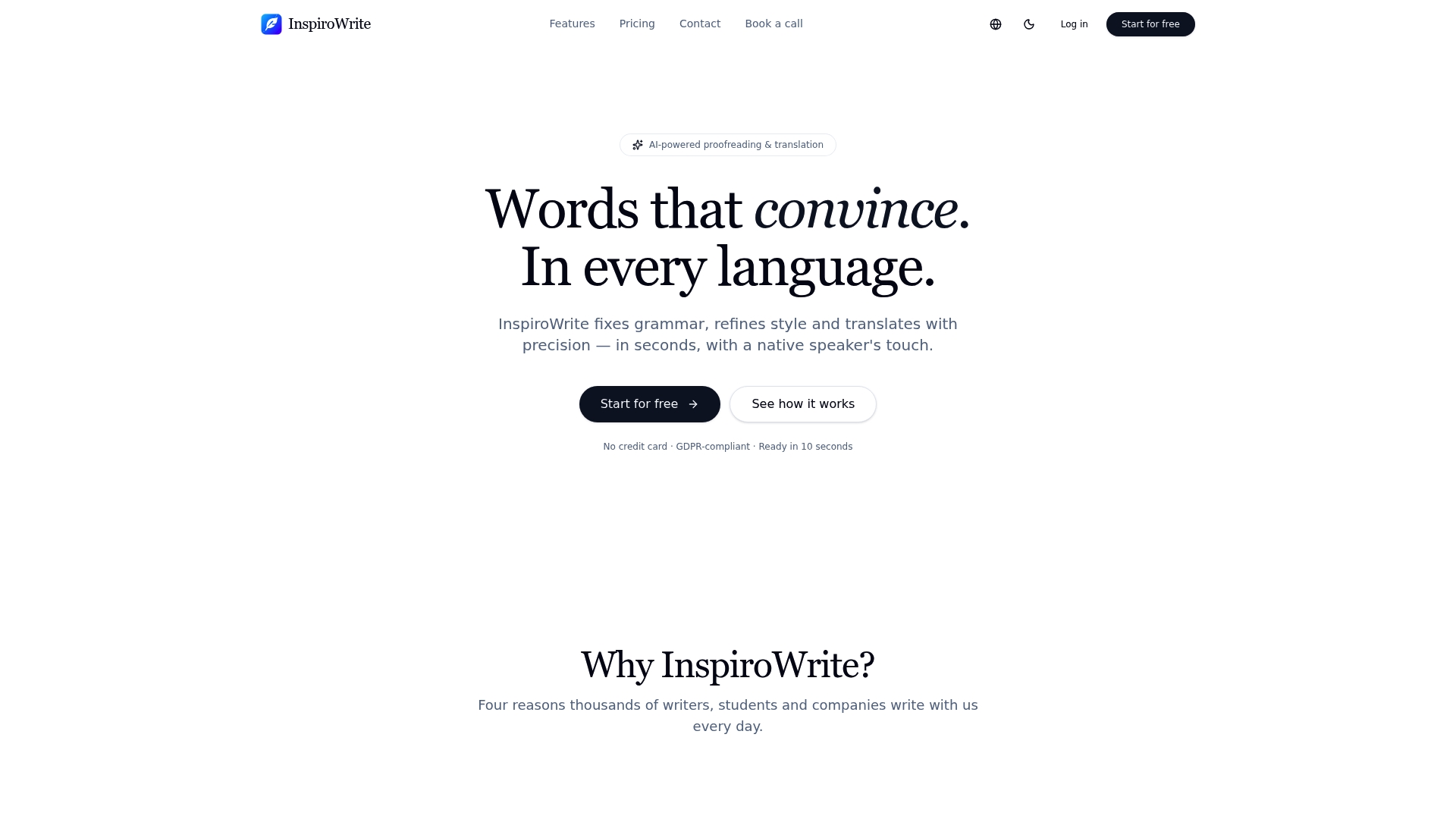
Whether you are a student refining an essay or a professional polishing a business report, Inspirowrite gives you clear suggestions within seconds. Visit Inspirowrite to see how it works, and check the proofreading guide for your own writing to build the habits that make every draft stronger.
FAQ
What are the most common grammar mistakes in english?
The most frequent errors are incorrect verb tenses, subject-verb disagreement, article misuse, and preposition confusion. These mistakes are predictable and fixable with focused practice.
Why do non-native speakers struggle with english articles?
Many languages do not use articles, so speakers of Russian, Chinese, Arabic, and Japanese often omit or misplace "a," "an," and "the." Learning whether a noun is specific or general resolves most article errors.
How can i improve my english grammar quickly?
Daily short practice sessions focused on one rule at a time produce faster results than irregular intensive study. Keeping an error log and reviewing it weekly accelerates improvement further.
Do grammar checkers fix all english errors?
Grammar checkers catch obvious mistakes but miss context-dependent errors and unnatural phrasing. Use them as a first pass, then read your work aloud and apply your own judgement before submitting.
What is language transfer in english writing?
Language transfer is when your first language's grammar structure influences your English writing, producing errors like wrong word order or missing verbs. Recognising your personal transfer patterns and logging them is the most direct way to correct them.