

TL;DR:
- Multilingual business documents include legal, financial, and operational materials that require category-specific translation expertise. Proper classification ensures accuracy, compliance, and professional credibility across jurisdictions. Effective workflows combine specialized human translators, layered AI extraction, and multilingual desktop publishing for optimal results.
Types of multilingual business documents refer to the distinct categories of corporate materials translated and localised for international audiences, spanning legal, financial, governance, HR, operational, compliance, intellectual property, and transactional functions. Each category carries unique translation requirements, certification standards, and formatting demands that directly affect legal validity and professional credibility across borders. Organisations working with partners in Germany, Japan, Brazil, or the UAE cannot treat all documents as interchangeable. A contract is not a brochure, and a patent filing is not an employee handbook. Getting the category right before commissioning any translation is the single most consequential decision in any multilingual document workflow.
Types of multilingual business documents by corporate function
Corporate multilingual business documents are best categorised into eight main types by corporate function: legal, governance, financial, HR, operational, compliance, intellectual property, and transactional. This framework, referenced by specialists including Espresso Translations and LinguaServe, gives business professionals a practical map for assigning the correct translator expertise, certification level, and formatting treatment to every document in their portfolio.

1. Legal corporate documents
Legal corporate documents include articles of incorporation, shareholder agreements, commercial contracts, and powers of attorney. These materials carry the highest precision requirements of any document category because a mistranslated clause can invalidate an agreement or expose a company to liability in a foreign jurisdiction.
Certified translation is almost always mandatory for legal documents submitted to foreign courts or government registries. The translator must attest in writing that the translation is complete and accurate, and in many jurisdictions a notary must also authenticate the certification. Selecting a translator without specialist legal knowledge in both the source and target jurisdiction is a common and costly error.
Pro Tip: When commissioning legal translations, request a glossary of agreed terminology before the translator begins. Consistent use of terms like "indemnification", "force majeure", and "governing law" across all documents in a transaction prevents disputes during due diligence.
2. Governance documents
Governance documents cover board meeting minutes, shareholder resolutions, committee reports, and corporate bylaws. These records establish the formal decision trail of a company and are frequently requested by auditors, regulators, and potential investors conducting due diligence.
Accuracy in governance translation goes beyond language. The translated document must reflect the procedural conventions of the target jurisdiction. A board resolution formatted for a UK company may need structural adaptation before it satisfies the filing requirements of a German Handelsregister or a Singapore ACRA submission.
3. Financial and accounting documents
Financial translation covers annual reports, audit reports, banking contracts, tax filings, and prospectuses, each with specific terminology and format requirements that differ substantially from one another. An annual report demands narrative fluency alongside numerical precision, while a tax filing requires strict adherence to local regulatory vocabulary.
LinguaServe notes that financial document types require distinct translators with specific expertise due to varying constraints and terminology needs. This means a single generalist translator is rarely adequate across the full financial document spectrum. Organisations that treat financial translation as a single homogeneous task routinely receive documents that are technically accurate but contextually wrong for their intended regulatory audience.
4. Human resource documents
HR documents include employment contracts, employee handbooks, disciplinary procedures, benefit summaries, and onboarding materials. These documents govern the relationship between employer and employee and must comply with local labour law in every country where they are used.
An employee handbook translated for a French workforce, for example, must reflect the specific rights and obligations under the French Labour Code, not simply carry a word-for-word rendering of the English original. Confidentiality is also a significant concern in this category. HR documents contain personal data, salary information, and performance records, making the choice of translation provider a data protection decision as much as a linguistic one.
5. Operational documents
Operational documents encompass standard operating procedures, quality management manuals, workflow guides, and technical specifications. These materials keep global teams aligned on processes and are particularly critical in manufacturing, logistics, and regulated industries such as pharmaceuticals and aerospace.
Clarity is the primary translation objective for operational documents. Ambiguity in a procedure manual can cause production errors, safety incidents, or regulatory non-compliance. Translators working on operational content must understand the technical domain as well as the language, and translated procedures should be reviewed by in-country subject matter experts before deployment.
6. Compliance and regulatory documents
Compliance documents include regulatory filings, environmental impact reports, data protection policies, anti-bribery statements, and licences. Every jurisdiction has its own regulatory vocabulary, and a document that satisfies the UK Financial Conduct Authority will not automatically satisfy the German BaFin or the US Securities and Exchange Commission.
Certified translations are necessary for documents submitted to courts, governments, or immigration authorities to legally attest completeness and accuracy. For compliance filings, this certification requirement is non-negotiable. Submitting an uncertified translation to a regulatory body is grounds for rejection and, in some cases, financial penalty.
7. Intellectual property documents
IP documents cover patent applications, trademark registrations, licensing agreements, and technology transfer agreements. These materials protect a company's innovations and commercial identity in foreign markets, and translation errors in this category can result in the loss of intellectual property rights.
Patent translation is among the most technically demanding of all business document translation tasks. Patent claims must be translated with absolute fidelity to the original scope of protection. A single word substitution that broadens or narrows a claim can affect enforceability in the target jurisdiction. Specialist patent translators typically hold qualifications in both law and the relevant technical field.
8. Transactional documents
Transactional documents include merger and acquisition agreements, joint venture contracts, vendor agreements, and investment term sheets. These materials are produced under time pressure during live commercial transactions and must be accurate, consistent, and legally sound across multiple languages simultaneously.
M&A transactions routinely involve document volumes running to thousands of pages across several jurisdictions. Translation memory tools and controlled terminology databases are standard practice in this context, allowing translation teams to maintain consistency across large document sets while meeting tight deal timelines.
How multilingual desktop publishing complements document translation
Multilingual desktop publishing (DTP) ensures translated documents preserve layout, formatting, and corporate identity, which is critical for compliance and professionalism. Translation alone delivers accurate text. DTP delivers a document that looks and functions correctly in its target language, including right-to-left scripts such as Arabic and Hebrew, character-dense scripts such as Chinese and Japanese, and languages that expand significantly in length relative to English, such as German or Finnish.
Infognana identifies DTP as a key enabler that preserves credibility and compliance perception in legal and regulatory multilingual documents by maintaining regional formatting and brand identity. A compliance handbook that arrives with broken layouts, misaligned tables, or incorrect date and currency formats signals carelessness to a regulator, regardless of how accurate the underlying translation is. The formatting is part of the message.
Practical integration of DTP into a translation workflow requires source files in editable formats such as InDesign, Word, or PowerPoint rather than locked PDFs. Providing editable source files to your translation partner at the outset eliminates the costly and time-consuming step of recreating document structure from scratch.
Pro Tip: Always request a DTP proof in the target language before final delivery. A single review round catches text overflow, font substitution errors, and misaligned graphics that are invisible in the translation file but obvious in the finished document.
Challenges and solutions in processing multilingual documents
Multilingual document workflows face significant challenges due to mixed-language pages, diverse scripts, and complex layouts requiring advanced OCR and extraction technologies. A single invoice arriving from a cross-border supplier may contain English headers, German body text, and Arabic numerals formatted to local conventions. Standard OCR tools fail on documents like this because they assume a single language and script throughout.
The key challenges in multilingual document processing include:
- Mixed-language detection: Documents combining two or more languages on a single page require language boundary detection before any extraction or classification can occur.
- Script diversity: Tools must handle Latin, Cyrillic, Arabic, CJK (Chinese, Japanese, Korean), and Devanagari scripts within the same workflow.
- Layout-aware processing: Multi-column layouts, tables, and embedded graphics require layout analysis before text extraction to preserve document structure.
- Structured data standards: Cross-border invoicing combines human-readable and machine-readable formats using standards such as ZUGFeRD with profiles EN 16931 (Comfort) and XRechnung, which go beyond simple text translation into structured data compliance.
The following table compares two leading approaches to multilingual document extraction:
| Approach | Best suited for | Key limitation |
|---|---|---|
| Multilingual OCR (e.g., PaddleOCR, Google Document AI) | Scanned documents, mixed scripts, complex layouts | Requires post-processing for structured data extraction |
| LLM orchestration (e.g., LlamaIndex pipelines) | Semantic classification, terminology extraction, translation memory integration | Higher computational cost; needs clean OCR input |
Emerging AI and large language model orchestration models are closing the gap between raw extraction and publication-ready translated output. A layered processing pipeline comprising OCR extraction, language classification, translation, and formatting steps is now the recognised standard for organisations handling high volumes of international business documents.
When certified translations are necessary
Certified translation is a formal attestation by a qualified translator that a translation is complete and accurate to the best of their knowledge. Notarised translation adds a further layer: a notary public authenticates the translator's signature and credentials. These are not interchangeable, and confusing them is a common and expensive mistake.
The corporate documents most frequently requiring certified translation include:
- Articles of incorporation and company registration documents
- Financial statements submitted to foreign regulators or lenders
- Shareholder agreements used in cross-border transactions
- Employment contracts for foreign national employees
- Patent and trademark filings with national IP offices
ISO 17100 recommends independent review and quality control to avoid errors, and certified translation workflows should follow this standard as a baseline. Choosing a provider solely on price in this category is a false economy. A rejected filing or an invalidated contract will cost far more than the difference between a budget and a specialist provider.
Key takeaways
Effective multilingual business document management requires matching each document category to the correct translation standard, certification level, and formatting treatment from the outset.
| Point | Details |
|---|---|
| Eight corporate document types | Legal, governance, financial, HR, operational, compliance, IP, and transactional documents each require distinct translation expertise. |
| Certified translation is category-specific | Legal, compliance, and IP documents almost always require certified or notarised translation for regulatory acceptance. |
| DTP is not optional | Multilingual desktop publishing preserves layout, brand identity, and compliance credibility in translated documents. |
| Technology requires a layered approach | Effective multilingual document processing combines OCR, language detection, classification, translation, and formatting in sequence. |
| Terminology consistency is a quality control issue | ISO 17100 mandates independent review to prevent terminology drift and structural errors across language versions. |
Why most multilingual document projects fail before translation begins
The most consistent failure I observe in multilingual document projects is not poor translation quality. It is the absence of any document classification step before the work begins. Organisations send a mixed batch of contracts, handbooks, and compliance filings to a single translation vendor and expect uniform results. They rarely get them.
Each of the eight corporate document categories I have outlined above demands a different professional profile. The translator who handles your M&A term sheet should not be the same person handling your employee onboarding handbook, even if both documents are being translated into the same language. The terminology, the regulatory context, and the consequences of error are entirely different.
I have also seen DTP treated as an afterthought. A legal team will spend weeks reviewing translated contract text and then approve a final document where the formatting has collapsed in the target language. That document goes to a regulator or a counterparty and immediately signals that the organisation does not take its international obligations seriously. Formatting is not cosmetic in a compliance context.
The technology side is improving rapidly. Tools like Google Document AI and LlamaIndex pipelines are making it genuinely feasible to process large volumes of mixed-language documents with structured extraction. But technology does not replace the need for language pair expertise in the translation step itself. The organisations getting this right in 2026 are the ones combining specialist human translators with well-configured AI extraction and DTP workflows, not choosing between them.
— Mike
How Inspirowrite supports your multilingual document workflow
Managing multilingual business documents at speed and scale requires tools that deliver accurate results without compromising confidentiality. Inspirowrite provides AI-powered proofreading and translation that processes text in seconds, with a strict privacy policy ensuring your content is never used to train AI models.
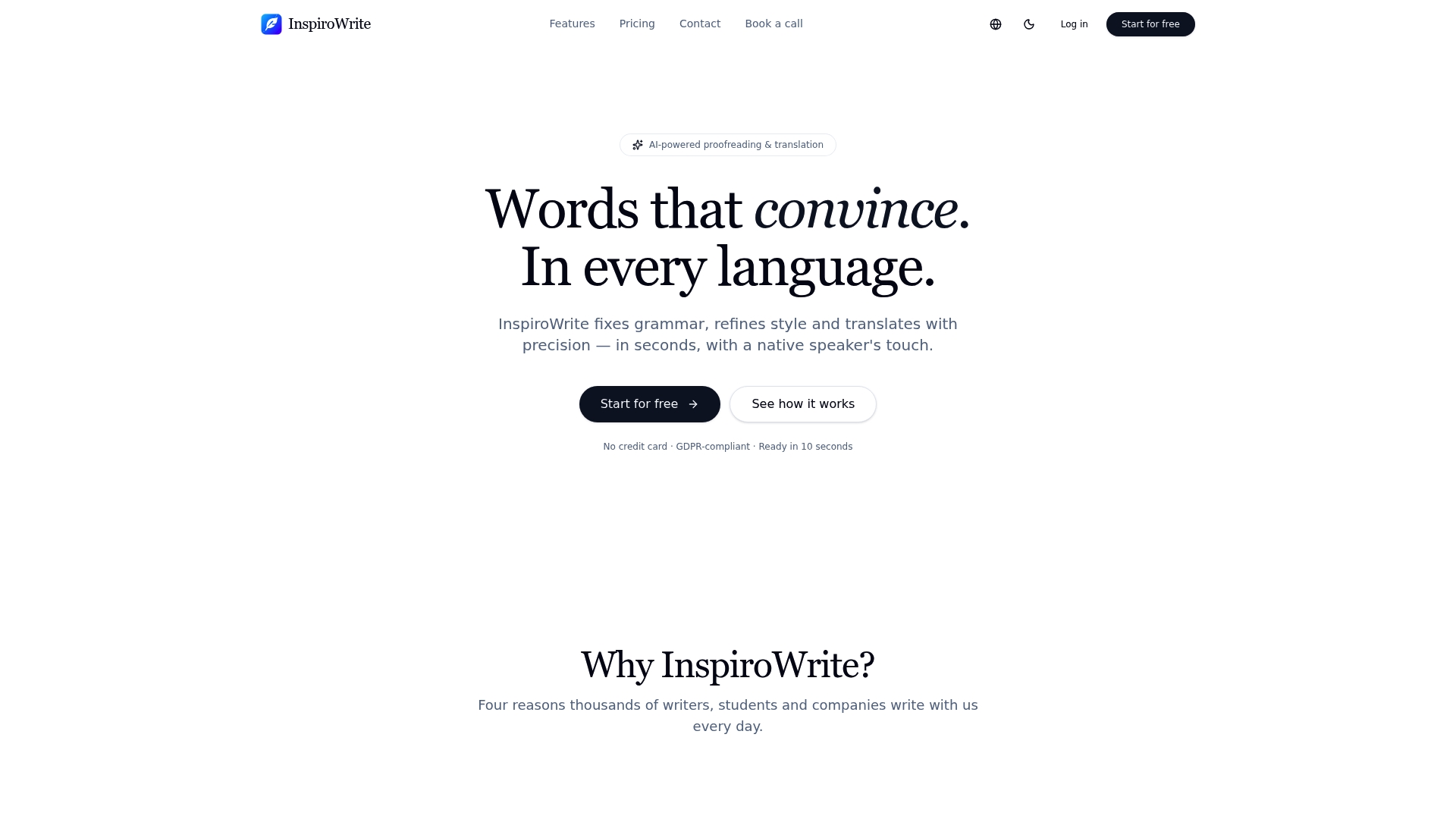
Whether you are refining a translated employee handbook, polishing a financial report for a foreign regulator, or checking the grammar of a multilingual vendor agreement, Inspirowrite's translation tools give you immediate, reliable feedback across languages. For business professionals managing international document portfolios, that combination of speed and privacy is not a luxury. It is a requirement.
FAQ
What are the main types of multilingual business documents?
The eight main types are legal, governance, financial, HR, operational, compliance, intellectual property, and transactional documents. Each category has distinct translation requirements, certification standards, and formatting needs.
When does a business document need certified translation?
Certified translation is required when a document is submitted to a court, government body, regulatory authority, or immigration agency. Articles of incorporation, financial statements, and shareholder agreements are the most common corporate documents requiring certification.
What is multilingual desktop publishing and why does it matter?
Multilingual desktop publishing (DTP) is the process of reformatting a translated document to preserve its original layout, typography, and brand identity in the target language. Without DTP, translated compliance and legal documents frequently contain broken layouts and formatting errors that undermine their credibility.
How do ZUGFeRD and XRechnung affect multilingual invoicing?
ZUGFeRD and XRechnung are structured data standards for cross-border e-invoicing that combine human-readable and machine-readable formats. Translating these documents requires compliance with the EN 16931 profile, not just linguistic accuracy.
What does ISO 17100 require for business document translation?
ISO 17100 is the international standard for translation services and requires independent linguistic review and quality control at each stage of the translation workflow. Following this standard is the baseline for any corporate document translation that carries legal or regulatory weight.