
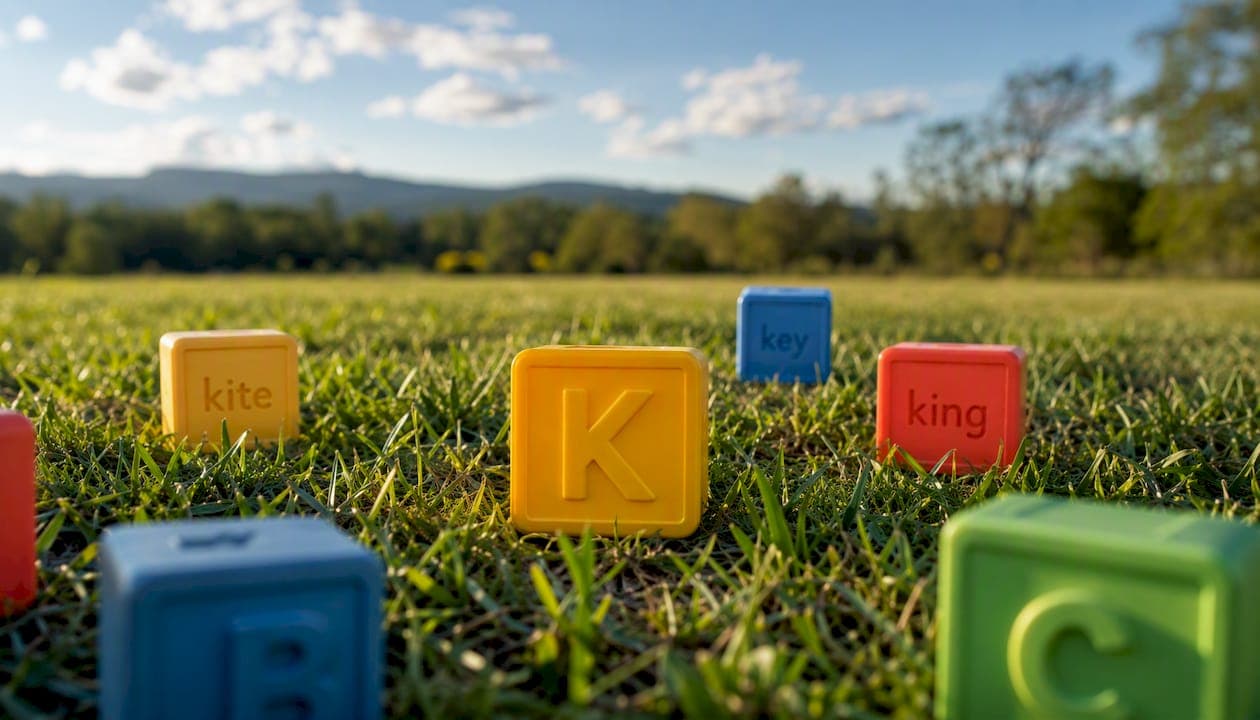
Here are some of the most common words that start with K: key, kite, kitten, kit, kin, kind, king, and kick. Those eight alone cover nouns, adjectives, and verbs, which is a useful spread for any learner or word-game player. BYJU'S lists these as core high-frequency examples, and they appear consistently across major dictionary indexes. The sections below organise K words by length, theme, and part of speech, with phonetics notes and game tips throughout.
Table of Contents
- How many K words are there, and how do dictionaries group them?
- K words organised by length: your quick reference
- K words kids love, with activity ideas
- Common K words with their meanings
- How K behaves in English: pronunciation and spelling patterns
- Practical ways to use K-word lists for games and study
- Key takeaways
- Why the way you organise K words matters more than the list itself
- Useful sources
- FAQ
How many K words are there, and how do dictionaries group them?
English has hundreds of words beginning with K, from the single letter K to long technical terms such as kaleidoscope and kinesthesia. Merriam-Webster's word-finder and TheFreeDictionary's K index confirm that standard reference sets contain several hundred distinct K-word entries, covering common vocabulary and specialised terms.
Grouping by length is the most practical approach for two reasons. For learners, shorter words tend to be higher frequency and easier to anchor in memory first. For word-game players, length is the primary filter: Scrabble and Wordle both require you to know exactly how many letters you are working with before anything else. Dictionary.com's word-finder tool is built around exactly this logic, letting players filter by letter count in seconds.
The Britannica dictionary's K index highlights a core set of high-frequency K words, keep, know, kind, and kick among them, which function as vocabulary anchors for learners at every level. Starting with those before moving to rarer entries is the approach most language teachers recommend.
K words organised by length: your quick reference
The table below shows example K words organised by length, drawn from standard dictionary and word-finder results. This organisation covers both high-frequency and specialised entries.
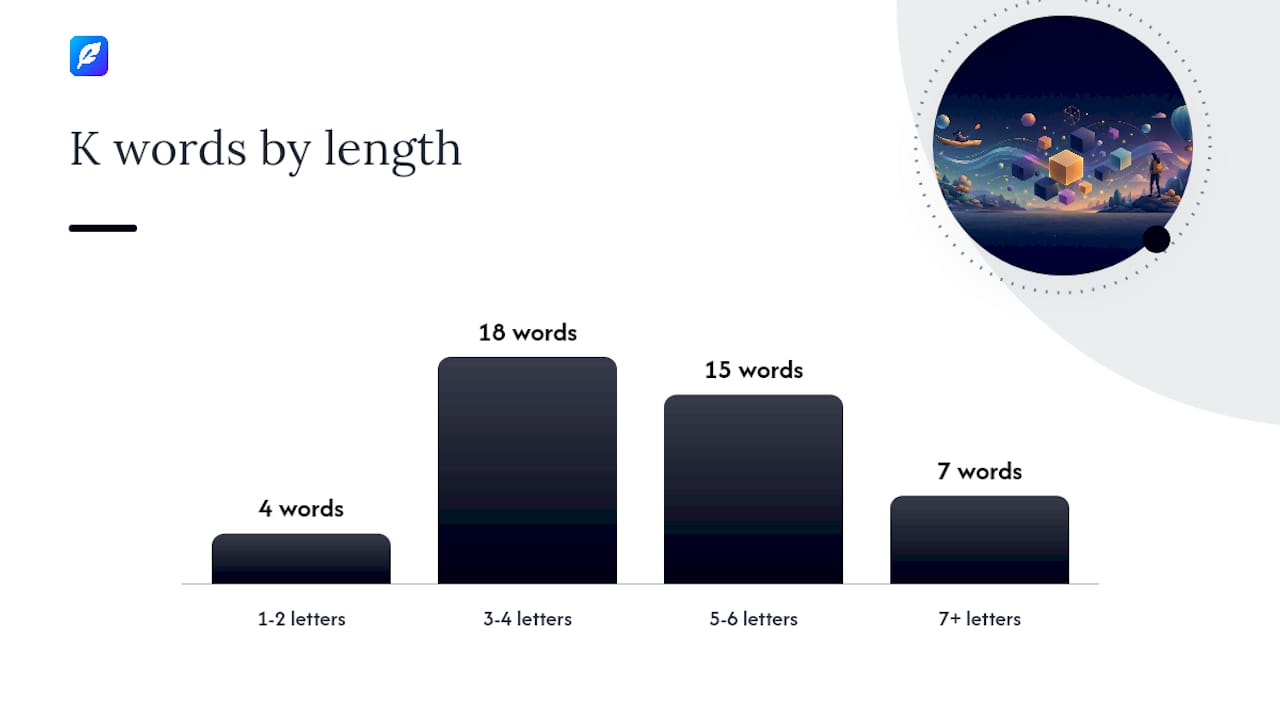
| Length | Example words | Notes |
|---|---|---|
| 1-letter | K | Used informally and in abbreviations |
| 2-letter | ka, ki, ko | Valid in some word games and special lists |
| 3-letter | key, kin, kit, kid, keg, ken, koi, kop | High-frequency; strong game value |
| 4-letter | keen, keep, kick, kill, kind, king, kite, knit, knob, know | Core everyday vocabulary |
| 5-letter | kayak, karma, kiosk, knife, knock, kneel, koala, kudos | Popular for Wordle and Scrabble |
| 6-letter | kitten, keeper, kernel, kettle, knight, knives, knotty | Mix of common and less familiar |
| 7+ letters | kaleidoscope, kangaroo, keyboard, kindness, knowledge, knapsack, kingfisher | Includes technical and cultural terms |
3-letter K words
- key, kid, kin, kit, keg, ken, koi, kop
Ken (meaning range of knowledge) and koi (the ornamental fish) often catch players off guard. Both are valid in Scrabble.
4-letter K words
- keen, keep, kick, kill, kind, king, kite, knit, knob, know
This group contains some of the most frequently used words in everyday English. Knit and know both carry a silent K, covered in detail in the pronunciation section below.
5-letter K words
- kayak, karma, kiosk, knife, knock, kneel, koala, kudos
Five-letter K words are popular among Wordle players and Scrabble enthusiasts, with standard dictionary indexes confirming hundreds of options—including kayak, karma, kiosk, knife, knock, kneel, koala, and kudos—each offering unique spelling and game strategies.
6-letter K words
- kitten, keeper, kernel, kettle, knight, knives, knotty
Knight is a useful one to flag: the silent kn at the start means it is often misspelt as night by younger learners.
7+ letter K words
Longer K words often have Greek or technical roots. TheFreeDictionary's K index and Engrdu's compiled list of 700+ K words confirm that there are at least several hundred distinct K words spanning technical, cultural, and scientific domains.
- kaleidoscope, kangaroo, keyboard, kindness, knowledge, knapsack, kingfisher
Kaleidoscope (Greek: kalos + eidos + skopein) is a good illustration of why Greek-rooted words tend to use K rather than C for the /k/ sound, a pattern explored in the spelling section.
K words kids love, with activity ideas
Young learners respond best to K words they can picture. Concrete, imageable words support both memory and correct production of the /k/ sound, which is one of the earlier consonants children typically acquire.
A short list that works well in the classroom or at home:
Three activities that reinforce both the sound and the meaning:
- Picture-card matching — Print or draw simple images of each word and ask children to match the card to the written word. The visual anchor speeds up recall.
Forbrain's speech-therapy activity guide recommends practising the /k/ sound in the initial position (start of a word) before moving to medial and final positions, because initial position is the easiest for most children to produce correctly.
Pro Tip: When teaching k words for kids, always say the word aloud before showing the written form. Hearing the /k/ sound first prevents children from silently reading the letter and skipping the phonetic step entirely.
Common K words with their meanings
The words below appear consistently across Britannica's core vocabulary index and are worth knowing whether you are studying English or preparing for a word game.
| Word | Part of speech | Meaning | Example |
|---|---|---|---|
| key | noun / adjective | Device for opening a lock; or most important | "She lost her door key." |
| kind | adjective / noun | Caring and generous; or a type/category | "He was kind to the new student." |
| keep | verb | To retain or continue to have | "Keep the receipt." |
| know | verb | To have information or awareness | "Do you know the answer?" |
| king | noun | A male monarch | "The king addressed his court." |
| kick | verb / noun | To strike with the foot; or the act of doing so | "She kicked the ball hard." |
| kitchen | noun | Room used for cooking | "The kitchen smelled of bread." |
| knack | noun | Natural skill or talent | "He has a knack for languages." |
Know and key are among the most versatile K words in English: know functions as a high-frequency verb, while key shifts between noun, adjective, and even verb ("to key in data") depending on context.
How K behaves in English: pronunciation and spelling patterns
The letter K represents the /k/ sound consistently in English, but its placement and behaviour follow patterns that are worth learning explicitly.
K versus C for the /k/ sound
English uses both K and C for the /k/ sound, and the choice is not random. A practical rule of thumb:
- Words with Greek roots tend to use K: kangaroo, karma, kiosk, kaleidoscope
That last point is the most useful spelling mnemonic. If the vowel following the /k/ sound is E or I, the letter is almost always K, not C.
Phonetic positions
- Initial position — (start of word): key, kick, kind — the clearest and easiest to produce.
Pro Tip: If you are practising English pronunciation, start with initial-position K words (key, kick, king) before moving to medial and final positions. Speech-therapy practice consistently shows that initial position is the most accessible entry point for mastering a new consonant sound.
Practical ways to use K-word lists for games and study
Lists are only useful if you do something with them. Here are four routines that turn a static word list into active vocabulary.
- Length drills — Pick one length group (say, 4-letter K words) and write down as many as you can in 90 seconds without looking. Check against the list, then repeat the next day. The gap between your first and second attempt is a direct measure of retention.
Pro Tip: For Scrabble preparation specifically, prioritise learning 2- and 3-letter K words (ka, ki, keg, ken, koi) before the longer ones. Short words open up board positions that longer words cannot reach, and the K tile's 5-point value makes even a short placement worthwhile.
Key takeaways
K words span a wide range of lengths and uses, but a small core set covers most everyday needs. Knowing the silent-K rule and the K-versus-C spelling pattern alone will prevent the most common errors.
| Point | Details |
|---|---|
| Start with high-frequency words | Key, kind, keep, know, and kick cover most everyday contexts and are the best study anchors. |
| Group by length for games | Use length-filtered tools on Dictionary.com or Merriam-Webster to find K words for Scrabble and Wordle quickly. |
| Watch for silent K | All kn- words (know, knife, knight, kneel) have a silent K; the N carries the sound. |
| K before E or I, not C | When the /k/ sound precedes E or I, the spelling is almost always K rather than C. |
| Practise by position | For pronunciation, work through initial, then medial, then final positions in that order. |
Why the way you organise K words matters more than the list itself
Most K-word articles hand you a wall of alphabetical entries and leave you to it. That approach works for a dictionary lookup, but it does almost nothing for retention or game performance.
The organisation here, by length, by theme, by part of speech, and by phonetic position, mirrors how memory actually works. You do not remember knack because you read it in a list of 400 words. You remember it because you connected it to kneel and knife through the silent-K pattern, or because you used it in a sentence about someone's talent for languages.
For word-game players, the length-first approach is not just convenient; it is the correct mental model. In Scrabble, you are always solving a constrained problem: a fixed rack, a fixed board position, a fixed letter count. Knowing that K has strong 3-letter options (keg, ken, koi) and high-value 5-letter options (kayak, karma) gives you a decision tree, not just a list.
For learners, the phonetics section is the part most resources skip. Understanding why knife starts with a silent K, because Old English actually pronounced it, makes the spelling stick in a way that rote memorisation never does. Etymology is not trivia here; it is a practical spelling tool.
If you write in English and want your vocabulary to be both accurate and polished, Inspirowrite offers AI-powered proofreading that catches spelling errors, flags awkward phrasing, and works across multiple languages, all without storing your text or using it to train any model.
Useful sources
The following references were used to compile and verify the lists, definitions, and phonetics guidance in this article.
- Words That Start with K - BYJU'S
- Words That Start With K | Britannica dictionary
- Words That Start with K | Merriam‑Webster
- Words That Start With K | Dictionary.com
- K | Cambridge Dictionary
- K‑words practice activities | Forbrain
- 700+ English words that start with K | Engrdu
- Words that start with k | TheFreeDictionary
FAQ
What are some fun K words for kids?
Kangaroo, kite, koala, kitten, and ketchup are among the most engaging K words for children because they are easy to picture and straightforward to pronounce. Forbrain recommends pairing these with drawing or matching activities to reinforce both the sound and the spelling.
What are good 5-letter K words for Wordle?
Kayak, karma, kiosk, knife, and knock are all strong five-letter K words for Wordle. Note that knife, knock, and kneel all begin with a silent K, so the second letter is N, which affects how you enter them.
What are 100 words that start with K with meanings?
The Britannica K index and Engrdu's compiled list together provide definitions for several hundred K words across everyday and specialised categories. The meanings table in this article covers the most frequently used entries.
What is a good K word to know?
Knack is one of the most useful K words to add to your vocabulary: it means a natural talent or skill, fits neatly into everyday conversation, and its silent K makes it a memorable spelling example. Kudos is another strong choice, particularly in professional writing.