

TL;DR:
- Mastering collocations enhances writing fluency by enabling natural, precise word partnerships.
- Learning specific combinations through targeted practice helps writers produce more native-like and confident texts.
Collocations are defined as habitual, predictable word combinations that native speakers use automatically to produce natural, fluent English. The role of collocations in English writing goes far beyond vocabulary choice. Writers who master collocation usage produce text that reads as precise and authoritative, while those who ignore it often sound grammatically correct but oddly unnatural. Research from Cambridge Dictionary, corpus linguistics studies, and 2026 findings on academic vocabulary all confirm that collocation mastery is a distinct competence, separate from grammar knowledge, that must be deliberately developed.
How do collocations improve clarity and fluency in writing?
Collocations are the mechanism by which grammar knowledge becomes real communicative competence. Knowing that "make" pairs with "a decision" and "do" pairs with "research" is not a grammar rule. It is collocation knowledge, and without it, your writing signals non-native production even when every sentence is technically correct.

The linguistic concept behind this is chunk-based processing. When writers internalise language chunks, they reduce cognitive load during production. Instead of assembling each sentence word by word, they retrieve whole units. This is why fluent writers produce text faster and with fewer awkward constructions.
Consider these contrasting examples:
- Unnatural: "She did a strong effort to finish the report."
- Natural: "She made a concerted effort to finish the report."
Both sentences are grammatically correct. Only one sounds like English. The difference is collocation. "Make a concerted effort" is a fixed combination that native speakers recognise immediately. "Did a strong effort" is not, and readers notice.
Research confirms that neglecting collocations in pedagogy leads to fossilisation, where learners plateau at a level of production that is grammatically passable but never quite native-like. This matters for students, professional writers, and anyone producing English text for an audience that expects precision.
Pro Tip: When you read in English, highlight two-word combinations rather than single words. Noting that "conduct research" appears far more often than "do research" in academic texts trains your eye for collocation patterns faster than any vocabulary list.
Learning to write naturally in English depends heavily on building this bank of reliable combinations. Fluency is not just speed. It is the ability to select the right word partner without hesitation.
What challenges do learners face with collocations?
The central difficulty with collocations is that their rules are not predictable from grammar alone. As Cambridge Dictionary notes, collocation errors arise precisely because learners apply logical substitution where fixed partnership is required. You cannot swap "heavy" for "strong" in "heavy rain" simply because both adjectives describe intensity.
The most common problem areas are:
- Verb-noun collocations: Learners write "do a mistake" instead of "make a mistake," or "take a decision" instead of "make a decision." The verb choice is not logical. It is conventional.
- Adjective-noun collocations: "Strong tea" is correct; "powerful tea" is not, despite both adjectives meaning roughly the same thing in other contexts.
- Preposition collocations: "Interested in" not "interested about." "Responsible for" not "responsible of." These preposition bindings follow no grammar rule.
- Low-frequency collocations: Phrases like "bear a resemblance" or "reach a consensus" appear infrequently enough that learners rarely encounter them naturally.
Language transfer makes this worse. Research identifies L1-incongruent collocation patterns as a primary source of errors. A Spanish speaker may write "do a photo" because the Spanish equivalent uses a verb that translates as "do." A French speaker may write "assist to a meeting" because French uses "assister à." These are not grammar failures. They are collocation transfer errors, and they require specific correction.
The deeper problem is that many learners treat collocation errors as vocabulary problems. They swap one word for a synonym and expect the combination to work. This approach fails because partner choice in collocations is not about meaning equivalence. It is about convention. Understanding this distinction is the first step towards genuine improvement.
Pro Tip: When you spot a collocation error in your writing, do not just replace the wrong word. Look up the correct partner in a dedicated resource like the Cambridge Dictionary or the Oxford Collocations Dictionary. Record the full phrase, not just the correction.
Recognising language transfer in writing as a source of collocation errors helps you target the right kind of practice rather than repeating the same mistakes.
How can you effectively learn and apply collocations?
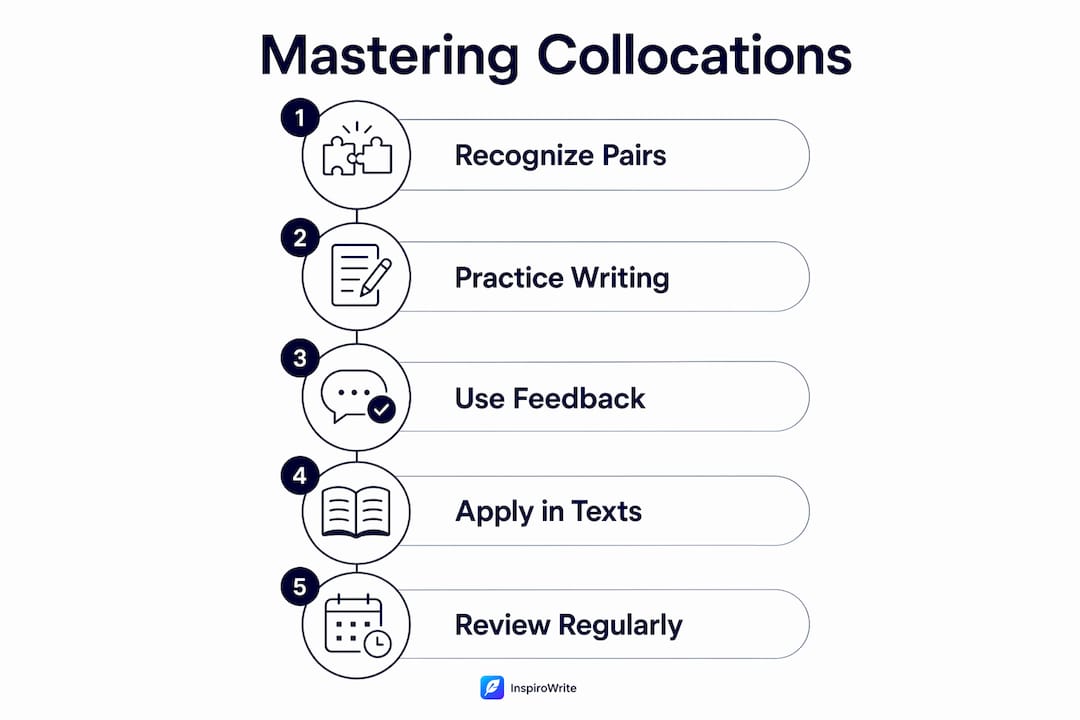
Collocational knowledge is not automatic from exposure alone. It requires explicit, targeted, corpus-informed instruction combined with strategy-based learning. Simply reading more English helps, but it is not sufficient for productive writing improvement.
The most effective strategies are:
- Build a collocation bank organised by function. Group combinations by what they do rhetorically. "Argue convincingly," "present compelling evidence," and "challenge the assumption" all serve argumentative functions. "Describe in detail," "outline the key features," and "illustrate with examples" serve descriptive functions. Organising by function rather than topic makes retrieval faster during writing.
- Practise form recall, not just recognition. Research on Vietnamese EFL learners found that academic collocation knowledge improves writing most when learners practise producing the full phrase from a prompt, not just recognising it in a multiple-choice test.
- Use corpus tools and AI writing aids. Tools like Grammarly flag unnatural combinations in real time. Corpus databases such as the British National Corpus show you how frequently a combination appears in real English text.
- Record collocations with their grammatical frame. Write "make + a + noun (decision, mistake, effort)" rather than just "make a decision." This frame helps you generate new correct combinations independently.
"Advanced L2 writers use collocational patterns to fulfil different rhetorical functions like argument, evaluation, and description." Corpus research on academic prose confirms that the most effective academic writers do not just know collocations. They deploy them strategically according to the purpose of each paragraph.
The gap between recognising a collocation and producing it under writing pressure is real. Productive retrieval practice closes that gap. Writing timed paragraphs where you deliberately use five target collocations trains the kind of automatic retrieval that fluent writing requires.
What role do collocations play in academic and exam writing?
Collocations in academic writing are not decorative. They are functional. Local grammar and collocational analysis shows that lexical items function differently depending on their predictable collocates. "Significant" collocates with "difference," "increase," and "impact" in academic prose. Using it with "problem" or "trouble" sounds informal and weakens the register.
For IELTS candidates, this matters directly. Collocation mastery distinguishes Band 7+ writing by improving the lexical resource score, one of the four marking criteria. Examiners reward writing that uses vocabulary precisely and naturally. Collocations are the mechanism that produces that precision.
The table below shows common academic collocations and their rhetorical functions:
| Collocation | Function | Example Use |
|---|---|---|
| Conduct research | Describing methodology | "The study conducted research into learner errors." |
| Draw a conclusion | Summarising findings | "We can draw a conclusion from the data." |
| Raise awareness | Arguing for action | "The report aims to raise awareness of the issue." |
| Provide evidence | Supporting a claim | "The results provide evidence for this theory." |
| Challenge the assumption | Critical evaluation | "This paper challenges the assumption that exposure is sufficient." |
Teaching collocations alongside academic vocabulary produces stronger results than teaching words in isolation. Research on EFL learners confirms that academic word and collocation knowledge are closely linked. Learning "significant" without also learning "significant difference" and "significant increase" leaves a productive gap that shows up in writing under exam conditions.
Students preparing for IELTS, TOEFL, or university-level writing should build a dedicated academic collocation list. Resources like the Academic Word List paired with collocation dictionaries give you the combinations most likely to appear in formal writing tasks. Understanding English writing conventions at this level is what separates competent writing from genuinely impressive writing.
Key takeaways
Mastering collocations is the single most direct route from grammatically correct English to genuinely fluent, natural writing that readers and examiners recognise as precise.
| Point | Details |
|---|---|
| Collocations define fluency | Natural word partnerships signal native-like writing more reliably than grammar accuracy alone. |
| Partner choice is not logical | Collocation errors come from incorrect word pairings, not grammar mistakes, requiring specific correction. |
| Explicit learning is necessary | Exposure alone does not build productive collocation knowledge; targeted practice is required. |
| Academic writing depends on them | Collocations fulfil rhetorical functions in essays and directly affect IELTS lexical resource scores. |
| Function-based banks aid retrieval | Organising collocations by argumentative, descriptive, or evaluative purpose speeds up writing production. |
Why collocation study changed how i think about writing quality
Most writers I have worked with over the years focus on vocabulary breadth. They learn more words, more synonyms, more sophisticated adjectives. The collocation problem sits underneath all of that, largely invisible, and it is the reason their writing still sounds slightly off even after years of study.
The shift that actually changes writing quality is moving from "what word means this?" to "what word goes with this?" Those are fundamentally different questions. The first is a dictionary question. The second is a collocation question, and it is the one that produces writing readers trust.
I have seen students with modest vocabulary ranges write more convincingly than students with extensive word lists, simply because the first group had developed reliable collocation habits. Their sentences landed cleanly. The second group's sentences were technically impressive but occasionally jarring, the way a well-dressed person wearing mismatched shoes catches your eye for the wrong reason.
The practical lesson is this: build your collocation bank before you expand your vocabulary list. Record phrases in context, organised by the writing task they serve. Practise producing them under time pressure. When you read academic texts, note the combinations, not just the words. This is slower than downloading a vocabulary app, but it is the work that actually transfers to better writing.
— Mike
How Inspirowrite helps you write with greater precision
Writing with correct, natural collocations is a skill that develops with practice and the right feedback. Inspirowrite gives you that feedback instantly. Its AI-powered proofreading tool flags unnatural word combinations, suggests precise alternatives, and helps you see where your writing sounds grammatically correct but collocationally off.
For students working on academic essays and writers producing professional content, Inspirowrite processes your text in seconds and keeps your content fully private. Your drafts are never used to train AI models. You can review Inspirowrite's full privacy and service details before you start. If you want writing that reads as fluent and precise rather than merely correct, Inspirowrite is the tool that closes that gap.
FAQ
What is a collocation in english grammar?
A collocation is a habitual word combination where specific words predictably appear together, such as "make a decision" or "heavy rain." These pairings are defined by convention rather than grammar rules.
Why are collocations important for writing?
Collocations improve the naturalness and precision of writing by replacing grammatically correct but unnatural phrases with combinations native speakers recognise immediately. Strong collocation usage is a key marker of writing fluency.
How do collocations affect IELTS writing scores?
Collocation mastery directly improves the lexical resource criterion in IELTS marking. Research confirms that Band 7+ writing is distinguished by precise, natural collocation use rather than simply a wide vocabulary range.
What are the most common collocation errors in english?
The most frequent errors involve verb-noun pairings such as "do a mistake" instead of "make a mistake," and preposition bindings such as "interested about" instead of "interested in." These errors arise from language transfer and incorrect partner substitution.
How can i learn collocations more effectively?
Build a function-based collocation bank, practise producing full phrases from memory under writing conditions, and use tools like Grammarly or the Oxford Collocations Dictionary to check and record natural combinations alongside their grammatical frames.