

TL;DR:
- English relies on fixed subject-verb-object order to convey clear meaning. Proper word placement is essential, as errors cause confusion and ambiguity.
Word order in English is defined as the fixed sequence in which words must appear in a sentence to convey grammatical roles and meaning. Unlike many languages that use word endings to signal who does what, English relies almost entirely on position. Move a word to the wrong place and the meaning collapses. Understanding what word order means in English is the single most important structural concept for learners to master, because English relies on word position rather than inflection to assign grammatical function. Get the order right, and your sentences are clear. Get it wrong, and even native speakers cannot follow you.
What is the basic word order structure in English sentences?
The standard structure of an English sentence is Subject + Verb + Object, commonly called SVO. This pattern is not a stylistic preference. It is the grammatical backbone of the language. SVO and SOV order together cover over 87% of the world's languages, and English sits firmly in the SVO category.
Consider these examples:
- "The dog bit the man." (Subject: the dog. Verb: bit. Object: the man.)
- "The man bit the dog." (Same words, reversed meaning.)
The words are identical. The order alone determines who is doing the biting. That is the power and the responsibility of word order in English.
Declarative, negative, and question sentences

Standard declarative sentences follow Subject + Verb + Object without exception. Negative sentences insert "not" or "never" after the auxiliary verb: "She does not like coffee." Questions invert the auxiliary verb and the subject: "Does she like coffee?" This inversion is not optional. It is a grammatical rule, and breaking it produces sentences that sound foreign or confusing.
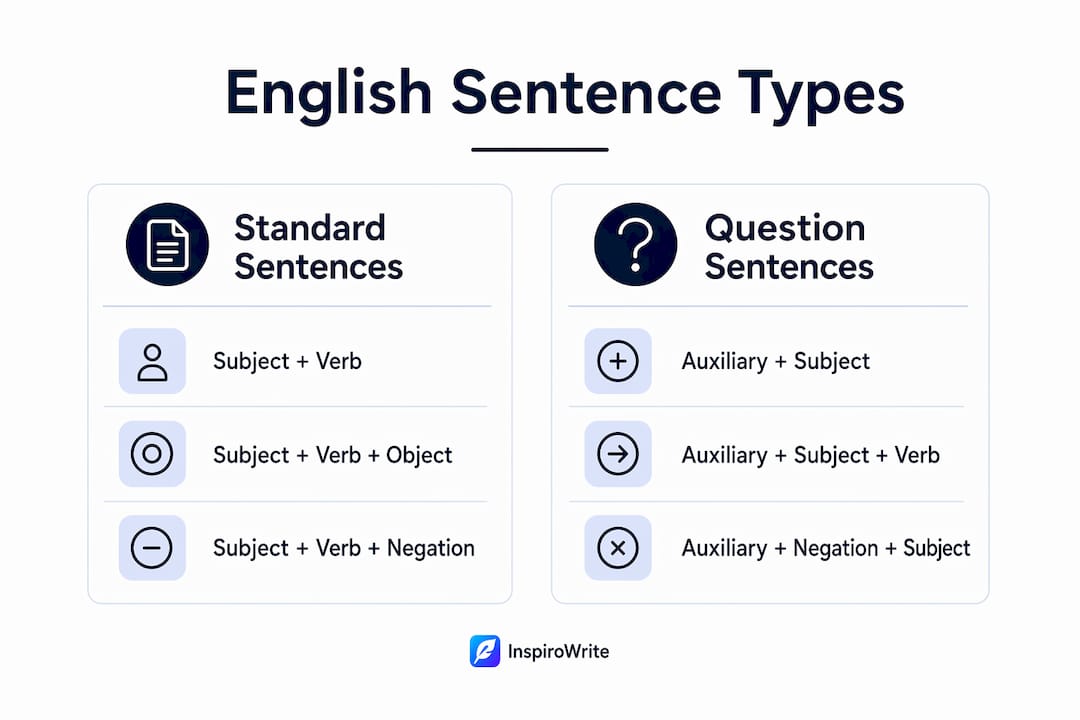
The verb is the anchor of every English sentence. Identify the verb first, and the subject and object fall into place around it. Learners who struggle with sentence structure almost always lose track of the verb.
Pro Tip: When you write a sentence, underline the verb first. Then ask: who is doing this action? That is your subject. What is the action being done to? That is your object. Build outward from the verb every time.
Why does English rely on word order more than other languages?
English is an analytic language, which means it uses very few inflectional endings to signal grammatical roles. This is the core reason word order is so rigid. In Latin, for example, the noun ending tells you whether a word is the subject or the object, so you can rearrange words freely without losing meaning. English lost most of those endings centuries ago, and position took over their job.
Compare these two sentences:
- English: "The cat chased the mouse." Change the order and you get "The mouse chased the cat." Completely different meaning.
- Latin: "Felis murem petit" and "Murem felis petit" mean the same thing, because the noun endings signal the roles regardless of position.
This is not a weakness in English. It is a trade-off. English gained simplicity in its word forms but became strict about sequence. Once learners accept this, the language becomes far more predictable.
How position prevents ambiguity
Incorrect word order is the leading cause of ambiguity in English sentences. When a learner writes "Yesterday went I to the market," a native speaker understands the words but feels the wrongness immediately. The sentence violates the SVO contract. English readers expect the subject before the verb in a declarative sentence, and any deviation triggers confusion.
| Sentence type | Correct order | Common learner error |
|---|---|---|
| Declarative | Subject + Verb + Object | Object placed before subject |
| Negative | Subject + Auxiliary + "not" + Verb | "not" placed after main verb |
| Question | Auxiliary + Subject + Verb | Subject placed before auxiliary |
| Emphasis | Fronted element + Auxiliary + Subject | Missing auxiliary inversion |
Pro Tip: If you speak a language with flexible word order, such as Russian, Turkish, or Japanese, resist the urge to translate sentence by sentence. Build the English sentence fresh, starting with the subject.
What are common variations and exceptions to standard word order?
English word order is rigid, but not completely inflexible. Several grammatical structures deliberately shift the standard sequence for emphasis, style, or grammatical necessity. Knowing these variations separates competent learners from advanced ones.
Word order variations such as inverted questions, locative inversion, and fronting each serve a specific purpose. They are not errors. They are deliberate tools.
- Question inversion: "Are you coming?" moves the auxiliary before the subject. This is mandatory in direct questions.
- Negative fronting: "Never have I seen such a thing." When a negative adverb opens the sentence, the auxiliary and subject invert. This structure adds dramatic weight.
- Locative inversion: "On the hill stood an old church." The location moves to the front, and the verb precedes the subject. This is common in literary writing.
- Passive voice: "The report was written by the team." The object of the action moves to the subject position. Writers use this to shift focus onto the action rather than the actor.
- Topicalisation: "That film, I absolutely loved." The object moves to the front for emphasis. This is informal but grammatically accepted in spoken English.
The critical rule with all these variations is that they require correct auxiliary placement. Marked word orders like locative inversion and negative fronting require auxiliary inversion or "do-support" to remain grammatical. Without the auxiliary in the right place, the sentence breaks down. "Never I have seen" is not a valid inversion. "Never have I seen" is.
Word order also manages focus and theme, allowing writers to highlight different parts of a sentence by shifting components intentionally. This is not rule-breaking. It is rhetoric.
How can learners effectively master English word order?
Mastering English sentence structure is a process of building reliable habits, not memorising a list of rules. The goal is to internalise the SVO pattern so deeply that it becomes automatic. Focusing on the verb to identify sentence structure is the single most effective technique for learners at every level.
- Learn sentence patterns, not just vocabulary. Study complete sentence frames such as "Subject + wants to + verb" or "Subject + has been + verb-ing." Vocabulary without structure produces word salad.
- Practise SVO with simple sentences first. Write ten sentences a day using only Subject + Verb + Object. "I eat breakfast. She reads books. They play football." Speed and accuracy come from repetition.
- Drill question formation separately. Questions require inversion, and this feels unnatural to many learners. Practise converting declarative sentences into questions: "She is tired" becomes "Is she tired?"
- Read English sentences aloud. Your ear catches word order errors faster than your eye. If a sentence sounds wrong when spoken, it probably is wrong.
- Avoid word-for-word translation. Native language interference causes the most common word order mistakes. Learners who translate directly from their mother tongue import the word order of that language into English. Build the English sentence from scratch instead.
- Study common word order mistakes in English to recognise patterns in your own writing before they become habits.
Syntax functions as a cognitive framework that organises words into meaning, not merely a set of rigid rules. Once learners shift their thinking from "rules to follow" to "a system to use," fluency follows far more quickly. English word order allows both grammatical accuracy and rhetorical sophistication through the strategic placement of sentence parts. That combination is worth the effort.
Key takeaways
English word order is the fixed SVO sequence that assigns grammatical roles and determines meaning, making correct placement the foundation of clear communication.
| Point | Details |
|---|---|
| SVO is the foundation | Every standard English sentence follows Subject + Verb + Object to assign grammatical roles. |
| Position replaces inflection | English uses word position, not word endings, to show who does what in a sentence. |
| Variations require auxiliary support | Inversions and fronting are valid but demand correct auxiliary placement to remain grammatical. |
| Verb identification is the key skill | Finding the verb first helps learners correctly place the subject and object around it. |
| Translation causes most errors | Learners who import native language word order into English produce the most common mistakes. |
Why I think most learners approach word order the wrong way
Most grammar courses teach word order as a list of rules to memorise. Subject first, then verb, then object. Do not put the adverb there. Move the auxiliary here. Learners dutifully copy the rules into notebooks and then freeze the moment they try to write a real sentence.
The problem is that rules without understanding produce anxiety, not fluency. What actually helped my students was a different framing entirely. I started asking them to think of the English sentence as a stage. The subject walks on first because the audience needs to know who the story is about. The verb enters next because it carries the action and the time. The object arrives last because it receives what the subject does. Once learners visualise the sentence as a sequence of events rather than a grid of grammar slots, the order starts to feel logical rather than arbitrary.
The other shift that made a real difference was getting learners to stop apologising for their native language. Your first language is not the enemy. It is simply a different system. Russian, Arabic, and Japanese all have their own internal logic. The task is not to forget that logic but to build a separate English system alongside it. Common ESL grammar mistakes almost always trace back to moments when a learner borrowed the architecture of their first language and applied it to English. Recognising that pattern is the first step to correcting it.
Patience matters more than most learners expect. Rigid English word order is actually an advantage once it is mastered, because it provides a stable, predictable framework. Every sentence you read in English reinforces the same pattern. That repetition is your teacher.
— Mike
Sharpen your English writing with Inspirowrite
Getting word order right in writing takes practice, and even experienced learners benefit from immediate, specific feedback on their sentences.

Inspirowrite is an AI-powered proofreading tool that checks your grammar and sentence structure in seconds, without storing your text or using it to train any AI model. For learners working on English grammar rules and sentence construction, that kind of fast, private feedback is genuinely useful. Visit Inspirowrite to see how it can support your writing practice and help you produce cleaner, clearer English from your very next draft.
FAQ
What does word order mean in English?
Word order in English refers to the fixed sequence of subject, verb, and object in a sentence. English uses this sequence to assign grammatical roles because it has very few inflectional word endings.
Why is word order so important in English?
Incorrect word order is the leading cause of ambiguity in English sentences. Because English does not use noun endings to signal grammatical roles, position alone determines who does what.
What is the correct word order for English questions?
English questions require the auxiliary verb to come before the subject, a structure called inversion. For example, "She is ready" becomes "Is she ready?" rather than "She is ready?"
Can word order change in English for emphasis?
Yes. Structures such as negative fronting ("Never have I seen...") and topicalisation ("That book, I loved") shift standard order for rhetorical effect. These variations require correct auxiliary placement to remain grammatical.
What is the most common word order mistake learners make?
The most common error is applying the word order of a learner's native language directly to English. Languages with flexible word order, such as Russian or Japanese, allow arrangements that English does not, and direct translation produces ungrammatical sentences.