

TL;DR:
- English prepositions are confusing because their meanings are idiomatic and depend on context, not rules.
- Native language interference often causes learners to omit, substitute, or insert incorrect prepositions.
Prepositions are defined as words that link nouns, pronouns, or phrases to other parts of a sentence, showing relationships of place, time, direction, and manner. Yet understanding English prepositions is notoriously hard because their usage does not follow consistent logical rules. Instead, it depends on idiomatic conventions, fixed collocations, and context that vary from one expression to the next. English has approximately 150 prepositions, but a core group of just 18 dominates everyday communication. That small group causes the most confusion, precisely because each one carries multiple meanings with no reliable pattern to guide learners.
Why prepositions are difficult in English: the core reasons
The central problem with English prepositions is polysemy. Polysemy means a single word carries several distinct meanings. The preposition "in," for example, can indicate physical location ("in the room"), a period of time ("in March"), a state ("in trouble"), or a manner ("in a hurry"). Each use follows a different logic, and none of them can be predicted from a single rule.
Prepositions do not follow logical rules but are idiomatic and must be learned through immersion and context-rich exposure. That finding matters because it shifts the learning strategy entirely. Memorising a definition of "on" will not tell you whether to say "on time" or "in time," or why you are "good at" something but "interested in" it.
Fixed collocations make this worse. A collocation is a word pair that English speakers use together by convention. You say "depend on," not "depend at" or "depend in." You say "married to," not "married with." These pairings cannot be guessed from the meaning of either word. They must be absorbed through repeated exposure to real English.
English prepositions split conceptual territory that is unified in many other languages. A single word in Spanish, French, or Arabic may cover what English splits across two or three prepositions. That mismatch is one of the deepest sources of confusion for non-native learners.
- "In" covers location inside an enclosed space, a period of time, and a state or condition.
- "At" marks a specific point in space or time ("at the door," "at noon").
- "On" indicates a surface, a day, or a medium ("on the table," "on Monday," "on the radio").
- "By" signals proximity, a deadline, a method, or an agent ("by the river," "by Friday," "by hand").
Pro Tip: When you learn a new verb or adjective, always record it with its preposition as a fixed chunk. Write "interested in," not just "interested." That habit builds accurate instincts faster than any rule.
How does first language interference cause prepositional errors?
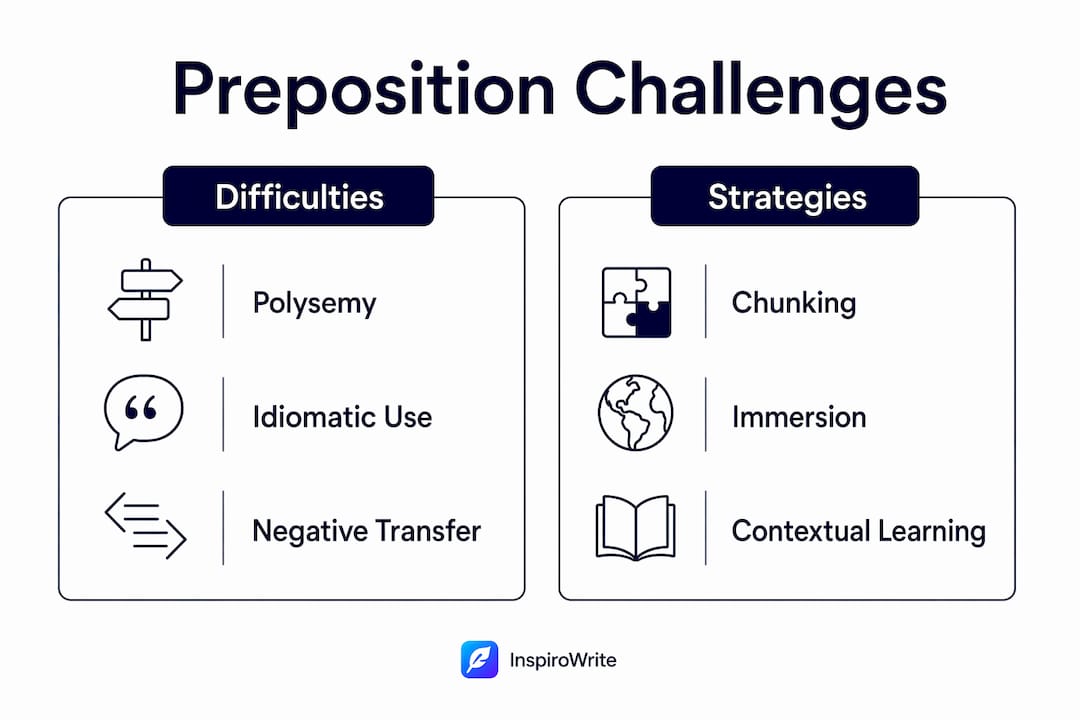
First language interference, known in linguistics as negative transfer, is the leading cause of persistent preposition errors among learners. A 2026 study of 40 university English learners showed that structural mismatches between a learner's native language and English produce three main error types: omission, substitution, and insertion.
Omission happens when a learner's native language does not require a preposition where English does. Substitution occurs when a learner applies the nearest native-language equivalent, which does not match the English convention. Insertion is the reverse: a learner adds a preposition where English uses none.
Arabic lacks direct equivalents for many English prepositions, so Arabic-speaking learners frequently substitute or omit them. A learner might write "I am interested to learn" instead of "interested in learning," because the Arabic equivalent uses a construction closer to "to." The error is logical from the learner's perspective, but wrong in English.
This pattern is not unique to Arabic speakers. Speakers of Romance languages often confuse "in" and "on" because their languages use a single preposition where English uses two. Speakers of East Asian languages, where prepositions function very differently or are replaced by postpositions, face a different but equally persistent challenge.
Contrastive teaching that highlights differences between a learner's native prepositions and English is the most effective method for reducing these errors. The approach works by making the mismatch visible rather than leaving learners to discover it through trial and error.
The four most productive steps for addressing L1 interference are:
- Identify which prepositions your native language handles differently from English.
- Make a personal list of the specific collocations where you consistently make errors.
- Practise those collocations in full sentences, not as isolated word pairs.
- Use a grammar checker to catch substitution and omission errors in your writing before they become habits.
Pro Tip: Keep a dedicated notebook section for "false friends" in prepositions. When you catch yourself translating directly from your native language, write down both the wrong version and the correct English form. Reviewing that list weekly accelerates correction.
Why are fixed prepositional phrases so hard to master?
Fixed prepositional phrases are a distinct learning barrier because they cannot be decoded through grammar rules. They are conventions, not logic. July 2026 expert analysis confirms that fixed pairings like "married to" versus "married with" are among the most frequent sources of unnatural usage in learner writing.
The difficulty is that many wrong versions sound plausible. "Married with" feels reasonable because "with" often signals accompaniment. "Bored of" sounds natural to many learners, yet standard British English uses "bored with." "Different to" is accepted in British English, while "different from" is also correct, but "different than" is typically American. These fine distinctions require exposure, not just rules.
Idiomatic prepositional usage must be learned through exposure and memorising fixed pairs, not through logical deduction. That means the most reliable learning method is reading and listening to large amounts of authentic English, noting which prepositions appear with which words.
Common fixed phrases where learners frequently make errors include:
- "Interested in" (not "interested on" or "interested at")
- "Responsible for" (not "responsible of")
- "Depend on" (not "depend in" or "depend of")
- "Arrive at" a specific place, but "arrive in" a city or country
- "Good at" a skill (not "good in" or "good on")
The role of collocations in fluency is well established. Learners who study collocations as fixed chunks, rather than trying to construct phrases word by word, produce more natural English and make fewer prepositional errors. Recent pedagogical approaches prioritise collocation learning from the earliest stages of instruction, rather than treating it as an advanced topic.
How does the unstressed nature of prepositions block natural acquisition?
Prepositions are nearly invisible in spoken English. In natural speech, they are unstressed, weakly pronounced, and often reduced to a schwa sound. A native speaker saying "I'll meet you at the station" compresses "at the" into a barely audible murmur. Prepositions are often missed in auditory input, which blocks learners from absorbing patterns even after extensive listening exposure.

This "auditory invisibility" has a direct effect on spoken fluency. Learners who cannot reliably hear prepositions in connected speech struggle to reproduce them accurately. They may understand the overall meaning of a sentence but miss the specific preposition, which means they never build an accurate mental model of which preposition belongs with which phrase.
Visualising prepositions as spatial relationships improves learner comprehension more than dictionary definitions. Mapping "at" as a point, "on" as a surface, and "in" as an enclosure gives learners a mental image to anchor each word. That image is easier to retrieve under pressure than an abstract definition.
Chunking is equally effective. Rather than listening for individual prepositions, learners benefit from training themselves to hear whole phrases as single units. "At the weekend," "in the morning," and "on time" are chunks, not collections of separate words. Treating them as units reduces the cognitive load of processing each element individually.
Pro Tip: When practising listening, pause audio at prepositional phrases and repeat them aloud as complete chunks. This trains your ear and your mouth simultaneously, which speeds up both comprehension and accurate speaking.
Key takeaways
English prepositions are difficult because their usage is idiomatic, polysemous, and shaped by fixed conventions that cannot be deduced from grammar rules alone.
| Point | Details |
|---|---|
| Polysemy drives confusion | A single preposition like "in" carries multiple unrelated meanings, none predictable from one rule. |
| L1 interference causes most errors | Native language structure produces omission, substitution, and insertion errors in English prepositions. |
| Fixed collocations must be memorised | Phrases like "interested in" and "depend on" cannot be guessed logically and require contextual learning. |
| Auditory invisibility slows acquisition | Unstressed prepositions are hard to hear in natural speech, blocking pattern absorption despite exposure. |
| Chunking and visualisation aid learning | Learning prepositional phrases as fixed chunks and mapping them to spatial images accelerates accuracy. |
The honest truth about learning prepositions
I have worked with non-native English writers for years, and prepositions are the one area where even advanced learners trip up. The frustrating part is that the errors are often invisible to the writer. You write "interested to" instead of "interested in" and it looks perfectly fine to you, because in your native language it is perfectly fine.
The conventional advice is to study grammar rules. I think that advice is mostly wrong for prepositions. Rules help with some spatial uses of "in," "on," and "at," but they collapse the moment you hit a collocation. No rule tells you to say "arrive at the station" but "arrive in London." That distinction is purely conventional, and the only way to absorb it is through language transfer awareness combined with massive exposure to real English text.
What actually works is learning phrases, not words. Every time you encounter a verb, adjective, or noun in English, note the preposition that follows it. Build a personal collocation list and review it regularly. Read authentic English texts, not simplified learner materials, because simplified texts often avoid the very collocations you need to learn.
The other thing I would say is: do not wait until your writing feels natural to start producing it. Write, get feedback, and correct. Errors caught early become correct habits faster than errors left to fossilise. The learners I have seen make the fastest progress are the ones who treat every correction as data, not as failure.
— Mike
Sharpen your English grammar with Inspirowrite
Preposition errors are among the hardest mistakes to catch on your own, because they often look correct even when they are wrong.
Inspirowrite's AI-powered proofreading tool identifies prepositional errors in seconds, flags incorrect collocations, and suggests the correct fixed phrase in context. It processes your text without storing or using it to train AI models, so your writing stays private. Whether you are a student submitting an essay or a professional writing in English as a second language, Inspirowrite gives you immediate, accurate feedback. Visit Inspirowrite to check your writing and catch the prepositional mistakes that grammar rules alone will never reveal.
FAQ
Why are English prepositions so confusing for learners?
English prepositions are confusing because most of their usage is idiomatic rather than rule-based. A single preposition can carry multiple unrelated meanings, and the correct choice in a fixed phrase must be memorised rather than deduced.
What are the most common preposition mistakes in English?
The most common preposition mistakes include substitution errors such as "interested to" instead of "interested in," omission errors where a required preposition is dropped, and insertion errors where a preposition is added where English uses none.
How does my native language affect my use of English prepositions?
Your native language creates negative transfer when its prepositional structure does not match English. A 2026 study found that Arabic-speaking learners produced systematic substitution and omission errors because Arabic lacks direct equivalents for many English prepositions.
What is the best way to learn English prepositional phrases?
The best method is to learn collocations as chunks, not individual words. Record each new verb or adjective together with its preposition, and practise the full phrase in sentences rather than studying the preposition in isolation.
Why do I miss prepositions when listening to English?
Prepositions are unstressed in natural speech and are often reduced to a weak schwa sound. This makes them nearly inaudible in connected speech, which prevents learners from building accurate listening patterns even after extended exposure to English audio.