

TL;DR:
- Business jargon translation is challenging due to specialized terms, metaphors, cultural differences, and industry-specific vocabulary that can lead to misunderstandings and disputes. Effective solutions include building controlled glossaries, employing cultural adaptation, and using human-reviewed AI tools to ensure clarity and consistency across markets. Proper management and measurement of translation impact are essential for reducing risks and improving cross-border communication.
Business jargon translation challenges arise when specialised corporate terms carry layered meanings that shift across languages, industries, and cultures, making word-for-word translation not just ineffective but actively misleading. 75% of cross-border business teams report significant communication problems rooted in language and jargon differences. That figure represents real projects stalled, contracts disputed, and deals lost. For team leaders managing multilingual operations, the professional term for this discipline is terminology management, and mastering it alongside cultural adaptation is the difference between a global team that functions and one that fragments.
1. What makes business jargon difficult to translate accurately?

Business jargon is difficult to translate because specialised terms carry contextual meaning that rarely maps cleanly onto another language. Words like "stakeholder," "ownership," and "leverage" have primary meanings in many languages that differ sharply from their corporate usage. Literal translation of these terms confuses readers far more than a fuller explanation would. A translator who renders "ownership" into French as propriété (property) has technically translated the word but destroyed the intended meaning entirely.
Three core factors compound these business language barriers:
- Metaphorical language. Corporate English is saturated with metaphors. "Move the needle," "boil the ocean," and "low-hanging fruit" have no logical equivalents in German, Japanese, or Arabic. Translators must decide whether to find a cultural analogue or explain the concept directly.
- Hierarchical and tonal expectations. High-context cultures such as Japan and South Korea embed meaning in tone, formality, and implication. Low-context cultures such as the United States and Germany expect explicit, direct statements. The same translated sentence can read as rude in one market and vague in another.
- Industry-specific vocabulary. Legal, financial, and technology sectors each carry dense terminology with precise definitions. A term like "indemnification" or "SaaS" requires not just translation but explanation for audiences unfamiliar with the sector.
Pro Tip: When briefing a translator, always provide a glossary of your ten most-used internal terms with their intended meaning in plain language. This single step eliminates the majority of jargon interpretation issues before they occur.
2. Build a controlled glossary before you translate anything
A controlled glossary is a curated list of approved terms, their definitions, and their verified translations across target languages. Static spreadsheets fail at this task; terminology management systems integrated directly into translation environments enforce consistent usage in real time. Tools such as SDL MultiTerm, memoQ, and Phrase TMS allow teams to flag unapproved terms mid-translation and prompt the translator to use the agreed equivalent.
The practical steps for building a working termbase are straightforward:
- Audit your most-used documents and extract recurring technical terms.
- Assign a subject-matter expert to define each term in plain language.
- Commission verified translations for each target language from a qualified linguist.
- Import the termbase into your chosen computer-assisted translation (CAT) tool.
- Schedule quarterly reviews to add new terms and retire obsolete ones.
Unmanaged jargon contributes directly to legal and arbitration failures in international commerce due to ambiguous contract terms. A controlled glossary is not a nice-to-have for legal and procurement teams. It is a contractual risk-management tool.
Pro Tip: Use back-translation as a quality check. After translating a document, have a second linguist translate it back into the source language without seeing the original. Discrepancies reveal where meaning has drifted.
3. Use bilingual proofreading to catch what machines miss
Bilingual proofreading is the process of reviewing a translated document against its source text to verify accuracy, tone, and terminology consistency. It is distinct from monolingual proofreading, which only checks the target-language text for grammar and style. For a detailed breakdown of the process, the bilingual proofreading guide from Inspirowrite covers the methodology clearly.
The value of bilingual proofreading is highest in documents where precision is non-negotiable: contracts, regulatory filings, technical specifications, and financial reports. A single mistranslated clause in a supplier agreement can invalidate the entire document under local law. Bilingual proofreaders also catch register errors, where a technically correct translation uses a tone that is too casual or too formal for the intended audience.
4. Apply cultural adaptation, not just linguistic translation
Cultural adaptation means adjusting the argument, tone, and framing of a message to match the expectations of a specific market, not merely converting words from one language to another. B2B marketing success requires transcreation that adapts argument hierarchies and cultural cues. One documented case showed a French market improving click-through rates by 45% after transcreation recalibrated the messaging to local cultural expectations. That is the gap between translation and adaptation.
The differences across markets are substantial:
- European markets (particularly Germany and the Netherlands) respond to data-led, direct arguments. Emotional appeals without evidence are treated with scepticism.
- Asian markets (particularly Japan and China) prioritise relationship signals, brand credibility, and long-term commitment over short-term value propositions.
- Latin American markets tend to favour warmer, relationship-oriented language and are sensitive to formality levels that can read as cold or dismissive.
Intelligibility alone is insufficient; business translation must convey local ecosystem trust signals to convert international buyers. A message that is grammatically correct but culturally tone-deaf will underperform against a competitor whose communication feels native. Transcreation services, which blend copywriting with cultural insight, are the appropriate solution for marketing and sales content.
5. Address the silent hierarchy problem in multilingual teams
Language gaps in global teams form silent communication hierarchies that disadvantage non-native speakers and reduce innovation. Fluent speakers dominate meetings, set the agenda, and receive more credit for ideas, not because their ideas are better but because they can articulate them faster. This is one of the most underreported challenges in business translation: the problem is not always the document. It is the meeting, the Slack thread, and the offhand comment that non-native speakers cannot parse in real time.
Team leaders can address this directly. Circulating meeting agendas and key terminology in advance gives non-native speakers time to prepare. Rotating facilitation duties reduces the dominance of any single linguistic style. Encouraging written summaries after verbal discussions creates a record that all team members can review and respond to at their own pace. These are not accommodation measures. They are productivity measures that protect the quality of decision-making.
6. Understand the limits of AI translation tools
AI-powered neural machine translation has improved dramatically. Tools such as DeepL, Google Translate, and Microsoft Translator now handle standard business prose with reasonable accuracy. New AI translation tools include cultural context, yet relying on them alone overlooks relational signals and fails at nuanced meaning. The limitation is not vocabulary. It is judgement.
AI tools cannot determine whether a phrase is ironic, whether a term carries a negative connotation in a specific regional dialect, or whether the formality level is appropriate for a C-suite audience in Seoul versus one in São Paulo. They also cannot flag when a client's preferred terminology differs from the industry standard. For internal communications and first-draft efficiency, AI translation is a genuine time-saver. For client-facing documents, contracts, and marketing content, it is a starting point that requires human review.
Pro Tip: Treat AI translation output as a first draft, not a final product. Build a review step into your workflow for any document that will be seen by an external audience.
7. Invest in role-based language training for your team
Different roles require tailored language standards: project managers typically need CEFR B1 to B2 proficiency, while operational staff may function effectively at A2 to B1. Setting blanket language requirements across an entire organisation wastes training budget and demoralises staff who are already performing well. Role-based language programmes target the specific vocabulary, registers, and communication scenarios each function actually encounters.
A legal team needs precision in contractual terminology. A sales team needs fluency in persuasive, culturally adapted dialogue. An operations team needs clarity in process documentation. Platforms such as Busuu for Business, Rosetta Stone for Enterprise, and Learnship allow organisations to build customised learning paths by role and language pair. Blended learning models, combining self-paced digital modules with live coaching sessions, consistently outperform either approach used alone.
8. Measure the business impact of better translation
Multilingual teams that address communication barriers experience a 30% increase in project efficiency and 25% fewer delays. Those numbers translate directly into cost savings, faster time-to-market, and reduced rework. The business case for investing in terminology management, cultural adaptation, and language training is not soft. It is quantifiable.
Tracking the right metrics makes the investment visible to leadership. Monitor the number of translation revision cycles per document, the frequency of jargon-related queries from international partners, and the time from document submission to sign-off across different language markets. A reduction in any of these metrics signals that your translation strategy is working. For a structured view of the document types that require the most attention, the multilingual business documents guide from Inspirowrite provides a practical framework for 2026.
Also worth tracking: employee replacement costs due to language marginalisation range from 50% to 200% of annual salary. Retaining non-native speaking talent through better communication infrastructure is a direct cost-avoidance measure that rarely appears in translation ROI calculations but absolutely should.
Key takeaways
Effective management of business jargon translation challenges requires integrating controlled terminology, cultural adaptation, and human-reviewed technology to protect communication quality across every market.
| Point | Details |
|---|---|
| Controlled glossaries prevent ambiguity | Integrate termbases into CAT tools to enforce approved terminology and reduce costly errors. |
| Cultural adaptation outperforms literal translation | Transcreation improves conversion and engagement by aligning messages with local expectations. |
| AI tools require human oversight | Use neural machine translation for drafts, then apply bilingual proofreading for client-facing content. |
| Role-based training maximises ROI | Tailor language proficiency targets by function to avoid wasted budget and improve outcomes. |
| Measure translation impact in business terms | Track revision cycles, sign-off times, and delay frequency to quantify the value of your strategy. |
Why most businesses are solving this problem backwards
I have reviewed translation workflows for organisations across financial services, technology, and professional services, and the pattern is remarkably consistent. Teams invest in translation tools first and terminology strategy last. They buy a CAT tool, subscribe to DeepL, and then wonder why their translated contracts still generate disputes and their marketing copy still underperforms in European markets.
The sequence matters. You cannot automate your way to accurate translation if you have not first defined what your terms mean. A neural machine translation engine fed ambiguous source text will produce ambiguous translated text at speed. That is not progress.
The organisations that get this right treat terminology management as infrastructure, not administration. They assign ownership of the glossary to a specific role, build review cycles into their content calendar, and train translators and internal reviewers together so that both groups share the same reference points. Cultural adaptation is treated as a distinct service from translation, not an optional upgrade.
The technology is genuinely useful. But it is a multiplier. If the underlying terminology strategy is weak, the technology multiplies the weakness. Get the foundations right first, and the tools become genuinely powerful.
— Mike
How Inspirowrite supports clearer business translation
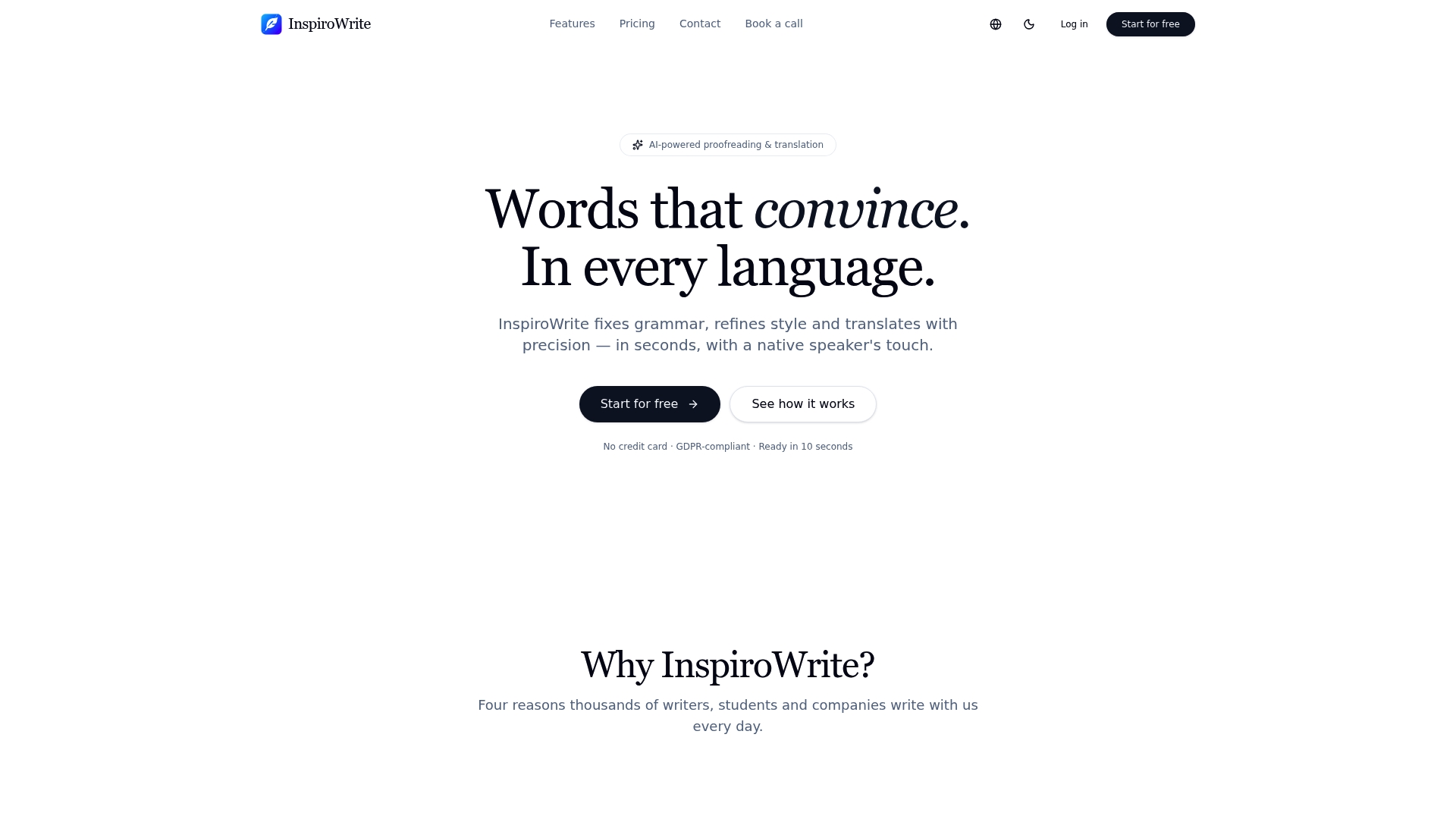
Managing translation accuracy across multilingual documents is significantly easier when your source text is already clear, consistent, and free of ambiguous phrasing. Inspirowrite's AI-powered proofreading and translation tool gives business professionals instant feedback on grammar, style, and terminology, processing documents in seconds while keeping all content fully private. Unlike tools that use your text to train their models, Inspirowrite guarantees confidentiality, which matters when you are working with contracts, proposals, or sensitive internal communications. If your team is producing multilingual business documents and needs a fast, private, and accurate review layer, Inspirowrite is worth adding to your workflow.
FAQ
What are the main business jargon translation challenges?
The main challenges include specialised terms with no direct equivalents, metaphorical language that loses meaning in translation, and cultural differences in communication style that affect tone and formality. These issues cause misunderstanding, project delays, and in legal contexts, contractual disputes.
How does cultural adaptation differ from translation?
Translation converts words from one language to another; cultural adaptation adjusts the argument, tone, and framing to match the expectations of a specific market. Transcreation, which blends copywriting with cultural insight, is the standard approach for marketing and sales content.
When should businesses use bilingual proofreading?
Bilingual proofreading is most critical for contracts, regulatory documents, financial reports, and any client-facing content where a terminology or register error could cause legal or reputational damage. It verifies accuracy against the source text, not just internal consistency in the target language.
Do AI translation tools solve jargon interpretation issues?
AI tools handle standard business prose well but cannot reliably manage irony, regional connotations, or audience-specific formality. They are effective as first-draft tools when combined with human review, but should not be used as the sole translation method for external or legally binding documents.
How do you measure the ROI of a translation strategy?
Track revision cycles per document, time from submission to sign-off across language markets, and the frequency of jargon-related queries from international partners. Multilingual teams that address language barriers report a 30% increase in project efficiency and 25% fewer delays, providing a measurable baseline for comparison.