

TL;DR:
- A phased essay proofreading checklist systematically guides writers through content, grammar, style, and formatting checks to improve accuracy and clarity. Prioritizing structural fixes before grammar and using manual techniques like reading aloud and printing enhances error detection, especially under tight deadlines. Automated tools are helpful but require human oversight, particularly for citation verification and nuanced stylistic issues.
An essay proofreading checklist is a structured, phased guide that helps students and writers catch errors, sharpen clarity, and produce writing that meets academic standards. Most writers treat proofreading as a single read-through, but structured phased checklists increase efficiency and writing quality compared to unstructured reviews. Tools like Grammarly and Hemingway Editor handle surface-level catches, yet manual verification remains non-negotiable. AI tools hallucinate citations at approximately 47%, meaning a 10-source essay can require up to 45 minutes of manual citation checking alone. University writing centres at Waterloo, Hull, and Reading all endorse a phased approach for exactly this reason.
1. Why follow a phased essay proofreading checklist?
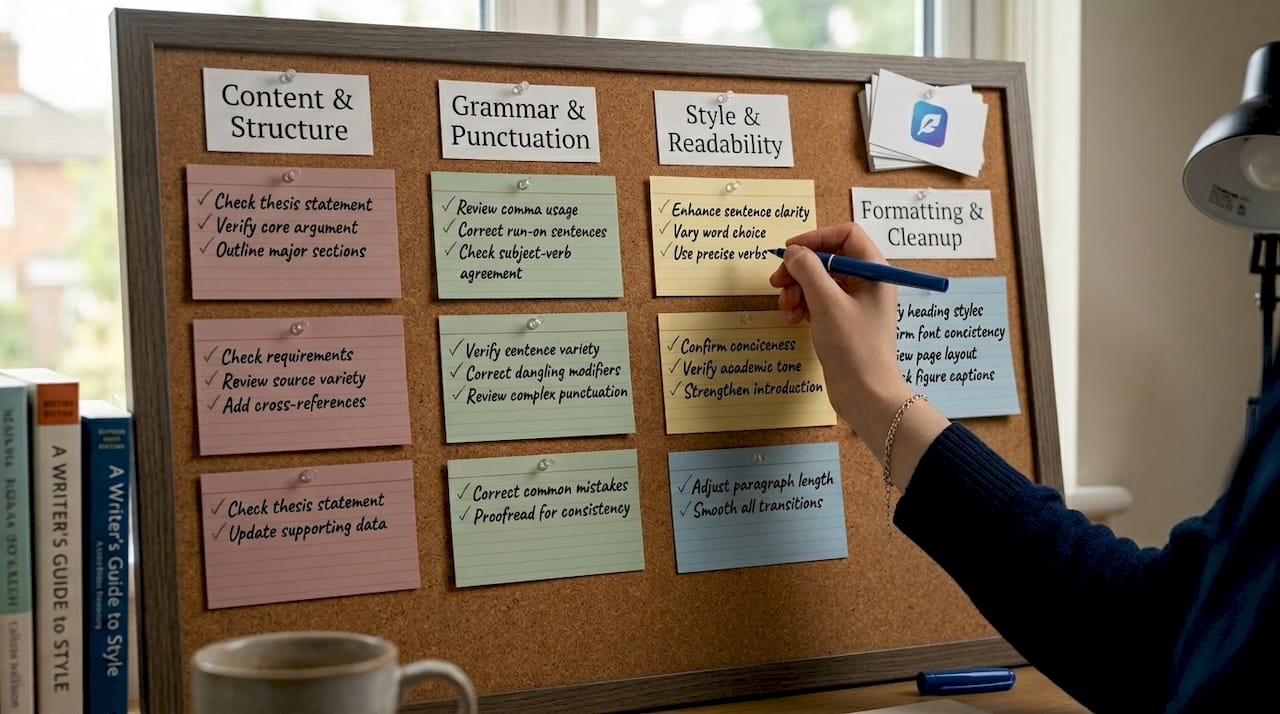
Revision and proofreading are distinct tasks, and they must happen in sequence to avoid wasted effort. Revision addresses global concerns such as argument strength, paragraph flow, and logical structure. Proofreading targets sentence-level correctness and only becomes productive once the structure is sound.
The four phases of an effective essay editing checklist are content and structure, grammar and punctuation, style and readability, and formatting and cleanup. Each phase has a specific focus, and mixing them produces confusion. Attempting to fix comma placement in a paragraph you later delete is a textbook example of wasted effort.
Fixing structural issues first before moving to grammar checks is the single most important sequencing rule. Once you confirm that every paragraph serves the essay's argument, grammar errors become the only remaining target. This prevents reintroducing errors into sections you have already corrected.
Pro Tip: Allocate roughly 40% of your proofreading time to content and structure, 30% to grammar, 20% to style, and 10% to formatting. This weighting reflects where the most consequential errors tend to hide.
The phases work as follows:
- Content and structure: Confirm your thesis is clear, paragraphs have topic sentences, and transitions connect ideas logically.
- Grammar and punctuation: Check subject-verb agreement, apostrophes, comma splices, and run-on sentences.
- Style and readability: Vary sentence length, remove clichés, and check your readability score using Hemingway Editor.
- Formatting and cleanup: Fix heading capitalisation, remove extra spaces, and delete any stray HTML tags.
2. Top 5 critical steps when proofreading under time pressure
When a deadline is close, prioritising five key steps captures the most consequential errors without requiring a full multi-pass review. These five areas account for the majority of marks lost in academic essays.
-
Intro and conclusion alignment. Read your introduction and conclusion back to back. They should reflect the same argument and not contradict each other. Misalignment here signals a structural problem that no grammar fix can resolve.
-
Apostrophe check. Use your word processor's Find function to locate every apostrophe in the document. Verify each one is used for possession or contraction, not for plurals. Apostrophe misuse is one of the most common grammatical pitfalls that damages credibility.
-
Passive voice removal. Search for "was," "were," and "been" to locate passive constructions. Replace them with active voice where the sentence allows. Active voice tightens prose and makes arguments feel more direct and confident.
-
Word count and readability check. Paste your essay into Hemingway Editor or use your word processor's built-in statistics. Aim for a readability grade appropriate to your audience. Sentences flagged as "very hard to read" should be split or rewritten.
-
Extra spaces removal. Use Find and Replace to search for double spaces and replace them with single spaces throughout the document. Formatting errors are frequent culprits in careless presentation and take seconds to fix.
Pro Tip: Run a manual apostrophe check even if you use Grammarly. Automated tools regularly miss contextual apostrophe errors, particularly in contractions like "its" versus "it's."
3. How to proofread an essay: techniques beyond automated tools
Automated AI and spell-checkers often miss structural errors and generate false positives and negatives with surprising regularity. Relying on them alone produces a false sense of security. Manual techniques remain the most reliable method for catching what software overlooks.
Reading aloud
Reading your essay aloud forces the ear to detect poorly constructed or punctuated sentences that eyes tend to skip. The University of Hull recommends this technique specifically because it engages different cognitive pathways than silent reading. When a sentence sounds awkward spoken, it almost always reads awkwardly too.
Reading backwards
Reading your essay backward, sentence by sentence, is effective for isolating mechanical errors by disrupting narrative flow. When you cannot follow the story, your brain stops filling in gaps and starts noticing what is actually on the page. This technique is particularly useful for catching repeated words, missing punctuation, and sentence fragments.
Proofreading from a printed copy
Reviewing from a printed copy activates different cognitive processes, reducing the oversight that screen reading produces. The University of Waterloo notes that paper reading uncovers spacing and layout errors that screens routinely hide. Print your essay, use a ruler to read one line at a time, and mark errors with a pen before transferring corrections digitally.
"Computers are mindless machines; they underline errors where none exist and miss blatant ones with equal confidence." — University of Hull Writing Centre
This is why the real role of proofreading in writing quality extends well beyond running a spell-check. Human judgement catches what algorithms cannot model.
4. Detailed phased checklist: what to check at each stage
Proofreading several times, with each pass targeting a different error type, improves thoroughness far more than a single comprehensive read. The following checklist breaks each phase into specific, verifiable items.
Phase 1: Content and structure
- Does your opening sentence state the essay's main argument directly?
- Does each paragraph contain a clear topic sentence?
- Do transitions between paragraphs signal logical progression rather than just sequence?
- Does your conclusion restate the thesis without introducing new claims?
- Are all sources cited in the text and listed in the bibliography?
Phase 2: Grammar and punctuation
Common errors at this stage include subject-verb agreement failures, comma splices, apostrophe misuse, run-on sentences, passive voice, and tense inconsistency. These high-frequency errors damage credibility and clarity and demand targeted, deliberate checks rather than a general read.
- Check every verb agrees with its subject, particularly in long sentences where the subject and verb are separated.
- Identify comma splices by looking for two independent clauses joined only by a comma. Replace with a full stop or a conjunction.
- Verify apostrophes are used correctly in every instance.
- Scan for passive constructions and rewrite where active voice strengthens the sentence.
- Confirm tense is consistent throughout each paragraph and across the essay.
For a deeper reference on recurring mistakes, the guide on common grammatical errors covers the most frequent issues writers encounter during this phase.
Phase 3: Style and readability
| Style check | What to look for |
|---|---|
| Sentence length variety | Mix short and long sentences; avoid five consecutive sentences of similar length |
| Clichés and overused phrases | Replace "in today's society" and similar filler with specific claims |
| Readability score | Target grade 10 to 12 using Hemingway Editor or a comparable tool |
| Adverb and adjective overuse | Remove modifiers that do not add meaning; "very unique" becomes "unique" |
| Repetition | Search for words used more than three times per page and vary vocabulary |
Phase 4: Formatting and cleanup
Formatting errors are overlooked without dedicated checks and are among the easiest to fix once you look for them specifically. Use Find and Replace to remove double spaces. Check that all headings follow consistent capitalisation. Confirm line spacing matches your institution's requirements. Remove any stray HTML tags if you have copied text from a web source. Verify page numbers, margins, and font size are uniform throughout.
Understanding English writing conventions at a deeper level makes this phase faster, because you recognise formatting standards rather than guessing at them.
Key takeaways
A phased essay proofreading checklist, covering content, grammar, style, and formatting in sequence, is the most reliable method for producing accurate, polished academic writing.
| Point | Details |
|---|---|
| Phase sequence matters | Fix structure before grammar to avoid correcting text you later delete. |
| Manual techniques are irreplaceable | Reading aloud and printing your draft catches errors that Grammarly and spell-checkers miss. |
| AI citations require verification | AI tools hallucinate citations at roughly 47%, making manual source checks non-negotiable. |
| Time-pressured checks | Under deadlines, prioritise intro and conclusion alignment, apostrophes, passive voice, readability, and extra spaces. |
| Formatting is a dedicated phase | Heading capitalisation, double spaces, and stray tags need a separate pass, not an afterthought. |
Why I think most writers proofread in the wrong order
After years of working with student essays and published drafts, the single most consistent mistake I see is writers proofreading too early and in the wrong sequence. They fix a comma on page three, then restructure the paragraph on page three, and introduce two new errors in the process. The comma fix was wasted effort.
The phased approach feels slower at first. It is not. Spending 20 minutes confirming your argument structure before touching a single grammar point saves you from correcting text that will not survive the next revision. I have seen writers spend an hour perfecting the prose of a paragraph they ultimately cut entirely.
My other strong conviction is that printed proofreading is underrated in 2026. Screens encourage scanning. Paper forces reading. The difference in error detection is not marginal. I recommend printing at least your introduction, conclusion, and any paragraph you are uncertain about, even if you review the rest on screen.
Finally, treat AI tools as a first pass, not a final authority. They are genuinely useful for catching obvious errors quickly. But AI tools require human oversight especially for citation accuracy and stylistic voice. A tool that hallucinates nearly half its citations is not a proofreader. It is a starting point.
— Mike
Polish your essays faster with Inspirowrite
Inspirowrite is built for exactly the moment when you have finished your draft and need fast, reliable feedback without sending your work to a third party.
Inspirowrite's AI-powered proofreading delivers grammar, style, and readability suggestions within seconds, and your content is never used to train AI models. That privacy commitment matters when your essay contains original research or unpublished arguments. For students and writers who need a polished final product quickly, Inspirowrite complements every phase of the checklist above. Review Inspirowrite's data handling practices before you start, and try the proofreading tool on your next draft.
FAQ
What is an essay proofreading checklist?
An essay proofreading checklist is a structured, phased guide covering content, grammar, style, and formatting checks. It helps writers catch errors systematically rather than relying on a single unstructured read-through.
How many times should you proofread an essay?
Proofreading several times, with each pass targeting a different error type, produces more thorough results than one comprehensive review. The University of Hull recommends multiple focused passes covering paragraph structure, spelling, punctuation, and repetition separately.
Can Grammarly replace manual proofreading?
Grammarly is useful for catching surface-level errors but cannot replace manual review. Automated tools regularly miss structural errors and produce false positives, and AI tools hallucinate citations at approximately 47%, making human verification non-negotiable.
What should you check first when proofreading an essay?
Content and structure should be checked first. Confirming your thesis, paragraph flow, and transitions before addressing grammar prevents you from correcting text that may later be restructured or deleted.
How do you proofread an essay under a tight deadline?
Under time pressure, prioritise five areas: intro and conclusion alignment, apostrophe accuracy, passive voice removal, readability score, and extra spaces. These five checks capture the most consequential errors in the shortest time.