

TL;DR:
- Mistranslated business phrases can cause significant legal, financial, and reputational damage across international markets. Proper translation involves cultural awareness, expert input, and rigorous quality assurance processes to prevent costly errors. Treating translation as a strategic business function is essential to protect outcomes and capitalize on global opportunities.
Mistranslated business phrases are a documented cause of contract disputes, reputational damage, and lost revenue in international commerce. The professional term for this problem is translation failure, defined as the breakdown of meaning transfer between languages rather than a simple grammatical slip. Whether you are negotiating a cross-border contract or launching a product in a new market, literal translation errors consistently produce outcomes that range from embarrassing to financially catastrophic. This article presents real-world examples of mistranslated business phrases across legal, marketing, and operational contexts, so you can recognise the risks before they cost you.
1. Examples of mistranslated business phrases that caused real damage
The most instructive way to understand business translation errors is through cases where the consequences were concrete and measurable. These are not hypothetical scenarios. They are documented failures from global companies and legal proceedings.
Honda's "Fitta" in Nordic markets. Honda launched a compact car under the name "Fitta" in Scandinavia, unaware that the word carries a vulgar meaning in Swedish, Norwegian, and Danish. The model was renamed to "Jazz" to avoid further reputational embarrassment. The cost was not just the rebrand. It was the erosion of consumer trust at the precise moment Honda needed to establish credibility in those markets.

IKEA's "Fartfull" workbench. IKEA's product naming convention, which uses Swedish words, produced the "Fartfull" children's workbench. In Swedish, fart means speed. In English-speaking markets, the name generated ridicule rather than sales. This is a textbook example of business phrases lost in translation when a company fails to audit names across target languages before launch.
HSBC's "Assume Nothing" campaign. HSBC's private banking slogan "Assume Nothing" was mistranslated in several markets as "Do Nothing." The bank spent an estimated $10 million rebranding the campaign after the error undermined its core message of proactive wealth management.
Amazon Sweden's machine translation disaster. When Amazon launched its Swedish marketplace, machine translation errors produced product listings that ranged from nonsensical to obscene. The word "rooster" was translated to a vulgar Swedish term, appearing across multiple product categories. The incident illustrated that automated translation without human review is not a cost-saving measure. It is a liability.
Pro Tip: Before any international product launch, run all brand names, slogans, and product descriptors through native speakers in each target market. A single overlooked term can undo months of marketing preparation.
2. How cultural nuances turn translation blunders into brand crises
Cultural context is the layer beneath language that most translation processes ignore. A phrase that is neutral in one culture can be offensive, absurd, or simply meaningless in another. This is where common mistranslations in business escalate from awkward to damaging.
Ignoring cultural differences in translation leads directly to ineffective or offensive messaging. The mechanism is straightforward: a translator renders words accurately but strips out the cultural assumptions that give those words their intended meaning.
Orange's Northern Ireland campaign is a striking example. The telecoms brand ran the slogan "The future's bright, the future's Orange" in Northern Ireland, where "Orange" carries strong associations with Loyalist politics and sectarian identity. The campaign was not a translation failure in the linguistic sense. It was a localisation failure, which is the broader category of error that includes cultural misreading. The result was public outcry and a forced withdrawal of the campaign.
Consider also how idiomatic business phrases travel poorly. The English phrase "we'll table this discussion" means to postpone it in British English but to bring it forward for immediate discussion in American English. When this phrase appears in a contract or meeting minutes translated into a third language, the ambiguity compounds. The translated version may commit one party to action while the other believes the matter is deferred.
Pro Tip: Localisation is not the same as translation. Hire localisation specialists who understand the cultural, political, and social context of your target market, not just its grammar.
3. Why legal and contract translations carry the highest financial risk
Legal documents are where misinterpreted business terms produce the most severe consequences. A single word change can shift a binding obligation to an optional one, or transfer liability from one party to another.
The distinction between "shall" and "may" is the clearest illustration. "Shall" denotes a mandatory obligation. "May" denotes a discretionary one. When a translator conflates these modal verbs, the entire enforceability of a clause changes. A Japanese company faced a $71 million lawsuit after a mistranslation of this type shifted liability in a supply contract. A pharmaceutical firm lost €2.3 million in arbitration because a single term was rendered inconsistently across the translated agreement.
The Western Bagel case demonstrates a different dimension of the same problem. A bilingual arbitration agreement contained conflicting language between its English and Spanish versions. Rather than resolving the underlying dispute, the parties spent years litigating which version of the agreement was enforceable. The translation error did not just cost money. It consumed the time and goodwill that the arbitration clause was designed to protect.
In shipping law, a Chinese contract used the term "drydocking" in its English version. The translated Chinese version rendered this as "tank washing", a fundamentally different maintenance obligation. The Shanghai Maritime Court had to adjudicate which party bore the cost difference. The dispute arose entirely from a translation choice, not from any disagreement about the underlying commercial intent.
Legal translation errors rarely surface at the time of signing. They emerge during enforcement, often years later, when the stakes are highest and the options for correction are fewest.
| Risk type | Example | Consequence |
|---|---|---|
| Modal verb confusion | "Shall" translated as "may" | Binding obligation becomes optional; $71 million lawsuit |
| Technical term substitution | "Drydocking" rendered as "tank washing" | Altered maintenance obligations; court dispute |
| Bilingual version conflict | English vs. Spanish arbitration clause | Litigation over enforceability instead of resolution |
| Terminology inconsistency | Pharmaceutical contract term rendered differently across clauses | €2.3 million arbitration loss |
4. How operational mistranslations disrupt day-to-day business
Beyond legal contracts, translation blunders affect routine business operations in ways that accumulate quietly until they become costly. Procurement documents, compliance filings, technical manuals, and HR policies all carry translation risk.
Multilingual business documents span a wide range of formats, and each carries its own translation risk profile. A compliance document mistranslated for a regulatory submission can trigger penalties. A technical manual with mistranslated safety instructions can create liability exposure that dwarfs the original translation budget.
The commercial stakes of poor translation extend to consumer behaviour. 76% of consumers prefer to buy products described in their native language, and 40% will not purchase from a website that is not in their language. This data comes from a CSA Research survey of 8,709 consumers across 29 countries. It means that translation quality is not a communication nicety. It is a direct driver of revenue and market access.
Operational teams also encounter business jargon translation challenges when corporate terminology does not map cleanly onto the vocabulary of a target language. Terms like "synergy," "bandwidth," or "pipeline" carry specific meanings in English-language business culture that have no direct equivalent in many other languages. A translator who renders these literally produces text that confuses rather than informs.
5. Strategies and tools that reduce mistranslation risk
Reducing the risk of business translation errors requires a structured process, not just a competent translator. The most effective approach combines human expertise, quality assurance workflows, and the right tools.
Multiple review passes, subject-matter expert involvement, and terminological consistency are the three pillars of professional translation quality assurance. Each addresses a different failure mode.
Here is what a reliable translation quality process looks like in practice:
- Use subject-matter experts alongside linguists. A fluent translator without domain knowledge will miss technical errors. A shipping contract requires someone who understands maritime law. A pharmaceutical agreement requires someone familiar with regulatory terminology. Domain expertise is not optional for high-stakes documents.
- Build and maintain bilingual glossaries. Terminology inconsistency is one of the most common causes of contract disputes. A glossary that defines key terms in both languages, agreed upon by both parties before translation begins, eliminates the ambiguity that produces litigation.
- Integrate translation checks into your content pipeline. Treating translation as a final step before publication or signing is the single most common process error. Multi-pass quality assurance built into the workflow catches errors before they become contractual or reputational problems.
- Do not rely solely on machine translation for legal or marketing content. Tools like Google Translate and DeepL are useful for internal communication and rapid comprehension. They are not adequate for documents where precision carries financial or legal consequences.
- Commission back-translation for critical documents. Back-translation, where a second translator renders the translated document back into the source language without seeing the original, reveals meaning gaps that forward translation alone cannot detect.
Pro Tip: When using AI-assisted translation tools, always have a qualified human reviewer check the output against the source document. AI prompt quality directly affects translation output. Understanding AI prompt mistakes helps you get more accurate results from automated tools.
Key takeaways
Mistranslated business phrases cause measurable financial, legal, and reputational damage, and the risk is highest in legal contracts, marketing campaigns, and operational documents where precision determines outcomes.
| Point | Details |
|---|---|
| Legal terms carry the most risk | Modal verb errors like "shall" vs "may" have triggered lawsuits worth tens of millions. |
| Cultural context is non-negotiable | Brand names and slogans must be audited by native speakers before any market launch. |
| Machine translation needs human review | Automated tools produce errors in legal and marketing content that create real liability. |
| Glossaries prevent contract disputes | Agreed bilingual terminology lists eliminate the ambiguity that leads to enforcement conflicts. |
| Translation is a revenue lever | 76% of consumers prefer native-language content, making quality translation a direct sales driver. |
Why translation precision is a business strategy, not an afterthought
I have reviewed enough cross-border contracts and international marketing campaigns to say with confidence that most translation failures are not caused by incompetent translators. They are caused by businesses that treat translation as a commodity task rather than a strategic function.
The cases that stay with me are not the obvious ones, like Honda's "Fitta" or IKEA's "Fartfull." Those are easy to laugh at in retrospect. The ones that concern me are the legal agreements where a single modal verb was rendered incorrectly, and nobody noticed until the contract was in dispute. By that point, the translation error is no longer a drafting problem. It is adversarial evidence in a legal proceeding.
What I have found actually works is treating translation as an ongoing process with defined quality gates, not a one-time task handed to a freelancer the week before signing. The businesses that get this right involve their legal counsel, their subject-matter experts, and their local market teams at every stage. They build glossaries. They commission back-translations for anything with financial consequences. They do not assume that fluency in a language equals competence in a domain.
The uncomfortable truth is that even fluent, grammatically correct translations can carry invisible risks when domain terminology is wrong. A document can read perfectly and still be legally catastrophic. That is why language fluency alone is never sufficient for high-stakes business translation.
— Mike
How Inspirowrite helps you avoid costly translation errors
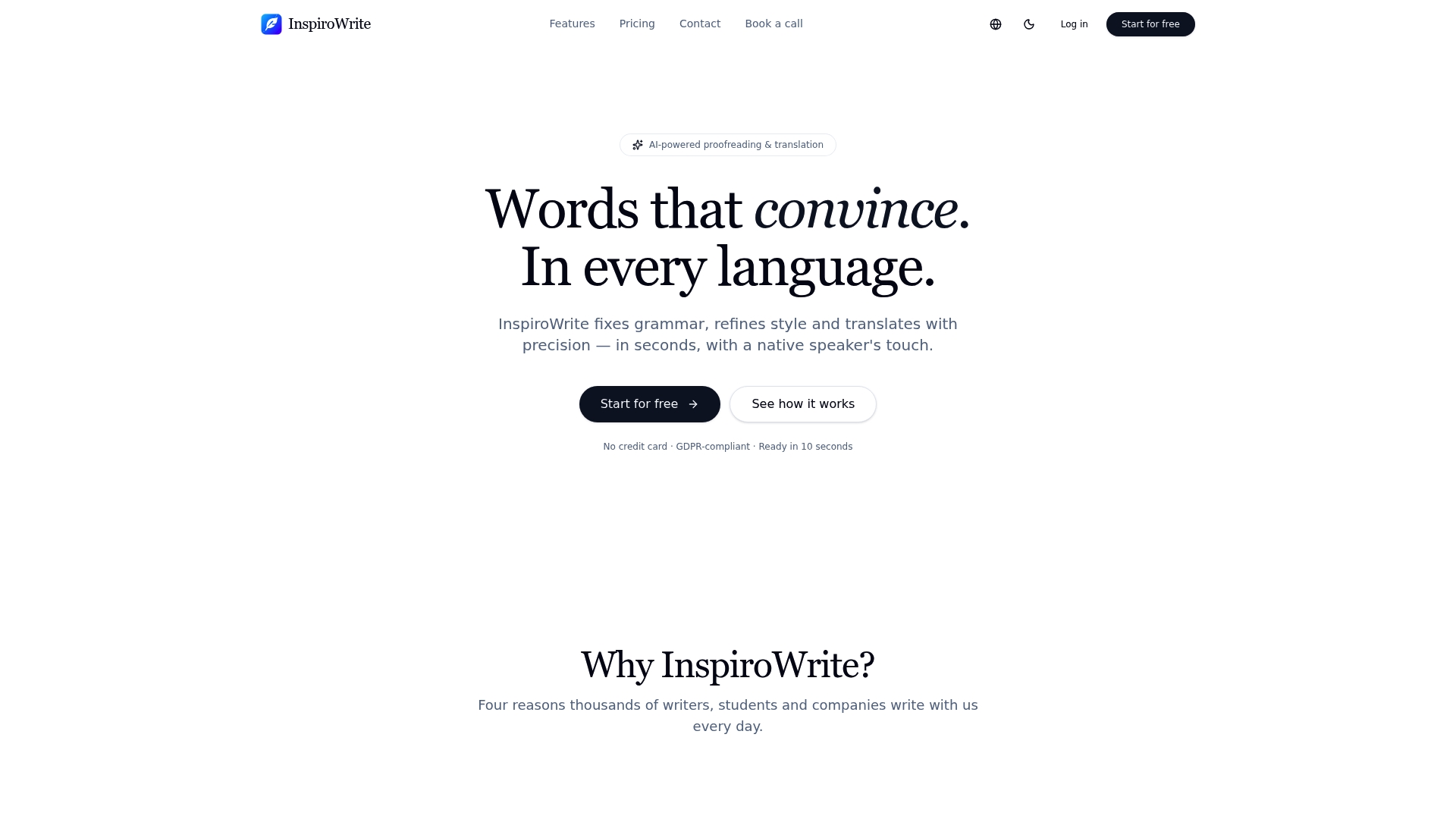
Inspirowrite's AI-powered translation and proofreading tool is built for business professionals who cannot afford the kind of errors described in this article. It delivers fast, accurate results while keeping your documents entirely private. Your content is never used to train AI models, which matters when you are handling contracts, compliance documents, or sensitive commercial communications. Inspirowrite's terms and conditions reflect its commitment to legal clarity and user trust, the same standards it applies to every translation it supports. If you are working across languages and need a polished, precise result without the wait, Inspirowrite is the tool to have in your workflow.
FAQ
What are the most common examples of translation blunders in business?
The most documented examples include Honda's "Fitta" renaming in Nordic markets, HSBC's "Assume Nothing" mistranslated as "Do Nothing," and Amazon Sweden's machine-translated product listings that produced obscene descriptions. Each caused measurable reputational or financial damage.
How do mistranslations in legal contracts lead to financial loss?
A single mistranslated term can shift a binding obligation to an optional one or transfer liability between parties. A Japanese company faced a $71 million lawsuit after a modal verb error, and a pharmaceutical firm lost €2.3 million in arbitration over inconsistent terminology.
Is machine translation reliable for business documents?
Machine translation is adequate for internal communication and rapid comprehension but not for legal contracts, marketing materials, or compliance documents. The Amazon Sweden case demonstrates that unreviewed machine translation produces errors that range from embarrassing to legally problematic.
What is the difference between translation and localisation?
Translation converts text from one language to another. Localisation adapts content to the cultural, social, and political context of the target market. The Orange Northern Ireland campaign failed at localisation, not translation, because the brand name carried unintended political associations.
How can businesses reduce the risk of mistranslated phrases?
The most effective approach combines subject-matter expert reviewers, bilingual glossaries agreed before translation begins, and multi-pass quality assurance integrated into the content workflow. Back-translation of critical documents is also a reliable method for identifying meaning gaps before they become disputes.