

TL;DR:
- Language transfer involves applying L1 features in L2 writing, which can facilitate or hinder learning. Recognizing positive and negative transfer helps writers address errors and improve clarity by understanding their linguistic and rhetorical influences. Developing metalinguistic awareness and using targeted strategies enables more deliberate control over language transfer effects in digital and academic writing.
Language transfer in writing is defined as the process where a writer applies linguistic features, structures, or strategies from their first language (L1) when composing in a second language (L2). Oxford Learner's Dictionaries describes this as using L1 knowledge in a new language, which can make learning either easier or harder. The academic field often uses the broader term cross-linguistic influence to capture the bidirectional nature of this process, where languages shape each other in both helpful and disruptive ways. For students and writers working to improve second-language fluency, understanding language transfer writing techniques is the single most direct route to diagnosing persistent errors and accelerating progress.
What are positive and negative language transfer examples in writing?
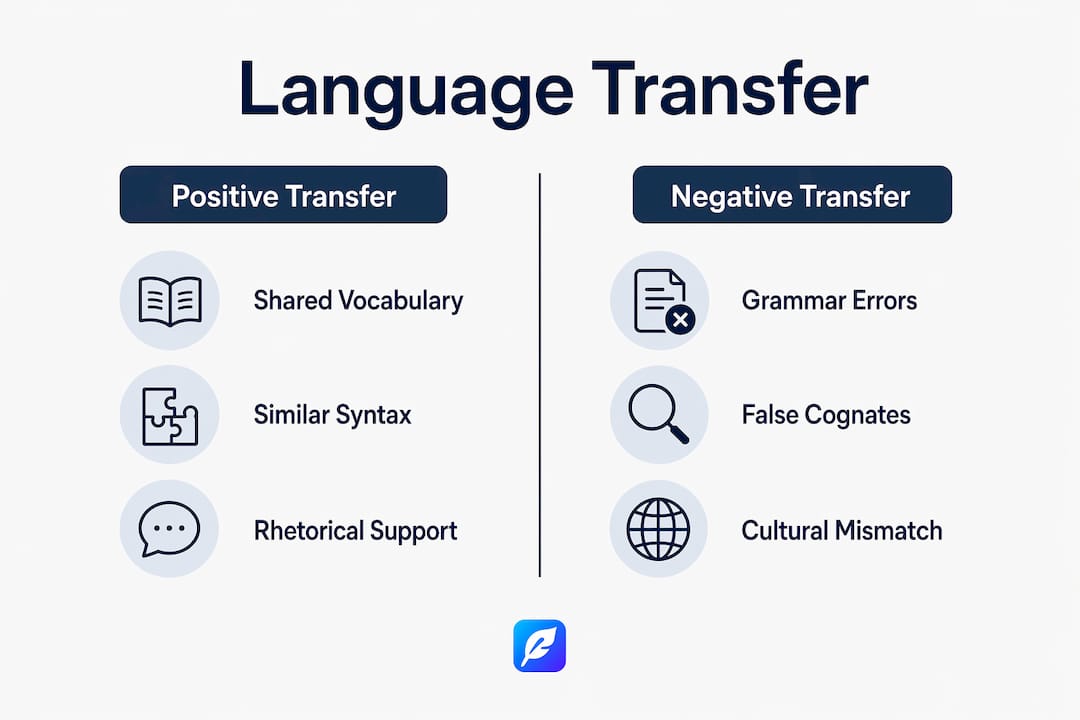
Language transfer produces two distinct outcomes in L2 writing: positive transfer, where L1 knowledge accelerates L2 production, and negative transfer, where L1 patterns create errors or awkward constructions. Recognising which type is at work in your own writing is the foundation of any serious improvement effort.
Positive transfer occurs when L1 and L2 share structural or lexical features. A Spanish speaker writing in English benefits from the shared Latin roots of words like communication and comunicación, or the parallel use of subject-verb-object sentence order. A French speaker already understands grammatical gender and complex tense systems, which reduces the cognitive load when learning Italian. These shared features mean less time spent on fundamentals and more capacity for developing style and argument.
Negative transfer, sometimes called interference, is where L1 habits actively conflict with L2 conventions. Classroom research shows that common errors such as missing plural markers, dropped articles, and inverted adjective placement directly reflect L1 structural patterns. A Mandarin speaker writing in English may omit plural endings because Mandarin does not mark plurality on nouns. A Spanish speaker may write "the car red" because adjectives follow nouns in Spanish.
| Transfer type | L1 influence | L2 writing outcome |
|---|---|---|
| Positive | Shared Latin vocabulary (Spanish to English) | Faster vocabulary acquisition and recognition |
| Positive | Subject-verb-object order (German to English) | Fewer syntactic errors in basic sentences |
| Negative | No plural marking (Mandarin to English) | Omission of plural endings ("three student") |
| Negative | Adjective-noun order (Spanish to English) | Inverted adjective placement ("the car red") |
| Negative | Pro-drop syntax (Italian to English) | Missing subject pronouns ("Is raining today") |
Pro Tip: When you spot a recurring error in your L2 writing, ask whether the same construction is grammatically correct in your L1. If it is, you have identified a negative transfer pattern you can target directly.
Understanding language transfer at this level turns error correction from guesswork into a systematic process. Rather than memorising rules in isolation, you begin to see the logic behind your own mistakes, which makes them far easier to fix.
How do conceptual and rhetorical transfer shape L2 writing beyond grammar?
Grammar errors are the most visible sign of language transfer, but research on L2 literature review writing shows that the deeper challenges lie in how writers organise knowledge, construct arguments, and position their own voice within a text. These are the domains of conceptual and rhetorical transfer, and they are far less discussed in standard writing guides.

Conceptual transfer refers to the way writers select, organise, and connect information based on L1 cognitive habits. A writer trained in an academic tradition that values extensive background before the main claim will produce L2 texts that feel indirect or over-contextualised to an English-speaking reader. The knowledge-transforming operations involved in synthesising sources, such as paraphrasing, comparing, and critiquing, are shaped by L1 academic norms, not just L1 grammar.
Rhetorical transfer affects how writers construct stance and argument. English academic writing typically expects a clear thesis early in a text, direct attribution of claims, and explicit signposting of structure. Writers from traditions that favour implicit argumentation or collective rather than individual voice often produce L2 texts that feel vague or under-argued to English readers, even when the grammar is correct.
| Transfer dimension | What it affects | Typical L2 challenge |
|---|---|---|
| Linguistic | Grammar, vocabulary, syntax | Plural omissions, article errors, word order |
| Conceptual | Knowledge organisation and synthesis | Difficulty integrating and critiquing sources |
| Rhetorical | Argument structure and authorial stance | Indirect thesis, weak signposting, passive voice overuse |
Cross-linguistic influence research recognises that all three dimensions operate simultaneously, which explains why a writer can correct every grammar error and still produce a text that feels foreign to a native reader. The solution is not just proofreading but developing awareness of how your L1 academic culture shapes the way you present ideas.
Pro Tip: Read published academic texts in your L2 field and annotate where the author states their thesis, how they introduce sources, and how they signal transitions. Compare this structure with texts in your L1 field. The differences you notice are your rhetorical transfer targets.
What strategies help writers manage language transfer in L2 writing?
The most effective approach to managing language transfer is developing metalinguistic awareness: the ability to think consciously about how language works and to notice when L1 patterns are influencing L2 production. Affirming L1 patterns while contrasting them with L2 usage reduces learner anxiety and accelerates proficiency development. This is not about suppressing your first language. It is about making the differences visible so you can choose deliberately.
A study of 239 Chinese students found that L1 integrated writing strategies directly predict L2 strategy use and writing outcomes. This means the planning, drafting, and revision habits you already use in your first language are transferable assets, not obstacles. Writers who consciously adapt their L1 strategies for L2 contexts outperform those who try to start from scratch.
Here are six practical techniques for managing and benefiting from language transfer:
- Conduct a contrastive analysis. Compare a specific grammatical feature in your L1 and L2, such as article use or verb tense, and write out the rules for both. This makes the contrast explicit and gives you a reference point when editing.
- Keep a transfer journal. After each writing session, note any moment where you felt uncertain or where you defaulted to an L1 structure. Over time, patterns emerge that you can address systematically.
- Adapt your L1 planning strategies. If you outline in your first language, continue to do so. Then translate the outline into L2 before drafting. This separates the cognitive work of organising ideas from the linguistic work of expressing them.
- Use targeted grammar tools. Tools such as Grammarly flag structural errors in real time, which is particularly useful for catching negative transfer patterns like missing articles or incorrect verb agreement. For bilingual proofreading support, specialist tools can address cross-language interference more precisely than general grammar checkers.
- Study English writing conventions explicitly. Understanding English-specific conventions such as paragraph structure, hedging language, and citation norms gives you a concrete target to work towards rather than a vague sense of "sounding more natural."
- Seek feedback on organisation, not just grammar. Ask a reader to identify where your argument feels unclear or where the structure seems indirect. This surfaces rhetorical transfer issues that grammar tools cannot detect.
Pro Tip: Reusing your strongest L1 writing strategies in L2 is not cheating. It is evidence-based practice. The goal is adaptation, not abandonment.
How does language transfer appear in digital and multimodal writing?
Digital writing environments introduce a new layer of complexity to language transfer. When writers compose on screen using word processors, translation plugins, or multimodal tools, transfer processes occur moment by moment in ways that are invisible in the final text. Process-retrospective research using screencasts, interviews, and reflective journals captures these hidden transfer actions during digital composing, revealing decisions that never appear in the finished draft.
This matters for L2 writers because digital tools can both mask and amplify transfer. A writer who drafts in their L1 and then translates using machine translation is transferring at the structural level of entire sentences. A writer who switches between keyboard layouts or uses L1 autocorrect suggestions is transferring at the word level. Neither process shows up in a grammar check of the final document.
Moment-by-moment transfer processes are often invisible without detailed process capture. Technology-based methods such as screen recording and keystroke logging reveal these hidden actions. For writers who want to understand their own transfer habits in digital contexts, the following approaches are worth adopting:
- Record a screen capture of yourself composing a short text and review it afterwards. Note every moment you paused, deleted, or switched languages.
- Use reflective journaling after digital writing sessions to document decisions you made about word choice, sentence structure, or organisation.
- Experiment with multilingual audio aids to reinforce L2 patterns aurally, which can reduce the pull of L1 structures during composing.
- Review common grammatical errors that frequently appear in L2 digital writing to build a personal checklist for revision.
Multimodal composing, which involves combining text with images, audio, or video, adds further complexity because the conventions for structuring multimodal arguments differ across cultures. A writer whose L1 culture favours image-heavy, low-text communication may produce multimodal L2 texts that feel under-written to an English-speaking audience. Recognising this as a form of rhetorical transfer, rather than a lack of effort, is the first step towards addressing it.
Key takeaways
Language transfer writing is a multi-dimensional process affecting grammar, knowledge organisation, and argument structure, and managing it requires metalinguistic awareness, strategy adaptation, and targeted use of digital tools.
| Point | Details |
|---|---|
| Transfer is bidirectional | L1 can both help and hinder L2 writing; positive transfer accelerates learning, negative transfer creates persistent errors. |
| Grammar is only one layer | Conceptual and rhetorical transfer affect how writers organise arguments and synthesise sources, not just sentence structure. |
| L1 strategies are transferable | Adapting your strongest L1 writing strategies for L2 contexts improves writing outcomes, as shown in research with Chinese students. |
| Digital writing reveals hidden transfer | Screen recording and journaling expose moment-by-moment transfer decisions invisible in final texts. |
| Metalinguistic awareness is the core skill | Consciously noticing L1 and L2 differences reduces anxiety and accelerates proficiency development. |
Why I think most L2 writers are solving the wrong problem
Most writers who struggle with second-language writing focus almost entirely on grammar. They buy grammar books, run spell checks, and ask native speakers to "fix" their sentences. This approach addresses the surface but misses the root. In my experience working with multilingual writers, the most persistent problems are not grammatical. They are structural and rhetorical. A writer who has been trained to build an argument through narrative accumulation rather than explicit thesis-first logic will keep producing texts that feel indirect, no matter how clean the grammar is.
The uncomfortable truth is that improving L2 writing requires you to examine your L1 academic culture, not just your L1 grammar. That is a more demanding task, but it is also a more rewarding one. Writers who do this work do not just improve their L2 writing. They become more conscious and deliberate writers in every language they use. The role of proofreading matters, but it comes after the structural thinking, not instead of it. Transfer awareness is not a remedial skill. It is an advanced one.
— Mike
How Inspirowrite helps writers address language transfer
Writers dealing with language transfer need more than a standard spell checker. Inspirowrite is an AI-powered proofreading and translation tool built to detect grammar, style, and structural issues that arise specifically from cross-language interference. It processes your text in seconds, flags transfer-related errors such as article omissions, incorrect verb agreement, and awkward syntax, and suggests corrections that respect your intended meaning rather than overwriting your voice.
Inspirowrite supports multiple languages and is designed with privacy at its centre. Your content is never used to train AI models, which makes it a trustworthy choice for students and professional writers handling sensitive material. You can review the full data protection policy to see exactly how your content is handled. For writers serious about improving L2 fluency, Inspirowrite provides the fast, private, and precise feedback that turns transfer awareness into measurable writing improvement.
FAQ
What is language transfer in writing?
Language transfer in writing is the process of applying L1 linguistic features, structures, or strategies when composing in a second language. It can produce positive effects, such as faster vocabulary acquisition, or negative effects, such as grammatical errors that mirror L1 patterns.
What are the most common negative language transfer examples?
Common negative transfer errors include omitting plural endings, dropping articles, inverting adjective-noun order, and missing subject pronouns. These errors directly reflect grammatical rules that are correct in the writer's first language but incorrect in the target language.
How does language transfer affect academic writing?
Beyond grammar, language transfer affects how writers organise arguments, synthesise sources, and position their own voice. Research on L2 literature reviews shows that conceptual and rhetorical transfer challenges are as significant as linguistic ones.
Can language transfer ever be helpful?
Positive transfer is a genuine advantage. Writers whose L1 shares vocabulary, syntax, or rhetorical conventions with their L2 acquire proficiency faster. Adapting effective L1 writing strategies for L2 contexts also improves writing outcomes, as demonstrated in studies of Chinese students writing in English.
How can I reduce negative language transfer in my writing?
Developing metalinguistic awareness through contrastive analysis, transfer journaling, and targeted feedback is the most effective method. Using tools such as Grammarly or Inspirowrite to catch structural errors, combined with explicit study of L2 writing conventions, addresses both surface and structural transfer issues.