

Write claim-first, verifiable headlines with the primary keyword front-loaded in the first three words. That single rule covers most of what separates a headline that gets cited, clicked, and preserved from one that Google rewrites before anyone sees it. Three things to do right now:
- Draft at least three headline variants before choosing one, then test them against CTR data.
- Place your primary keyword in the first three words of the title tag, not buried mid-sentence.
- Make sure every number in your headline is accurate and matched by the body content.
Claim-first headlines produced a very high AI Overview citation rate and a high Google title-preservation rate in a benchmark of headline formats. That is the clearest signal available in 2026 that the rules for writing headlines have converged: what works for human readers now works for AI extraction layers too.
Key takeaways
Claim-first, keyword-front-loaded headlines with accurate numbers and aligned title tag and H1 pairings produce the highest Google title-preservation and AI citation rates in 2026.
| Point | Details |
|---|---|
| Lead with a verifiable claim | Claim-first headlines produced an 82% AI citation rate and 88% title-preservation rate in benchmarks. |
| Front-load the primary keyword | Place the primary keyword in the first three words of the title tag to aid both human readers and AI classification. |
| Match numbers to body content | Every number in a headline must correspond exactly to what the body delivers; mismatches harm E-E-A-T. |
| Keep title tags under 60 characters | Title tags truncate in search results; use a longer H1 on the page for fuller context and clarity. |
| Inspirowrite for fast iteration | Inspirowrite's privacy-first proofreading and rephrasing tools speed up headline variant drafting and QA. |
Table of Contents
- What headline writing best practices actually look like in 2026
- How SEO and AI changed the rules for headlines in 2026
- Ready-to-use headline templates and before/after examples
- How to test, measure, and iterate your headlines
- What to avoid: common headline mistakes that cost you clicks
- Your pre-publish headline QA checklist
- Why the "two-audience" problem is actually good news for writers
- Refine your headlines faster with Inspirowrite
- Sources
- FAQ
What headline writing best practices actually look like in 2026
Headline craft has always balanced clarity with curiosity. What changed is the audience. You are now writing for two readers simultaneously: the human who scans a SERP and the AI model that extracts your headline as a citation candidate. The good news is that the techniques that serve one tend to serve the other.
Clarity beats cleverness every time
Explicit, descriptive headlines consistently outperform vague or cryptic ones across platforms. Adobe's guidance on headline writing is unambiguous on this: readers reward headlines that tell them exactly what they will get. A headline like "Why content marketing is broken" might earn a click from curiosity, but "Content marketing ROI drops when teams skip headline testing" earns a click and a citation.
The practical rule: state what is true before you promise a benefit. "How to cut your editing time by half" is a benefit promise. "Structured editing workflows reduce revision cycles" is a verifiable claim. The second version is more likely to be preserved by Google and extracted by an LLM.
Lead with the claim, front-load the keyword
LLMs parse headlines as token sequences and weight early tokens heavily. Placing the primary entity and action in the first three words increases the chance a model classifies your content correctly. The same logic applies to human readers scanning a mobile screen: the first three words are often all they see before the line wraps.
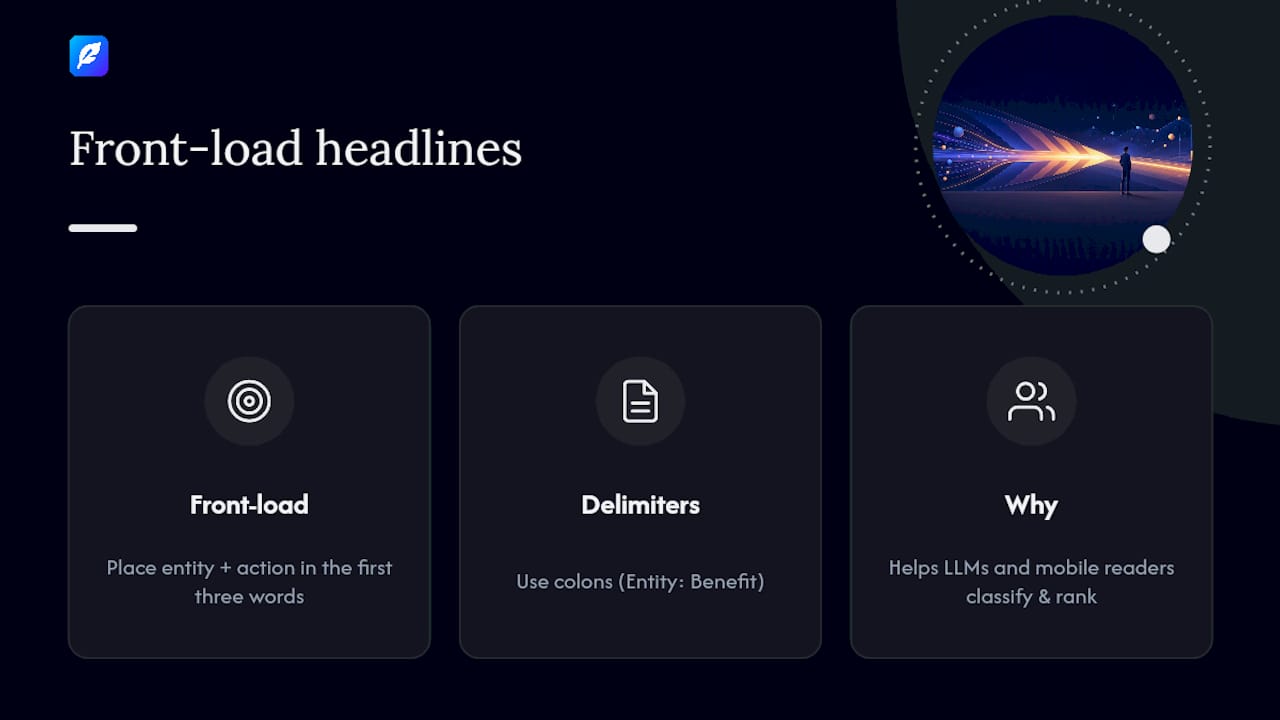
Front-loading the main entity and action helps both search engines and AI models classify and rank headlines correctly. Delimiters like colons also help. A structure of "Entity: Benefit" or "Topic: What You Need to Know" is both machine-friendly and immediately legible to a human.
Use numbers only when the body delivers them
Numbers increase perceived structure and CTR. Specific counts outperform vague ones, and numerals (7, not "seven") signal a list format that readers trust. The catch: AI systems cross-reference numbers against body content. A headline promising "47 tips" that delivers 12 items is penalised for incoherence, which damages E-E-A-T and citation potential. Use a number only when the body matches it exactly.
Length: title tag vs H1
Keep the title tag under roughly 60 characters for SERP display; use a longer H1 on the page for fuller context. These two elements serve different roles. The title tag is truncated in search results and needs to be self-contained at 50–60 characters. The H1 can run longer because it sits on the page where the reader has already arrived. A common and effective approach is to write a tight, keyword-front-loaded title tag and a slightly expanded H1 that adds a qualifier or audience signal.
Write multiple variants and iterate
Industry practice recommends creating 3–5 headline variants before committing to one. This is not just about quality control. Writing variants forces you to consider different intent shapes: a how-to, a list, a question, a claim. Each shape attracts a different type of searcher, and testing reveals which one your audience actually responds to.
Match the headline shape to the search intent
- How-to headlines ("How to write headlines that AI will cite") suit procedural queries where the reader wants steps.
- List headlines ("7 headline mistakes that cost you clicks") suit informational queries where the reader wants a quick scan.
- Question headlines ("What makes a headline AI-citation-ready?") suit navigational and discovery queries.
- Claim-first headlines ("Claim-first headlines preserve 88% of title tags") suit research-intent queries and work best for AI extraction.
For social, email, and mobile, keep the headline under 60 characters where possible. Emoji can add visual contrast on social timelines but should be placed after the core text, never before the keyword, and avoided entirely in title tags and formal contexts.
How SEO and AI changed the rules for headlines in 2026
Google rewrote approximately 76% of title tags in Q1 2025 and has since been testing AI-generated headline replacements. That figure should reframe how you think about headline writing: your title tag is a proposal, not a guarantee. Google accepts it when it is clear, accurate, and intent-matched. When it is not, the algorithm substitutes its own version, often pulling text from the H1 or body.
What triggers a rewrite
Google rewrites title tags when:
- The title tag does not match the page's primary topic (intent mismatch).
- The title is too long and truncates awkwardly.
- The title is keyword-stuffed or reads as manipulative.
- The title is vague and the H1 is more descriptive.
The defensive tactic is straightforward: align the intent of your title tag and H1 so closely that there is no better alternative for Google to substitute. If your title tag says "Headline writing tips" and your H1 says "The complete guide to writing headlines that rank in 2026," Google will likely prefer the H1. Write both to say the same thing at different lengths.
Token weighting and AI extraction
Modern LLMs assign higher weight to tokens that appear early in a sequence. For headline authors, this means the first three words of a title tag carry disproportionate influence over how a model classifies your content. A headline that buries the topic mid-sentence ("A practical look at the techniques behind effective headline writing") is harder for a model to classify than "Effective headline writing: techniques that work in 2026."
Structured prompts, shared formulas, and a short checklist help teams validate AI-generated headline suggestions before publishing. AI tools can generate useful variants quickly, but human editing remains necessary to check claim accuracy, tone, and intent alignment.
Voice search and mobile truncation
Voice assistants read headlines aloud. A headline that works visually ("7 SEO Headline Hacks [2026]") sounds odd spoken. For voice-optimised content, prefer natural spoken phrasing: "Seven ways to write headlines that rank in 2026." Shorter headlines perform better on mobile and social timelines, where the first 50–60 characters are often all that display before truncation.
Pro Tip: Before publishing, paste your title tag into a SERP preview tool (such as Mangools or Portent's SERP Snippet Optimiser) and your H1 into a plain-text document. Read both aloud. If either sounds like it was written for a robot rather than a person, rewrite it.
Ready-to-use headline templates and before/after examples
Templates give you a starting structure. The goal is to adapt them, not copy them. Each format below includes when to use it and a before/after rewrite.
Core templates
-
Claim-first: "[Verifiable assertion]: [Qualifier or audience]" Use when: the article makes a specific, defensible claim. Best for AI citation and title preservation. Before: "Tips for better headlines"
-
How-to: "How to [achieve outcome] [qualifier]" Use when: the reader wants a process. Keep the outcome specific. Before: "How to write good headlines" After: "How to write headlines Google will not rewrite"
-
List: "[Number] [things] that [outcome]" Use when: the content is genuinely a list and the number is accurate. Before: "Headline mistakes to avoid" After: "6 headline mistakes that trigger Google title rewrites"
-
Question: "What [does/makes/is] [topic]?" Use when: the reader is in discovery mode and the article answers the question directly. Before: "Understanding AI and headlines" After: "What makes a headline AI-citation-ready in 2026?"
-
Title tag + H1 pairing: Title tag (≤60 characters): "Headline writing best practices 2026" H1 (longer, on-page): "Headline writing best practices for 2026: the claim-first approach that AI and humans both reward"
On emoji and symbols
Place emoji after the core text on social platforms: "Headline writing tips for 2026 ✍️" not "✍️ Headline writing tips." Never use emoji in title tags; they render inconsistently across browsers and can trigger rewrites. Avoid symbols that carry different cultural meanings across markets. For UK audiences, a 📋 (clipboard) or ✅ (tick) is generally safe; a 🤞 or 👌 can be misread in some cultural contexts. When writing for multilingual or localised content, strip emoji from headline variants intended for markets where their meaning is ambiguous.
How to test, measure, and iterate your headlines
Testing is where headline writing becomes a discipline rather than a guess. A structured workflow prevents you from optimising for the wrong metric.
- Set a baseline. Record the current CTR for the page in Google Search Console before changing anything. Note the average position and impressions over the past 28 days.
- Write a hypothesis. "Changing the title tag to a claim-first format will increase CTR by moving the primary keyword to the first three words." A hypothesis forces you to define what you expect and why.
- Create 2–3 variants. Each variant should change one variable: keyword position, headline shape, or the presence of a number. Changing everything at once makes it impossible to know what worked.
- Choose your test environment. Google Search Console's Search Appearance experiments allow title tag testing directly in search. On-site A/B testing tools (such as Google Optimize's successor integrations or VWO) work for H1 and on-page headline variants. Email subject line splits run natively in most email platforms.
- Run for at least two weeks. Headline experiments need enough impressions to produce a reliable signal. For low-traffic pages, four weeks is safer.
- Measure the right metric by channel. CTR is the primary metric for search. Open rate is the equivalent for email. For social referrals, track time on page and scroll depth rather than raw clicks, which can be inflated by misleading headlines.
Formal significance testing (p < 0.05) requires sample sizes that most individual pages will not reach in a reasonable timeframe.
Statistic to anchor the case for testing: Teams that generate multiple headline variants before selecting one consistently avoid anchoring on the first phrasing and find stronger performers. The feedback loop between draft, test, and revision is what separates teams that improve headline performance from those that guess and hope.
What to avoid: common headline mistakes that cost you clicks
- Clickbait and mis-promises. A headline that overpromises and underdelivers destroys trust and increases bounce rate. AI systems flag incoherence between headline claims and body content, which harms E-E-A-T. Descriptive, honest headlines convert better than curiosity gaps that disappoint.
- Inaccurate numbers. If your headline says "12 tools" and the article lists nine, AI cross-referencing will catch it. Fix the number or fix the article, but never leave them mismatched.
- Keyword stuffing. Phrases like "best headline writing tips headline SEO 2026 headlines" are detected by Google's SpamBrain classifier and are likely to trigger a rewrite. One primary keyword, front-loaded, is enough.
- Writing only for AI. Optimising purely for token weighting produces headlines that read as mechanical. Human readers still decide whether to click. Balance machine readability with natural phrasing.
- Vague superlatives. "The best guide ever" and "the ultimate resource" are unverifiable and increasingly ignored. Specific claims ("the technique that preserved 88% of title tags") are more credible and more citable.
- Culturally insensitive or biased language. Idioms, metaphors, and colloquialisms that work in one market can alienate or offend in another. For UK audiences, avoid US-centric idioms and check that any metaphor involving sport, politics, or social norms translates cleanly. Localisation guidance is worth consulting before publishing headlines for multiple markets.
- Ambiguous emoji. An emoji that reads as positive in one context can carry a different meaning in another. When in doubt, leave it out of the headline.
Your pre-publish headline QA checklist
Run through this before every publish. It takes under three minutes and prevents the most common errors.
- Claim verifiable? Can the headline's assertion be supported by the body content? If not, rewrite the headline or the body.
- Keyword in the first three words? Check the title tag specifically. If the primary keyword appears after word four, move it forward.
- Numbers accurate? Count the items, tips, or steps in the body. Match the number in the headline exactly.
- Intent matched? Does the headline shape (how-to, list, question, claim) match what the page actually delivers? A list headline on a narrative article confuses both readers and algorithms.
- Title tag under 60 characters? Paste it into a character counter. Trim if needed, preserving the keyword and the core claim.
- H1 and title tag aligned? They should say the same thing at different lengths, not contradict each other.
- No duplicate titles? Check that no other page on the site uses the same or near-identical title tag. Duplicate titles dilute authority.
- Mobile truncation test passed? View the title tag on a mobile SERP preview. Does the meaningful part appear before the cut-off?
- Accessibility check: Plain language, no misleading punctuation, no emoji that could be misread by screen readers or in different cultural contexts.
- Inclusivity check: No idioms, metaphors, or references that could exclude or alienate part of your audience.
Pro Tip: Paste your headline into a general-purpose LLM (such as Claude or ChatGPT) and ask: "What is this article about, based only on this headline?" If the model's answer matches your page's actual topic, your headline is doing its job for AI extraction. If it guesses wrong, rewrite until it guesses right.
Why the "two-audience" problem is actually good news for writers
Most commentary on AI and headlines frames it as a threat: Google rewrites your title, LLMs extract your content without attribution, and the rules keep shifting. That framing misses something. The criteria that make a headline AI-citation-ready, clarity, a verifiable claim, a front-loaded keyword, and an accurate number, are the same criteria that make a headline good for human readers.
The convergence is not accidental. AI systems are trained on human engagement signals. What humans click, read, and share is what models learn to reward. The "two-audience problem" turns out to be a single audience problem in disguise: write clearly and honestly, and you satisfy both.
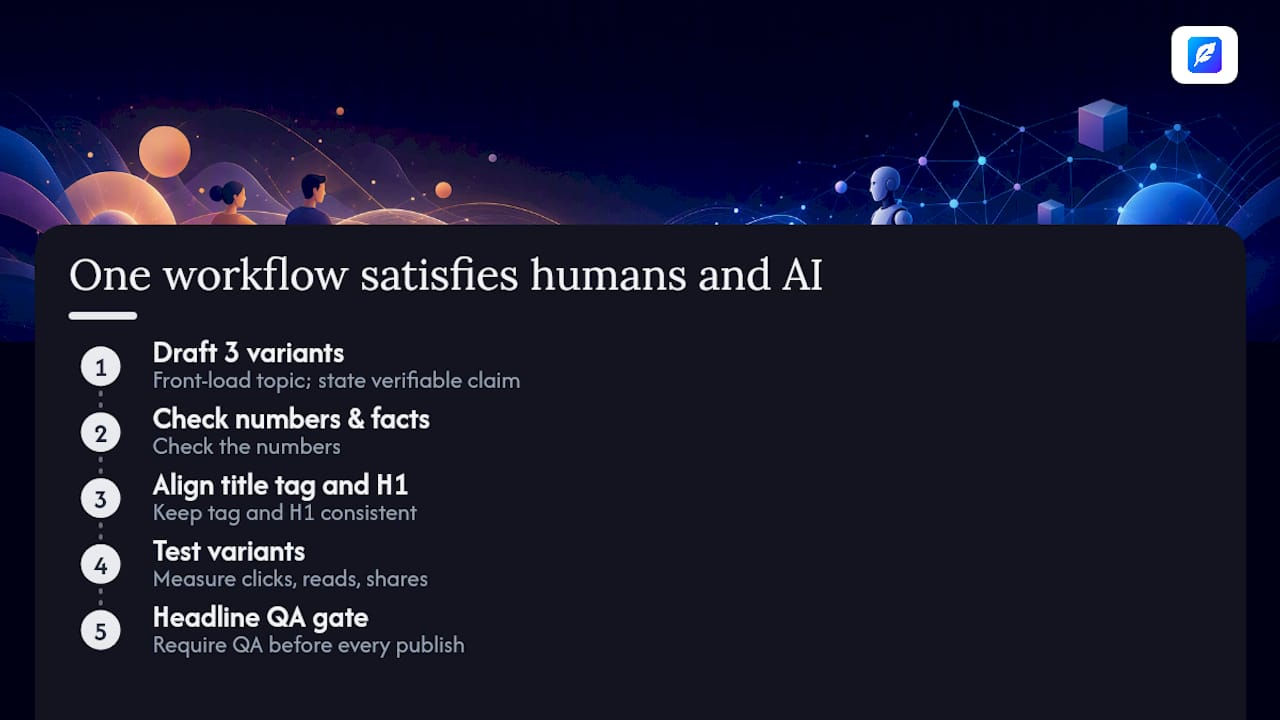
Where teams go wrong is in treating AI optimisation as a separate layer of work. It is not. A headline that states a true claim, front-loads the topic, and delivers on its promise does not need a separate AI-optimisation pass. The discipline is in the drafting: write three variants, check the numbers, align the title tag and H1, and test. That workflow is the same one that has always produced good headlines. The 2026 context just makes the consequences of skipping it more visible.
My single recommendation for teams: standardise a three-variant drafting workflow with a headline QA gate before every publish. Not because AI demands it, but because it produces better headlines. The AI citation benefits follow automatically.
Refine your headlines faster with Inspirowrite
Writing three headline variants, checking grammar, adjusting tone, and verifying that phrasing works across UK and international audiences takes time. Inspirowrite cuts that iteration cycle significantly. Paste a draft headline and get instant grammar, style, and tone feedback in seconds, without your text being used to train any AI model.
For content creators and marketers working across multiple formats, Inspirowrite's rephrasing, shortening, and formal/casual rewriting tools let you generate clean variants quickly, then apply the QA checklist above before publishing. The privacy-first processing means your unpublished headlines and drafts stay confidential throughout. Start refining your headline drafts at Inspirowrite and move from first draft to publish-ready in a fraction of the usual time.
Sources
- Effective Headline Writing Techniques 2026 — Full Guide
- 9 practical tips for writing headlines that get clicks
- How to Write Headlines: A Step-by-Step Guide
- AI Headline Optimization: Headlines That Work for Humans and AI
- A simple formula for writing kick‑ass titles
FAQ
What are the core rules for headline writing in 2026?
Lead with a verifiable claim, place the primary keyword in the first three words of the title tag, keep the title tag under 60 characters, and align it with the H1. Write at least three variants before choosing one.
What should you avoid when writing headlines?
Avoid clickbait, inaccurate numbers, keyword stuffing, vague superlatives, and culturally insensitive language. Headlines that promise more than the body delivers are penalised by both readers and AI systems that cross-reference content.
Can you give examples of strong and weak headlines?
How do you write headlines that AI tools will cite?
Write claim-first headlines that state a verifiable assertion before promising a benefit. Place the primary keyword in the first three words, use accurate numbers, and align the title tag with the H1. This structure produced the highest AI citation rates in available benchmarks.
How does Inspirowrite help with headline writing?
Inspirowrite's rephrasing, shortening, and tone-adjustment tools let you generate and refine headline variants quickly, with instant grammar and style feedback. Your drafts remain confidential and are never used to train AI models.