

TL;DR:
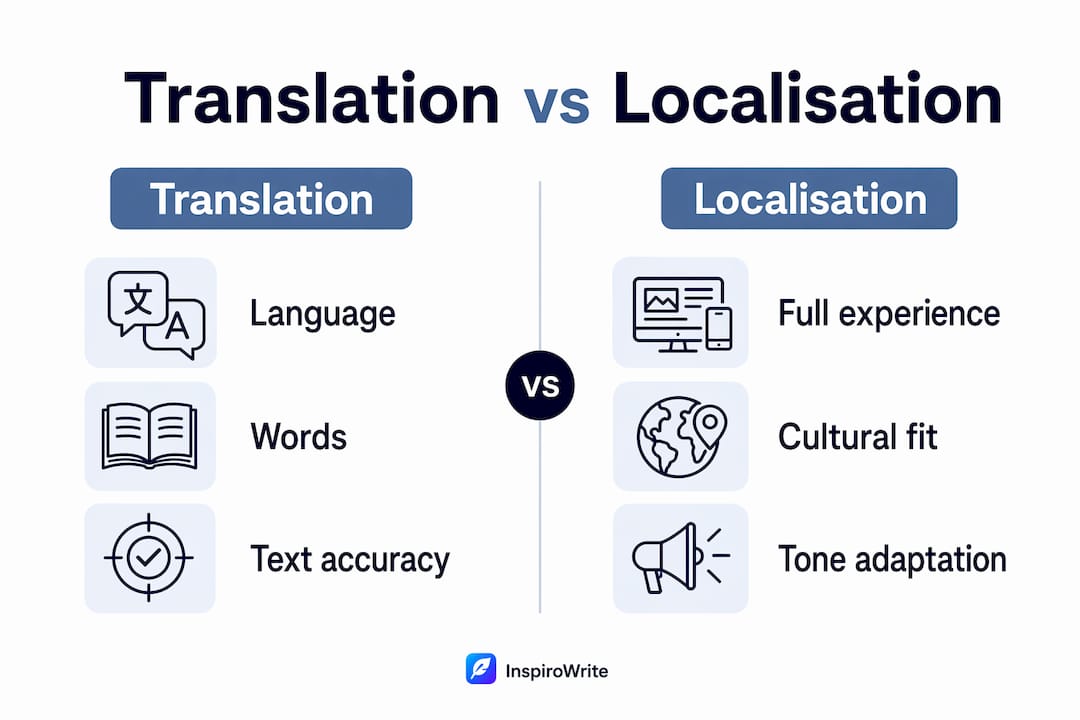
- Localization adapts the entire experience to feel native in a target market, while translation simply converts words from one language to another.
- Choosing between them depends on cultural sensitivity and legal, brand, or revenue risks associated with the content.
Localisation adapts an entire experience to feel native in a target market; translation converts words from one language to another. If you are working with informational text, a quick AI translation often suffices. If you are writing marketing copy, UI strings, or anything that touches cultural norms, legal formats, or brand tone, you need localisation. Three signals tell you which path to take: how sensitive your audience is to cultural missteps, whether legal or format requirements apply (such as UK GDPR cookie notices), and how much revenue or brand reputation is at stake.
Quick orientation for new readers: the industry uses L10n as shorthand for localisation (ten letters sit between the "L" and the "n"), and the broader GILT framework (Globalisation, Internationalisation, Localisation, Translation) places both activities in context. For privacy-conscious writers using AI tools, Inspirowrite processes text without storing it for model training, which matters the moment you paste anything confidential.
Table of Contents
- What does translation actually mean for writers?
- What localisation (L10n) covers beyond language
- Translation vs localisation: how do they compare?
- When should you translate, and when should you localise?
- How AI translation fits your workflow, and where it falls short
- Privacy and UK compliance when using AI translation
- How to write source text that translates and localises well
- Rough timeline and cost expectations (UK context)
- Key takeaways
- A note on where writers go wrong
- Inspirowrite: private, fast AI translation for writers
- Useful sources and further reading
- FAQ
What does translation actually mean for writers?
Translation converts source text into a target language while preserving meaning and register. A technical manual, a quick FAQ, a draft email you want to understand — these are natural translation tasks. The process is linear: source text in, target text out.
The limitation surfaces fast with idioms. "It's raining cats and dogs" translated word-for-word into French produces nonsense. A good translation finds the functional equivalent; a poor one leaves the reader confused. This is where idiom translation failures become costly, particularly in business writing.
Translation is not a mechanical swap of words. It is a judgment call about which meaning to preserve when a single source phrase carries several possible readings in the target language.
Translation sits inside the GILT framework as one component, not the whole activity. Treating it as the complete task is the most common mistake writers make when preparing content for international audiences.
Typical translation use cases:
- Internal documents and draft comprehension
- Technical documentation with low cultural sensitivity
- Quick FAQ pages and informational blog posts
- Personal emails and academic submissions
What localisation (L10n) covers beyond language
Localisation goes further. Where translation changes words, localisation changes the experience. A landing page localised for a Japanese audience might use different imagery, a different colour palette, a different date format (YYYY/MM/DD rather than DD/MM/YYYY), and different social proof examples — none of which translation touches.
The scope of localisation includes:
- Tone and register — formal vs casual, direct vs indirect
- Date, time, and number formats — 12 March 2025 vs 03/12/25 vs 2025-03-12
- Currency and units — £, €, $; miles vs kilometres
- Images and icons — gestures, colours, and symbols carry different meanings
- Right-to-left (RTL) layouts — Arabic and Hebrew require design changes
- Legal copy — cookie notices, disclaimers, and terms vary by jurisdiction
- Seasonal and cultural references — Christmas campaigns do not land universally
A professional document localisation project for a SaaS product, for example, typically involves engineers (for internationalisation), designers (for layout), legal reviewers, and linguists working in parallel. Translation is one thread in that fabric.
Pro Tip: When you write "localisation" in a brief, spell out which elements you mean. "Translate and localise" without a scope list usually means the agency translates and leaves the rest.
The GILT framework is worth knowing because tools and documentation use these terms precisely. Globalisation is the business strategy; Internationalisation (i18n) is the technical groundwork; Localisation (L10n) is the market-specific adaptation; Translation is the language conversion step within it.
Translation vs localisation: how do they compare?
The single biggest practical difference: translation changes words, localisation changes the experience a reader has.

| Dimension | Translation | Localisation |
|---|---|---|
| Scope | Language conversion only | Language, culture, formats, design, legal |
| Typical cost shape | Lower | Higher (cross-functional teams) |
| Turnaround shape | Hours to days | Weeks to months |
| QA requirements | Linguistic accuracy | Linguistic + cultural + technical + legal |
| Risk to brand | Low for informational content | High if skipped for user-facing content |
L10n and i18n appear throughout tool documentation. Knowing them prevents confusion when you read platform guides or brief a vendor.
- Translation is a subset of localisation, not an alternative to it.
- Localisation without good translation produces culturally adapted but linguistically poor content.
- The GILT framework treats both as distinct, sequential activities.
When should you translate, and when should you localise?
The decision comes down to five criteria: audience sensitivity, revenue or brand impact, legal and regulatory requirements, UI or format constraints, and content type.
Translate when:
- The content is informational and low-stakes (internal reports, draft comprehension, FAQs).
- Your audience shares enough cultural context with the source.
- No legal formatting requirements apply in the target market.
- Speed matters more than cultural precision.
Localise when:
- The content is user-facing: marketing copy, onboarding flows, landing pages.
- Legal copy must comply with local rules — UK GDPR cookie notices, for instance, require specific language and format.
- The content includes idioms, humour, or culturally specific references.
- Revenue or brand reputation depends on the reader feeling at home.
- Images, dates, currencies, or layouts differ between source and target markets.
A blog post explaining a product feature? Translate it. The landing page selling that product in Germany? Localise it. The onboarding email sequence for new users in Japan? Localise every element, including the examples and the sign-off tone.
How AI translation fits your workflow, and where it falls short
AI is excellent for fast first drafts and comprehension. It is not a substitute for localisation judgment on culturally dense content.
Mid-2026 reporting shows that model architecture affects idiom handling: larger models tend to recognise idioms more reliably than efficiency-optimised mini models, but disagreements persist on culturally loaded text. When six models were asked to translate the Japanese concept gaman, three produced defensible outputs and three did not — and among those that succeeded, no two gave the same result.
That divergence between AI outputs is not noise. It signals that the source text contains ambiguity or cultural weight that requires human judgment. The practical response: run the same passage through more than one model, compare outputs, and route disagreements to a human reviewer. Multi-model comparison structurally reduces the risk of invisible errors — the kind that read as grammatically correct but miss the cultural meaning entirely.
Practical safeguards for AI translation:
- Use a glossary or style guide to constrain brand terms and technical vocabulary.
- Compare outputs from at least two models on culturally sensitive passages.
- Flag divergent outputs for human review rather than accepting one automatically.
- Avoid single-model workflows for marketing, legal, or HR content.
Pro Tip: When prompting an AI for translation, specify the register explicitly: "Translate this into formal British English for a B2B audience." Without that instruction, most models default to a neutral register that may not match your brand voice.
For business translation errors and how to catch them early, a structured QA pass against your source glossary catches the majority of systematic mistakes before they reach readers.
Privacy and UK compliance when using AI translation
Treat any AI translation service as a potential data processor under UK GDPR the moment you paste text containing personal data. That includes names, email addresses, job titles, or any information that could identify an individual.
Practical steps:
- Anonymise personal data fields before pasting into any public AI model.
- Check the service's data retention and processing policies before use.
- For professional projects, use privacy-first tools that do not store or train on your inputs.
- Document your lawful basis for processing if personal data must be translated.
- Involve your Data Protection Officer on high-risk projects (medical, legal, HR).
Pro Tip: Keep a brief log for professional translation projects: date, tool used, data category, and any anonymisation steps taken. This takes two minutes and satisfies most audit requests.
UK GDPR treats data processors the same whether they are a translation agency or an AI service. The obligation to have a Data Processing Agreement in place does not disappear because the tool is fast and free.
This article is general information, not legal advice. Confirm current UK GDPR requirements with the ICO or a qualified data protection professional for your specific situation.
How to write source text that translates and localises well
Good source text is the cheapest quality investment in any translation or localisation project. Localisation-ready authoring reduces rework and shortens timelines.
Author checklist:
- Write in plain language; avoid idioms, slang, and culturally specific metaphors.
- Mark brand terms and product names that must not be translated.
- Separate content from code — never hard-code translatable strings inside scripts.
- Use placeholders for dates, currencies, and units rather than fixed values.
- Provide a brief context note: who is the audience, what is the tone, what is the purpose?
- Prepare a minimal glossary of key terms before the project starts.
- Design for text expansion — translated text is often 20–30% longer than English source.
- Avoid embedding text inside images; it cannot be extracted for translation without redesign.
Pro Tip: Attach a one-page localisation brief to every project: target market, tone, glossary, and any terms to avoid. Translators and AI tools both produce better output when they know the context.
Rough timeline and cost expectations (UK context)
Timelines and costs vary significantly by scope. Here is a practical orientation:
| Approach | Typical turnaround | Cost shape | What drives cost up |
|---|---|---|---|
| AI translation (first draft) | Minutes to hours | Low | Volume, post-editing |
| Human translation | 1–5 days | Medium | Specialist subject matter |
| Full localisation | 2–4 weeks | High | Design, legal, engineering |
| Enterprise localisation | Months | Very high | Multi-market, multi-asset |
Factors that push cost and time upward: design changes for RTL layouts, legal review of jurisdiction-specific copy, large image asset sets with embedded text, and late involvement of engineering for internationalisation groundwork. Teams that treat localisation as a finishing step rather than a parallel workstream consistently spend more and wait longer.
For writers preparing slides or documents, translating presentation slides with AI can compress a one-day task to under an hour — provided the source text follows the authoring checklist above.
Key takeaways
Localisation is the broader activity; translation is one component inside it. Choosing the wrong one for your content type costs time, money, and reader trust.
| Point | Details |
|---|---|
| Translation vs localisation | Translation converts language; localisation adapts the full experience including culture, formats, and design. |
| Decision signal | Choose localisation for user-facing, revenue-critical, or legally regulated content; translation for informational drafts. |
| AI model divergence | When multiple AI models disagree on a phrase, treat it as a signal of cultural complexity requiring human review. |
| Privacy under UK GDPR | Treat AI translation services as data processors; anonymise personal data and check retention policies before use. |
| Inspirowrite | Processes text privately without using your content for model training, making it suitable for confidential translation drafts. |
A note on where writers go wrong
The most persistent mistake is treating translation as the main event and localisation as a polish step applied afterwards, if at all. That framing produces content that reads correctly but feels foreign — grammatically sound, culturally off. Readers notice, even when they cannot name what is wrong.
The second mistake is trusting a single AI model on culturally loaded text. The gaman example from the 2026 model comparison is instructive: three of six models failed, and each failed differently. None of those failures would be obvious to a reader who does not know Japanese. The error is invisible until it costs something.
The practical fix is simple: compare outputs, use a glossary, and route divergent results to a human. Speed and quality are not opposites here. A fast AI draft reviewed by a human who knows the target culture is faster and better than a slow single-model workflow with no review.
Inspirowrite: private, fast AI translation for writers
Writers who need quick, confidential translation drafts without feeding their content into a public training dataset have a specific problem that most free tools do not solve. Inspirowrite processes your text privately, returns results in seconds, and does not use your inputs to train its models.
Use Inspirowrite for fast translation drafts of informational content, proofreading non-native English text before submission, and as the first pass in a localisation workflow before a human reviewer handles cultural adaptation. It supports glossary-aware processing, which keeps brand terms and technical vocabulary consistent across documents. For writers working on multilingual business documents, that consistency matters more than most people expect until the first inconsistency reaches a client.
Visit Inspirowrite to run your first translation or proofreading draft privately, with no account required to start.
Useful sources and further reading
Definitions and frameworks:
- W3C Internationalisation (i18n) Q&A — authoritative technical guidance on i18n as the foundation for localisation; essential for anyone preparing content for engineering handoff.
- TechTarget: Localisation definition — clear industry definition including the L10n numeronym and GILT context.
- Wikipedia: Localisation — broad overview covering language, software, video game, and cultural localisation variants.
Practical localisation guidance:
- Contentful: Translation and localisation differences — practical product content team perspective on what changes and why; good for authors and editors.
- EPAM SolutionsHub: Localisation vs translation — scope and risk framing; useful for writers briefing stakeholders.
- Phrase: Localisation is not just translation — cross-functional planning guide; especially useful for legal and privacy checks.
- Better i18n: Content localisation vs translation — authoring and design guidance for localisation-ready source text.
AI translation and model divergence:
- EasyAIChecker: Six AI models, one translation task — 2026 analysis of model disagreement on culturally loaded text; essential reading before committing to a single-model workflow.
- NerdBot: Five AI models, same sentence — companion piece on architecture and idiom handling differences.
Inspirowrite blog guides:
- Why idioms fail direct translation — practical fixes for the most common AI translation failure mode.
- Role of glossaries in multilingual content — how termbases keep brand and technical terms consistent across languages.
- Subject matter expertise in translation — when to involve a specialist and how it shortens review cycles.
FAQ
What is the difference between localisation and translation?
Translation converts text from one language to another. Localisation adapts the full experience, including tone, imagery, date and currency formats, and legal copy, so content feels native in the target market.
When is translation enough, and when do you need localisation?
Translation suffices for informational, low-stakes content such as internal documents and FAQs. Localisation is needed for marketing copy, UI strings, onboarding flows, and any content where cultural fit or legal compliance affects the reader's response.
What does L10n mean?
L10n is the industry shorthand for localisation. The number 10 represents the ten letters between the "L" and the "n" in "localisation." It appears widely in tool documentation and platform settings.
How do I know when AI translation needs human review?
When multiple AI models produce different translations for the same phrase, that divergence signals cultural complexity or ambiguity. Route those passages to a human reviewer rather than accepting one model's output automatically.
Is it safe to use AI translation tools under UK GDPR?
Only if you treat the service as a data processor and check its data handling policies. Anonymise personal data before pasting it into any public model, and use privacy-first tools for confidential content. Inspirowrite does not use your inputs for model training, which reduces this risk for writers handling sensitive drafts.