
TL;DR:
- Self-proofreading is essential for catching errors automated tools often miss and requires structured, multi-stage routines. Waiting at least 24 hours before reviewing reduces familiarity bias, and switching formats or printing enhances error detection. Separating review phases for structure, grammar, style, and formatting, along with reading aloud or reverse-order reading, significantly improves accuracy.
Self-proofreading is the final quality-control step that separates polished writing from work riddled with errors that automated tools never catch. When you attempt to proofread your own English writing, your brain actively works against you. It reads what you meant to write rather than what is actually on the page. This guide walks you through the tools, techniques, and structured routines that overcome that perception bias. From Grammarly and Hemingway Editor to reading aloud and reverse-order checking, you will find a method that fits your writing process and skill level.
What do you need before you proofread your own writing?
Preparation is not optional. Sitting down to proofread immediately after finishing a draft is one of the most common mistakes writers make, and it costs them accuracy every time.
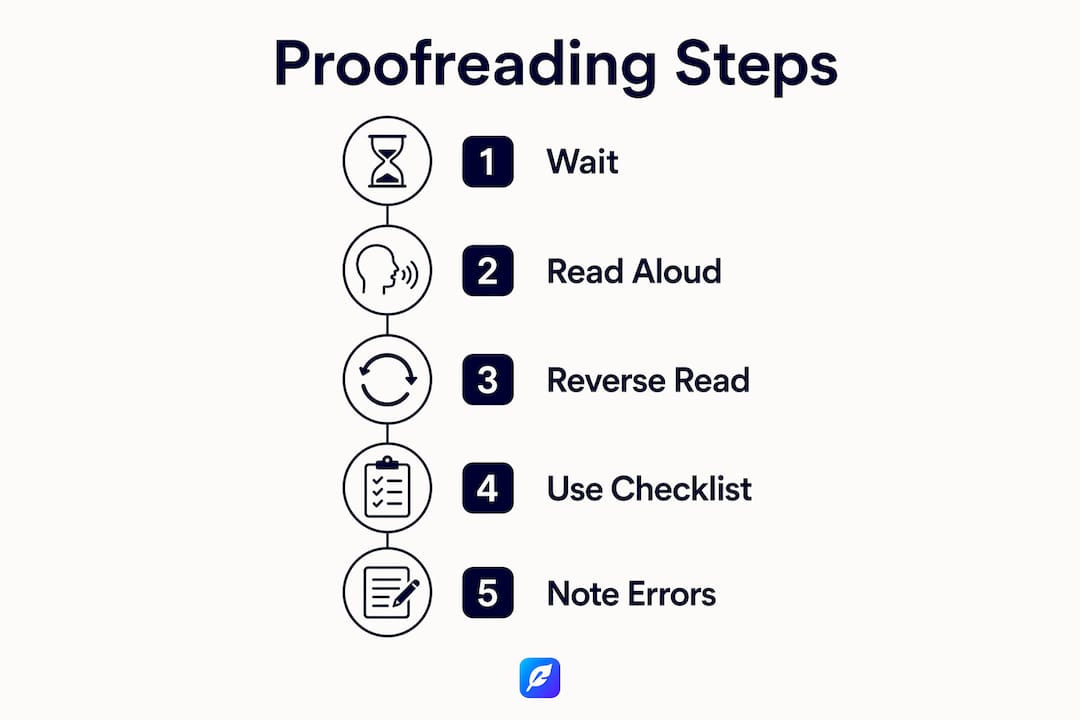
The single most effective preparation step is time. Waiting at least 24 hours before reviewing your draft significantly reduces familiarity bias. Your brain stops filling in gaps automatically, and you begin to read what is actually written. For high-stakes documents such as dissertations or business proposals, waiting a full day or even longer is worth the delay.
Digital tools serve as a useful first pass, but they have firm limits. Grammarly, Hemingway Editor, and ProWritingAid each catch different categories of error. Grammarly flags grammar and punctuation issues. Hemingway Editor highlights dense, hard-to-read sentences. ProWritingAid analyses style patterns across longer documents. None of them, however, can reliably catch context-dependent errors such as homophones or misused words that are spelled correctly. "Their" instead of "there" will pass a spell-check every time.
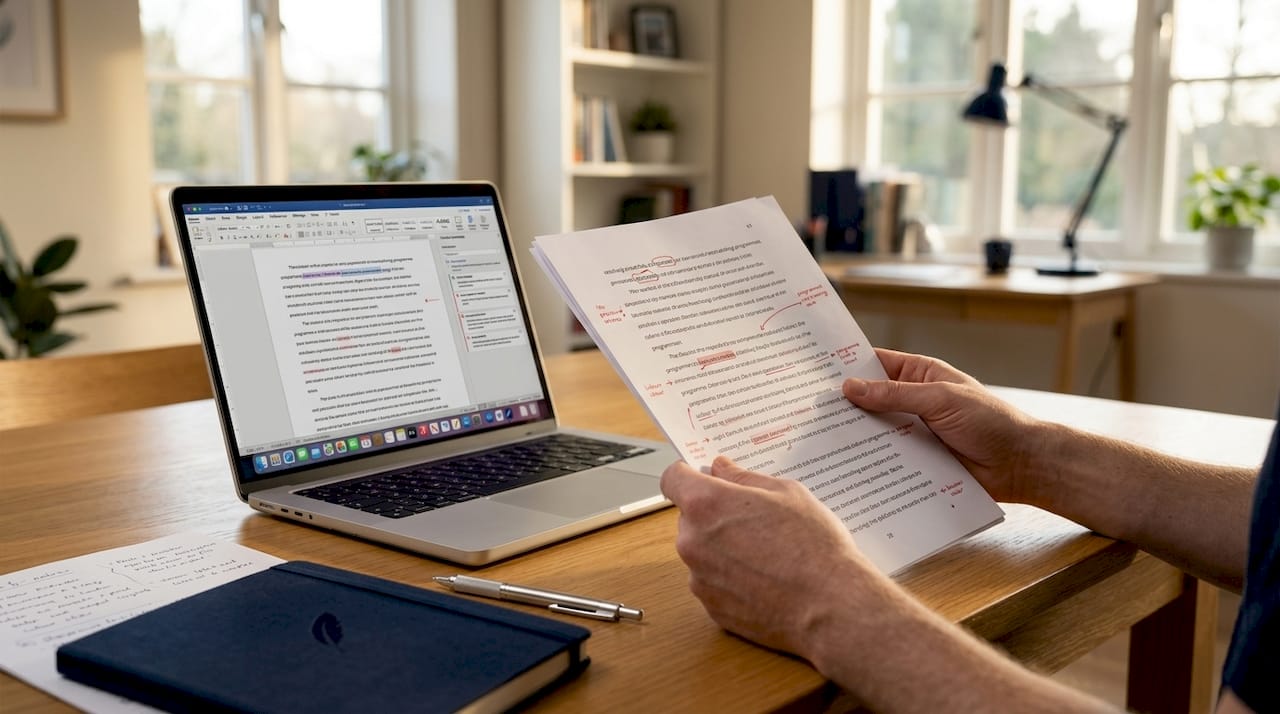
Changing the physical format of your text is another preparation technique that works surprisingly well. Reformatting the text by switching the font, increasing the size, or printing a hard copy tricks your brain into treating the content as unfamiliar. Errors that were invisible on screen become obvious on paper. Many professional editors print manuscripts specifically for this reason.
- Take a break of at least a few hours, ideally 24 hours, before beginning your review
- Run your draft through Grammarly, Hemingway Editor, or ProWritingAid as a first-pass filter
- Change the font, print the document, or switch to a different reading device
- Build a personal error list of your most frequent mistakes to guide targeted checks
Pro Tip: Keep a running note of the errors you catch most often across your writing. If you consistently confuse "practise" and "practice" or drop commas after introductory clauses, add these to a personal checklist and search for them deliberately in every document.
How to execute a multi-stage proofreading process
A single read-through is never enough. The most reliable self-proofreading tips all point to the same principle: separate your review into distinct passes, each focused on a different layer of the writing.
Proofreading is distinct from editing and should always come last. Editing addresses logic, structure, and sentence clarity. Proofreading is the final sweep for spelling, punctuation, and formatting. Mixing the two in a single pass means you will miss errors at both levels.
A four-phase approach gives you the best results:
- Structure and content. Read the full document to confirm the argument flows logically. Check that each paragraph has a clear purpose and that the introduction and conclusion align with the body.
- Grammar and syntax. Look specifically for subject-verb agreement errors, comma splices, misplaced modifiers, and incorrect apostrophe use. These are the errors most likely to undermine credibility.
- Style and word choice. Identify repetitive phrasing, overly long sentences, and passive constructions that weaken clarity. Hemingway Editor is useful here for flagging readability issues.
- Punctuation and formatting. Check full stops, commas, quotation marks, and heading consistency. Verify that any lists, tables, or citations follow a consistent format throughout.
Reading aloud is the most underrated technique in this process. Reading aloud forces slower review and surfaces awkward phrasing, missing words, and rhythm problems that silent reading skips entirely. If you stumble over a sentence while reading it aloud, your reader will stumble over it too.
The reverse-order reading technique takes this further. Reading backward sentence by sentence from the bottom of the document to the top removes all contextual clues. Without narrative flow to carry you forward, your brain is forced to evaluate each sentence in isolation. This is where typos and punctuation errors that survived every other pass finally become visible.
Pro Tip: Use checklists to separate your passes rather than trying to catch everything at once. A checklist focused solely on comma use will catch far more comma errors than a general read-through ever will.
What pitfalls should you avoid when editing your own work?
Knowing what not to do is as valuable as knowing what to do. Several habits consistently undermine self-proofreading, even for experienced writers.
Proofreading too soon after writing is the most damaging habit. Your familiarity with the content means your mind sees what you intended, not what is on the page. This is not a discipline problem. It is how human perception works. The solution is structural: build the waiting period into your writing schedule rather than treating it as optional.
Relying solely on spell-check is the second most common pitfall. Spell-check tools catch basic misspellings but miss every error involving correctly spelled words used in the wrong context. Homophones such as "affect" and "effect," "complement" and "compliment," or "principal" and "principle" will pass any automated check without a flag.
Over-editing is a less obvious but equally real problem. Writers who revise the same passage repeatedly often strip out the natural voice that made the writing engaging in the first place. Set a rule for yourself: if you have revised a sentence three times and are still uncertain, leave it and return to it after a fresh break.
For ESL writers, the challenges are more specific. Non-native English speakers frequently struggle with idiomatic phrasing, article use ("a" versus "the"), and preposition choice. These errors are difficult to catch without either a grammar tool designed for English learners or feedback from a native speaker. Tools built with ESL users in mind, and AI-assisted review processes, can provide an additional layer of support that general grammar checkers do not offer.
- Never proofread immediately after writing. Build a waiting period into your schedule.
- Do not treat spell-check as a substitute for manual review. It misses too much.
- Avoid over-editing. Excessive revision can erode clarity and natural voice.
- ESL writers should use grammar tools designed for English learners and seek native-speaker feedback for high-stakes documents.
- Maintain a personal error list of your recurring mistakes and search for them systematically in every draft.
How to improve your English writing quality beyond proofreading
Proofreading is a skill that compounds over time. The more deliberately you practise it, the fewer errors you produce in the first draft, which makes each subsequent round of review faster and more accurate.
Multiple proofreading rounds, each with a different focus, produce better results than a single thorough pass. The first round catches structural problems. The second catches grammar. The third catches style. By the time you reach the fourth round, you are looking at punctuation and formatting with fresh attention rather than scanning a document you have already half-memorised.
Text-to-speech tools offer a practical alternative to reading aloud yourself. Microsoft Word's Read Aloud feature, Apple's built-in text-to-speech, and dedicated tools such as Natural Reader all convert your text to audio. Hearing your writing read back by a neutral voice exposes awkward phrasing and missing words with remarkable efficiency. This technique is particularly useful for non-native speakers who may not yet have a strong intuitive sense of English rhythm.
Checking introduction and conclusion alignment is a step many writers skip, but it reveals structural disconnects that affect the reader's overall experience. Read your opening paragraph, then read your closing paragraph immediately after. If they do not feel like they belong to the same document, your argument has drifted somewhere in the middle.
| Technique | When to use it |
|---|---|
| Reading aloud | Every draft, especially for rhythm and missing words |
| Reverse-order reading | Final pass to catch typos and punctuation errors |
| Text-to-speech | When reading aloud yourself is not practical |
| Peer review | High-stakes documents such as academic submissions or business proposals |
| Professional proofreading | Final quality check for published or formally submitted work |
Peer review and professional proofreading complement self-editing rather than replace it. For academic submissions, job applications, or published content, a second set of eyes catches errors that familiarity makes invisible to the author. Understanding English writing conventions more deeply also reduces the errors you make in the first place, which shortens every proofreading session that follows.
Key takeaways
Effective self-proofreading requires a structured multi-stage process, deliberate preparation, and the discipline to separate editing from proofreading entirely.
| Point | Details |
|---|---|
| Wait before you review | Allow at least 24 hours between writing and proofreading to reduce familiarity bias. |
| Use tools as a first pass only | Grammarly, Hemingway Editor, and ProWritingAid catch surface errors but miss context-dependent mistakes. |
| Separate your passes | Address structure, grammar, style, and formatting in distinct rounds for higher accuracy. |
| Read aloud or use text-to-speech | Verbalising your text exposes awkward phrasing and missing words that silent reading skips. |
| Build a personal error list | Searching systematically for your recurring mistakes is more effective than general scanning. |
Why I think most writers approach self-proofreading backwards
When I first started reviewing my own work seriously, I made every mistake in this article. I proofread immediately after writing, ran a spell-check, and called it done. The errors I missed were not random. They were the same ones, in the same patterns, every time.
The shift that changed everything was not a new tool. It was accepting that my brain is genuinely bad at reading my own writing accurately, and that no amount of concentration fixes that. The solution is structural, not motivational. You build the waiting period into your schedule. You use a checklist. You read backward. You stop trying to catch everything in one pass.
The technology helps, but it does not replace judgement. Grammarly will not tell you that a sentence is technically correct but completely wrong for your audience. Hemingway Editor will not tell you that a long sentence is actually the right choice for a particular moment. Those calls require a human reader, and for your own work, that human reader has to be a future version of you who has had enough distance from the draft to see it clearly.
The writers I have seen improve fastest are not the ones who spend the most time proofreading. They are the ones who proofread smarter, with a routine that respects how perception actually works. Patience and structure beat effort and intensity every time. Understanding the real role of proofreading in the writing process is where that shift begins.
— Mike
When self-proofreading is not enough
Self-proofreading gets you far, but some documents demand a higher standard of accuracy than any individual can reliably achieve alone. Academic submissions, business proposals, and published content all carry consequences for errors that slip through.
Inspirowrite provides AI-powered proofreading and correction that delivers results in seconds, without storing your content or using it to train models. Your text stays private. The feedback is immediate. For non-native English speakers in particular, Inspirowrite catches idiomatic errors and article misuse that standard grammar tools routinely miss. When your draft is as good as you can make it yourself, Inspirowrite's proofreading service gives it the final layer of accuracy that high-stakes writing requires.
FAQ
What is the best way to proofread your own writing?
The most effective method combines a waiting period of at least 24 hours with a multi-stage review process that addresses structure, grammar, style, and formatting in separate passes. Reading aloud during at least one of those passes significantly increases the number of errors you catch.
Why is it so hard to proofread your own work?
Your brain reads what you intended to write rather than what is on the page. This familiarity bias means errors become invisible to the author. Techniques such as changing the font, printing the document, or reading backward sentence by sentence help override this automatic correction effect.
What common errors should I look for when proofreading?
Focus on subject-verb agreement, comma splices, apostrophe errors, and homophones such as "their/there/they're" and "affect/effect." Maintaining a personal list of common errors based on your own writing history makes these searches faster and more targeted.
Are grammar tools like Grammarly enough for proofreading?
No. Tools like Grammarly catch surface-level grammar and spelling issues but miss context-dependent errors, idiomatic mistakes, and misused words that are spelled correctly. They work best as a first-pass filter before manual review, not as a replacement for it.
How many times should you proofread a document?
For most documents, three to four passes with different focuses produce the best results. For high-stakes writing such as academic submissions or formal business documents, a final review by a peer or professional proofreader adds a layer of accuracy that self-review alone cannot match.