

TL;DR:
- English articles "a," "an," and "the" indicate whether a noun refers to something specific or general. Proper usage depends on whether nouns are countable, singular, and definite, affecting article choice and fluency in writing.
What are English articles and how do they work?
English articles, "a," "an," and "the," are the three most frequently used determiners in English, and getting them right is one of the clearest markers of fluency. They do one job: tell the reader whether a noun refers to something specific and known, or something general and new.
The definite article "the" signals that both writer and reader share knowledge of the exact noun being discussed. The indefinite articles "a" and "an" introduce something new or unspecified. "An" precedes vowel sounds; "a" precedes consonant sounds. So: an hour, a university (because "university" starts with a "y" sound, not a vowel sound).
Here is a quick-reference summary:
- "the" — definite article; used with singular, plural, and uncountable nouns when the referent is known or unique
- "a" / "an" — indefinite articles; used only with singular countable nouns for first mention or general reference
- Zero article (Ø) — no article at all; used with plural and uncountable nouns in general or indefinite reference
- Countable nouns — can be counted (one book, three books); take "a/an" in the singular and no article in the indefinite plural
- Uncountable nouns — cannot be counted (water, advice, music); take no article for general reference, "the" for specific reference
How to choose the right article every time
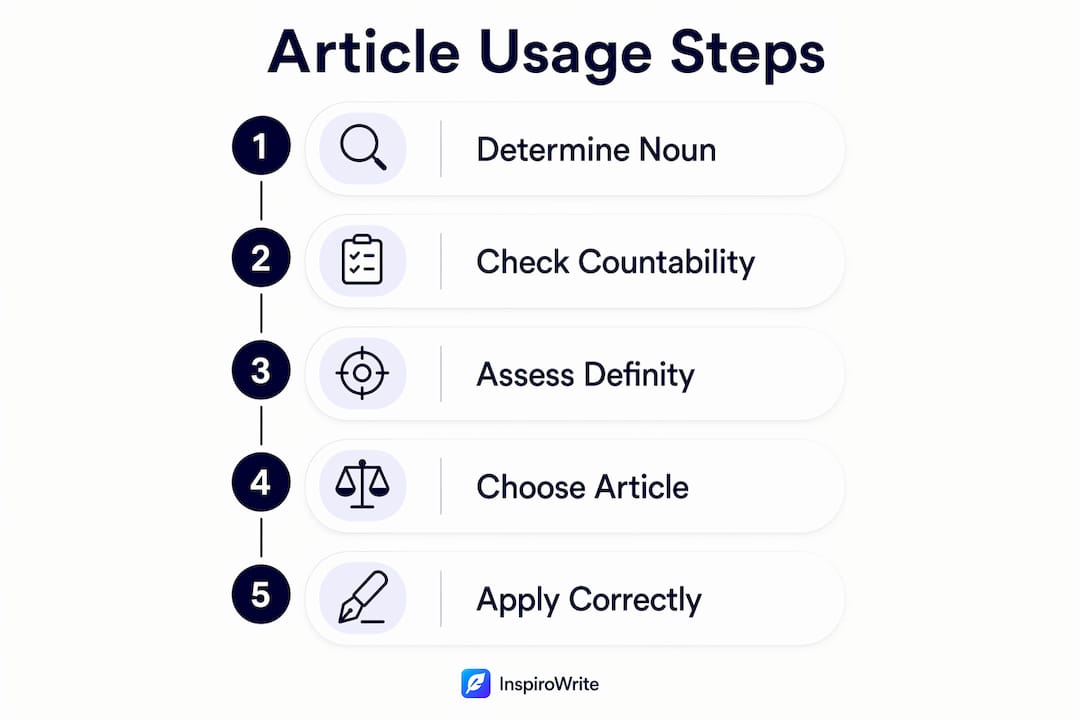
The three-question framework from the University of Toronto's Writing Advice is the clearest decision process available. Work through these steps before every noun you are unsure about.
-
Is the noun countable or uncountable? A noun is countable if you can put a number in front of it: four exams, two chairs. Words like concentration, honesty, or luggage are uncountable. Uncountable nouns never take "a/an."
-
Is it singular or plural? Only singular countable nouns take "a/an." Plural countable nouns and all uncountable nouns take either "the" (definite) or no article (indefinite).
-
Is it definite or indefinite? A noun is definite when your reader can identify exactly which one you mean, either from prior mention, shared context, or because only one exists. If it is definite, always use "the." If it is indefinite, never use "the."
A simple rule of thumb worth memorising: definite always takes "the"; indefinite never takes "the." The first time you mention a noun, it is usually indefinite. Every subsequent reference to that same noun becomes definite. For example: I found a photograph. The photograph was old. The second sentence uses "the" because the reader now knows exactly which photograph.
Pro Tip: When you are unsure whether a noun is definite, ask yourself: "Could my reader point to the exact thing I mean?" If yes, use "the." If not, use "a/an" or no article.
Common mistakes and exceptions you need to know
Even advanced learners trip over the same patterns. Misuse frequently occurs with abstract or uncountable nouns and with plural nouns used in a general sense. The table below shows the most common errors alongside the correct forms.

| Common mistake | Correct usage | Rule |
|---|---|---|
| The honesty is the best policy. | Honesty is the best policy. | No article with abstract uncountable nouns in general statements |
| I love the music. (general) | I love music. | No article for uncountable nouns in general reference |
| The dogs are loyal animals. (general) | Dogs are loyal animals. | No article for plural nouns in generic statements |
| She is the doctor. (profession) | She is a doctor. | Indefinite article for professions and roles |
| My the book is here. | My book is here. | Never combine an article with another determiner |
| I visited the France. | I visited France. | Most country names take no article |
| We crossed the Lake Windermere. | We crossed Lake Windermere. | Lakes take no article; rivers and oceans do |
Proper nouns: the UK-specific exceptions
Most proper nouns take no article, but the exceptions matter enormously for UK English. Countries such as Canada, France, and Germany need no article. However, "the United Kingdom" and "the United States" both require "the" because they are collective names made up of constituent parts. The same logic applies to geographic features: rivers, mountain ranges, seas, and oceans all take "the" (the Thames, the Alps, the Atlantic), while individual lakes do not (Lake Windermere, Lake Bala).
Learners also frequently combine articles with other determiners such as "my," "this," "each," or "every." This is always wrong. You cannot say the my car or a this book. The determiner replaces the article entirely.
British vs American English
Article usage varies between British and American English in a handful of specific contexts. British English says in hospital and at university with no article; American English typically uses in the hospital and at the university. These differences are worth knowing if you are writing for a UK audience, as the British forms sound more natural to native readers here. For a broader look at common grammar mistakes that affect non-native writers, the patterns around articles come up repeatedly.
Why getting articles right changes how fluent you sound
Article choice shapes the rhetorical and stylistic effect of a sentence in ways that go beyond strict grammar. Consider these three sentences, all grammatically acceptable:
- The lion is a majestic animal. (one representative stands for the whole species)
- A lion is a majestic animal. (any lion, taken from the class)
- Lions are majestic animals. (the whole group, stated directly)
All three mean the same thing, but each carries a slightly different emphasis. The first feels more formal and literary; the third is the most natural in everyday writing. Choosing between them is not a grammar decision. It is a style decision, and that is exactly where article usage influences fluency most.
Native speakers master article rules intuitively, absorbing them through years of reading and conversation without ever consciously applying a framework. For non-native writers, the path is different: deliberate practice with clear rules accelerates what would otherwise take years. The good news is that applying article rules consciously through examples and exercises produces measurable improvement in natural English flow. Effective communication tools can also support this process by exposing you to well-written English in context.
How AI tools can help you improve article accuracy
AI proofreading tools provide real-time grammar guidance that helps learners detect article errors far more efficiently than manual review alone. The benefits are practical and immediate.
- Instant error detection: AI flags incorrect or missing articles as you write, so you see the mistake in context rather than discovering it later.
- Contextual suggestions: rather than just marking an error, good AI tools explain why a particular article is wrong, reinforcing the underlying rule.
- Privacy-first feedback: Inspirowrite processes your text without storing it or using it to train models, which matters when you are working on sensitive academic or professional writing.
- Speed: corrections appear in seconds, keeping your writing momentum intact rather than breaking it for a manual grammar check.
- Consistent improvement: repeated AI feedback on the same error type builds pattern recognition over time, gradually reducing how often you make that mistake.
Inspirowrite is built specifically for writers and students who need accurate, fast feedback on grammar and style. It handles article errors alongside broader issues of tone and clarity, making it a practical companion for anyone working to write more natural English.
Practice exercises for mastering article usage
The most reliable way to build article instincts is to practise through examples drawn from real writing, not isolated drills. Try these approaches.
Fill-in-the-blank practice: Take a paragraph from a newspaper or academic text, remove all articles, and reinsert them using the three-question framework. Then compare your version with the original. Mismatches reveal exactly where your instincts need work.
First-mention tracking: Read any short article and highlight every noun on its first appearance. Ask yourself: is it definite or indefinite? Does it take "a/an," "the," or no article? This trains you to notice the definiteness shift that happens as a text develops.
Translation check: If you speak another language, translate a sentence from that language into English and pay attention to where articles appear or disappear. Many languages have no articles at all, which is why learners from those backgrounds find this area particularly tricky. A student's guide to English grammar rules can provide additional structured practice alongside these exercises.
How articles shape idiomatic expressions
Articles are embedded in dozens of English idioms, and changing or removing them breaks the expression entirely. "In the long run," "on the whole," "at a loss," "make a difference," "the other day" — each of these is fixed. You cannot say in long run or at the loss without sounding wrong to any native speaker.
Some idioms drop the article where you might expect one: at school, in hospital, by car, on foot. Others require "the" even though the noun is abstract: the truth, the point, the fact that. These patterns are best learnt as fixed phrases rather than derived from rules, because the rules do not always predict them. Reading widely in British English, particularly journalism and literary fiction, is the fastest way to absorb these idioms naturally. For a practical guide to avoiding ESL grammar mistakes that includes idiomatic article patterns, the Inspirowrite blog covers this ground in detail.
Ready to write with confidence? Inspirowrite gives you instant, privacy-safe feedback on article errors and grammar across your entire text. Try Inspirowrite and see the difference in your next draft.
Key takeaways
Definite nouns always take "the"; indefinite nouns never do — and that single rule resolves the majority of article decisions in English writing.
| Point | Details |
|---|---|
| Three-question framework | Ask: countable or not, singular or plural, definite or indefinite — then apply the correct article. |
| Definite vs indefinite rule | Definite nouns always take "the"; indefinite nouns never take "the." |
| Uncountable nouns | Never use "a/an" with uncountable nouns; use "the" only when the reference is specific. |
| Proper noun exceptions | The United Kingdom and the United States take "the"; most other countries do not. |
| Idioms are fixed | Article use in idiomatic expressions must be memorised, not derived from grammar rules. |
FAQ
What is the difference between "a," "an," and "the"?
"The" is the definite article, used when both writer and reader know exactly which noun is meant. "A" and "an" are indefinite articles, used with singular countable nouns when the noun is new or unspecified; "an" precedes vowel sounds and "a" precedes consonant sounds.
When do you use no article at all?
No article is used with uncountable nouns and plural countable nouns in general or indefinite reference, for example Water is essential or Dogs are loyal. Most proper nouns, including people's names and most country names, also take no article.
Why do "the United Kingdom" and "the United States" take "the"?
Both names refer to collections of constituent parts (kingdoms, states), so they follow the rule that collective or plural-component proper nouns take "the." Most single-unit country names such as France or Canada do not.
Can you use an article with words like "my" or "this"?
No. Determiners such as "my," "this," "each," and "every" replace the article entirely. Combining them produces an ungrammatical phrase such as the my book or a this chair.
How does British English differ from American English in article use?
British English omits the article in phrases like in hospital and at university, whereas American English typically uses in the hospital and at the university. Writers targeting a UK audience should use the British forms for natural-sounding prose.