

TL;DR:
- Grammar rules in English are essential for clear communication, credibility, and preventing ambiguity. Focusing on high-impact rules like subject-verb agreement, pronoun clarity, and tense consistency improves writing effectively. AI-assisted tools require solid grammar knowledge for accurate editing and evaluation of generated content.
Grammar rules in English writing are the structural framework that organises language, prevents ambiguity, and determines whether a reader trusts you or stops reading. The role of grammar rules in English writing extends far beyond avoiding red marks on an essay. It shapes how clearly your ideas land, how professional you appear, and how effectively you communicate under pressure. Research from 2026 confirms that explicit grammar instruction produces measurable gains in writing proficiency. Tools like Grammarly and Inspirowrite now make grammar feedback faster than ever, but knowing why the rules matter is what separates a writer who improves from one who just corrects.
How grammar rules improve writing clarity and coherence
Grammar is the difference between a sentence that guides a reader and one that makes them work. When your sentence structure is sound, your ideas move forward without friction. When it breaks down, readers pause, re-read, or give up entirely.
Syntax mastery correlates directly with higher writing accuracy. Students who understand how clauses, phrases, and modifiers function produce sentences that are correct and well-constructed. That is not a coincidence. Understanding structure lets you build sentences deliberately rather than by instinct alone.
Consider the difference between these two sentences:
- "Having finished the report, the deadline was met." (dangling modifier, unclear subject)
- "Having finished the report, the team met the deadline." (clear subject, logical flow)
The second sentence requires no extra effort from the reader. That ease is what good grammar delivers.
A 2026 study found a large effect size (Cohen's d = 3.29) for adverbial use after explicit grammar instruction. Writers who learned to deploy adverbials correctly produced work that scored at higher grade-level benchmarks. The implication is direct: targeted grammar learning produces measurable writing gains, not just marginal ones.
Common issues that grammar knowledge resolves include:
- Comma splices: Joining two independent clauses with only a comma. Fix by adding a conjunction or splitting into two sentences.
- Run-on sentences: Cramming multiple ideas into one sentence without proper punctuation. Fix by identifying where one thought ends and another begins.
- Pronoun ambiguity: Writing "she told her that her work was good" without clarifying who is who. Fix by naming subjects explicitly.
- Tense inconsistency: Shifting between past and present tense within a paragraph. Fix by choosing one tense and maintaining it throughout.
Pro Tip: When you revise a draft, read only the first sentence of each paragraph. If those sentences alone do not tell a coherent story, your paragraph structure needs attention before you address individual grammar errors.
Which grammar rules matter most for effective writing?
Not all grammar rules carry equal weight. Focusing on rules that affect comprehension and reader trust yields far better results than obsessing over rules that are largely stylistic or outdated.

High-impact rules are those that, when broken, confuse the reader or damage your credibility. Low-impact rules are those that grammarians debate but readers rarely notice.
| Grammar Rule | Impact Level | Why It Matters |
|---|---|---|
| Subject-verb agreement | High | Errors signal carelessness and confuse meaning |
| Pronoun clarity | High | Ambiguity forces re-reading and creates misunderstanding |
| Tense consistency | High | Inconsistency disrupts narrative flow and reader trust |
| Comma splices | High | Signals poor sentence control to academic and professional readers |
| Split infinitives | Low | Stylistic preference; rarely affects comprehension |
| Ending with a preposition | Low | Traditional rule; modern usage accepts it widely |
| Oxford comma | Medium | Context-dependent; can prevent genuine ambiguity in lists |
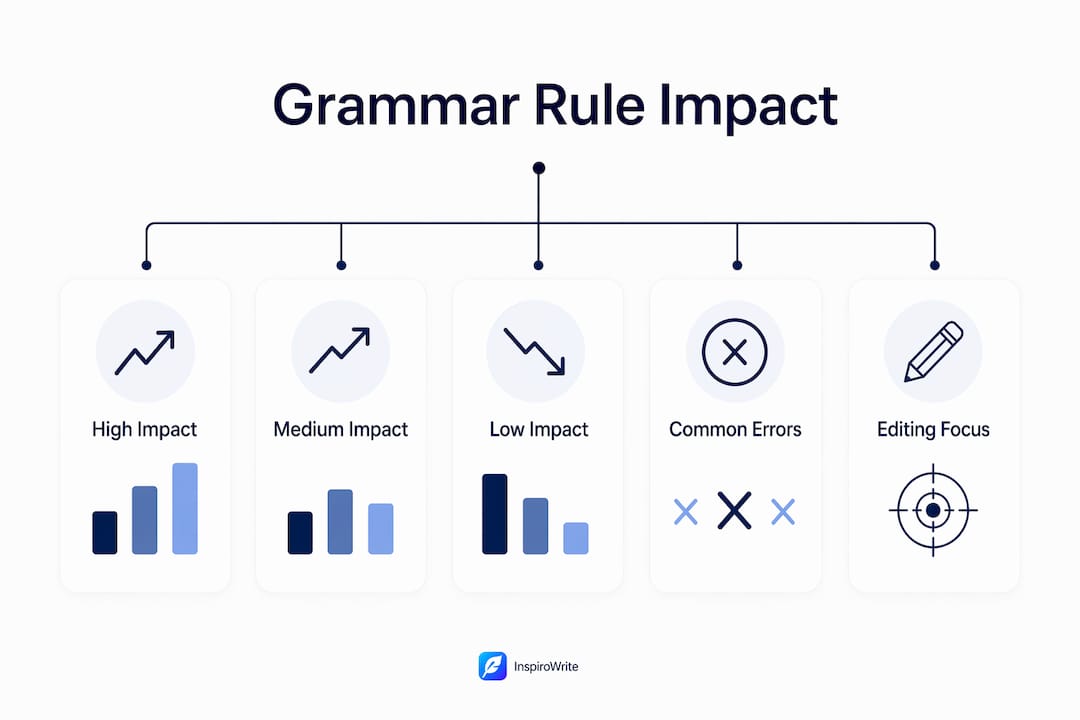
The practical takeaway is this: spend your editing time on the high-impact column first. Subject-verb disagreement and pronoun ambiguity are the errors that make readers question your competence. Splitting an infinitive does not.
Research also highlights a gap between classroom grammar knowledge and real-world application. Grammar awareness does not automatically transfer to professional writing. You need to practise applying rules in the contexts where they matter most, whether that is an academic essay, a job application, or a business report.
Pro Tip: Build a personal error log. Every time a teacher, editor, or tool flags a grammar error, write it down. After ten entries, you will see a pattern. Fix the pattern, not just the individual errors.
Does grammar knowledge still matter when using AI writing tools?
The short answer is yes, more than ever. Grammar is a guardian of meaning in the AI era, as Pearson's language experts describe it. AI tools generate fluent-sounding text, but fluency is not the same as accuracy or appropriateness.
AI writing tools misinterpret context regularly. A sentence like "The bank was steep" could refer to a riverbank or a financial institution. Without grammar and contextual knowledge, an AI may choose the wrong interpretation and build an entire paragraph around it. You need to recognise the error to catch it.
The rise of AI writing tools makes human grammar awareness more essential, not less. Here is why:
- AI cannot reliably detect tone. A grammatically correct sentence can still be inappropriate for its audience. Recognising that requires human judgement.
- AI misses nuanced agreement errors. In long, complex sentences, AI tools sometimes miss subject-verb disagreements that a grammar-literate reader spots immediately.
- AI-generated content can be confidently wrong. The output reads smoothly, which makes errors harder to spot without a trained eye.
- Grammar knowledge lets you edit AI output efficiently. Without it, you are proofreading in the dark, accepting or rejecting suggestions without understanding why.
Understanding English writing conventions gives you the critical framework to evaluate what any tool produces. AI is a capable assistant. Grammar literacy is what makes you a capable editor of that assistant's work.
How to apply grammar rules and avoid common errors
Knowing grammar rules and applying them under pressure are two different skills. A systematic editing process closes that gap.
Follow this sequence when editing any piece of writing:
- Fix structural errors first. Comma splices, run-on sentences, and sentence fragments are the highest-visibility errors. Experts recommend spending 5–10 minutes on a final grammar-specific pass targeting these issues before submission.
- Check subject-verb agreement throughout. Pay particular attention to sentences where the subject and verb are separated by a long phrase. The verb must agree with the subject, not the nearest noun.
- Audit pronoun references. For every pronoun, ask: is it immediately clear what or who this refers to? If not, replace the pronoun with the noun.
- Verify tense consistency. Read each paragraph and confirm the tense does not shift without reason. Academic writing typically uses past tense for completed research and present tense for established facts.
- Simplify complex sentences. Conservative, error-free grammar is consistently preferred over ambitious but flawed prose. If a sentence requires three attempts to untangle, split it into two.
- Read the text aloud. Reading aloud catches awkward phrasing and errors that your eyes skip over when reading silently. Your ear hears what your eye misses.
- Use a proofreading tool as a final pass. Tools like Grammarly or Inspirowrite catch residual errors after your manual review. Use them after your own editing, not instead of it.
A useful resource for students working through this process is this essay proofreading checklist, which maps grammar checks to specific stages of essay writing.
Pro Tip: Do not edit immediately after writing. Leave at least 30 minutes between drafting and editing. Distance makes errors visible that familiarity hides.
For a deeper look at the most frequent pitfalls, the common grammatical errors guide covers the errors that appear most often in student and professional writing, with practical fixes for each.
Key takeaways
Grammar rules in English writing are the foundation of clear, credible, and professional communication, and prioritising high-impact rules produces the greatest gains.
| Point | Details |
|---|---|
| Grammar shapes credibility | Subject-verb errors and pronoun ambiguity damage reader trust more than any stylistic choice. |
| Prioritise high-impact rules | Focus editing time on comma splices, tense consistency, and agreement before stylistic concerns. |
| Grammar literacy enables AI oversight | Without grammar knowledge, you cannot reliably evaluate or correct AI-generated writing. |
| Systematic editing outperforms instinct | A structured editing sequence catches errors that a single read-through consistently misses. |
| Application gap is real | Classroom grammar knowledge does not automatically transfer to professional writing without deliberate practise. |
Grammar rules and the writing habits that actually stick
Writers often ask me whether grammar rules matter less now that AI can catch errors automatically. My answer is always the same: grammar matters more now, not less, and for a reason most people overlook.
When you understand grammar, you read differently. You notice when a sentence is technically correct but tonally wrong. You catch the moment an AI tool has chosen the right word in the wrong context. You recognise that a passive construction is not just a style choice but a way of obscuring responsibility. That kind of reading is not something a tool can do for you.
The students I see struggle most are not those who make grammar errors. Everyone makes grammar errors. The ones who struggle are those who cannot distinguish between a serious error and a minor one. They spend twenty minutes debating whether to split an infinitive and miss the comma splice three lines above it. Knowing which rules genuinely affect communication changes how you edit and how quickly you improve.
There is also a career dimension that does not get enough attention. Grammar reinforces communicator credibility in ways that affect how employers and academic assessors judge your competence. A well-structured email or report signals that you think clearly. That perception is built sentence by sentence.
My honest advice: stop trying to memorise every grammar rule and start learning to recognise the ten errors that appear in your writing most often. Fix those, and your writing will improve faster than any grammar course promises.
— Mike
Polish your writing with Inspirowrite
Grammar knowledge gets you far. Inspirowrite gets you the rest of the way.
Inspirowrite is an AI-powered proofreading tool built for students and writers who need fast, accurate feedback without compromising their privacy. Your content is never used to train AI models, which matters when you are submitting original academic or professional work. Inspirowrite catches the grammar errors that slip through manual editing, from tense inconsistencies to pronoun ambiguity, and returns polished suggestions within seconds. You can review Inspirowrite's privacy and data practices before you start, so you know exactly how your writing is handled. Try it on your next draft and see the difference a second set of eyes makes.
FAQ
What is the role of grammar rules in english writing?
Grammar rules organise language, prevent ambiguity, and uphold a writer's credibility. They determine whether a reader understands your meaning on the first read or has to work to decode it.
Which grammar errors damage writing credibility the most?
Subject-verb disagreement, comma splices, pronoun ambiguity, and tense inconsistency are the highest-impact errors in professional and academic writing. These errors signal poor sentence control and undermine reader trust immediately.
Does grammar still matter when using AI writing tools?
Grammar knowledge is essential for evaluating AI output. AI tools misunderstand nuanced context and tone, so a grammar-literate writer is required to catch and correct errors that AI generates confidently.
How long should grammar editing take?
Experts recommend a dedicated 5–10 minute grammar pass at the end of your editing process, focusing on high-visibility errors like comma splices and run-on sentences before submission.
How can students improve grammar application in real writing?
Keeping a personal error log and practising grammar in the specific contexts where you write, such as essays or reports, closes the gap between classroom knowledge and real-world application. Structured tools like Inspirowrite provide immediate feedback that accelerates this process.