

TL;DR:
- Avoiding common ESL grammar mistakes improves clarity, confidence, and persuasiveness in English. Recognizing errors like subject-verb agreement, article use, verb tense, and prepositions helps learners correct patterns rooted in their native languages. Using structured feedback, reading aloud, and practicing daily accelerates mastery and promotes clear communication over perfection.
Avoiding common ESL grammar mistakes is the fastest way to make your English clearer, more confident, and more convincing. ESL, or English as a Second Language, is the recognised term for the field of teaching and learning English by non-native speakers. The most frequent errors fall into four categories: subject-verb agreement, article use, verb tense, and prepositions. Each category has a clear cause and a clear fix. This guide gives you both, using techniques grounded in established ESL teaching practice, so you can stop repeating the same errors and start writing with real authority.
What are the most frequent ESL grammar mistakes and why do they happen?
Grammar mistakes often stem from differences between English and a learner's first language. This is called language transfer, and it explains why speakers of Chinese, Arabic, Spanish, and dozens of other languages make predictable, consistent errors. Understanding the cause is the first step to fixing the problem.
Subject-verb agreement trips up learners at every level. The rule is simple: a singular subject takes a singular verb. Yet sentences like "She go to school every day" or "The team are winning" appear constantly in ESL writing. The confusion grows when collective nouns, indefinite pronouns like "everyone," or compound subjects enter the picture.
Article errors are among the most persistent common ESL grammar errors. Many languages, including Russian, Japanese, and Mandarin, have no direct equivalent of "a," "an," or "the." Learners either omit articles entirely ("I went to park") or add them where English does not use them ("The life is beautiful"). The rule that "the" signals something specific and "a" signals something general takes time to internalise.
Verb tense problems cause significant confusion. B1–B2 learners should avoid double-marking errors like "more taller" or "must to go," which add an extra grammatical marker where only one is needed. Mixing past and present tense within a single paragraph is equally common, and it makes writing feel unstable and hard to follow.
Preposition errors are almost always caused by direct translation. Many errors occur because learners translate word-for-word instead of learning English collocations as whole units. In Spanish, you say "depender de" (depend on), but the preposition changes across contexts in English. Learning "interested in," "good at," and "afraid of" as fixed phrases, rather than translating each word, removes this problem at its root.
- Subject-verb agreement: singular subjects need singular verbs ("She goes," not "She go")
- Articles: "a" for general reference, "the" for specific reference, no article for general plurals
- Verb tense: one tense per time frame; avoid double-marking like "did not went"
- Prepositions: learn them as fixed collocations, not word-for-word translations
- Double modals: never combine two modal verbs ("must to go" should be "must go")
How can you identify your ESL grammar mistakes effectively?
The most reliable method for identifying frequent grammar issues in ESL writing is keeping a personal error notebook. Every time a teacher, colleague, or feedback tool flags a mistake, write it down. Note the error, the correction, and the rule behind it. Consistent practice with structured feedback improves speaking and writing habits over time. Reviewing your notebook weekly reveals patterns you would never spot by reading a grammar textbook.
Pattern recognition beats rote memorisation every time. When you notice that you consistently write "I am agree" instead of "I agree," you have identified a pattern. That single insight is worth more than memorising a page of grammar rules, because it targets your specific weakness rather than a general one.
The substitution test is a quick fix for apostrophe errors. Replacing contractions with their full forms helps learners distinguish between possessive and contraction mistakes. If you write "it's," replace it with "it is" and read the sentence. If "it is" makes sense, the apostrophe is correct. If not, you need the possessive "its" without an apostrophe. This test takes three seconds and eliminates one of the most common errors in ESL writing.
Reading your writing aloud is the single most underused self-correction technique. Reading sentences aloud reveals awkward rhythms and missing grammar parts that silent reading misses. Your ear catches what your eye skips. When a sentence sounds wrong spoken out loud, it almost certainly reads wrong on the page.

Pro Tip: Record yourself reading a paragraph aloud, then play it back. You will hear missing articles, wrong verb forms, and clumsy prepositions far more clearly than you would by rereading the text silently.
| Method | What it catches | How to use it |
|---|---|---|
| Error notebook | Recurring personal mistakes | Write errors and corrections after every feedback session |
| Substitution test | Apostrophe and contraction errors | Replace "it's" with "it is" and check if the sentence still works |
| Reading aloud | Missing words, wrong rhythm, tense shifts | Read every draft aloud before submitting |
| AI proofreading | Spelling, grammar, style | Paste your text into a proofreading tool for instant feedback |
| Structured feedback loop | All error types | Identify, recall the rule, rewrite, speak the correction aloud |
For a deeper look at self-proofreading techniques, the Inspirowrite blog covers practical methods that work for ESL learners at every level.
Step-by-step approach to correcting common ESL grammar mistakes
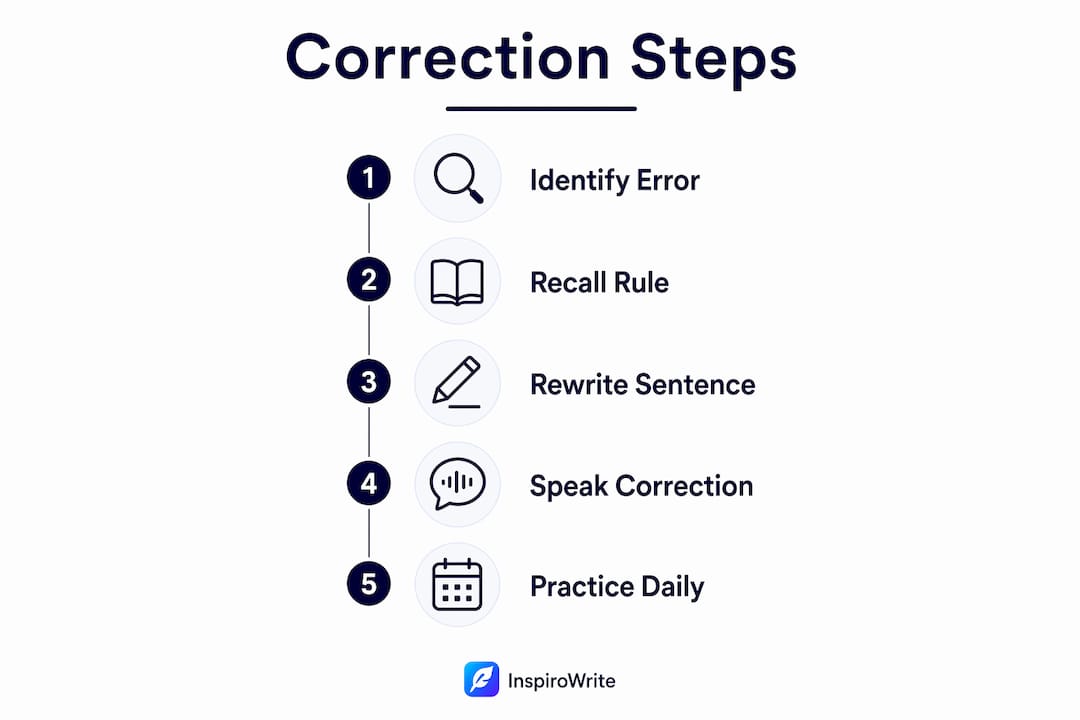
A structured feedback loop involving identification, recalling rules, rewriting, and speaking aloud is the most effective method to correct grammar errors. The key word is "structured." Random correction without a system produces random results. A clear sequence turns correction into a habit.
- Identify the specific mistake. Underline or highlight the error in your text. Name it: "This is a subject-verb agreement error" or "This is a missing article."
- Recall the rule. Do not just fix the word. State the rule aloud or write it in your notebook. "Singular subjects take singular verbs. 'She goes,' not 'She go.'"
- Rewrite the sentence correctly. Write the full corrected sentence, not just the corrected word. This builds the correct pattern in your memory.
- Speak the corrected sentence aloud. Practising one grammar topic at a time and rewriting sentences correctly helps build strong habits. Speaking the correction adds an auditory memory to the visual one.
- Write three similar sentences using the same rule. This step is what most learners skip, and it is the most important. One corrected sentence is a fix. Three new sentences are a habit.
Pro Tip: Focus on one error type per week. If you try to fix subject-verb agreement, articles, and prepositions simultaneously, you will make slow progress on all three. One at a time produces faster, more lasting results.
The table below compares two approaches to correction so you can see the difference in outcome clearly.
| Approach | Method | Result |
|---|---|---|
| Reactive correction | Fix the error and move on | Error reappears in the next piece of writing |
| Structured correction | Identify, recall rule, rewrite, speak, practise | Error reduces and eventually disappears |
Common pitfalls to avoid during correction include fixing only the underlined word without reading the whole sentence, correcting errors without noting the rule, and trying to fix every mistake in one sitting. Slow, deliberate practice with one error type at a time is what produces lasting improvement. For a comprehensive look at grammar rules for students, the Inspirowrite blog provides clear explanations with examples.
What difficulties do ESL learners face when avoiding grammar mistakes?
The biggest obstacle is the pressure to be perfect. Learners should prioritise clear communication over perfect grammar to improve fluency efficiently. Obsessing over every article or preposition slows your speaking, freezes your writing, and drains your motivation. The goal of grammar is to make your meaning clear, not to pass a grammar exam in every conversation.
Mistakes are a natural part of language learning, not a sign of failure. Every fluent English speaker made thousands of errors before reaching fluency. The difference between learners who improve and those who plateau is not talent. It is consistent, patient practice combined with honest self-review.
Balancing patience with discipline is harder than it sounds. Patience without practice produces no progress. Practice without patience produces burnout. The solution is a fixed, manageable routine: fifteen minutes of focused grammar practice per day beats two hours of exhausted cramming once a week.
Tips for sustaining progress without burning out:
- Read English content daily, even for ten minutes. Novels, news articles, and blogs all expose you to correct grammar in context.
- Listen to English podcasts or radio. Your ear absorbs correct patterns even when you are not actively studying.
- Write one short paragraph every day and review it using your error notebook.
- Celebrate small wins. Noticing that you no longer make a mistake you used to make is real progress.
- Accept that some errors will persist for months. That is normal. Consistency matters more than speed.
Language transfer from your first language is the root cause of most persistent errors. Understanding exactly how your native language differs from English helps you target the right problems.
Key takeaways
Avoiding common ESL grammar mistakes requires pattern recognition, structured correction, and consistent daily practice rather than memorising grammar rules in isolation.
| Point | Details |
|---|---|
| Know the four main error types | Subject-verb agreement, articles, verb tense, and prepositions cause the majority of ESL errors. |
| Use the substitution test | Replace contractions with full forms to catch apostrophe errors instantly. |
| Read your writing aloud | Speaking your text reveals missing words and wrong rhythms that silent reading misses. |
| Correct with a system | Identify, recall the rule, rewrite, speak aloud, and practise three new sentences. |
| Prioritise clear communication | Fluency improves faster when you focus on being understood rather than being perfect. |
Why pattern recognition changed how I think about ESL grammar
Most ESL learners I have worked with arrive believing that grammar is a set of rules to memorise. They carry thick textbooks and colour-coded notes. They can recite the rule for the present perfect tense but still write "I have went" in their essays. That gap between knowing a rule and applying it is the real problem, and memorisation does not close it.
What actually works is pattern recognition. When a learner notices that they always drop the article before "university" but never before "school," they have found a pattern. That pattern is worth more than ten grammar exercises, because it is personal, specific, and immediately correctable. Experts recommend shifting from rule memorisation to pattern recognition, accepting mistakes as natural in language learning. I think this is the most important shift any ESL learner can make.
Speaking corrections aloud is the technique I recommend most strongly, and it is the one learners resist most. There is something uncomfortable about hearing your own mistakes. Push through that discomfort. Your ear is a better editor than your eye, and speaking a correct sentence three times embeds it in a way that writing it once never does.
Clear communication is the goal. A sentence that conveys your meaning accurately, even with a minor article error, is a success. A grammatically perfect sentence that confuses the reader is a failure. Keep that hierarchy in mind every time you write or speak.
— Mike
How Inspirowrite supports your ESL grammar improvement
Grammar improvement is faster when you get immediate, specific feedback on your own writing rather than studying examples written by someone else.

Inspirowrite is an AI-powered proofreading tool built for exactly this purpose. It reviews your text in seconds, flags grammar errors with explanations, and preserves your privacy by never using your content to train AI models. For ESL learners, that combination of speed and specificity means you can paste a paragraph, see your errors highlighted with clear corrections, and apply the structured feedback loop described in this guide straight away. Visit Inspirowrite to see how fast your writing can improve. For further reading, the common grammatical errors guide on the Inspirowrite blog covers the most frequent mistakes writers make and how to fix them efficiently.
FAQ
What are the most common ESL grammar mistakes?
The four most frequent errors are subject-verb agreement, article misuse, verb tense problems, and preposition errors. These arise primarily from language transfer between a learner's first language and English.
How do I fix ESL grammar mistakes quickly?
Use a structured feedback loop: identify the error, recall the rule, rewrite the sentence, and speak the correction aloud. Practising one grammar topic at a time produces faster results than trying to correct everything at once.
What is the substitution test for apostrophe errors?
The substitution test means replacing a contraction with its full form to check whether it is correct. If "it's" can be replaced with "it is" and the sentence still makes sense, the apostrophe is correct.
Should I focus on perfect grammar or clear communication?
Clear communication is more valuable than flawless grammar for ESL learners. Focusing on subject-verb agreement and verb tense gives the highest return for your effort.
How often should I practise to improve my ESL grammar?
Fifteen minutes of focused daily practice beats longer, infrequent sessions. Reviewing your personal error notebook weekly and writing one short paragraph each day builds consistent, lasting improvement.