

To polish a rough draft essay, revise in focused passes: fix the structure first, then the paragraphs, then the sentences, and finish with a proofread. Work in that order and you never waste time perfecting a sentence that gets deleted when you restructure the argument two hours later. Revision is most effective when tackled in stages rather than all at once, because each pass has a different job and mixing them slows you down.
Two things you can do right now, before anything else:
- Step away for even 20 minutes. Fresh eyes catch structural problems that tired eyes miss entirely.
- Read the whole draft aloud, slowly and a little dramatically. Every stumble marks a sentence your reader will trip over too.
Pro Tip: Print the draft or switch fonts before your first pass. Seeing the text in an unfamiliar shape tricks your brain into reading it properly instead of skimming what you already know is there.
Key Takeaways
Polishing an essay works best as an ordered sequence of passes, structure first and sentences last, because each pass depends on the one before it being settled.
| Point | Details |
|---|---|
| Revise in passes | Fix structure, then paragraphs, then sentences, then proofread. Never mix the stages. |
| Diagnose before you edit | Do one uninterrupted read to spot confusion, drift, and evidence gaps before changing anything. |
| Test every paragraph | Check that each topic sentence previews the paragraph and links back to the thesis. |
| Read aloud, twice | Once slowly and dramatically for phrasing, once backwards for typos. |
| Use tools at the right stage | Inspirowrite works best on a near final draft, for fast, private grammar and style passes. |
Table of Contents
- How do you polish the structure of a rough draft essay?
- Do your paragraphs actually earn their place?
- What line-editing moves actually improve a sentence?
- What should be on your final proofreading checklist?
- How should you use feedback and digital tools when revising?
- Sources
- FAQ
How do you polish the structure of a rough draft essay?
Structure comes first because a beautifully written paragraph in the wrong place is still in the wrong place. Do one uninterrupted read of the whole essay with no red pen in hand. Just note, in the margin or a separate document, anywhere you got confused, anywhere the argument seemed to drift, or anywhere a claim showed up with no evidence behind it. That diagnostic read is worth more than three read-throughs done with editing in mind, because diagnosing structural problems before touching prose is standard advice across university writing centres, and for good reason.
Once you've got that list of trouble spots, work through a short structural checklist:
- Does the thesis still match what the essay actually argues, or has your thinking moved on since you wrote it?
- Does every major point from the introduction get proper coverage in the body?
- Is the order of points logical, building towards something, rather than just the order you happened to think of them?
- Where are the evidence gaps, the claims stated but never backed up?
Some writers find it useful to build a quick paragraph map: one line per paragraph stating what it does. That map exposes repetition fast (two paragraphs doing the same job) and makes it obvious where to cut, merge, or reorder. A pacing audit, where you colour code sections by how much energy or momentum they carry, works especially well for longer essays with a sagging middle section. If the thesis no longer fits the argument you've actually made, rewrite it now. Everything downstream depends on getting that sentence right first.
Do your paragraphs actually earn their place?
Every paragraph should do one job and do it in service of the thesis, not just supply information near the topic. Test each one with a simple question: does the topic sentence tell the reader what this paragraph is going to prove, and does that link back to your central argument?
Watch for paragraphs that are heavy on summary and light on analysis. If a paragraph mostly restates what a source said without explaining why that matters for your argument, it's not pulling its weight yet.
- Read only the first sentence of every paragraph, in sequence. Does that string of sentences sound like a coherent argument on its own?
- Flag any paragraph that's pure evidence with no analysis attached, then add a sentence explaining what the evidence proves.
- Check transitions between paragraphs. A jump from one idea to the next with no bridge phrase forces the reader to do work you should be doing.
- Cut anything that repeats a point already made elsewhere.
Pro Tip: A weak topic sentence often starts with "This essay will discuss..." Swap it for a sentence that states the actual claim the paragraph proves. "This essay will discuss the causes of the 1929 crash" becomes "Overproduction, not the stock market alone, triggered the 1929 crash."
What line-editing moves actually improve a sentence?
Sentence-level polishing is where most students start, which is exactly why it should come last. Fixing grammar on a paragraph you're about to delete is wasted effort, and prioritising clarity of argument before correctness of phrasing saves real time.
Once structure and paragraphs are solid, work through these fixes:
- Cut filler words: "sort of", "very", "really", "in order to" (just "to" works fine).
- Replace weak verb plus adverb combinations with one strong verb. "Walked quickly" becomes "hurried".
- Remove redundant prepositional phrases: "the reason for this is because" just means "because".
- Vary sentence length deliberately. A string of same-length sentences reads flat even when every sentence is technically correct.
- Watch for dangling modifiers, comma splices, and subject-verb agreement slips. They cluster near the end of long sentences where you lost track of the subject.
Reading aloud, slowly, catches most of these on its own; your voice trips over a sentence before your eye admits there's a problem.
What should be on your final proofreading checklist?
This is the last pass, done minutes before submission, and it's purely mechanical. No new arguments, no rewriting.
- Formatting: font, spacing, margins, heading style match the assignment brief exactly.
- Page numbers and word count are correct and visible.
- Citations and references match: every in-text citation has a corresponding entry in the reference list, and vice versa.
- Filename and file type match what's requested (a surprising number of marks get lost to a submitted .pages file when .docx was required).
- One slow, dramatic read-aloud pass for anything that still sounds wrong.
- One backward pass, reading sentence by sentence from the end, to catch typos your brain has started auto-correcting.
Reading a sentence backwards stops your brain from predicting what comes next, which is precisely why it catches errors a normal forward read skips over. Spellcheck and grammar tools handle typos and basic mechanics well; they cannot judge whether your evidence actually supports your argument or whether you've answered the actual essay question. That judgement stays manual, every time.
How should you use feedback and digital tools when revising?
Not all feedback carries equal weight, and running everything through a grammar tool on day one wastes its usefulness. A rough hierarchy works well: your instructor's rubric or written comments first, since they define what "good" means for this specific assignment. Peer reviewers next, particularly for catching confusion a stranger to your topic would hit. Writing centre tutors after that, if you have access to one, for structural and argument-level feedback. Digital tools last, once the bones of the essay are settled.
The most efficient order tends to be: make the big structural fixes yourself, get targeted feedback on the parts you're unsure about, then run a focused tool pass for grammar and style using the systematic review quality checklist for AI-assisted research, and finish with your own read-aloud proof. That sequence matters because tools are strongest at mechanical polish and pattern-spotting, while argument coherence and evidence quality genuinely need a human reader.
A student running a final tool pass wants speed and privacy in equal measure: fast turnaround so a last-minute polish doesn't cost hours, and confidence the essay isn't being stored or used to train someone else's model.
- If you're rewording heavily repeated phrasing, a tool that flags redundancy earns its keep fast, and Inspirowrite's approach to reducing repetition is worth a look for that specific fix.
- Never let a tool's suggestion overrule your own judgement on tone, especially if the assignment calls for a particular academic voice.
- Keep drafts you're not ready to submit out of any tool that doesn't guarantee privacy. That's a real consideration for coursework under a plagiarism policy, not a minor detail.
A note on getting this right
Students consistently over-invest in sentence polish and under-invest in structural honesty, mostly because line edits feel like progress while admitting your thesis doesn't hold up feels like failure. It isn't. The essays that read as effortless are almost always the ones where the writer cut a paragraph they'd spent an hour perfecting because it no longer fitted the argument. For further reading on turning that discipline into a routine, our proofreading checklist for students covers the final stage in more depth.
Where Inspirowrite fits in your final pass
Inspirowrite is built for exactly the moment described above: your structure is settled, your paragraphs are doing their job, and you need a fast, private grammar and style pass before you submit. It processes your draft in seconds rather than minutes, and it never uses your writing to train its own models, which matters if your essay is still under an active plagiarism check or you'd simply rather your unfinished thoughts stayed unfinished and private.
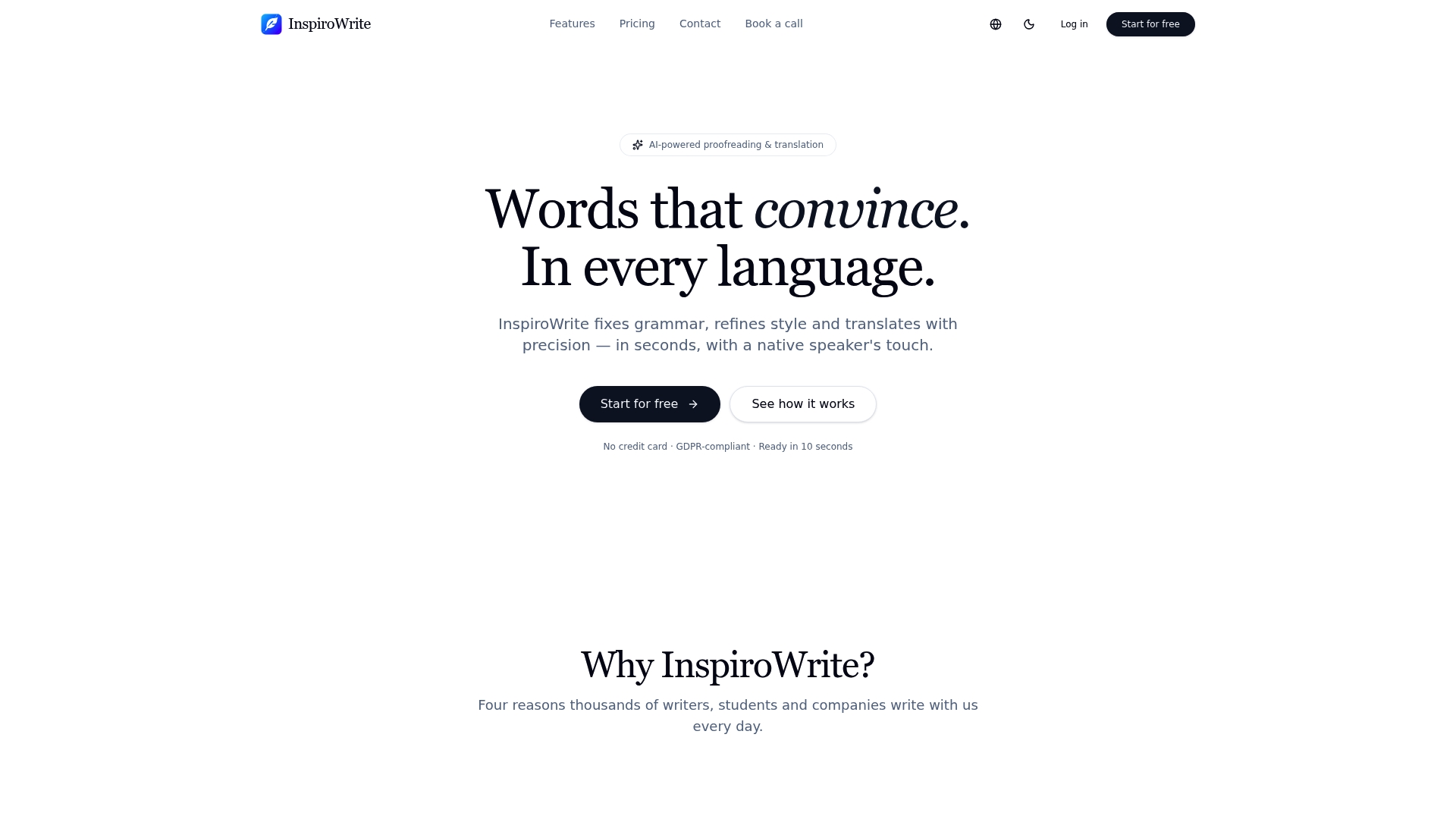
Paste your near final draft in, run a focused pass for grammar, tone, and wordiness, then do your own slow read-aloud proof afterwards. The tool catches the mechanical slips; your ear catches the last few things that only a human notices. If you want to see how this fits your own workflow, try the free plan on Inspirowrite before your next deadline.
Sources
FAQ
What does a rough draft essay actually look like?
A rough draft usually has a working thesis that may shift, uneven paragraph development, some unsupported claims, and rougher phrasing throughout. It's meant to get the argument down, not to read cleanly yet.
How do I polish my essay properly?
Revise in passes: fix the overall structure and thesis first, then strengthen each paragraph, then edit sentences for clarity, then run a final proofread. Reading the whole thing aloud catches problems a silent read misses at every stage.
Can I write and polish a 1,000 word essay in two days?
Yes, if you split the time by pass rather than by section. Spend day one on structure and paragraphs, and reserve day two for sentence-level editing and a proper proofread, including a read-aloud pass.
How do you get a strong mark on every essay?
There's no single trick, but essays that score well consistently show a clear thesis carried through every paragraph, evidence paired with analysis rather than left to speak for itself, and a final proofread that catches the small errors a rushed submission leaves behind.