

The fastest way to reduce repetition in essays is a single targeted edit pass: delete redundant word pairs and intensifiers, replace close repeats with pronouns or pro-forms, then run a reverse outline to catch ideas you have said twice in different paragraphs. Most students can clear the majority of repetition in under an hour using exactly this sequence.
Three actions to start right now:
- Delete redundant pairs and intensifiers. Phrases like "each and every," "full and complete," and "very unique" add zero meaning. Cut one word from each pair; cut the intensifier entirely.
- Replace repeated nouns with pro-forms. If you have just named "the argument," the next sentence can say "this" or "it." The British Council's grammar guidance specifically recommends pro-forms such as this, that, and do so to shorten text without losing formality.
- Run a reverse outline. Write one sentence summarising each paragraph, then read those sentences in sequence. Duplicate ideas become obvious immediately. The WFU Writing Center recommends this as the primary diagnostic for idea-level repetition.
Before and after:
Before: "The study shows that the results of the study demonstrate a clear pattern." After: "The study demonstrates a clear pattern."
A tool like Inspirowrite can speed up the final pass by flagging high-frequency words and offering rephrase suggestions, so you spend your time on judgement calls rather than hunting for repeats manually.
Key takeaways
Reducing repetition in essays requires three distinct moves: a structural reverse outline to catch conceptual duplication, sentence-level edits to remove redundant pairs and apply pro-forms, and a style pass to vary rhythm and sentence openings.
| Point | Details |
|---|---|
| Structural pass first | Run a reverse outline before touching sentence-level wording to avoid polishing text you will later cut. |
| Delete redundant pairs | Remove one word from pairs like "full and complete"; cut intensifiers like "very" and "basically" entirely. |
| Use pro-forms | Replace repeated nouns and verbs with this, that, or do so to maintain formality while cutting length. |
| Three separate passes | Structural, style, and mechanical passes reduce cognitive load and prevent over-editing. |
| Inspirowrite for the final pass | Use Inspirowrite's rephrase and shorten features to flag high-frequency words and get instant suggestions. |
Table of Contents
- How do you spot repetition in your own draft?
- Micro-edits that cut repeated words at sentence level
- How does a reverse outline fix repetition across paragraphs?
- Style moves that reduce the feel of repetition
- A multi-pass editing workflow that actually works
- When should you keep repetition in an essay?
- What tools and resources help you find repetition?
- A research-backed checklist you can print and use
- Why repetition is so hard to see in your own work
- Inspirowrite speeds up your final editing pass
- Sources
- FAQ
How do you spot repetition in your own draft?
Repetition in essays shows up at two distinct levels, and confusing them leads to the wrong fix.
Sentence-level repetition is the obvious kind: the same word or phrase appearing twice within a few lines, redundant pairs ("basic fundamentals," "past history"), and intensifiers that do nothing ("basically," "actually," "very"). It is easy to miss when you are reading your own work because your brain fills in meaning automatically.
Idea-level repetition is subtler and more damaging to an essay's structure. This is where you make the same claim in paragraph two and again in paragraph five, or use two different examples that illustrate exactly the same point. A reader notices this as a vague sense that the essay is going in circles, even if they cannot pinpoint why.
How to run a reverse outline
Extract one sentence per paragraph that captures its central claim. Do not copy the topic sentence verbatim; write what the paragraph actually argues. Then read those sentences in order. If two sentences say the same thing, you have conceptual repetition. If one sentence is vague or missing, the paragraph may not have a clear point at all.

Academic guides also warn against a specific trap: repeating the exact wording of the essay question in your introduction. Rephrasing the prompt in your own terms both avoids stale repetition and signals to the reader that you understand the question rather than just echoing it.
Pro Tip: Use the Find function in Microsoft Word or Google Docs to search for your three or four most-used words. Do not just count occurrences; read each one in context to decide whether it is a problem or a necessary technical term.
Micro-edits that cut repeated words at sentence level
Sentence-level repetition usually falls into three categories, each with a clean fix.
Redundant pairs and meaningless intensifiers are the quickest wins. The UNC Writing Center advises deleting one word from circular pairs and trimming intensifiers that add no precision:
- "each and every" → "every"
- "full and complete" → "complete"
- "very important" → "important" (or choose a stronger adjective: "critical")
- "basically argues" → "argues"
- "actually demonstrates" → "demonstrates"
Grammatical substitutions and pro-forms are underused in academic writing. Once you have named a concept, subsequent sentences can refer to it with this, that, these, or those. Verbs can be replaced with do so. The British Council's guidance on avoiding repetition treats this as a formal, precise technique rather than a shortcut.
Before: "The researcher collected data. The researcher then analysed the data." After: "The researcher collected data and then analysed it."
Function swaps are worth knowing when pro-forms feel awkward. If you keep repeating the verb "analyse," try converting it to a noun: "the analysis revealed" instead of "analysing the data revealed." This changes the sentence rhythm and avoids the slightly desperate feel of a thesaurus swap. Practitioner guides consistently favour function changes over single-word synonym substitutions for exactly this reason.
Pro Tip: Before reaching for a thesaurus, try a function swap or a pro-form. A synonym chosen under pressure often sounds wrong in context; a grammatical substitution almost never does. Reserve the thesaurus for cases where you genuinely need a different shade of meaning.
Understanding English writing conventions more broadly can also help you recognise which grammatical patterns tend to generate repetition in the first place.
How does a reverse outline fix repetition across paragraphs?
Sentence-level edits cannot fix an essay that repeats the same idea in three different paragraphs. That requires a structural pass, and the reverse outline is the right tool for it.
Step-by-step reverse outline
- Extract. Write one sentence per paragraph summarising its central claim. Keep it to your own words.
- Map. List those sentences in order. Note what evidence each paragraph uses.
- Flag. Mark any two sentences that make the same claim, or any two paragraphs that use the same example.
- Resolve. For flagged pairs, either consolidate them into one stronger paragraph or replace one with new evidence that actually advances the argument.
The WFU Writing Center recommends colour-coding as a companion technique: assign a colour to each distinct idea, then highlight your reverse-outline sentences. Two paragraphs in the same colour are candidates for merging.
Here is a compact example. Suppose your reverse outline produces:
- Para 1: "Social media increases anxiety in adolescents."
- Para 3: "Research shows social media use correlates with higher anxiety rates in teenagers."
- Para 5: "Studies confirm that adolescents who use social media report greater anxiety."
All three say the same thing. The fix is to keep the strongest paragraph, fold any unique evidence from the other two into it, and use the freed space for a point you have not yet made.
| Structural checklist item | Action |
|---|---|
| Duplicate claims | Merge into one paragraph; keep the strongest evidence |
| Repeated examples | Delete the weaker instance; replace with new evidence |
| Vague topic sentences | Rewrite to make the claim specific |
| Orphaned evidence | Relocate to the paragraph whose claim it actually supports |
Style moves that reduce the feel of repetition
Even after structural and sentence-level edits, an essay can still feel monotonous if every paragraph opens the same way or uses the same connective tissue. These style techniques address that.
Vary your sentence openings. Starting five consecutive sentences with "This" or "Therefore" creates a mechanical rhythm that reads as repetitive even when the content differs. Try opening with:
- A time marker: "By the mid-twentieth century, researchers had established..."
- A concessive clause: "Although the evidence is mixed, the dominant finding suggests..."
- A short declarative: "The pattern is consistent."
Use transitions purposefully, not automatically. "Moreover," "furthermore," and "additionally" are not wrong, but inserting them at the start of every paragraph signals that you are listing rather than arguing. A well-constructed paragraph often needs no transition word at all; the logic carries the reader forward.
One concrete example per paragraph. Repeating abstract terms ("agency," "discourse," "hegemony") across multiple paragraphs without grounding them in a specific case makes the essay feel circular. One precise example per paragraph anchors the abstraction and removes the need to restate it.
Pro Tip: Deliberate repetition — anaphora — is a legitimate rhetorical device. "We shall fight on the beaches, we shall fight on the landing grounds, we shall fight in the fields" works because the repetition is intentional and builds momentum. The rule of thumb: if you are repeating a phrase for emphasis across three or more parallel structures, keep it. If you are repeating it because you forgot you already used it, cut it.
A multi-pass editing workflow that actually works
Trying to fix structure, style, and grammar in a single read-through is how students end up changing things that were fine and missing things that were not. Experienced editors separate revision into distinct passes to reduce cognitive load and prevent over-editing.
Pass 1: Structural (30 minutes). Run the reverse outline. Identify and resolve conceptual repetition. Do not touch sentence-level wording yet.
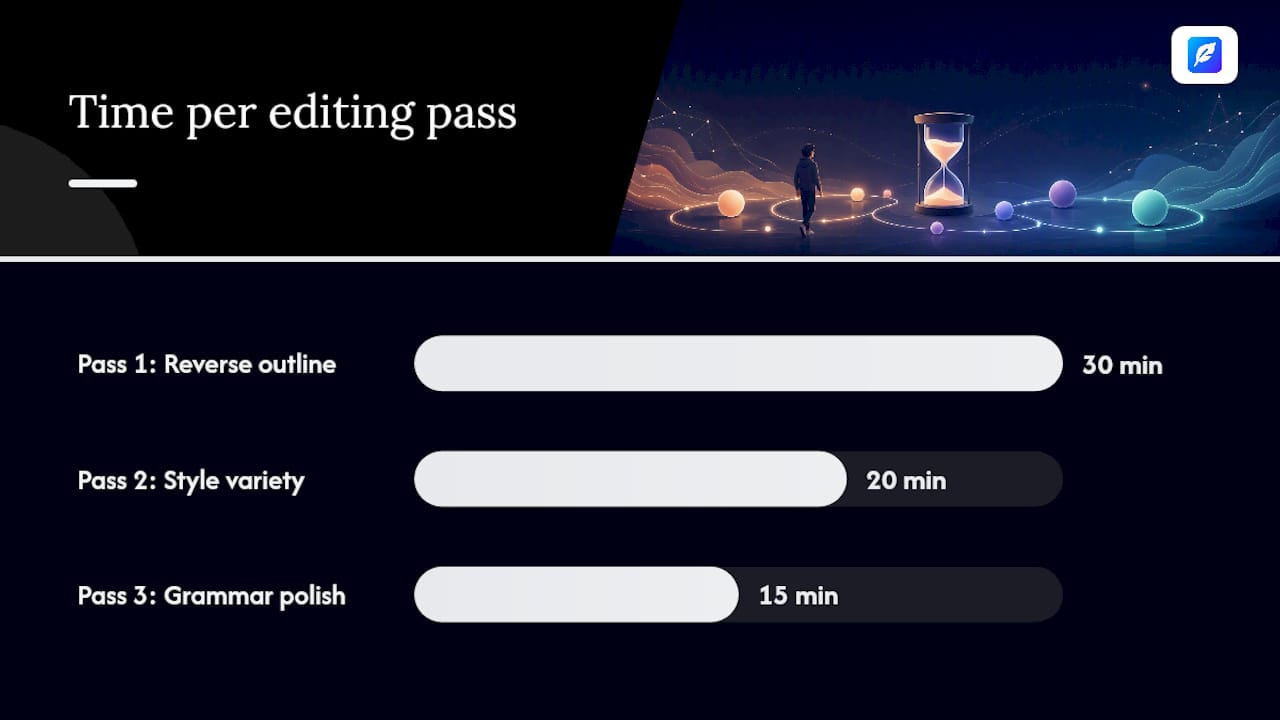
Pass 2: Style and variety (20 minutes). Work through the essay sentence by sentence. Apply pro-forms, delete redundant pairs, vary sentence openings. This is also when you consult your personal ban list (see the Perspective section below).
Pass 3: Mechanical polish (15 minutes). Grammar, punctuation, spelling. A last-minute proofreading checklist can help you stay systematic here without losing focus.
Space the passes. Even a 20-minute break between Pass 1 and Pass 2 lets you read the essay more like a stranger would. Reading aloud during Pass 2 is particularly effective: your ear catches repeated sounds and rhythms that your eye skips over. Printing the essay and marking it by hand also works; the physical distance from the screen changes what you notice.
| Pass | Focus | Key actions |
|---|---|---|
| 1: Structural | Idea-level repetition | Reverse outline, merge duplicate paragraphs |
| 2: Style | Word and sentence variety | Pro-forms, ban list, sentence-opening variation |
| 3: Mechanical | Grammar and punctuation | Spelling, punctuation, final word check |
When should you keep repetition in an essay?
Not all repetition is a problem. Removing it by reflex can actually weaken your writing.
Technical terminology must stay consistent. If your essay is about "cognitive load theory," switching to "mental effort framework" mid-essay to avoid repetition confuses the reader and suggests you are unsure of the term. Precision requires consistency.
Anaphora and rhetorical emphasis are deliberate. Repeating a phrase at the start of successive clauses builds rhythm and force. Academic writing uses this sparingly but effectively in conclusions and thesis statements.
Pedagogical clarity sometimes requires restating a complex idea in slightly different terms so the reader can follow the argument. This is not redundancy; it is scaffolding.
A practical test: ask whether the repeated element adds something the first instance did not. If the answer is yes, keep it. If the answer is "I just needed to fill the sentence," cut it.
What tools and resources help you find repetition?
The most useful tools for eliminating redundancy in writing share a few key features: a word-frequency or repeat report, a find-and-highlight function, and some form of rephrase or shorten suggestion. No tool makes the final call for you; each one surfaces candidates for your review.
When evaluating any writing tool, look for:
- High-frequency word reports that show which words appear most often across the full text
- Contextual rephrase suggestions that offer alternatives without forcing a synonym swap
- Shorten or condense functions that flag wordy constructions
- Privacy-assured processing so your draft is not stored or used to train models
Inspirowrite covers all of these. Its rephrase and shorten features work at sentence level, and its processing does not use your content to train AI models, which matters when you are submitting original academic work. You can paste a paragraph, see which phrases are flagged as repetitive or wordy, and decide whether the suggestion fits. It is a prompt, not an automatic fix.
For structural diagnosis, the WFU Writing Center's reverse-outlining guidance and the UNC Writing Center's conciseness handout are the two most practical free resources available. Purdue OWL's wordiness guide is the best single reference for sentence-level cuts. The British Council's grammar section covers pro-forms and grammatical substitution in detail.
For a broader look at rephrasing tools and how to use them without losing your voice, the rewording tool alternatives guide on the Inspirowrite blog compares approaches worth knowing about.
A research-backed checklist you can print and use
The items below draw on guidance from WFU, UNC, Purdue OWL, and the British Council. Work through them in order during your revision passes.
| Checklist item | Why it matters | Example action |
|---|---|---|
| Run a reverse outline | Exposes idea-level repetition invisible to line editing | Write one sentence per paragraph; flag duplicates |
| Delete redundant pairs | Each pair adds a word with no added meaning | "basic fundamentals" → "fundamentals" |
| Cut meaningless intensifiers | They weaken rather than strengthen the claim | "very significant" → "significant" |
| Apply pro-forms | Reduces noun/verb repetition while keeping formality | "the argument... it" not "the argument... the argument" |
| Vary sentence openings | Prevents rhythmic monotony even when content differs | Alternate time markers, concessive clauses, short declaratives |
| Build a personal ban list | Targets your specific repetition habits efficiently | Circle your three most-used filler words after the first draft |
University writing centres consistently recommend addressing structure before style: fixing conceptual repetition first means you are not polishing sentences that may be cut entirely.
Why repetition is so hard to see in your own work
Repetition creeps into student drafts for a straightforward reason: when you are writing under pressure, you reach for the words you already know are working. The same phrase that felt precise in paragraph two feels safe again in paragraph five. The problem is not laziness; it is familiarity. Your brain reads what it expects to see, not what is actually on the page.
The multi-pass method described here works precisely because it separates the tasks. You cannot reliably spot structural repetition and sentence-level repetition in the same read-through; the cognitive load is too high. Structural pass first, style pass second, mechanical pass third. That sequence is not arbitrary; it reflects how professional editors actually work.
One habit worth building immediately: after your first draft, circle the five words you used most and write them on a sticky note. That is your ban list for the revision. Practitioner guides consistently find that a short, personalised ban list reduces repetition faster than any general rule because it targets your specific patterns rather than generic advice. Inspirowrite's word-frequency feature can generate that list in seconds, which is a good starting point before you begin Pass 2.
Inspirowrite speeds up your final editing pass
Repetition is one of the hardest things to catch in your own writing because familiarity blinds you to it. Inspirowrite gives you a second set of eyes in seconds, without sending your draft to a server that stores or learns from it.
Paste any paragraph into Inspirowrite and you get immediate rephrase and shorten suggestions, a clear view of high-frequency words, and options to rewrite for tone or concision. The privacy-assured processing means your academic work stays yours. It is not a replacement for the reverse-outline method or your own editorial judgement; it is the tool that handles the mechanical hunting so you can focus on the decisions that actually matter.
Start with Inspirowrite's free plan to run a short extract through the rephrase and shorten features before your next submission.
Sources
The four resources below underpin the techniques in this guide. The WFU Writing Center's repetition tip is the clearest practical explanation of reverse outlining and colour-coding for idea-level diagnosis. The UNC Writing Center's conciseness handout covers redundant pairs and intensifiers in detail, with examples you can apply directly. Purdue OWL's wordiness guide is the best reference for rewriting wordy constructions at sentence level. The British Council's grammar section on avoiding repetition explains pro-forms and grammatical substitution with worked examples suited to academic writing.
- Tuesday’s Tip: Repetition, Repetition, Repetition – Writing Center
- Writing concisely – The Writing Center (UNC)
- Avoiding repetition in text – British Council
- Eliminating words to improve concision – Purdue OWL
FAQ
How do you reduce repetition in an essay quickly?
Run one targeted edit pass: delete redundant pairs and intensifiers, replace close repeats with pronouns or pro-forms, then use a reverse outline to find ideas you have stated more than once. Most repetition clears in under an hour using this sequence.
What are the most common types of repetition in essays?
Sentence-level repetition (the same word or phrase appearing twice in close proximity) and idea-level repetition (the same claim or example appearing in multiple paragraphs) are the two main types. Each requires a different fix: pro-forms and deletion for the first, reverse outlining and consolidation for the second.
When is repetition acceptable in academic writing?
Repetition is acceptable when it is deliberate: consistent technical terminology, rhetorical anaphora for emphasis, or restating a complex idea in different terms to aid clarity. The test is whether the repeated element adds something the first instance did not.
What are the 5 C's of essay writing?
Definitions vary across institutions, but a widely used version lists Clear, Concise, Coherent, Correct, and Complete. Reducing repetition directly supports the first two: clarity suffers when the same idea appears multiple times, and concision requires cutting words that add no meaning.
How does Inspirowrite help with repetition in essays?
Inspirowrite flags high-frequency words, offers rephrase and shorten suggestions at sentence level, and processes your text without storing it or using it to train AI models. It works best as a complement to the reverse-outline method, handling the mechanical detection while you make the editorial decisions.