

TL;DR:
- If you have less than 60 minutes before submission, focus on fixing spelling, citations, and word count without altering your argument. Spending 15 minutes on mechanics and 60 minutes on structure and references ensures a solid final draft, while longer periods allow thorough revision and accuracy. Prioritize thesis clarity, citation integrity, and sentence mechanics to maximize your grade under time pressure.
If you have under 60 minutes before submission, do these five things now: check your thesis matches the prompt, run a spell-check pass, fix any broken citations, confirm your word count sits within tolerance, then save with the correct filename. That is your minimum viable proofread.
- Reread your thesis sentence and compare it word-for-word against the essay question
- Run your spell-checker once, accepting only changes you understand
- Scan your bibliography for missing author names, dates, or page numbers
- Check your word count against your department's tolerance (many UK institutions allow 10% either way)
- Save as the correct file format (usually PDF or .docx) with the filename your department specifies
- Back up to cloud storage before you close the document
TL;DR: With 15 minutes left, fix mechanics only. With 60 minutes, add a structure and citation pass. With 3 hours, run all four passes below. With a full day, use the complete 1,440-minute template.
Table of Contents
- What can you realistically fix when time is tight?
- What to do with 15, 60, 180, or 1,440 minutes left
- Which copy-edit tasks actually move your grade?
- Which tools and techniques actually save time?
- How Inspirowrite can help when you cannot finish the pass yourself
- The last 10 minutes: what to check before you hit submit
- Key takeaways
- What editors actually look for under pressure
- Inspirowrite: instant private proofreading when the deadline is close
- Further reading and quick references
- FAQ
What can you realistically fix when time is tight?
The honest answer: mechanics, citations, and thesis clarity. Not your argument.
Fixes that are realistic in the final hours:
- Spelling and punctuation errors
- Broken or incomplete references
- A muddled thesis sentence (rewrite it, do not restructure the essay)
- Paragraph order within a section (move one paragraph, not five)
- Repeated words or obvious tautologies
- Word count trimming to stay within tolerance
What to accept and leave alone:
- Core argument structure
- New research or additional sources
- Wholesale rewriting of any section
- Changing your essay question interpretation
Pro Tip: Revising (argument-level changes) and proofreading (mechanical fixes) use different parts of your brain. Mixing them under pressure means you do neither well. Decide which mode you are in before you start a pass, and keep the two tasks separate.
UK students should also note that referencing errors carry real grade penalties. The University of Warwick recommends reserving 2–3 hours at the end specifically for reading through and fine-tuning references.
What to do with 15, 60, 180, or 1,440 minutes left
| Time left | Pass name | Focus | Expected outcome |
|---|---|---|---|
| 15 minutes | Mechanical pass | Spelling, punctuation, filename, word count | No surface errors on submission |
| 60 minutes | Structure + citations | Thesis clarity, paragraph logic, bibliography | Coherent argument, clean references |
| 180 minutes | Full four-pass | Thesis → structure → sentence mechanics → references | Publication-ready draft |
| 1,440 minutes | Complete review | All passes plus a rest break before final read | Confident, polished submission |
The 15-minute plan
You have one job: catch errors that will cost you marks on sight. Run spell-check, fix any citation that is obviously broken, confirm the word count, rename the file correctly, and submit. Do not touch the argument.
The 60-minute plan
Spend the first 15 minutes on your thesis and paragraph order. Read your introduction, then your conclusion. Do they match? If not, adjust one sentence in each. Spend the next 30 minutes on citations: check every in-text reference has a corresponding bibliography entry. Use the final 15 minutes for a mechanical pass.
The 180-minute plan
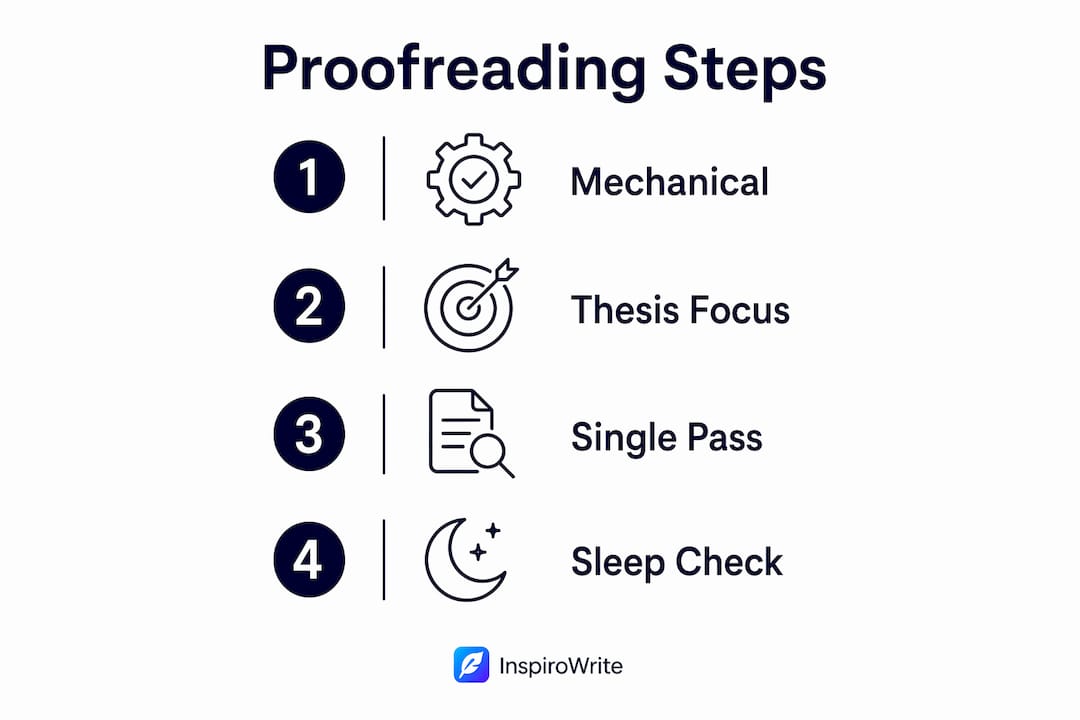
Use the single-issue pass strategy recommended by academic writing centres: one pass per error type. Pass one (30 min): thesis and argument coherence. Pass two (45 min): paragraph structure and transitions. Pass three (45 min): sentence-level mechanics. Pass four (30 min): references and bibliography. Final 30 minutes: read aloud from start to finish.
The 1,440-minute plan
Run all four passes above, then sleep on it. A fresh read the morning before submission catches errors that fatigue hides. The Warwick student toolkit advises building this final block into your schedule rather than treating it as optional.
Which copy-edit tasks actually move your grade?
Sentence-level fixes that examiners notice fall into a short list. Work through these in order.
Highest-impact fixes:
- Tighten the thesis sentence: it should state your argument and its basis in one sentence, with no hedging words like "perhaps" or "might suggest"
- Cut every instance of "very", "quite", "rather", and "somewhat" — they weaken claims without adding meaning
- Remove repeated phrases: search for your three most-used content words and cut at least one instance of each
- Shorten sentences over 30 words by splitting at the main conjunction
- Fix punctuation that changes meaning: missing commas after introductory clauses, apostrophe errors, and misplaced colons
- Mark any in-text citation missing a page number and add it before moving on
Pro Tip: Use find-and-replace to locate weak words fast. Search "very " (with a space) and review each hit. Do the same for "it is" and "there are" — both often signal a passive construction you can tighten. For a full list of common grammar errors worth checking, keep a reference tab open while you work.
Academic writing centres confirm that single-issue passes reduce cognitive load and increase error detection compared with reading through once looking for everything at once.
Which tools and techniques actually save time?
Speed comes from reducing the number of times your eyes slide over the same error. These techniques break that habit.
Techniques that work:
- Read aloud: your voice catches missing words, rhythm breaks, and punctuation errors that silent reading misses — this is one of the fastest detectors available for a final pass
- Text-to-speech (TTS): paste your text into your device's built-in TTS reader or a browser extension; hearing the essay read back to you at normal speed surfaces awkward phrasing immediately
- Change the font or zoom level: switching from your drafting font to something different (or printing the page) forces your brain to process the text as new
- Single-issue passes: do not try to catch everything at once — one pass for punctuation, one for citations, one for word choice
Tools worth using:
- Your word processor's built-in spell-checker (accept only changes you understand)
- Grammarly or LanguageTool for a second mechanical pass
- Find-and-replace for weak words and formatting inconsistencies
- A reference manager (Zotero, Mendeley) to cross-check bibliography entries quickly
- FinalDraft's export and session recovery features to avoid losing edits when working fast
AI grammar tools assist with surface errors but cannot replace your judgement on argument and tone. Treat every AI suggestion as a prompt to think, not a final answer — industry commentary consistently notes that AI assists but does not replace human proofreading.
Pro Tip: Turn off auto-correct and "suggested edits" before your final read-through. Auto-formatting can silently change punctuation, capitalisation, or spacing in ways that are hard to spot — and hard to explain to a marker.

How Inspirowrite can help when you cannot finish the pass yourself
When the clock is genuinely against you, Inspirowrite offers instant AI-powered proofreading that returns results in seconds, not hours. Your draft stays private: content is never used to train AI models, which matters when submitting original academic work.
How to use it quickly:
- Paste your essay text or upload your file directly
- Select the urgent proofreading option
- Review the suggested corrections and accept the ones that improve clarity
- Download the corrected version and submit
Pro Tip: Inspirowrite works best as your final mechanical pass, not a substitute for the argument and citation checks you need to do yourself. Use it after your thesis and reference passes are complete. For context on what a final proofreading pass should cover, the academic proofreading guide on the Inspirowrite blog sets out the scope clearly.
Privacy is built into the service: your text is not stored or used for model training, which addresses the main concern students have about submitting draft work to an online tool.
The last 10 minutes: what to check before you hit submit
Run through this list in order. If something is wrong and unfixable, note it — do not ignore it.
- File saved in the correct format (PDF or .docx as specified)
- Filename matches your department's convention (e.g. StudentID_ModuleCode_Essay1)
- Word count confirmed and within tolerance
- Bibliography present and formatted in the correct referencing style
- All in-text citations have a matching bibliography entry
- No tracked changes or comments visible in the final version
- Backed up to at least one cloud location (Google Drive, OneDrive, or similar)
- Submission portal open and deadline confirmed
If you spot an error you cannot fix in the time remaining, do not attempt a rushed rewrite. Submit what you have. A coherent, slightly imperfect essay scores better than a last-minute restructure that breaks the argument.
Pro Tip: Convert to PDF last, after all edits are complete. Opening a PDF to check formatting takes 90 seconds and catches font substitutions, missing images, and page-break errors that only appear after conversion. The final deliverables guide covers this step in detail.
Key takeaways
When you proofread an essay last minute, the single most effective approach is to run separate, timed passes in strict priority order: thesis and argument first, then citations, then sentence mechanics.
| Point | Details |
|---|---|
| Separate revising from proofreading | Never mix argument-level changes with mechanical fixes in the same pass — it slows both tasks. |
| Use the timed pass framework | 15 min: mechanics only; 60 min: add citations; 180 min: all four passes in sequence. |
| Word count tolerance matters | Many UK departments allow a 10% tolerance — check your handbook before trimming or padding. |
| TTS catches what eyes miss | Reading aloud or using text-to-speech surfaces rhythm errors and missing words faster than silent scanning. |
| Inspirowrite for the final mechanical pass | Paste your draft into Inspirowrite for instant, private proofreading after your argument and citation checks are done. |
What editors actually look for under pressure
The three things that affect a grade most in a last-minute review are not the ones students spend time on. Most students fix spelling first. Editors fix thesis clarity first, because a muddled central claim makes every paragraph around it look weaker than it is. Second comes citation integrity: a missing page number or a bibliography entry in the wrong format signals carelessness to a marker even when the argument is strong. Third is sentence-level redundancy — phrases that say the same thing twice, hedges that undercut a point, and sentences so long they lose the reader before the verb arrives.
The instinct to rewrite under pressure is almost always wrong. A sentence that is grammatically imperfect but makes a clear point will score better than a rewritten sentence that is grammatically clean but vague. Confidentiality matters too: submitting a draft to any online tool should only happen when you are certain your text stays private and is not used for any other purpose.
Inspirowrite: instant private proofreading when the deadline is close
When you have done your argument and citation passes but the mechanical errors are still there, Inspirowrite gives you a fast, private final check. Your draft is processed in seconds, corrections are returned immediately, and your content is never stored or used to train AI models — a concrete difference from many free tools that retain your text.
Paste your essay, review the suggestions, and submit with confidence. You stay the author: Inspirowrite flags the errors, you decide what to accept. That matters for academic integrity. For students who need a quick, confidential mechanical pass right before a deadline, it is a practical option with no subscription required.
Visit Inspirowrite to run your final pass now, and review the privacy policy if you want to confirm how your data is handled before you upload.
Further reading and quick references
Credible, UK-relevant sources worth bookmarking for any last-minute essay situation:
- University of Warwick student toolkit: last-minute essay writing — covers argument planning, source tracking, and the case for reserving a final proofreading block; directly applicable to the 180-minute and 1,440-minute templates above
- QMUL student handbook: word count and the 10% rule — the clearest UK-institution explanation of word-count tolerance and what markers are permitted to assess beyond the upper limit
- Touro University writing centre: seven steps to effective proofreading — the source for the single-issue pass strategy; practical and quick to read
- FinalDraft changelog: mimic v2 launch — documents collaboration and edit-history features that reduce the risk of losing work during urgent editing sessions
- Inspirowrite blog: essay proofreading checklist for students — a step-by-step checklist that complements the timed templates in this article
"Set aside a final, mandatory block of time at the end specifically for a last read-through and reference checks — this is the most effective way to catch avoidable mistakes before submission." — University of Warwick student toolkit
FAQ
What is the best way to proofread an essay quickly?
Use the single-issue pass method: one pass for thesis clarity, one for citations, one for sentence mechanics. Academic writing centres confirm this approach catches more errors in less time than a single combined read-through.
What is the 10% rule for essays?
Many UK departments allow submissions up to 10% above or below the stated word limit without penalty; content beyond the upper limit may not be assessed. Always check your own institution's handbook, as policies vary.
Can I use AI tools like ChatGPT for proofreading?
AI tools can flag grammar and style issues quickly, but they cannot reliably judge argument coherence or academic tone. Use them as a first mechanical pass, then review every suggestion yourself before accepting it.
Is AI replacing human proofreading entirely?
No. Industry commentary notes that AI assists with surface-level corrections but lacks the contextual judgement to assess argument strength, disciplinary conventions, or citation accuracy — all of which affect academic grades.
How does Inspirowrite handle my essay draft privately?
Inspirowrite processes your text and returns corrections without storing your content or using it to train AI models, which addresses the main privacy concern students have about submitting draft work to an online tool.