

Pick your reader, then pick your register. Change three levers, vocabulary, sentence rhythm, and formality, and finish with a short consistency edit pass. Ground the check against an established framework such as the Style Manual and a readability score, and use a privacy-first tool when you need the pass done fast without pasting a client draft into an open web tool.
TL;DR:
- Most adjustments should focus on changing vocabulary, sentence rhythm, and formality in targeted areas rather than overhauling the entire text.
- Maintaining your original voice and purpose prevents losing clarity or authenticity during style shifts.
- Use privacy-first tools that target stylistic tokens to test tone variations quickly without risking confidentiality or drifting from core content.
- Focus your quick fifteen-minute edits on key paragraphs like introductions, requests, or conclusions to preserve overall coherence.
- Regularly review your default habits, such as sentence length and pronoun use, to understand your baseline style before making deliberate adjustments.
Table of Contents
- What writing style actually comprises
- How do you adjust your writing style step by step?
- Before and after: rewriting the same idea for different registers
- The five-minute editing checklist for style consistency
- Why privacy-conscious tools speed up safe style edits
- Finding your own style before you change it
- Adapting style across academic, creative, and business writing
- Common pitfalls when adjusting your writing style
- What I would actually do on a tight deadline
- How Inspirowrite fits into your style adjustment workflow
- Sources
- FAQ
What writing style actually comprises
Style is the sum of choices a reader never sees you make. Voice is the personality behind the words, consistent across everything you write. Tone shifts by situation, the same voice sounding warmer in a thank-you note and sharper in a warning email. Register is the formality band you're writing in: legal, business casual, or conversational. Get these three confused and your writing feels inconsistent even when each sentence is fine on its own.
Underneath voice and tone sit the mechanical levers you actually pull when editing:
- Vocabulary: jargon versus plain language, technical terms versus everyday equivalents
- Sentence length and cadence: short and punchy versus long and layered
- Active versus passive voice: "the team missed the deadline" versus "the deadline was missed"
- Pronoun use: first person, second person direct address, or the more distant third person
- Hedging and modality: "will" versus "should" versus "might"
- Paragraph structure: one idea per block versus dense multi-point paragraphs
Clear, active-voice writing tends to work best for professional communication, because readers act on it faster than they act on hedged, passive prose. Formality tiers roughly split into formal, standard, and informal, and a basic readability check (a Flesch-Kincaid grade level, for instance) tells you whether your standard tier reads as standard to an actual reader, not just to you.
How do you adjust your writing style step by step?
Style adjustment writing works best as a repeatable sequence, not a vague instinct you apply differently every time. Four steps, in order, get you from a rough draft to something that fits the reader in front of you.
- Clarify audience and purpose. Ask three exact questions before touching a sentence: who is reading this, what do they need to do after reading it, and how much do they already know about the subject? A board member skimming for a decision needs different handling than a junior analyst reading for instruction.
- Choose the target register and two or three priority levers. Don't try to change everything at once. If you're moving from academic to business, your two levers might be sentence length (shorter) and jargon (cut by half). If you're moving from casual to formal, the levers are probably contractions and pronoun distance.
- Run a micro pass, then a macro pass. The micro pass works sentence by sentence: swap jargon, tighten verbs, fix pronoun slips. The macro pass looks at the whole document: does paragraph length match the register, does the rhythm hold across sections, does the structure still make sense once the small edits are in? Research on constrained region editing backs this order. Editing small semantic regions rather than regenerating whole passages preserves meaning better and avoids the fluency slips that come from rewriting everything at once.
- Verify quickly. Read the piece aloud. If you stumble, so will the reader. Run a one-sentence audience test: could someone from your target group summarise the point back to you correctly? Finish with a basic readability check. Where you can, show a paragraph to one real person from the target audience. Testing edits with even a small, representative sample beats guessing, and it beats waiting for a slow, formal survey too.
Pro Tip: *Keep a running log of which lever fixed which problem.
Before and after: rewriting the same idea for different registers
Seeing the edit is faster than reading about it. Here are four short before-and-after pairs, each using a different combination of levers.
- Formal report. Before: "We think the numbers are looking pretty good this quarter." After: "The data indicate a positive trend for this quarter." Change: dropped the hedge ("we think"), swapped casual vocabulary for measured wording. One lever: formality.
- Professional email. Before: "I need this back to me by Friday, don't forget." After: "Could you send this back by Friday? Let me know if that timeline doesn't work." Change: replaced a command with a polite question, added an escape route. Two levers: tone and modality.
- Social update. Before: "Our quarterly results were released today, showing continued growth across our core markets." After: "Big quarter. Growth held up across every core market." Change: shorter sentences, dropped a subordinate clause, cut a passive construction. Two levers: sentence length and voice.
- Executive summary. Before: "There were several factors that contributed to the outcome, which was largely unexpected given prior projections." After: "Three factors drove the result. None of them appeared in our forecast." Change: split one vague sentence into two direct ones, replaced abstraction with a number. Two levers: sentence length and vocabulary.
Two reusable templates worth keeping on hand: for a formal email opening, "I'm writing to [purpose], and wanted to flag [key detail] before [deadline/next step]." For an executive one-paragraph summary, lead with the outcome, follow with the driver, close with the action required. Both patterns show up again in the professional email guide.
The five-minute editing checklist for style consistency
Run this after the main edit, not instead of it. It catches the small slips that undermine an otherwise well-adjusted piece.
- Pronoun and address stay consistent throughout (don't drift from "you" to "one" to "the reader")
- Contraction policy is deliberate, not accidental (formal pieces avoid them, casual pieces use them freely)
- Jargon audit: every technical term either belongs to the audience's vocabulary or gets a plain-language substitute
- Sentence-length distribution varies, rather than every sentence running the same sixteen words
- Active voice carries most of the load, with passive reserved for genuine emphasis shifts
- Readability grade matches the audience's expected reading level
- The call to action, if there is one, is unambiguous in the final paragraph
Three quick tests confirm the fit. Read the piece aloud and note where you stumble. Try the three-word headline test: can you summarise the piece in three words, and do those words match what you meant to say? Run a tiny audience micro-poll, even just one colleague from the target reader group, and ask what they took away.
On tools: readability meters catch surface issues, human review catches nuance and cultural fit, and privacy-first AI editors sit somewhere useful in between, fast enough for iteration without asking you to hand over a confidential draft. Proofreading still matters even after a style pass; grammar slips undo a well-adjusted register faster than almost anything else.
Why privacy-conscious tools speed up safe style edits
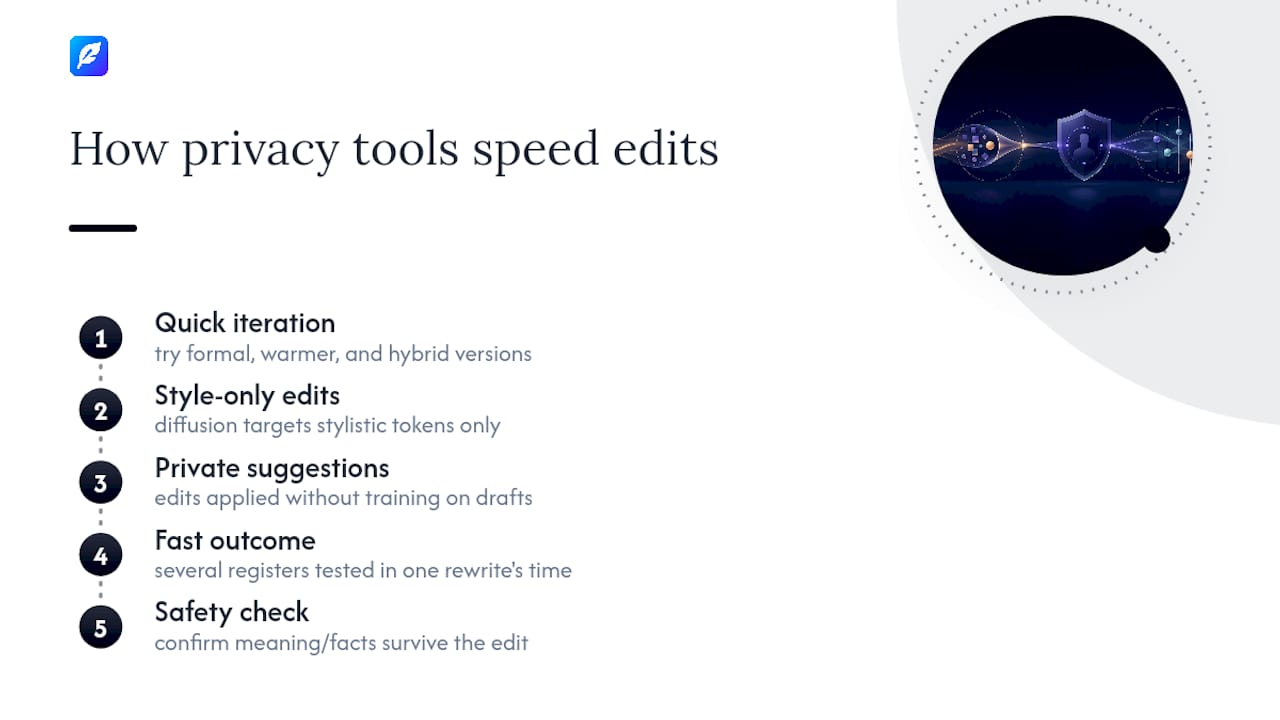
Editing style fast usually means running the same paragraph through a tool several times, testing a formal version, then a warmer one, then something in between. That iteration only works if you're not worried about where the draft ends up. Diffusion-based approaches to text style transfer show a useful principle here: targeting only the stylistic tokens while leaving content-bearing words untouched keeps meaning intact across several rounds of editing, rather than drifting further from the original with each pass.
That's the same logic behind some tools offering quick suggestions, applied to your own wording, without the draft being used to train anything. For a writer working on a client report at 6pm with a deadline in the morning, the practical outcome is a handful of register options tested in the time it would normally take to rewrite one paragraph by hand.
Speed only helps if the meaning survives the edit. A fast tool that changes your tone but loses your facts has solved the wrong problem.
Finding your own style before you change it
You can't adjust what you haven't identified. Before touching a single sentence for a new audience, pull three or four pieces you've already written and read them together, back to back, not one at a time.
Look for repeated habits rather than one-off choices. Do you default to long sentences with several clauses, or short direct ones? Do you hedge automatically ("it seems", "arguably", "to some extent"), or state things flatly? Count your paragraph lengths across a couple of pages. Most writers have a default rhythm they don't notice until it's laid out next to itself.
Check your pronoun instincts too. Some writers naturally address the reader directly; others default to a distant third person even in casual pieces. Neither is wrong, but knowing which one is your default tells you how far you need to travel to hit a different register.
A useful trick: paste a paragraph of your own writing next to a paragraph from a style you're aiming for, academic, conversational, technical, and mark every point of difference. Vocabulary level, sentence length, formality markers, all of it. That comparison does more to reveal your baseline than trying to describe your own style from memory, which almost everyone gets wrong because we're bad judges of our own habits.
Once you know your starting point, adjustment becomes a measured distance rather than a guess. You're not trying to write like someone else; you're deciding how far to move three or four specific levers from where they naturally sit.
Adapting style across academic, creative, and business writing
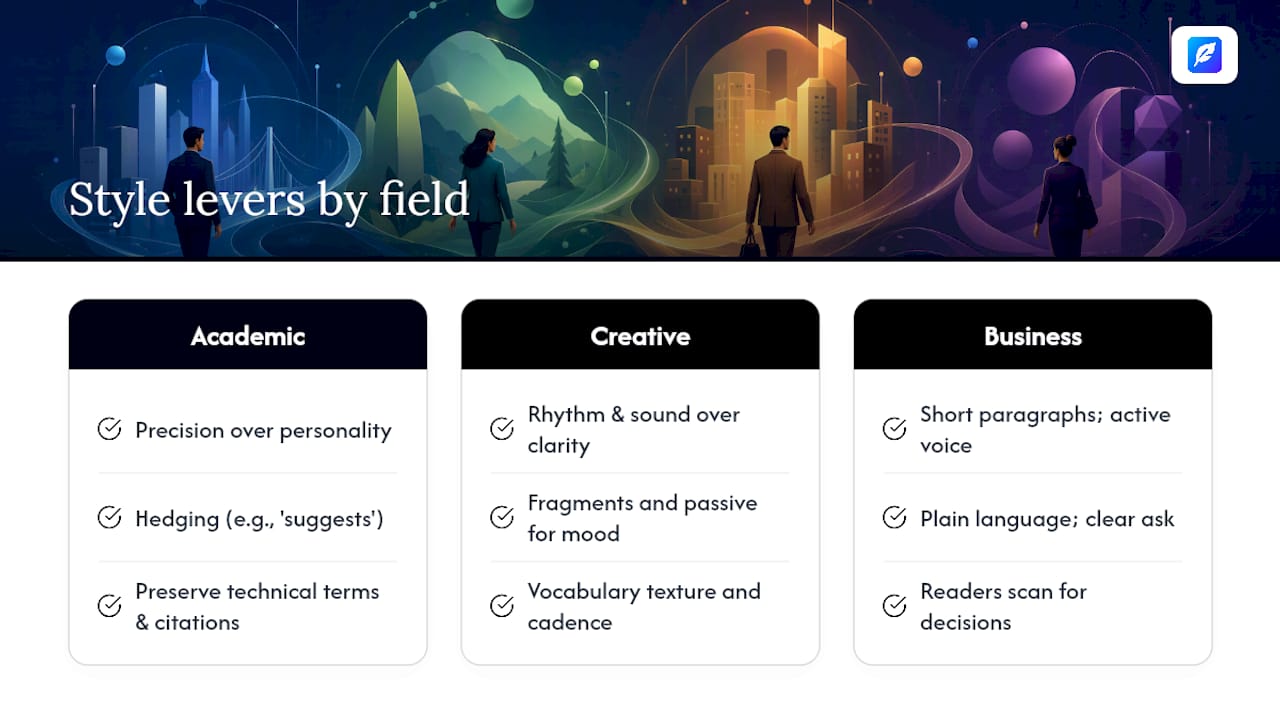
Each field rewards a different mix of levers, and treating them all the same way is the fastest route to writing that fits nowhere well.
Academic writing rewards precision over personality. Hedging language ("suggests", "may indicate") is often correct here, not weak, because it accurately reflects uncertainty in research. Keep technical terms and citations intact. Guidance on academic sentence rewriting consistently stresses preserving citations and key terminology while tidying the surrounding structure, rather than simplifying the vocabulary that actually carries the meaning.
Creative writing flips several of the same rules. Sentence fragments become tools, not errors. Rhythm and sound often outrank strict clarity, and a passive construction might be the right choice for emphasis or mood rather than a mistake to fix. The lever set shifts almost entirely towards vocabulary texture and cadence, with formality barely mattering.
Business writing sits closest to the "adjust for clarity" advice most style guides lead with: short paragraphs, active voice, a clear ask near the top or bottom of the piece. The plain language approach fits here better than almost anywhere else, because business readers are usually scanning for a decision, not settling in for a considered read.
The practical skill isn't memorising three separate rulebooks. It's recognising, within the first paragraph of a new task, which field's defaults apply, then applying the matching lever set rather than your personal default.
Common pitfalls when adjusting your writing style
Over-adjusting is the single most common failure, and it's almost always invisible to the writer doing it. Push formality too far and a business email starts sounding like a legal filing. Push casualness too far and a professional update reads like a text message to a friend, undermining the authority the piece needed to have.
Watch for these specific traps:
- Losing your own voice entirely. A piece adjusted for maximum formality can end up sounding like nobody wrote it. Keep at least one distinctive phrasing choice that's recognisably yours.
- Over-hedging in the name of politeness. Adding "perhaps", "it might be worth considering", and "in some ways" to every sentence doesn't make a piece more professional; it makes it vague.
- Jargon overcorrection. Stripping every technical term from a piece written for specialists insults the reader's expertise and often makes the writing less precise, not more accessible.
- Formality creep across a whole document. One overly formal sentence early on can push you to match that register for the rest of the piece, even when the original brief called for something warmer.
- Editing every sentence identically. If every paragraph gets the same treatment regardless of its job in the document, you lose the natural variation that makes writing feel human rather than processed.
The fix for all of these is the same: check the edit against the original purpose, not against how "correct" the adjusted version sounds in isolation. If the adjusted piece no longer sounds like it was written by a person who understands the subject, you've gone too far.
What I would actually do on a tight deadline
Ten minutes, start to finish. Read the piece once, out loud if possible, and pick the three levers doing the most damage, usually formality, sentence length, and one jargon cluster. Micro-edit the two or three paragraphs that matter most: the opening, wherever the decision or ask sits, and the closing line. Run one readability check, not five. Finish with a single read-aloud pass to catch anything that still trips.
What I leave for later, if there's a later: pronoun consistency across the whole document, a full jargon audit, and formatting rhythm. Those matter, but they rarely change whether the reader understands the piece or acts on it, and that's the bar a ten-minute pass has to clear.
— Mike
How Inspirowrite fits into your style adjustment workflow
Inspirowrite handles the mechanical part of style adjustment writing, tone shifts, register changes, and instant rewrite suggestions, so the thinking stays yours and the retyping doesn't have to.
Run the workflow above with it directly: paste a paragraph, ask for a shift toward formal or casual, and get suggestions back in seconds rather than the several minutes a manual pass usually takes. Because the platform doesn't use submitted drafts to train models, a client report or an unpublished manuscript stays confidential while you iterate on tone, a detail worth checking on the privacy practices page before you upload anything sensitive. For business teams running the same style checks across multiple writers, that consistency matters more than any single edit. Try a paragraph from your current draft on the Inspirowrite landing page and see how many of the levers above it catches in one pass.
Sources
FAQ
What are the seven types of writing styles?
Most style frameworks group writing into narrative, descriptive, persuasive, expository, and creative as the core five, with technical and academic writing often added as two further specialised types built on top of expository structure.
What is the 2/3-1 rule in writing?
This isn't a standard, widely documented writing rule, definitions vary depending on the source, so treat any specific numbered claim about it with caution rather than as an established framework.
What are the five C's of effective writing?
Common versions list clear, concise, correct, complete, and coherent, though different style guides swap one or two terms; the consistent thread across all versions is writing that a reader can act on without needing to ask a follow-up question.
What is an example of style in writing?
Comparing "we think the numbers look good" with "the data indicate a positive trend" shows style in action: same underlying fact, different vocabulary, formality, and hedging, adjusted for a more formal reader.
How long should a style adjustment edit take?
A focused pass on a short document, one email or a single-page summary, usually takes ten to fifteen minutes using the four-step workflow: clarify audience, pick levers, micro and macro edit, then verify.