

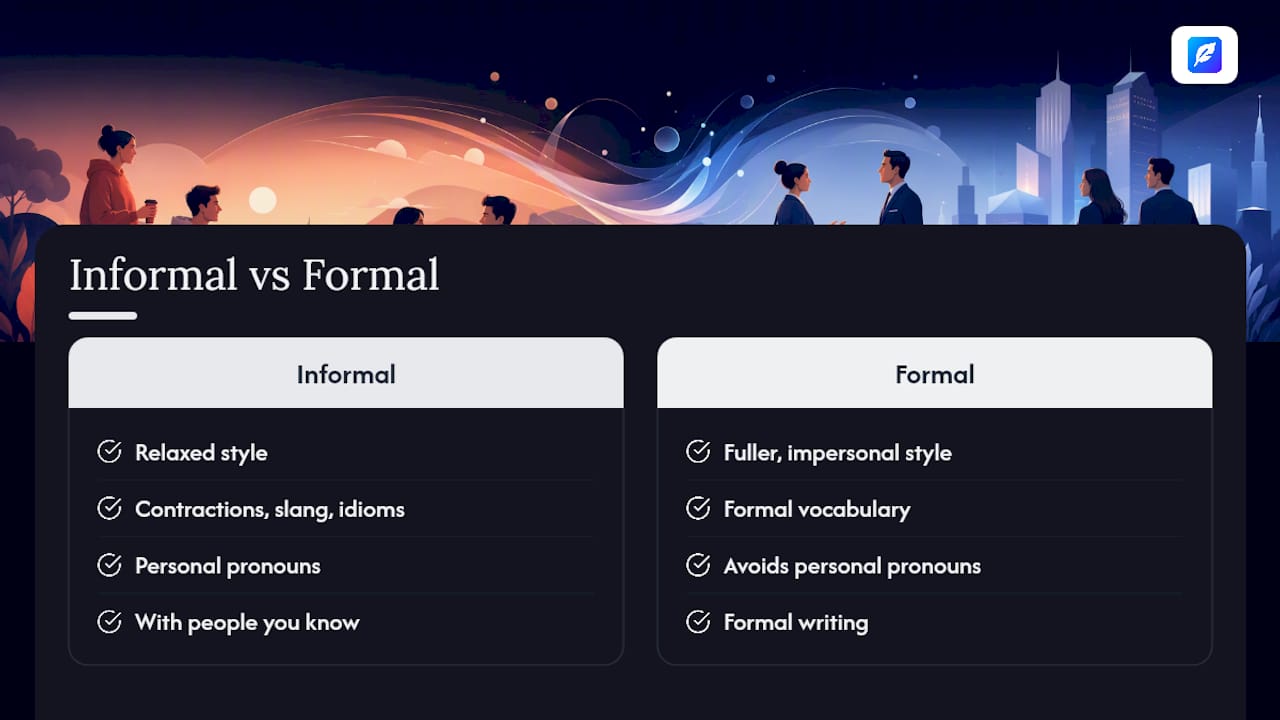
Formal language uses full grammatical forms, precise vocabulary and an impersonal tone for unfamiliar or authoritative audiences; informal language uses contractions, slang and personal pronouns for people you know well. The decision rule is simple: match your register to your audience and purpose, not to how you feel like writing. The Cambridge Grammar and Australia's Style Manual both treat this as a spectrum, not a switch.
- Unknown reader or authority figure → lean formal
- Close colleague, friend or family → lean informal
- Unsure? → aim for standard, neutral English
Key Takeaways
Matching register to audience, purpose and channel, rather than defaulting to either extreme, is the single skill that makes formal vs informal writing work.
| Point | Details |
|---|---|
| Register is a spectrum | Choose formal, standard or informal based on audience, purpose and relationship, not a fixed rule. |
| Vocabulary origin is the clearest cue | Latin or Greek roots signal formal; Anglo-Saxon words signal informal tone. |
| Contractions aren't automatically wrong | Occasional contractions can stay in formal writing if the rest of the structure remains formal. |
| Consistency beats perfection | Inconsistent register within one piece damages credibility more than any single wrong word choice. |
| Tools speed up practice | Inspirowrite flags contractions and suggests register swaps instantly, with privacy-first processing. |
Table of Contents
- Formal vs informal writing: the five markers that give it away
- Informal tone examples and their formal rewrites
- When to use formal language and when to relax it
- How to shift register on any sentence
- Common mistakes when switching between registers
- Why register matters and where the linguistics comes from
- What learners get wrong about "sounding professional"
- Practise register swaps with instant, private feedback
- Sources
- FAQ
Formal vs informal writing: the five markers that give it away
Once you know what to look for, spotting the register of a sentence takes seconds. Five features do most of the work.
- Tone: formal writing stays impersonal and measured; informal writing sounds warm, direct, sometimes cheeky.
- Word choice: formal English leans on Latin or Greek roots ("commence", "terminate"); informal English prefers plain Anglo-Saxon words ("start", "end"). This single cue predicts perceived formality more reliably than almost anything else, according to Cambridge's US grammar guide.
- Grammar and sentence structure: formal writing uses complete clauses and passive constructions; informal writing allows fragments, dropped relative pronouns ("the man I saw" instead of "the man whom I saw") and looser syntax.
- Contractions and punctuation: informal writing is full of "don't", "it's" and exclamation marks; formal writing generally avoids contractions and keeps punctuation restrained.
- Typical contexts: formal suits legal documents, academic papers and first contact with strangers; informal suits texts, social posts and chats with people you already trust.
Scan for these five and you can classify almost any sentence within a couple of readings, whether you're marking your own grammar habits or someone else's.
Informal tone examples and their formal rewrites
Seeing the swap in action teaches you faster than any rule list. Here are paired sentences, one informal and one formal, with a note on what actually changed.
| Informal | Formal rewrite | What changed |
|---|---|---|
| Can't make it, sorry! | I regret that I am unable to attend. | Contraction removed, first person kept but structure formalised |
| Gonna send it over tomorrow | I will send it over tomorrow | Slang contraction ("gonna") replaced with standard grammar |
| The boss is well annoyed | The manager is visibly frustrated | Colloquial intensifier and slang word swapped for neutral vocabulary |
| We need to sort this out ASAP | This matter requires urgent resolution | Phrasal verb and abbreviation replaced with a single formal verb |
| Please find attached the requested documentation | Here's the file you asked for | Formal→informal: dense phrasing simplified, contraction added |
| It is imperative that you respond forthwith | You really need to reply soon | Formal→informal: archaic adverb dropped, tone warmed |
| Thx for getting back to me so fast | Thank you for your prompt reply | Abbreviation and casual phrasing replaced with full words |
| That idea's kind of risky, no? | That proposal carries considerable risk | Hedge and slang tag question replaced with direct, measured statement |
Notice the pattern: most swaps touch vocabulary and contractions first, then grammar. That order matters when you're editing under time pressure, and it lines up with how university writing centres teach this exact skill.
When to use formal language and when to relax it
Context decides register more than personal preference ever will. Three buckets cover almost every situation you'll meet.
- Formal: job applications, academic essays, legal correspondence, first emails to someone senior, public reports.
- Standard (neutral): most workplace emails, news writing, customer service replies, government content aimed at the public.
- Informal: texts to friends, casual social posts, chats with teammates you know well, personal notes.
Audience cues matter as much as the channel. Writing to someone you've never met, or to a person with authority over you, calls for formal or standard English. Writing to a close friend allows contractions and slang freely. Channel can override expectation too. A lecture is spoken but often formal; a postcard is written but casual, an exception both the Cambridge Grammar and everyday experience confirm. The rule to memorise: audience + purpose + channel = register.
How to shift register on any sentence
Rewriting a sentence's tone is a repeatable process once you break it into steps, not a matter of guesswork.
- Identify your audience and what you need from them.
- Swap vocabulary: Latin or Greek roots for formal, plain Anglo-Saxon words for informal.
- Add or remove contractions depending on the direction you're shifting.
- Adjust sentence length and pronoun use, shorter and more personal for informal, longer and more impersonal for formal.
- Check punctuation and cut idioms or phrasal verbs that could confuse a non-native reader.
Try this on one sentence right now: take "I can't come to the meeting, sorry about that" and rewrite it formally, then take a stiff formal sentence from a report and loosen it up. You'll feel the mechanics faster than reading about them.
Pro Tip: A handful of well-placed contractions won't wreck a formal document. The credibility risk comes from informal sentence structure and slang creeping in alongside them, not the contraction itself.
Common mistakes when switching between registers
Most register errors aren't about knowing the rules. They're about applying them unevenly across a single piece of writing.
- Inconsistent register: formal opening, casual middle. Fix: read the whole piece aloud in one sitting before sending it.
- Over-formality: burying a simple point in dense Latinate vocabulary. Fix: ask if a shorter, plainer word says the same thing.
- Confusing idioms: phrasal verbs that puzzle non-native readers. Fix: replace with a literal, single-word equivalent.
- Excessive contractions in formal writing: too many "don't"s and "it's"s stacked together. Fix: keep one or two at most, and only where the surrounding structure stays formal.
Why register matters and where the linguistics comes from
Tone is the overall feel a piece of writing gives off, and formality is one of its biggest levers. Diction and sentence structure do most of that work, which is why the same idea can read as warm or cold depending purely on word choice, as Literaryterms. Word origin backs this up directly: Latin and Greek-derived vocabulary reads as more formal, Anglo-Saxon vocabulary reads as more approachable, a pattern confirmed across multiple grammar references and useful for automated vocabulary suggestions.
- Understanding origin-based vocabulary cues speeds up editing, especially when translating technical language for a business audience.
- An AI writing tool can flag contractions, suggest formal or informal swaps, and show you the register shift in real time rather than leaving you to guess.
Pro Tip: Treat any AI suggestion as a tutor, not a rubber stamp. Read why a swap was suggested before accepting it, that's how the rule actually sticks.
What learners get wrong about "sounding professional"
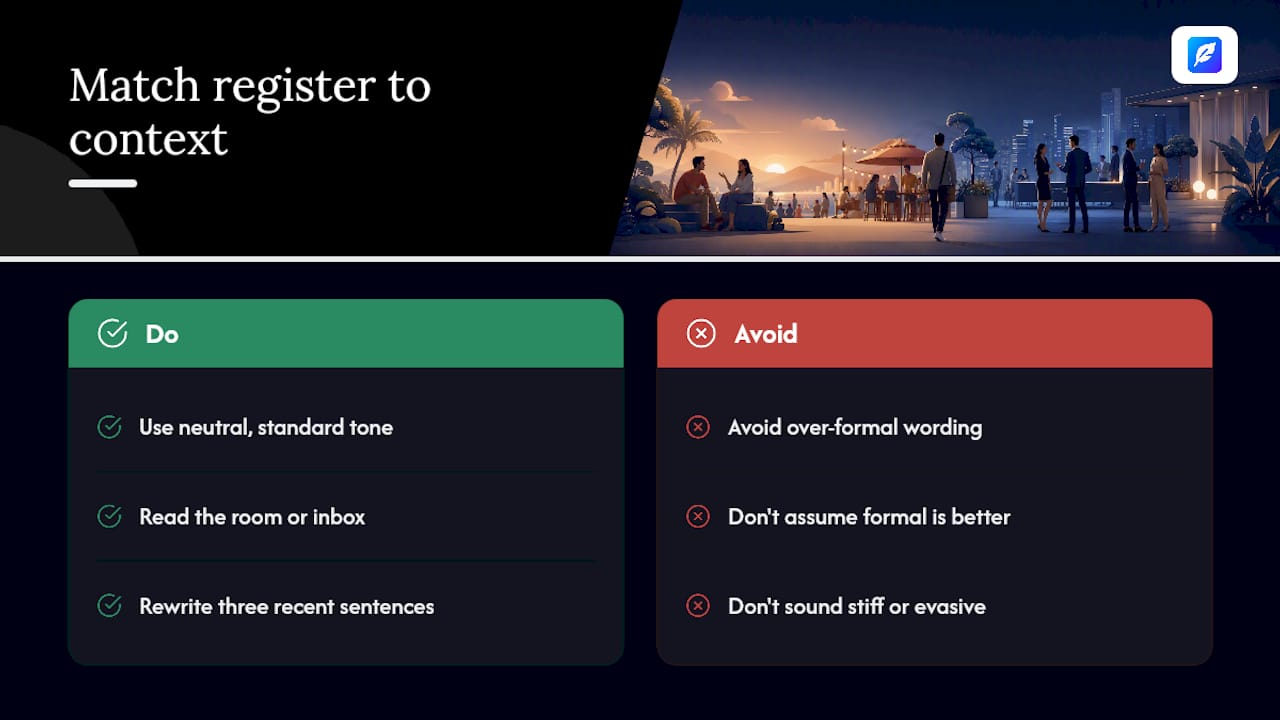
Most learners assume formal automatically means better, and that's the mistake I see most often. Over-formal writing can read as stiff or evasive, and standard, neutral tone is usually the safer choice for public-facing content. The real skill isn't memorising formal vocabulary. It's reading a room, or an inbox, and matching it.
Practise this today: pick three sentences you've written recently and rewrite each one in the opposite register. You'll notice which of your habits default to formal and which default to casual, and that's the pattern worth fixing first. For more on sounding right in professional contexts specifically, see how to sound professional in English emails.
Practise register swaps with instant, private feedback
Rewriting a sentence's tone by hand is good practice, but getting a second opinion on whether the swap actually landed is where most learners get stuck. Inspirowrite gives you instant, register-aware suggestions, flagging contractions, suggesting formal or informal vocabulary swaps, and showing you the shift in seconds, all without your drafts being used to train any AI model.
That privacy-first processing matters if you're rewriting a client email, a university assignment or a job application you'd rather not see floating around online. Students and professionals both use it the same way: paste a sentence, see how formal or informal it reads, and adjust before sending. If you want to test how your own writing shifts between registers, try the formal and casual rewriting tools on Inspirowrite and see the suggestions for yourself.
Sources
- Formal and informal language
- Voice and tone | Style Manual
- Formal and informal style (NIU writing tutorial)
- Literaryterms
FAQ
What are examples of formal and informal language?
Formal: "I would be grateful if you could respond at your earliest convenience." Informal: "Let me know when you get a sec." The difference sits in contractions, word choice and sentence structure.
What does "informal" mean in language?
Informal language means the relaxed style used with people you know well, marked by contractions, slang, idioms and personal pronouns, as opposed to the fuller, more impersonal forms used in formal writing.
How do you know if a word is formal or informal?
Check its origin and context: words from Latin or Greek roots, like "commence" or "terminate", tend to read as formal, while shorter Anglo-Saxon words like "start" or "end" read as informal.
When would you use formal language?
Use formal language for legal documents, academic writing, job applications, and any first contact with someone senior or unfamiliar, where clarity and impersonal tone protect your credibility.