

TL;DR:
- Plain language in business improves clarity, findability, and usability, leading to better decisions and trust. Jargon harms engagement and decision-making by obscuring meaning and reducing understanding. Applying simple words, the BLUF technique, and real-world testing enhances communication effectiveness.
Plain language in business is communication structured and expressed so the intended audience can find, understand, and use the information without effort. The formal term for this discipline is plain language communication, and it is now governed by ISO 24495-1, which defines it through four measurable outcomes: relevance, findability, understandability, and usability. This is not a style preference. It is a communication standard with direct consequences for business performance, employee engagement, and organisational trust. Understanding what plain language means for business is the first step to writing that actually works.
What are the key principles that define plain language in business writing?
ISO 24495-1 defines plain language as wording, structure, and design that enables readers to find, understand, and use information. That definition shifts the focus away from readability scores and towards real user outcomes. A document written in short sentences but buried in a confusing folder structure still fails the plain language test.
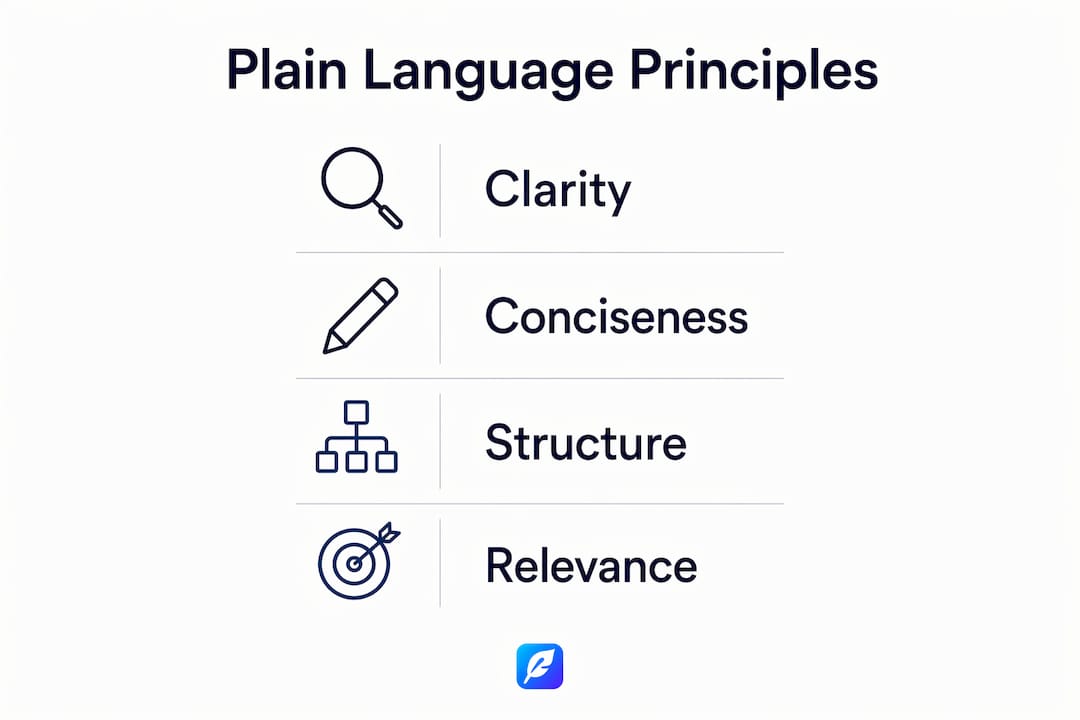
The standard organises plain language around four governing principles:
- Relevance: Content must match what the reader actually needs. Irrelevant detail, however well written, wastes the reader's time and obscures the core message.
- Findability: Documents must be structured so readers can locate the information they need quickly. Headers, logical sequencing, and clear navigation all serve this principle.
- Understandability: Language must use familiar words and accessible sentence structures. Technical terms require explanation when the audience is not a specialist.
- Usability: Communications must be tested and designed for practical application. If a reader cannot act on the information, the document has not done its job.
These four principles work together. Improving vocabulary without addressing structure produces documents that are readable but not usable. Plain language is a service design discipline that treats the reader's experience as the measure of success, not the writer's effort.
Pro Tip: Before sending any business document, ask one question: "Can my reader find the key point in under 30 seconds?" If the answer is no, restructure before you edit the words.
How does corporate jargon damage decision-making and engagement?
Corporate jargon is not a neutral stylistic choice. A 2026 Cornell University study found that higher receptivity to vague corporate language correlates directly with worse workplace decision-making. The researchers developed the Corporate BS Receptivity Scale (CBSR) to measure susceptibility to empty organisational rhetoric. The finding is striking: employees who feel inspired by jargon-heavy communication tend to make poorer decisions.
"Employees receptive to corporate jargon often feel inspired but make poorer decisions, indicating a leadership communication failure rather than an individual one."
This matters because jargon is frequently used to obscure difficult topics. HR communications, in particular, use vague language to soften difficult messages, which reduces trust and leaves employees unable to understand what is actually being asked of them. The result is disengagement, not protection.
The damage spreads in predictable ways:
- Employees cannot act on instructions they do not understand.
- Managers spend time clarifying messages that should have been clear the first time.
- Trust erodes when language feels designed to confuse rather than inform.
- Psychological safety suffers, making it harder for staff to challenge unclear communication without fear of appearing ignorant.
The cost is not abstract. Every clarification email, every misunderstood policy, and every delayed decision traces back to a communication that failed its reader.
What practical benefits do businesses gain from plain language?

Clear communication is a financial strategy, not just a courtesy. Plain language lowers organisational costs by reducing the time employees spend seeking clarification, correcting errors caused by misunderstanding, and re-reading dense documents. That time saving compounds across teams and departments.
The practical benefits fall into four categories:
- Reduced error rates. When instructions are clear, employees follow them correctly the first time. Fewer errors mean fewer corrections, fewer complaints, and less wasted resource.
- Faster decision-making. A message that delivers its key point immediately allows the reader to act without delay. Buried conclusions slow every process they touch.
- Stronger employee engagement. Staff who receive clear, respectful communication feel valued. Jargon signals that the writer prioritised their own convenience over the reader's understanding.
- Improved reputation and client trust. Jargon-filled websites become invisible to search engines and fail to connect with clients who use plain English terms. Businesses that write clearly attract and retain clients more effectively.
Plain language also improves how employees use internal policies and benefits. When a policy is written clearly, staff can apply it without asking a manager. That single change reduces the administrative burden on HR teams and speeds up compliance across the organisation.
The bottom line: plain language communication is not a writing style. It is an operational efficiency tool with measurable returns.
How can business professionals implement plain language effectively?
The most effective technique for business writing is BLUF: Bottom Line Up Front. BLUF originates from military communication and ensures the key point is understood even if the reader only reads the first sentence. In practice, this means leading every email, report, and briefing with the conclusion, not the context.
Alongside BLUF, the following strategies produce consistent results:
- Choose simpler words. Write "use" instead of "utilise," "start" instead of "commence," and "end" instead of "terminate." Choosing simpler words builds credibility and signals clear thinking, not laziness.
- Structure for findability. Use descriptive headings, numbered lists for sequential steps, and white space to separate ideas. A reader should be able to scan the document and locate any section in seconds.
- Test with real readers. Regular testing and user feedback turn plain language from a writing exercise into a usability discipline. Ask a colleague who was not involved in writing the document to find a specific piece of information. Their experience reveals what the writer cannot see.
- Reduce jargon systematically. A guide to translating technical jargon in business contexts can help teams identify which terms need replacing and which are genuinely necessary for the audience.
The cultural shift is the hardest part. Many professionals associate complex language with expertise. The opposite is true. Focusing on writer cleverness rather than reader utility harms clarity and business outcomes. The measure of good business writing is not how impressive it sounds. It is how quickly the reader can act on it.
The table below compares common jargon patterns with their plain language equivalents:
| Jargon phrase | Plain language equivalent |
|---|---|
| "Leverage our synergies" | "Work together" |
| "Circle back on this" | "Follow up later" |
| "Boil the ocean" | "Try to do too much" |
| "Move the needle" | "Make a measurable difference" |
| "At this point in time" | "Now" |
Pro Tip: When reviewing a draft, highlight every word over three syllables. Then ask whether a shorter word would carry the same meaning. Most of the time, it will.
Key takeaways
Plain language communication, governed by ISO 24495-1, is the most direct path to reducing organisational costs, improving decisions, and building reader trust in business writing.
| Point | Details |
|---|---|
| ISO 24495-1 sets the standard | Plain language is defined by four outcomes: relevance, findability, understandability, and usability. |
| Jargon harms decision-making | The 2026 Cornell CBSR study links corporate jargon receptivity to worse workplace decisions. |
| Clarity reduces costs | Plain language lowers error rates, clarification time, and administrative burden across teams. |
| BLUF is the core technique | Leading with the conclusion respects the reader's time and speeds up action on every message. |
| Testing proves usability | Real reader feedback is the only reliable way to confirm a document achieves its purpose. |
Plain language as a discipline, not a style
The framing that changed how I think about this was simple: plain language is not about dumbing things down. It is about respecting the reader enough to do the hard work before they receive the document.
The hardest shift for professionals moving from academic or technical writing to business communication is cutting accurate but unnecessary detail to put the key message first. That feels wrong at first. It feels like you are leaving something out. You are not. You are making a decision about what the reader actually needs, which is the job of a writer, not a data repository.
What I have seen repeatedly in organisations is that jargon persists not because people think it is effective, but because no one feels safe enough to question it. Psychological safety is the prerequisite for plain language culture. Without it, staff nod along to communications they do not understand, and the organisation pays the price in errors and disengagement.
The ISO 24495-1 standard matters because it gives professionals a framework to argue for clarity without it sounding like a personal preference. When you can point to an international standard that defines plain language through user outcomes, the conversation shifts from "I prefer simpler writing" to "this document does not meet the usability standard." That is a different conversation entirely, and it is one worth having.
Understanding business jargon translation challenges is also critical for organisations operating across languages and cultures. What reads as confident in one context reads as evasive in another. Plain language is the common ground.
— Mike
How Inspirowrite supports clearer business writing
Writing clearly under time pressure is genuinely difficult. Inspirowrite is an AI-powered proofreading and writing tool built for professionals who need fast, accurate feedback on grammar, style, and clarity without sacrificing privacy. Your content stays confidential and is never used to train AI models.
For business professionals working to apply plain language principles, Inspirowrite provides immediate suggestions for simplifying complex sentences, replacing jargon, and improving document structure. Results appear within seconds, which makes it practical for daily use rather than a final-stage review tool. Visit Inspirowrite to see how it fits into your writing process.
FAQ
What is the formal definition of plain language?
ISO 24495-1 defines plain language as wording, structure, and design that enables readers to find, understand, and use information. The standard focuses on user outcomes rather than readability scores alone.
Why does plain language matter in business communication?
Plain language reduces errors, speeds up decision-making, and lowers the cost of unnecessary clarifications. It also builds trust with employees and clients by showing that the writer respects the reader's time.
What is the BLUF technique in business writing?
BLUF stands for Bottom Line Up Front. It means leading every document or message with the key conclusion so the reader understands the point immediately, even if they read nothing else.
How does corporate jargon affect employee performance?
The 2026 Cornell University study found that employees who are more receptive to corporate jargon tend to make worse decisions at work. Vague language reduces understanding and erodes the psychological safety needed for clear communication.
How can I start applying plain language principles today?
Replace complex words with simpler equivalents, lead every message with your conclusion, and test documents with a real reader before sending. Structured guides on writing naturally in English can support the transition from jargon-heavy to reader-focused writing.