

TL;DR:
- Writing naturally in English involves producing text that sounds authentic, with familiar phrasing and smooth flow, beyond just correct grammar. Developing this skill requires reading widely, practicing regularly, and using tools like Grammarly and Hemingway Editor to refine tone and readability. Consistent revision, understanding language conventions, and avoiding literal translations are essential for achieving natural, fluent writing.
Writing naturally in English means producing text that sounds like a real person wrote it, with familiar phrasing, smooth flow, and appropriate tone rather than just grammatical correctness. Many students and writers produce sentences that are technically correct but feel stiff, robotic, or translated. The difference between correct English and natural English lies in tone, rhythm, and word choice, not grammar alone. Tools like Grammarly and Hemingway Editor help you close that gap, but the foundation is built through reading widely and practising regularly. This guide gives you the techniques, tools, and habits to get there.
What tools and mindset help you write naturally in English?
Natural English writing is a skill, not a talent, and the right tools accelerate your progress significantly. Grammarly checks grammar, tone, and clarity in real time. Hemingway Editor highlights sentences that are too long or dense, pushing you towards the direct, readable style that native writers use instinctively. For students working on academic essays, browser extensions like LanguageTool offer grammar and style suggestions without interrupting your workflow.

Tools alone are not enough. You need a solid grasp of English writing conventions before any software can help you refine them. Understanding when to use formal versus informal register, how paragraphs are structured in English, and what punctuation signals to a reader are all foundational. Without this baseline, you risk polishing sentences that are structurally wrong from the start.
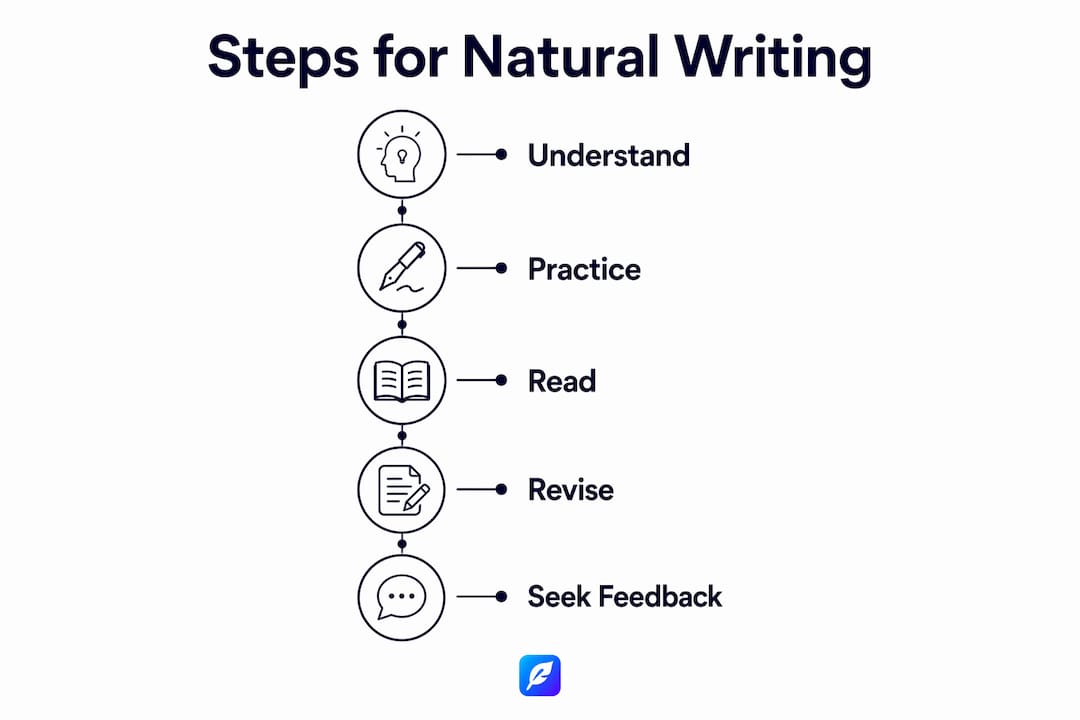
Reading native English texts is the single most underrated habit for improving fluency. Novels, quality journalism from publications like The Guardian or The Atlantic, and well-written essays all expose you to the phrases, rhythms, and idioms that make English feel alive. Combining reading with writing and revision is more effective than following advice alone. You absorb patterns unconsciously, and those patterns surface when you write.
Set realistic, specific goals for your practice. "Write better" is not a goal. "Write 200 words in my journal every morning this week" is. Specific targets create momentum and make improvement measurable.
Pro Tip: Read one short article aloud each day. Hearing how sentences flow trains your ear for natural rhythm far faster than reading silently.
Key tools to have in your writing toolkit:
- Grammarly for real-time grammar, tone, and clarity checks
- Hemingway Editor for sentence length and readability feedback
- LanguageTool for multilingual grammar and style support
- A physical or digital vocabulary notebook for new phrases and idioms
- A reading list of native English texts across different genres
How to apply step-by-step techniques to write fluently and naturally
The most effective approach to writing fluently is to separate drafting from editing. When you try to write perfectly on the first attempt, you slow down and second-guess every word. Start with free writing: set a timer for ten minutes and write without stopping or correcting. This builds momentum and gets your ideas onto the page without interference from your inner critic.
Once you have a draft, apply these techniques in sequence:
- Use contractions and direct language. "I am unable to attend" sounds formal and distant. "I can't make it" sounds human. Contractions are not lazy; they are how native speakers communicate in most contexts outside formal academic writing.
- Vary your sentence length. Native English mixes short punches with longer building sentences; uniform sentence length feels monotone. A short sentence after a long one creates emphasis and rhythm.
- Replace literal translations with idiomatic expressions. Phrases like "under the weather" or "on the same page" add authenticity instantly. Use them where they fit naturally, not as decoration.
- Use active voice. Active voice shows clearly who is doing what, which builds reader trust and keeps sentences tight. "The report was written by the team" becomes "The team wrote the report."
- Read your draft aloud. Your ear catches what your eye misses. If you stumble over a sentence, your reader will too. Rewrite anything that feels awkward to say.
- Proofread with purpose. Use a structured approach to catch grammar, punctuation, and word choice errors. An essay proofreading checklist gives students a reliable framework for this final pass.
Here is a quick comparison of formal versus natural phrasing to illustrate the difference:
| Formal or stiff phrasing | Natural English equivalent |
|---|---|
| "Please do not hesitate to contact me." | "Let me know if you have questions." |
| "I am of the opinion that..." | "I think..." |
| "It is necessary to..." | "You need to..." |
| "In the event that..." | "If..." |
| "At this point in time..." | "Now..." |
The right-hand column is not less intelligent. It is more readable, and readability is what makes writing effective.
Pro Tip: After drafting, do a "formality sweep." Search your text for phrases like "in the event that" or "it is necessary to" and replace each one with its natural equivalent.
What common mistakes hinder natural English writing?
The most common barrier to natural writing is not poor grammar. It is stiff formality applied in the wrong context. Many learners default to formal register because it feels "safer," but formal language in casual or semi-formal contexts creates distance between writer and reader.
Literal translation from a native language is the second major culprit. "Make a question" is a direct translation from several European languages, but English requires "ask a question." "It depends of the situation" is grammatically logical if you translate from Spanish or French, but English uses "It depends on the situation." These small errors accumulate and make writing feel foreign even when the vocabulary is correct.
Article and preposition errors are particularly persistent. English articles ("a," "an," "the") follow rules that do not exist in many other languages, which makes them easy to misuse or omit entirely. Reviewing a guide to common grammatical errors is a practical way to identify which of these patterns you repeat most often.
Excessive hedging is another habit that undermines natural tone. Phrases like "it could be argued that" or "some might suggest" weaken your voice and make writing feel evasive. State your point directly, then support it with evidence.
Mistakes to actively check for during revision:
- Overly formal openers and closings in emails or informal essays
- Literal translations that produce unnatural collocations
- Missing or incorrect articles before nouns
- Wrong prepositions in fixed phrases ("interested in," not "interested on")
- Passive constructions where active voice would be clearer
- Hedging language that dilutes your argument
How to make regular practice and feedback part of your routine
Consistent practice with specific goals and error tracking accelerates improvement faster than any single technique. The writers who improve most quickly are not the ones who study the most grammar rules. They are the ones who write regularly, review their mistakes, and revise with intention.
Build a sustainable writing habit using these methods:
- Keep a daily journal. Write freely for ten to fifteen minutes each morning. The topic does not matter. The habit does. Journals build fluency because there is no pressure to be perfect.
- Start a blog or write short essays. Publishing, even to a small audience, creates accountability. Knowing someone might read your work sharpens your attention to tone and clarity.
- Maintain an error log. Each time a teacher, peer, or tool flags a mistake, record it. Group errors by type: articles, prepositions, word choice. Review the log weekly. Patterns become visible quickly.
- Seek feedback from multiple sources. Peers catch different things than tutors. Automated tools like Grammarly catch different things than human readers. Use all three. Learning how to proofread your own writing is also a skill worth developing deliberately.
- Revise iteratively. Do not treat a first draft as a finished piece. Return to it after a day, read it fresh, and rewrite the sections that feel unnatural. Each revision cycle internalises new patterns.
Natural English writing is better treated as a revisable goal than a fixed achievement. Every draft is an opportunity to practise, not a test to pass or fail.
Key takeaways
Writing naturally in English requires consistent attention to tone, rhythm, and word choice, supported by regular practice, deliberate revision, and the right digital tools.
| Point | Details |
|---|---|
| Natural writing goes beyond grammar | Tone, rhythm, and word choice matter as much as grammatical correctness. |
| Use the right tools | Grammarly and Hemingway Editor give real-time feedback on clarity and readability. |
| Vary sentence length | Mixing short and long sentences creates the rhythm that makes English feel alive. |
| Fix literal translations | Replace direct translations with correct English collocations and idiomatic phrases. |
| Build a consistent practice habit | Daily journalling, error logs, and iterative revision accelerate long-term improvement. |
Why natural writing is a journey, not a destination
I have worked with hundreds of writers over the years, and the ones who struggle most are rarely the ones with the weakest grammar. They are the ones who believe that once they learn the rules, the writing will take care of itself. It does not work that way.
The writers who improve fastest share one habit: they treat every piece of writing as a draft. They write, read it back, wince at the awkward bits, and rewrite. They do not wait until they feel "ready" to write naturally. They write badly first, then fix it. That willingness to revise without ego is, in my experience, the single biggest predictor of improvement.
What I find genuinely encouraging is that natural English writing is not a mysterious gift. It is a pattern recognition skill. The more native English you read and the more you write, the more those patterns become automatic. Idioms stop feeling like vocabulary to memorise and start feeling like the obvious way to say something. Sentence rhythm stops being something you think about and starts being something you feel.
Be patient with the process. The gap between correct English and natural English closes faster than most learners expect, provided they practise with intention rather than just volume.
— Mike
How Inspirowrite helps you write with confidence
Polishing your writing to sound natural takes time, but you do not have to do it alone. Inspirowrite is an AI-powered proofreading and translation tool built for students and writers who need fast, accurate feedback without compromising their privacy. Unlike many tools, Inspirowrite does not use your content to train AI models, so your work stays yours.
Whether you are refining an academic essay or tightening a personal statement, Inspirowrite catches grammar issues, flags unnatural phrasing, and suggests clearer alternatives in seconds. The proofreading role in producing polished, natural writing is well established, and Inspirowrite makes that process faster and more reliable. Visit Inspirowrite to see how quickly your writing can improve.
FAQ
What does it mean to write naturally in English?
Writing naturally in English means your text sounds like a real person wrote it, with appropriate tone, smooth rhythm, and familiar phrasing rather than stiff or translated language. Grammatical correctness is necessary but not sufficient on its own.
How do contractions help with natural writing?
Contractions like "can't," "it's," and "you're" reflect how native English speakers actually communicate in most contexts. Avoiding them entirely makes writing feel formal and distant, even when that register is not appropriate.
What are the most common mistakes that make writing sound unnatural?
The most frequent errors include literal translations that produce wrong collocations, missing or incorrect articles, wrong prepositions in fixed phrases, and excessive formal language in informal contexts. Keeping an error log helps you identify and correct your personal patterns.
How often should I practise writing to improve fluency?
Daily writing practice with specific goals, even just ten to fifteen minutes, builds fluency faster than longer, infrequent sessions. Consistency matters more than volume.
Can reading improve my English writing skills?
Yes. Reading native English texts exposes you to natural phrasing, sentence rhythm, and idiomatic expressions that you absorb and reproduce in your own writing over time.