

TL;DR:
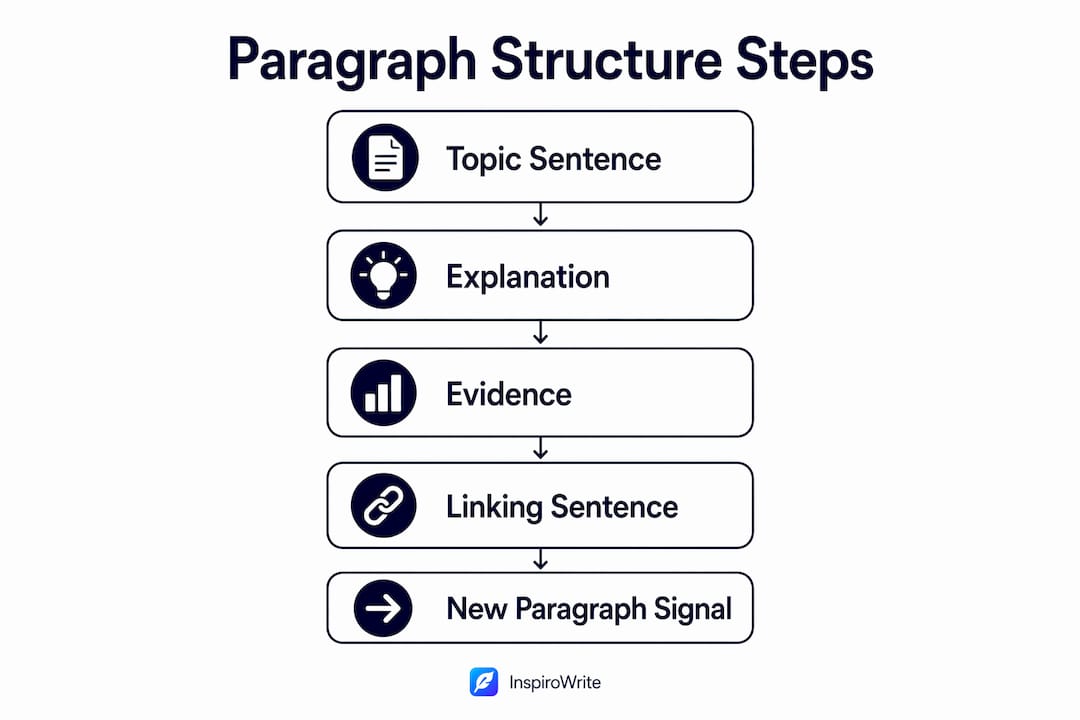
- A well-structured paragraph must include a topic sentence, explanation, evidence, and a linking statement.
- Paragraph length depends on how fully the main idea is developed, typically 4 to 7 sentences.
Correct paragraph structure in English is defined as a logical sequence of sentences that develops one main idea from introduction to conclusion. Every well-built paragraph follows a recognisable pattern: a topic sentence states the main point, supporting sentences develop it with explanation and evidence, and a final sentence closes or links to the next idea. Academic frameworks such as TEEL (Topic, Explanation, Evidence, Link) formalise this pattern and are widely taught in universities across the UK and Australia. Writers who learn to structure paragraphs in English correctly produce clearer arguments, stronger essays, and more persuasive prose at every level.
What are the essential components of a well-structured paragraph?
The TEEL framework defines four essential components: a topic sentence, explanation, evidence, and a linking or concluding statement. Each component has a distinct job, and skipping any one of them weakens the whole paragraph.
Here is what each component does:
- Topic sentence. This is the first sentence. It states the single main idea of the paragraph. A strong topic sentence tells the reader exactly what to expect and signals the paragraph's purpose.
- Explanation. These sentences develop the topic sentence. They clarify what you mean, add context, and show your reasoning. Explanation is where your own thinking is most visible.
- Evidence. This is the specific detail, quotation, statistic, or example that supports your claim. Evidence without explanation is just a list of facts with no argument attached.
- Link. The final sentence either summarises the paragraph's point or connects it to the next paragraph. A good link keeps the reader moving forward without confusion.
The TEEL method is not a rigid formula. Think of it as a checklist. Once you know the four components well, you can vary their order or weight depending on the writing context.
Pro Tip: Write your topic sentence first, then ask yourself: "Have I explained why this matters, given evidence, and connected it to what comes next?" If you cannot answer yes to all three, the paragraph is not finished.

How long should a paragraph be, and when should you start a new one?
A well-structured paragraph typically contains 4–7 sentences or approximately 200–300 words. That is a guideline, not a rule. The real criterion is whether the single main idea has been fully developed.
The table below shows the most common signals that tell you when to end one paragraph and begin another.
| Signal | What it means in practice |
|---|---|
| New main idea | The argument shifts to a different point entirely |
| Contrast or counterargument | You are introducing an opposing view or qualification |
| New time, place, or speaker | The context changes and needs a fresh orientation |
| Paragraph has grown too long | Multiple ideas have crept in and need separating |
| Logical sub-division | A complex idea benefits from being broken into stages |
Experienced writers split paragraphs at shifts in main ideas rather than at fixed sentence counts. That means a paragraph can be three sentences if the idea is simple, or eight sentences if the idea is complex. The length follows the idea, not the other way around.
A very long paragraph is almost always a sign that two or more ideas have been bundled together. When you notice a paragraph running past 300 words, read it back and ask whether it contains more than one main claim. If it does, split it.
Pro Tip: After drafting, read each paragraph and write a one-sentence summary of it in the margin. If you need two sentences to summarise it, the paragraph contains two ideas and should be divided.
What sentence structures improve paragraph flow and coherence?
Choppy writing is one of the most common problems in student paragraphs. Overusing simple sentences creates a staccato rhythm that breaks the reader's concentration. The fix is to use compound and complex sentences with correct punctuation.
Compound sentences join two independent clauses with a coordinating conjunction. The coordinating conjunctions are for, and, nor, but, or, yet, and so. A comma always comes before the conjunction when both clauses are independent. For example: "The topic sentence introduces the idea, but the explanation sentences do the real argumentative work."
Complex sentences use subordinating conjunctions such as "although," "because," "while," and "since" to show relationships between ideas. They signal cause, contrast, time, and condition. Using them well makes your reasoning explicit rather than leaving the reader to infer connections.
Effective paragraph linking goes beyond transition words. Advanced linking involves conceptual bridges split between the end of one paragraph and the beginning of the next. The final sentence of a paragraph can foreshadow the next idea, so the opening of the following paragraph feels like a natural continuation rather than a sudden jump.
Practical strategies for improving flow include:
- Vary sentence length deliberately. Follow a long complex sentence with a short, direct one for emphasis.
- Use pronouns and synonyms to refer back to key terms without repeating the same word every sentence.
- Place the most important information at the end of a sentence, where it carries the most weight.
- Avoid starting consecutive sentences with the same word or phrase.
Good sentence variety is not about decoration. It reflects the natural rhythm of a well-reasoned argument.
Common pitfalls in paragraph writing and how to avoid them
Most paragraph problems fall into a small number of categories. Recognising them early saves significant revision time.
-
Failing to answer "So what?" Effective paragraphs explicitly explain why evidence is relevant to the argument. Dropping a quotation or statistic into a paragraph without explaining its significance leaves the reader doing your analytical work for you. After every piece of evidence, write a sentence that begins: "This shows that..." or "This matters because..."
-
Including multiple main ideas in one paragraph. Each paragraph must carry one central claim. When two ideas appear in the same paragraph, neither receives enough development. The reader cannot tell which point is primary.
-
Choppy or repetitive sentence structure. A paragraph built entirely from short, simple sentences reads like a list of disconnected facts. Varying sentence structure, as covered in the previous section, resolves this directly. Reading your paragraph aloud is the fastest way to hear where the rhythm breaks down.
-
Ignoring logical order. The sentences within a paragraph must follow a logical sequence. A common error is presenting evidence before the topic sentence, which confuses the reader about what the evidence is meant to support. The TEEL sequence exists precisely to prevent this.
-
Weak or missing concluding sentences. A paragraph that ends abruptly leaves the reader without closure. The final sentence should either summarise the paragraph's contribution to the argument or signal what comes next.
Pro Tip: Use an essay proofreading checklist when revising. Check each paragraph separately: does it have a topic sentence, explanation, evidence, and a link? Treating each paragraph as a self-contained unit makes structural problems much easier to spot.
Proofreading for paragraph structure is a separate task from proofreading for grammar. Do one pass for structure and a separate pass for sentence-level errors. Mixing the two tasks means you will miss problems in both.
What tools and approaches help plan and audit paragraph structure?
Planning before drafting prevents the most common structural errors. The most effective planning tool is listing your topic sentences before writing the full paragraphs. Read the list in order and ask: does each sentence follow logically from the one before? Does the sequence build a coherent argument? Flaws in logic show up clearly at this stage, before you have invested time in full paragraphs.
The table below compares three planning approaches by their purpose and best use case.
| Approach | Purpose | Best used when |
|---|---|---|
| Topic sentence listing | Audits logical flow of the whole argument | Planning essays or long reports |
| Paragraph outlining | Maps each component (TEEL) before drafting | Writing complex analytical paragraphs |
| TEEL checklist review | Confirms all components are present after drafting | Revising a completed draft |
Outlining each paragraph's components before writing is particularly useful for analytical writing. Write one line for each TEEL component before drafting the full paragraph. This forces you to identify your evidence before you write, which prevents the common problem of writing a paragraph and then realising you have no evidence to support it.
Reading widely also builds structural instincts. Pay attention to how published writers in your field open and close paragraphs. Notice how they handle transitions. Studying English writing conventions in published work builds a mental library of effective patterns that you can draw on in your own writing.
Key takeaways
Correct paragraph structure in English requires a topic sentence, explanation, evidence, and a linking statement, with paragraph length determined by idea development rather than sentence count.
| Point | Details |
|---|---|
| Use the TEEL framework | Every paragraph needs a topic sentence, explanation, evidence, and a link to stay focused. |
| Let the idea set the length | Aim for 4–7 sentences, but split the paragraph whenever a second main idea appears. |
| Vary sentence structure | Mix compound and complex sentences to avoid choppy rhythm and make reasoning explicit. |
| Explain your evidence | Always answer "So what?" after citing evidence to connect it to your argument. |
| Plan with topic sentence lists | List topic sentences before drafting to catch logical gaps before they become full paragraphs. |
Why paragraph structure is the skill most writers underestimate
Writers tend to focus on grammar and vocabulary when they want to improve. Paragraph structure gets far less attention, and that is a mistake. A sentence can be grammatically perfect and still destroy the clarity of a paragraph if it is in the wrong place.
The most common thing I see in student writing is a paragraph that contains a strong idea buried in the middle, surrounded by sentences that neither introduce it nor develop it. The idea is there. The thinking is there. But the structure has hidden it. Readers should not have to search for your point.
The TEEL framework is not just an academic exercise. It is a thinking tool. When you force yourself to separate explanation from evidence, you realise how often writers confuse the two. Explanation is your reasoning. Evidence is the support for that reasoning. Keeping them distinct makes your argument far more persuasive.
I also think writers underestimate the value of the linking sentence. Most students end a paragraph when they run out of things to say about the topic. That is the wrong reason to stop. End the paragraph when the idea is complete, and use the final sentence to show the reader where the argument is going next. That single habit transforms choppy essays into coherent arguments.
Revising for structure is a different skill from revising for grammar. Treat them as separate tasks. Read your draft once looking only at paragraph organisation. Ask whether each paragraph earns its place and whether the sequence makes sense. Then do a second pass for sentence-level issues. Writers who conflate the two tasks tend to fix commas while missing the structural problems that actually weaken their work.
— Mike
Sharpen your writing with Inspirowrite
Knowing the principles of correct paragraph structure is one thing. Applying them consistently under time pressure is another. Inspirowrite gives writers and students immediate feedback on grammar, style, and clarity, so structural and sentence-level issues surface before submission rather than after.
Inspirowrite processes your text in seconds and keeps your content fully private. Nothing you submit is used to train AI models. Whether you are polishing an essay or refining a professional document, try Inspirowrite to see exactly where your paragraphs can be tightened. Writers who want to go deeper on sentence-level accuracy can also explore guidance on common grammar mistakes that affect paragraph clarity.
FAQ
What is the TEEL method for paragraph structure?
TEEL stands for Topic, Explanation, Evidence, and Link. It is an academic framework that ensures every paragraph contains a clear main idea, supporting reasoning, specific evidence, and a closing or transitional statement.
How many sentences should a paragraph have?
A paragraph typically contains 4–7 sentences or around 200–300 words, but length is determined by the development of a single main idea rather than a fixed sentence count.
When should you start a new paragraph?
Start a new paragraph when you introduce a new main idea, shift to a contrasting point, or when the current paragraph has fully developed its central claim.
Why is the concluding sentence important in a paragraph?
The concluding sentence either summarises the paragraph's contribution to the argument or signals the next point. Without it, the paragraph ends abruptly and the reader loses the thread of the argument.
How do you improve paragraph flow without just adding transition words?
Use conceptual bridges by ending one paragraph with a sentence that foreshadows the next idea. This creates a natural connection between paragraphs rather than relying on isolated transition phrases at the start of each new section.