

TL;DR:
- Thinking directly in English helps eliminate translation delays that cause hesitations, improving fluency.
- Consistent daily practice, including narrating surroundings and learning idiomatic phrases, trains the brain to produce natural, confident speech.
Translating thoughts into fluent English means forming ideas directly in English without mentally converting from your native language first. This cognitive shift is the single biggest factor separating intermediate learners from truly fluent speakers. Learners who practise this skill consistently can reach B2 conversational fluency with 45–60 minutes of focused daily work within a year. Tools like Grammarly, AI speech platforms, and Inspirowrite now make it faster than ever to close the gap between what you think and what you write or say in English.
How does thinking directly in english improve fluency?
The translation bottleneck is the pause your brain creates when it forms a thought in your native language and then converts it into English. That delay is the main reason non-native speakers sound hesitant or stilted, even when their vocabulary is strong. Bypassing it is the core goal of every serious fluency programme.

Training your brain to think in English rewires the neural pathways associated with language production. Research shows that 15–20 minutes of daily speaking practice improves communication speed and confidence by reducing those translation pauses. The brain learns to associate concepts directly with English words, cutting out the middleman entirely.
Idiomatic expressions play a central role here. When you learn phrases like "That makes sense" or "I get that" as complete units, your brain retrieves them instantly rather than constructing them word by word. This is why learning whole phrases produces faster, more natural speech than memorising isolated vocabulary.
"Fluency is not about speaking perfect English. It is about communicating your ideas clearly and handling complex conversations with confidence."
Learners who prioritise rhythm and natural phrasing over grammatical perfection progress noticeably faster. The brain responds to patterns and music in language. Once you stop mentally editing every sentence before you speak, your fluency accelerates.
Pro Tip: Set your phone, social media feeds, and internal device settings to English. Constant low-level exposure trains your brain to default to English thinking without any formal study time.
What practical daily exercises help you think in english?
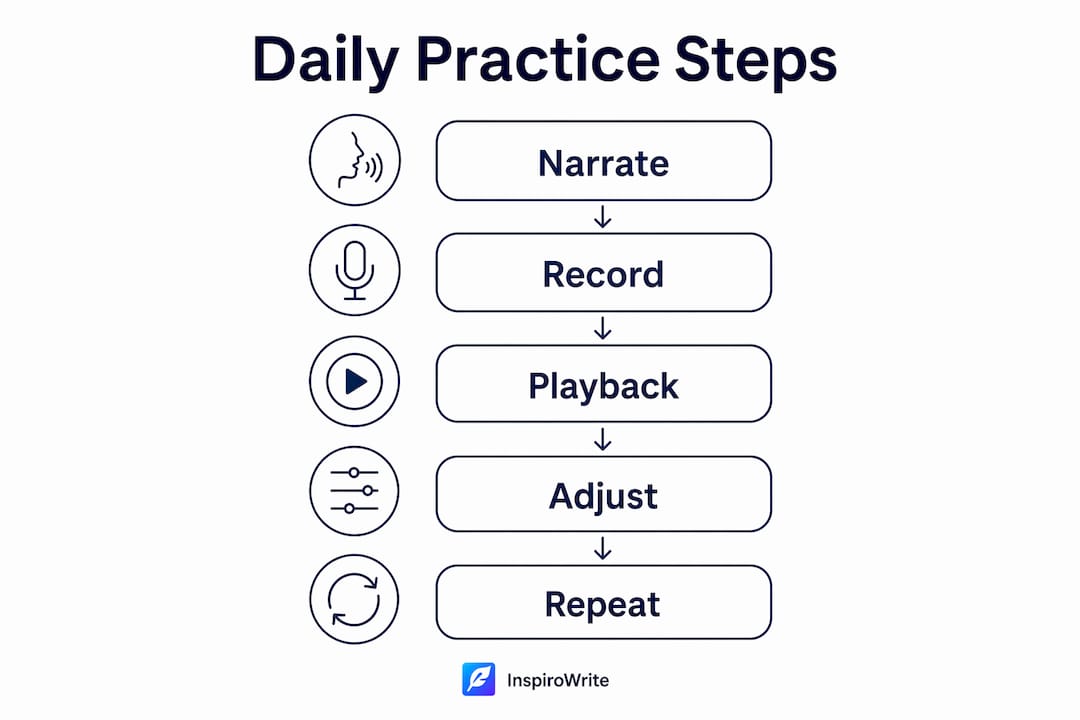
Consistent daily routines are more effective than occasional intensive study sessions. The goal is to create as many moments of English thinking as possible throughout your normal day.
- Narrate your surroundings. Describe what you see, hear, and do as you move through your day. Narrating your environment for at least 10 minutes daily creates a direct thought-to-speech neural link that bypasses slower mental translation. Start with simple sentences: "I am making coffee. The cup is blue. The kitchen is quiet."
- Name objects and actions. When you pick up your keys, think "keys." When you open a door, think "I am opening the door." This grounds your thinking in English at the most basic level and builds automatic retrieval.
- Practise internal questions. Ask yourself questions in English throughout the day. "What do I need to do next?" or "How do I feel about this?" This keeps English active in your mind even when you are not speaking.
- Use language exchange apps. Platforms like HelloTalk connect you with native speakers for real conversational practice. Conversations with native speakers train the brain to respond within seconds without conscious translation.
- Keep an English journal. Write three to five sentences each morning about your plans or feelings. This is one of the most direct ways to write naturally in English and build the habit of expressing ideas in English first.
Consistency matters far more than duration. Five days a week of 20-minute practice outperforms a single three-hour session at the weekend. Your brain builds fluency through repetition, not volume.
Pro Tip: Record yourself speaking for 60 seconds each morning without stopping to correct yourself. Play it back once a week. You will hear your own progress more clearly than any test can show you.
Do idioms and phrases make you sound more natural?
Idiomatic language is the difference between sounding textbook-correct and sounding genuinely fluent. Literal translation produces sentences that are grammatically acceptable but oddly formal or unnatural to native ears.
Consider the difference between "I do not understand" and "I'm not following you." Both are correct. Only one sounds like a native speaker in casual conversation. Idiomatic English improves natural communication and makes both writing and speaking more engaging.
The table below shows the contrast between literal translations and natural idiomatic alternatives:
| Literal Translation | Natural Idiomatic English |
|---|---|
| I have hunger | I'm starving |
| It is not my problem | That's not my concern |
| I agree with you | You've got a point |
| This is very difficult | This is no walk in the park |
| I do not remember | It's slipped my mind |
Learning collocations is equally important. A collocation is a pair or group of words that native speakers naturally use together. You "make a decision," not "do a decision." You "take a break," not "have a pause." These combinations feel automatic to native speakers because they have heard them thousands of times.
- Learn five new collocations per week rather than five new individual words
- Group idioms by topic: workplace English, social situations, academic writing
- Practise each new phrase in three different sentences before moving on
- Connect idiomatic learning to your field. Business English has its own set of phrases, and understanding business jargon translation challenges is particularly useful for professional contexts
Idiomatic fluency also matters in formal settings. Academic writing, job interviews, and professional emails all reward candidates who use natural phrasing over stiff, over-translated prose.
Which tools help you express ideas in english effectively?
Technology in 2026 offers non-native speakers a genuinely useful set of tools for reducing the gap between thought and fluent expression. The key is choosing tools that support your thinking rather than replacing it.
| Tool | Primary Function | Best For |
|---|---|---|
| Grammarly | Grammar and style correction | Written English polishing |
| Oravo | AI speech-to-text and translation | Real-time dictation and meetings |
| Inspirowrite | AI proofreading and translation | Privacy-safe writing improvement |
| HelloTalk | Language exchange with native speakers | Spoken fluency and conversation |
Oravo is worth particular attention for professional users. Modern AI tools like Oravo support over 20 languages and 100 accents, with HIPAA-ready and SOC 2 Type II certification as of early 2026. That level of security matters for anyone dictating sensitive content in a business or medical setting.
Grammarly remains the most widely used writing assistant for non-native speakers. It catches grammar errors, suggests clearer phrasing, and flags unnatural constructions. The limitation is that it corrects after the fact. It does not help you think in English in the first place.
Inspirowrite addresses a different problem. It combines AI-powered proofreading with translation support, and critically, it does not use your content to train its models. For students and professionals who need fast, private feedback on their writing, that distinction matters. You can also explore AI translation alternatives if you want to compare approaches before committing to one platform.
The most effective approach combines tools with daily practice. Technology catches errors and suggests improvements. Only consistent mental exercise builds the habit of thinking in English from the start.
What mistakes slow down your progress in english thinking?
Several common errors consistently hold learners back, and most of them stem from misunderstanding what fluency actually requires.
- Chasing perfect grammar before speaking. Waiting until your sentence is grammatically flawless before saying it reinforces the translation bottleneck. Speak first, refine later.
- Relying on direct word-for-word translation. Translating your native language sentence structure into English produces awkward results. English has its own word order and rhythm that must be absorbed through exposure, not calculation.
- Using complex vocabulary too early. Learners who reach for advanced words before mastering simple phrases sound unnatural. Fluency does not require linguistic perfection. It requires clear communication.
- Avoiding real conversation. Textbooks and apps are useful, but they cannot replicate the speed and unpredictability of a real conversation. Avoiding native speakers because you fear mistakes is the single most common reason fluency stalls.
- Ignoring natural rhythm. English has stress patterns and a natural cadence. Learners who ignore this sound robotic even when their vocabulary is excellent. Listen to podcasts, films, and interviews to absorb the music of the language.
Understanding language transfer in writing is also worth your time. Many errors non-native writers make are not random. They follow predictable patterns from the learner's first language. Recognising those patterns helps you correct them faster.
Key takeaways
Translating thoughts into fluent English requires training your brain to think directly in English through daily narration, idiomatic phrase learning, and consistent conversational practice.
| Point | Details |
|---|---|
| Break the translation bottleneck | Train your brain to form ideas in English first by narrating your surroundings daily. |
| Practise consistently, not intensively | 15–20 minutes of daily practice beats infrequent long sessions for building fluency. |
| Learn phrases, not just words | Whole idioms and collocations produce faster, more natural speech than isolated vocabulary. |
| Use technology wisely | Tools like Grammarly, Oravo, and Inspirowrite support writing quality but cannot replace active thinking practice. |
| Fluency means clarity, not perfection | Clear communication and confident conversation matter more than accent or flawless grammar. |
What i have learnt after years of watching learners struggle
The single biggest mistake I see non-native English speakers make is waiting until they feel ready. They study grammar rules, build vocabulary lists, and consume content passively, then wonder why they still freeze when someone speaks to them quickly. Fluency does not come from preparation. It comes from doing.
The learners who progress fastest are the ones who start talking to themselves in English on day one. Not perfectly. Not fluently. Just constantly. They narrate their commute, describe their lunch, argue with themselves about what to watch that evening. That daily self-talk builds the neural habit that no grammar exercise can replicate.
Idiomatic language is where the real transformation happens. The moment a learner stops translating "I understand" and starts instinctively reaching for "I follow you" or "That tracks," something shifts. The language stops feeling like a code to crack and starts feeling like a tool they actually own.
Technology has made this process faster and more accessible than it was even five years ago. But the tools work best when they are catching errors in thinking you have already done in English, not translating thinking you did in another language. That distinction is everything.
Start simple. Stay consistent. Trust the process more than the grammar book.
— Mike
How Inspirowrite helps you convey thoughts in english
Inspirowrite is built for exactly the moment when your English thinking is almost right but not quite there. You have formed the idea, you have written the sentence, and something still feels off. Inspirowrite's AI-powered proofreading and translation tool catches those gaps in seconds, suggesting natural phrasing and correcting grammar without storing your content or using it to train any model.
For students submitting academic work, professionals writing client-facing documents, or anyone who needs polished written English fast, Inspirowrite delivers immediate, private feedback. Try Inspirowrite and see how quickly your written English improves when you have the right tool behind you.
FAQ
How long does it take to think in english naturally?
Most intermediate learners develop natural English thinking habits within six to twelve months of consistent daily practice. Reaching B2 fluency typically requires 45–60 minutes of focused practice each day over that period.
Does thinking in english mean losing my accent?
No. Fluency does not require losing your accent or speaking without mistakes. It means communicating clearly and handling complex conversations with confidence.
What is the fastest way to stop translating in my head?
Narrating your surroundings out loud for 10 minutes daily is the most direct method. This thought-to-speech neural link trains your brain to bypass mental translation and respond in English automatically.
Are AI tools useful for improving english fluency?
AI tools like Grammarly and Inspirowrite improve written accuracy and suggest natural phrasing, which reinforces correct English patterns over time. They work best when combined with active speaking and thinking practice rather than used as a replacement for it.
Why do idioms matter more than vocabulary size?
Idioms and collocations are retrieved as complete units, which speeds up both speaking and writing. Learning whole phrases like "That makes sense" or "I get that" produces faster, more natural responses than assembling sentences word by word from a large vocabulary list.