

TL;DR:
- A translation memory is a database that stores approved source and target text segments for reuse in future projects, improving efficiency and consistency. It differentiates between exact and fuzzy matches, helping translators save time on repetitive content while requiring active maintenance to prevent errors. Combining TM with glossaries and quality processes optimizes translation accuracy, significantly reducing costs and turnaround times over time.
A translation memory (TM) is a database of paired segments storing previously translated source and target text for reuse in future projects. Every time a translator approves a translation, that segment is saved and becomes available the next time the same or similar text appears. This technology sits at the heart of computer-assisted translation (CAT) tools such as memoQ, Smartling, and Phrase, and it is the single most effective mechanism for maintaining consistency and reducing costs across large or recurring translation projects. TM systems differentiate between exact matches and fuzzy matches, giving translators a practical starting point rather than a blank page.
What is a translation memory and how does it work?
Translation memory technology operates by breaking source text into discrete units called segments, typically sentences or clauses, and comparing each segment against stored source-target pairs in the TM database. When the system finds a match, it presents the stored translation to the translator for review and acceptance. The process runs continuously as work progresses, building the TM with every approved segment.
The matching process follows a clear hierarchy:
- Exact match (100%): The incoming segment is identical to a stored source segment. The system presents the stored translation directly, requiring only a quick review before acceptance.
- Fuzzy match: The incoming segment is similar but not identical, expressed as a similarity percentage (for example, 75% or 85%). The translator edits the suggested translation to fit the new context rather than translating from scratch.
- No match: No stored segment is close enough. The translator produces a new translation, which is then saved to the TM upon approval.
TM systems suggest prior translations and save new approved translations as work progresses, meaning the database grows more valuable with every completed project. This compounding effect is what makes TM particularly powerful for organisations that translate the same product documentation, legal templates, or technical manuals repeatedly.
TM data is typically stored and shared using the TMX XML file format, which contains translation units alongside metadata such as language codes and creation dates. TMX files allow translators to move their TM data between CAT tools without losing any prior work, making portability a genuine practical advantage.

Pro Tip: Always export your TM as a TMX file at the end of each project. This protects your institutional translation knowledge and allows you to import it into any CAT tool your next client or employer uses.
How does translation memory compare with machine translation and glossaries?
Translation memory, machine translation (MT), and glossaries are three distinct tools that serve complementary roles. Conflating them is one of the most common misconceptions among translation students and newer professionals.
| Tool | What it stores | How it generates output | Best suited for |
|---|---|---|---|
| Translation memory | Approved human-translated segment pairs | Retrieves and suggests stored translations | Repetitive content, incremental updates |
| Machine translation | Statistical or neural language models | Generates new translations algorithmically | High-volume content needing rapid first drafts |
| Glossary / termbase | Individual terms and their approved equivalents | Flags or inserts approved terms during translation | Brand names, technical terminology, legal terms |
TM reuses approved human translations while MT generates new translations algorithmically. This distinction matters because TM output carries the authority of a previously reviewed human decision, whereas MT output always requires post-editing for quality assurance. For technical documents where a single mistranslated term can cause serious problems, TM's reliance on vetted prior work is a significant advantage.
Glossaries complement TM by managing individual terms to maintain precision and brand consistency alongside TM's sentence-level reuse. A glossary tells the translator that "user interface" must always be rendered as a specific term in the target language. The TM handles the full sentence containing that term. Together, they cover both levels of consistency.
The limitation of TM compared with MT is its dependence on prior translations. A brand-new project with no existing TM has nothing to draw on. MT can generate a first draft for any content immediately, which is why many professional workflows now combine both: MT produces the initial draft, and TM matches override MT suggestions wherever approved human translations already exist.
What are the benefits and limitations of translation memory?
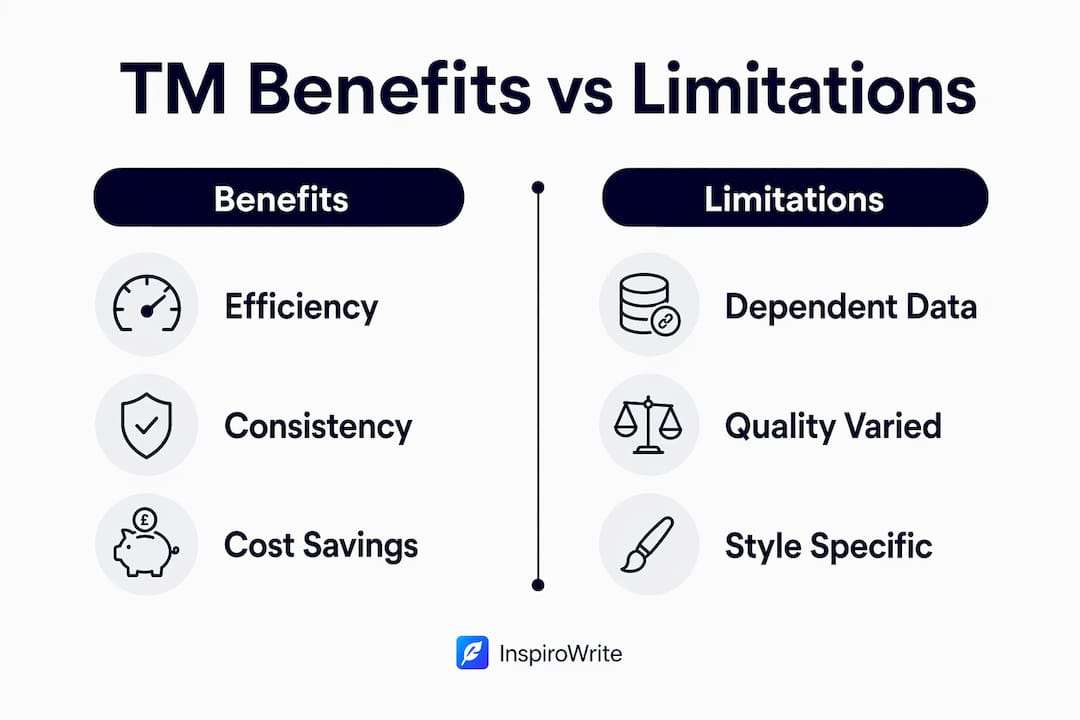
The practical advantages of TM are well documented and directly measurable. Mature TMs reduce new translation volume by 30 to 70%, delivering cost savings and consistency benefits that compound over time. For organisations managing multilingual product catalogues, legal templates, or software interfaces, this reduction in new word count translates directly into lower costs and faster delivery.
The core benefits for translators and organisations include:
- Efficiency: Translators spend less time on repeated or near-identical content, freeing capacity for genuinely new material.
- Consistency: The same source phrase always produces the same approved target phrase, eliminating variation across documents, teams, or time periods.
- Institutional knowledge: Well-curated TMs act as approved knowledge bases that mature and increase in value over time, capturing the linguistic decisions of experienced translators.
- Cost reduction: Clients and agencies typically apply discounted rates for TM matches, reflecting the reduced effort required.
- Faster turnaround: Projects with high TM leverage move through the translation stage significantly faster, benefiting both translators and clients.
TM also reduces the risk of common business translation errors by anchoring new work to previously approved decisions rather than relying on a translator's memory alone.
The limitations are equally worth understanding. TM quality depends entirely on the quality of what has been saved. If an error enters the TM, it will be suggested repeatedly until someone catches and corrects it. Inconsistent segmentation caused by formatting differences or punctuation changes can reduce expected matches even when the visible text appears identical. This means a TM built without consistent segmentation rules will underperform, frustrating translators who expect matches that never appear.
Client-specific language and style also affect TM value. A TM built for one client's technical documentation may be of limited use for another client in the same industry if their preferred terminology and register differ significantly.
Pro Tip: Run a TM clean-up at least once per year. Remove duplicate entries, correct known errors, and standardise segmentation. A well-maintained TM is worth far more than a large but unchecked one.
How can translators and organisations optimise translation memory use?
Getting the most from a TM requires deliberate management rather than passive accumulation. The following practices make a measurable difference to TM performance and translation quality:
- Establish consistent segmentation rules before a project begins. Agree on how the CAT tool segments text, particularly around abbreviations, bullet points, and numbered lists, and apply those rules uniformly across all files.
- Save only approved translations. Only confirmed translations should enter the TM to prevent errors spreading across future projects. Unreviewed machine translation output should never be saved directly.
- Edit fuzzy matches carefully. A 75% fuzzy match still requires 25% of the sentence to be reconsidered. Read the full segment in context before accepting any suggestion.
- Pair TM with a termbase. Combining TM with terminology databases improves both phrase-level and term-level consistency. Tools such as memoQ and Phrase support simultaneous TM and termbase lookup natively.
- Use TMX for portability. TMX files transfer TM data accurately across different tools and teams. Always request a TMX export when changing CAT tools or onboarding a new client's existing TM.
- Integrate TM with a translation management system (TMS). Platforms that combine TM with project management, quality assurance, and terminology tools create a single workflow rather than a collection of disconnected resources. This integration is particularly valuable for multilingual business documents that require consistent handling across languages and departments.
The gaming localisation sector offers a useful illustration of TM optimisation in practice. Studios managing multilingual game content across dozens of languages use TM to maintain character name consistency, UI string accuracy, and narrative tone across updates, where even small inconsistencies break player immersion.
Key takeaways
Translation memory is the most effective single technology for maintaining consistency and reducing costs in professional translation workflows, provided it is actively maintained and used alongside termbases and quality assurance processes.
| Point | Details |
|---|---|
| TM definition | A database storing approved source-target segment pairs for reuse in future translation projects. |
| Match types matter | Exact matches require only review; fuzzy matches require editing based on similarity percentage. |
| TM vs MT vs glossary | TM reuses human-approved segments; MT generates new output; glossaries manage individual terms. |
| Efficiency gains | Mature TMs reduce new translation volume by 30 to 70%, cutting costs and turnaround times. |
| Maintenance is critical | Only save approved translations and clean the TM regularly to prevent errors compounding. |
Why TM is more than a time-saving trick
I have worked with translators who treat their TM as a passive archive, something that accumulates in the background and occasionally throws up a useful suggestion. That approach leaves most of the value on the table.
The translators I have seen get the most from TM treat it as a living document. They review it after every major project, correct errors before they propagate, and build it deliberately around the client's specific register and terminology. One technical translator I worked with maintained separate TMs for each of her three main clients, each tuned to that client's preferred style. Her consistency scores were consistently higher than colleagues using a single shared TM, and her revision rates were lower.
The tension between TM and machine translation is also worth addressing honestly. MT has improved dramatically, and some professionals now question whether TM remains necessary. My view is that TM and MT are not competing technologies. MT is fast and broad; TM is precise and authoritative. For any content where a client has previously approved specific phrasing, TM will always outperform MT because it reflects a deliberate human decision rather than a statistical probability.
For those new to the field, my advice is to start building your TM from your very first project, even if it is small. The compounding value of a well-maintained TM becomes apparent quickly, and the habits you build early will define the quality of your work for years.
— Mike
How Inspirowrite supports your translation workflow
Inspirowrite combines AI-powered translation accuracy with a firm commitment to user privacy, making it a practical choice for translators and language professionals who need fast, reliable results without compromising confidentiality. Unlike tools that use your content to train their models, Inspirowrite keeps your work private. Whether you are working on technical documents, business correspondence, or multilingual content, Inspirowrite delivers polished translations and proofreading feedback within seconds. Explore Inspirowrite's translation and proofreading tools to see how professional-grade technology can support your next project.
FAQ
What is TM in translation?
TM stands for translation memory, a database that stores previously translated source and target text segments for reuse. CAT tools such as memoQ, Smartling, and Phrase use TM to suggest approved translations whenever matching or similar content appears in a new project.
How does translation memory differ from a glossary?
A translation memory stores and reuses full translated segments at sentence level, while a glossary manages individual terms and their approved equivalents. Using both together provides consistency at both the phrase level and the term level.
Can translation memory be used across different CAT tools?
Yes. TM data is typically exported and imported using the TMX file format, which preserves translation units and metadata such as language codes and creation dates, allowing portability across different tools and teams.
What types of content benefit most from translation memory?
Content with high repetition or incremental updates benefits most, including technical documentation, product catalogues, legal templates, and software interfaces. Mature TMs can reduce new translation volume by 30 to 70% for this type of content.
Does translation memory replace machine translation?
No. TM reuses approved human translations for matching content, while MT generates new translations algorithmically for content with no prior TM coverage. Professional workflows increasingly combine both, with TM matches taking priority over MT suggestions wherever approved translations exist.