

TL;DR:
- Back translation verifies that a translation preserves the original meaning by re-translating it into the source language with an independent linguist. It involves four steps: forward translation, blind back translation, discrepancy reconciliation, and revision, ensuring a thorough quality check. This process is crucial in high-stakes fields like medical, legal, and research, where accuracy impacts safety, compliance, and validity.
Back translation is the process of re-translating a completed translation back into the original source language by an independent linguist, to verify that the translated content accurately preserves the original meaning and context. This quality assurance method sits at the heart of professional translation workflows, particularly in fields where a mistranslation carries serious consequences. Understanding what is back translation explained in full, including its methodology and limitations, is the difference between a translation that reads well and one that actually means what it should. Tools and platforms such as Smartling have helped bring this process into mainstream professional use.
What is the back translation process, step by step?
The standard back translation process consists of four structured steps: forward translation, blind back translation, discrepancy reconciliation, and revision. Each stage serves a distinct purpose, and skipping any one of them weakens the entire quality check.
Step 1: Forward translation. A qualified linguist translates the source text into the target language. This is the primary translation that will eventually reach the end reader.
Step 2: Blind back translation. A second, entirely independent translator re-translates the target language text back into the source language. This translator has not seen the original source text. That independence is the whole point.

Step 3: Discrepancy reconciliation. A project manager or senior linguist compares the original source text against the back-translated version. Any differences in meaning, tone, or intent are flagged and discussed.
Step 4: Revision. The original translation is revised based on the findings. Changes are documented, along with notes on whether any meaning shifts posed a functional or safety risk.
Pro Tip: Never use the same translator for both the forward and back translation. The back translator must be independent and unaware of the original source text. Any familiarity with the original wording introduces bias and defeats the purpose of the check.
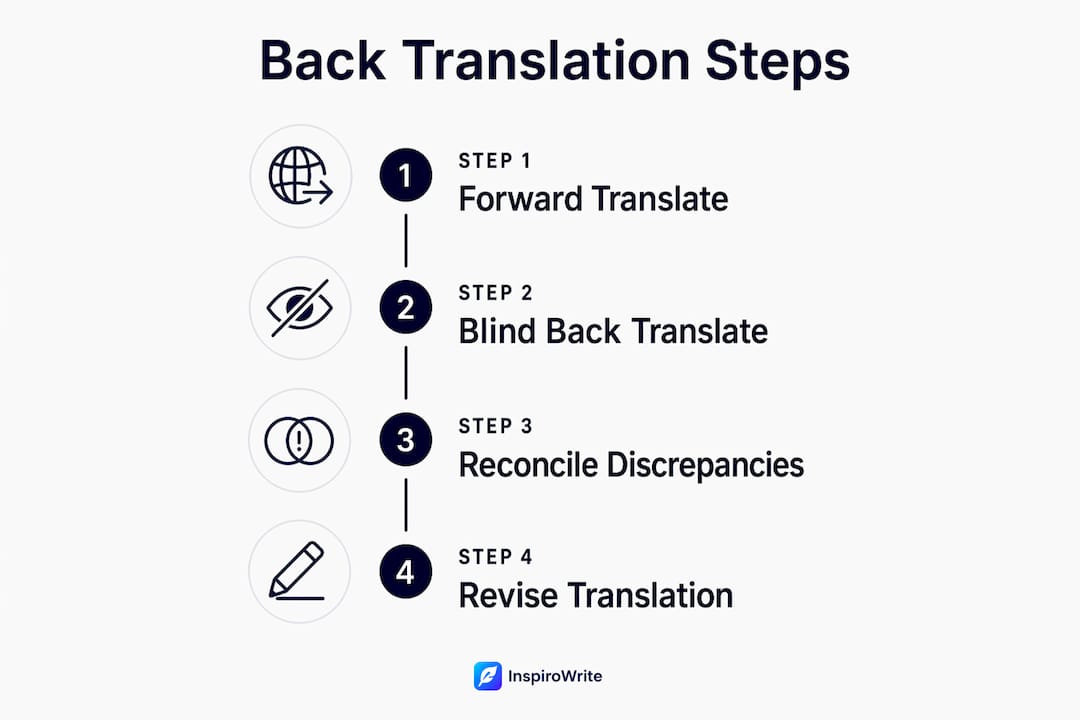
This four-step workflow is not bureaucratic overhead. It is the mechanism that catches the errors a bilingual proofreader would miss entirely, because it tests meaning rather than grammar.
How does back translation differ from proofreading?
Back translation and proofreading address completely different problems. Proofreading checks grammar, spelling, style, and fluency within a single language. Back translation tests semantic accuracy by stress-testing whether the translated text still carries the original meaning. A translation can be grammatically perfect and still be wrong.
Consider a clinical trial consent form translated from English into Mandarin. A proofreader confirms the Mandarin reads naturally. Back translation reveals that a phrase meaning "mild discomfort" in English has been rendered as something closer to "minor pain" in the back-translated version. That shift matters enormously to a patient deciding whether to participate.
Back translation also identifies errors, omissions, and cultural misinterpretations that proofreading cannot detect. A proofreader works within the target language and has no reference point for what the source text actually said.
Key differences at a glance:
- Proofreading checks grammar, punctuation, and fluency within the target language.
- Back translation compares meaning between the source and the re-translated version.
- Proofreading is suitable for general content where style matters most.
- Back translation is required where semantic accuracy affects safety, compliance, or research validity.
- Proofreading is faster and less costly. Back translation requires two independent linguists and a reconciliation stage.
- Back translation does not replace proofreading. Both serve different functions and work best together.
Pro Tip: When reviewing culturally adapted content, do not treat every difference between the original and back-translated text as an error. Cultural adaptations and idioms will naturally produce variation. The goal is to catch meaning drift, not to demand word-for-word equivalence.
Understanding bilingual proofreading as a separate discipline helps clarify where each method fits within a broader quality assurance workflow.
What are the common misconceptions about back translation?
The most persistent misconception is that the back-translated text must match the original word for word. It does not, and expecting it to reveals a misunderstanding of what the method is for. Back translation acts as a mirror, showing where the translation has drifted and where the original source text may itself contain ambiguities.
A second misconception is that back translation guarantees a perfect translation. It does not. It reveals problems. The quality of the final translation still depends on the skill of the original translator and the thoroughness of the reconciliation stage.
Common challenges translators and project managers face include:
- Stylistic variation. Two skilled translators will phrase the same idea differently. Not every stylistic difference signals a meaning error.
- Translator intervention. A translator may have made a deliberate choice to adapt a phrase for cultural reasons. Back translation flags this, but the team must judge whether the adaptation is appropriate.
- Source text ambiguity. Sometimes back translation reveals that the original source text was unclear. The problem was never in the translation at all.
- Over-reliance on the method. Back translation does not detect display problems, formatting errors, or localisation issues such as date formats and currency symbols.
The best practice for translators performing back translation is to translate only what the target text says, not what they assume it means. Any assumptions introduced at this stage corrupt the entire comparison. Reviewing common translation errors before undertaking a back translation project sharpens awareness of where meaning drift typically occurs.
Which industries rely most on back translation?
Back translation is especially critical in high-stakes industries such as medical research, clinical trials, legal documentation, and market research. Regulatory and ethical requirements in these fields often mandate back translation as a formal step in the translation process.
In clinical research, patient questionnaires and informed consent forms must convey identical meaning across all language versions. A shift in how a symptom is described can skew trial data or mislead a patient. In legal translation, a single word change can alter the interpretation of a contract clause. In market research, survey questions that drift in meaning produce unreliable data across language groups.
| Industry | Primary risk without back translation | Back translation benefit |
|---|---|---|
| Medical research | Inaccurate patient data, safety risks | Confirms symptom descriptions match across languages |
| Legal documentation | Contractual misinterpretation | Verifies clause meaning is preserved exactly |
| Market research | Skewed survey responses | Ensures question intent is consistent across languages |
| Pharmaceutical | Regulatory non-compliance | Meets mandatory accuracy standards for drug labelling |
| Academic research | Invalid cross-language comparisons | Validates instrument equivalence across study groups |
Back translation costs approximately 25–40% of the original translation budget, which explains why it is not applied universally. That cost is justified for legally sensitive or medically adjacent content, where a translation error carries consequences far greater than the additional spend.
Back translation is also a cornerstone of multilingual qualitative research. When researchers conduct interviews or administer validated psychological scales across multiple languages, back translation confirms that the instrument measures the same construct in every language version. Without it, cross-language comparisons lose their validity.
Key takeaways
Back translation is a four-step quality assurance process that reveals meaning drift and hidden ambiguities in translated content, making it indispensable in medical, legal, and research contexts.
| Point | Details |
|---|---|
| Definition of back translation | An independent translator re-translates target text into the source language to verify meaning accuracy. |
| Four-step process | Forward translation, blind back translation, discrepancy reconciliation, and revision form the standard workflow. |
| Not a proofreading substitute | Back translation tests semantic accuracy; proofreading checks grammar and fluency. Both are needed. |
| Independence is non-negotiable | The back translator must not have seen the original source text to avoid bias in the comparison. |
| High-stakes industries | Medical, legal, pharmaceutical, and market research fields rely on back translation for regulatory and ethical compliance. |
Why back translation deserves more respect than it gets
Back translation is the most underused quality check in professional translation, and the reasons are almost always about cost and time. I have seen project managers skip it on medical device manuals because the deadline was tight, only to discover months later that a dosage instruction had shifted meaning between English and Spanish. The back translation would have caught it in hours.
The method also teaches translators something that no style guide can. When you translate your own work back into the source language, you see your assumptions laid bare. The phrases you thought were equivalent often are not. The idioms you adapted confidently sometimes carry a different weight than you intended. Back translation is, in that sense, the most honest feedback a translator can receive.
The misconception that it demands word-for-word matching frustrates me most. That expectation turns a useful diagnostic tool into an impossible standard. The goal is to spot meaning drift, not to produce a clone of the original. A skilled project manager reads the back translation as a diagnostic report, not a verdict.
My advice to language learners starting out in translation: practise back translation on your own work before submitting it. Translate a paragraph into your target language, set it aside for a day, then translate it back without looking at the original. The gaps you find will teach you more about your own translation habits than any textbook.
— Mike
Take your translation accuracy further with Inspirowrite
Back translation is one layer of a rigorous quality assurance process. Getting every layer right requires the right tools working alongside skilled linguists.
Inspirowrite is an AI-powered proofreading and translation solution built for writers, students, and professionals who need fast, accurate results without compromising privacy. Your content is never used to train AI models, and feedback arrives within seconds. Whether you are refining a translated document or checking a draft for meaning and style, Inspirowrite gives you a polished result quickly. Explore what Inspirowrite can do for your translation workflow at inspirowrite.com.
FAQ
What is the definition of back translation?
Back translation is the process of re-translating a target language text back into the original source language by an independent linguist. Its purpose is to verify that the translated content accurately preserves the meaning and intent of the original.
How does back translation work in practice?
The process follows four steps: forward translation, blind back translation by an independent linguist, reconciliation of discrepancies, and revision of the original translation. The back translator must not have seen the original source text to ensure an unbiased comparison.
Is back translation the same as proofreading?
No. Proofreading checks grammar, spelling, and fluency within the target language. Back translation tests semantic accuracy by comparing the meaning of the re-translated text against the original source.
Why is back translation important in medical research?
Medical research requires that patient questionnaires, consent forms, and clinical instruments convey identical meaning across all language versions. Back translation catches meaning shifts that could compromise patient safety or invalidate research data.
Does back translation need to match the original text exactly?
No. The purpose of back translation is to reveal where meaning has drifted or where the original text contains ambiguities, not to produce a word-for-word replica of the source.