
TL;DR:
- Editing improves a document's structure, clarity, and argument during drafting, while proofreading detects surface errors before publication. These stages require different techniques, with editing happening first and proofreading conducted after all content is finalized. Relying solely on automation or combining both processes compromises quality and trustworthiness.
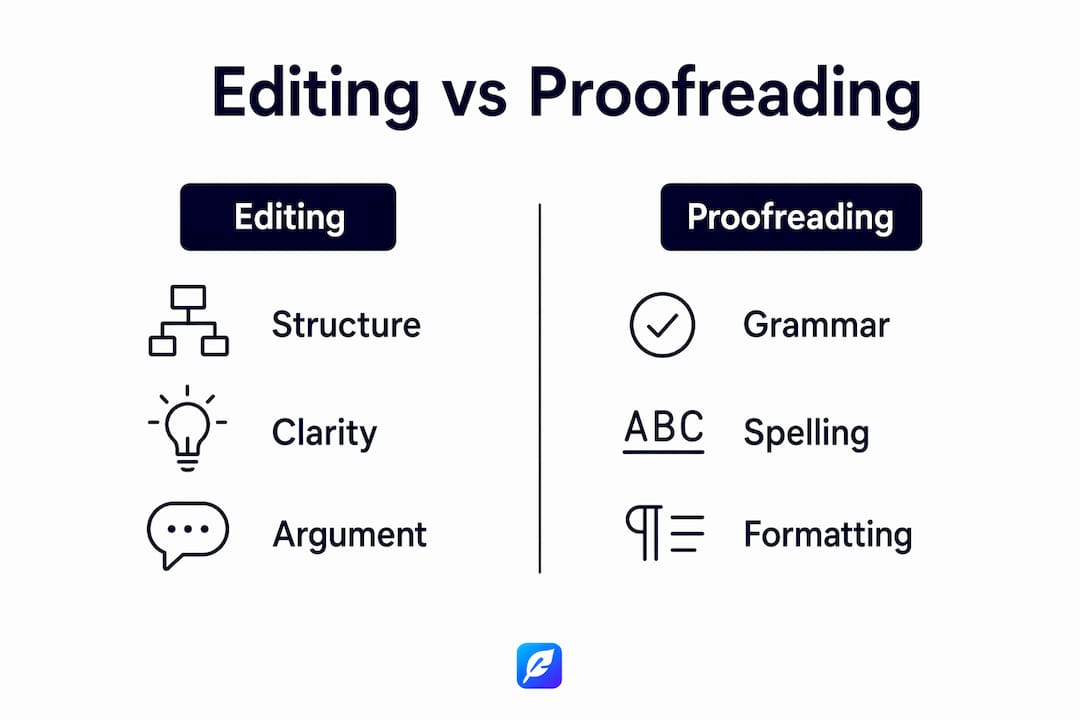
Editing is defined as the process of improving a text's structure, clarity, and argument before publication, while proofreading is the final review that catches surface errors such as typos, punctuation mistakes, and formatting inconsistencies. Understanding why editing differs from proofreading is not a minor technicality. It determines whether your writing is genuinely improved or merely tidied up. Students submitting dissertations, professionals drafting reports, and writers preparing manuscripts all make the same costly mistake: treating these two processes as interchangeable. They are not. Each serves a distinct purpose, operates at a different stage, and requires a different set of skills.
Why editing differs from proofreading: purpose and scope
Editing and proofreading differ by purpose and stage. Editing works on drafts to improve clarity, consistency, and overall strength of argument. Proofreading checks the finished, laid-out document for small errors that slipped through earlier stages. Conflating the two means you risk publishing work that is either structurally weak or riddled with surface errors, sometimes both.
The scope of editing is considerably broader than most writers realise. Editing includes multiple sub-stages: substantive editing addresses narrative logic and overall structure; copyediting handles grammar, style consistency, and terminology; line editing refines sentence-level clarity and tone. Each sub-stage targets a different layer of the text. Proofreading comes after all of these, once the document has been formatted and is ready for publication.
The roles of editing and proofreading can be summarised as follows:
- Editing reorganises content, strengthens arguments, adjusts tone, and improves readability throughout the drafting process.
- Copyediting corrects grammar, ensures stylistic consistency, and standardises terminology across the document.
- Substantive editing examines whether the logic holds, whether sections are ordered effectively, and whether the reader's journey through the text is coherent.
- Proofreading is the final pass. It checks spelling, punctuation, capitalisation, citation formatting, and layout consistency. No restructuring occurs at this stage.
- Sequence matters absolutely. Editing must come first. Attempting to proofread before editing duplicates work and reduces efficiency because structural changes during editing will introduce new surface errors that require another proofread.
This sequence is not a stylistic preference. It is the professional standard across publishing, academia, and corporate communications.
How do the processes and techniques for editing and proofreading differ?
The practical difference between editing and proofreading becomes clearest when you examine what each process actually involves. Editing requires you to read with a strategic eye. You are asking whether the argument is logical, whether the tone suits the audience, and whether any section could be cut, merged, or reordered without losing meaning. If you change sentence order or restructure paragraphs, you are copyediting or substantive editing, not proofreading. These are fundamentally different cognitive tasks.
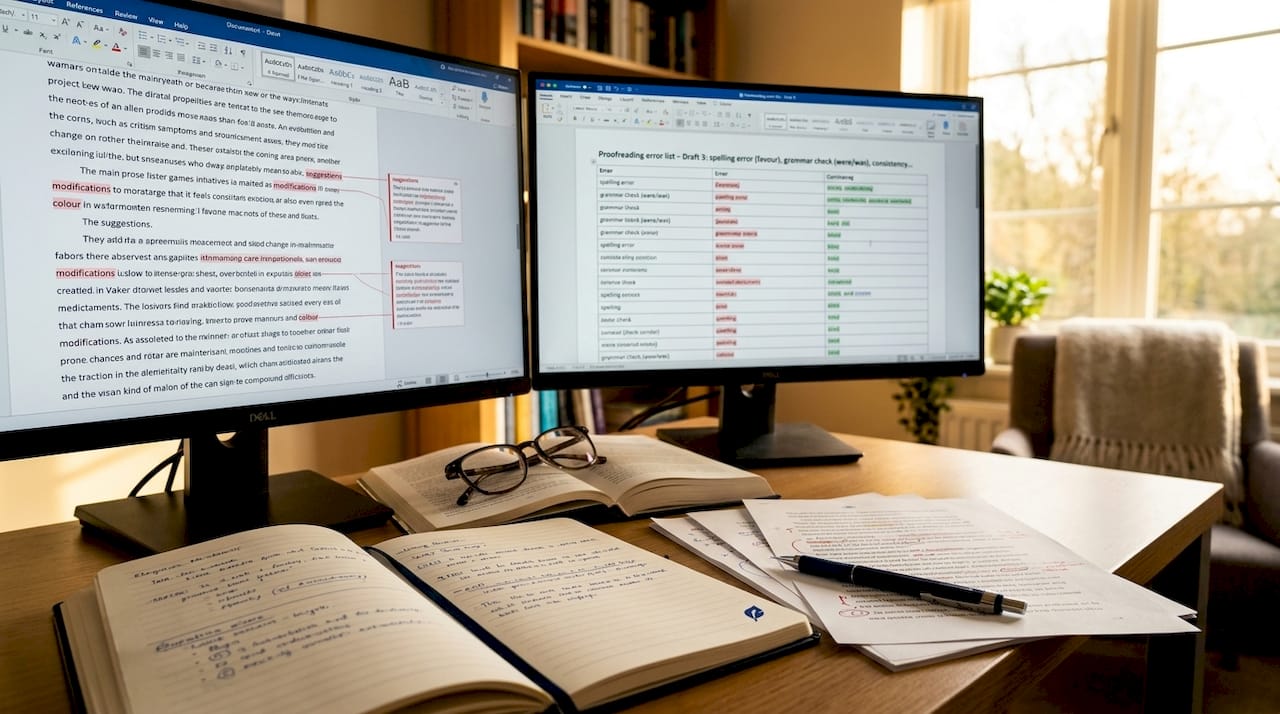
Proofreading, by contrast, demands a different kind of attention. Proofreading is a distinct skill requiring deliberate focus and techniques that differ from editing or writing. The goal is to see what is actually on the page, not what you expect to be there. Your brain, having written or edited the text, will automatically fill in missing words and overlook repeated errors. Effective proofreaders use specific techniques to disrupt this pattern recognition.
Here is a practical sequence for proofreading any document:
- Create distance first. Leave at least 24 hours between finishing your edit and beginning your proofread. Fresh eyes catch more errors.
- Read aloud. Reading aloud catches more errors than silent reading because your ear detects missing words and awkward phrasing that your eye skips over.
- Use a ruler or pointer. Placing a ruler under each line forces you to read one line at a time and prevents your eye from jumping ahead.
- Read from the bottom up. Reading sentences out of order disrupts cognitive pattern recognition, helping you see genuine errors rather than what you expect the text to say.
- Run targeted passes. Check spelling in one pass, punctuation in another, and citation formatting in a third. Single-focus passes are more reliable than trying to catch everything at once.
Pro Tip: When proofreading your own work, change the font and font size before you begin. This simple visual shift makes familiar text look different and helps you spot errors you would otherwise miss.
Editing techniques look entirely different. A skilled editor might use tools like Google Docs' suggestion mode or Microsoft Word's Track Changes to propose restructuring without overwriting the original. The editor assesses whether the introduction delivers on what the conclusion promises, whether technical terms are defined on first use, and whether the tone remains consistent throughout. These are judgements that require understanding the text's purpose and audience, not just its grammar.
What common misconceptions exist about editing and proofreading?
Several persistent misconceptions cause writers to undermine their own work. The most damaging is the belief that automated grammar checkers can replace either process.
Automated tools sometimes wrongly change names, idiomatic expressions, or deliberate style choices. A grammar checker cannot assess whether your argument is logically sound, whether your tone is appropriate for a board report versus a blog post, or whether a paragraph belongs in chapter two rather than chapter four. These are editorial judgements, not pattern-matching tasks. Relying solely on tools like Grammarly or Microsoft Editor for editing is the equivalent of asking a spell-checker to assess whether your business case is persuasive.
"Automation can introduce errors and cannot handle structural or stylistic issues. Human editors assess voice and meaning in ways no algorithm currently replicates."
Other common misconceptions include:
- Proofreading is not editing. Correcting a typo is not the same as improving an argument. Writers who only proofread their work are polishing a flawed structure.
- Editing and proofreading cannot be done in one pass. Combining editing and proofreading in one pass leads to conflicting corrections and overlooked errors. The cognitive demands of each task are incompatible when performed simultaneously.
- Reversing the sequence wastes time. If you proofread first and then edit, any structural change you make during editing will introduce new surface errors, requiring you to proofread again from scratch.
- Editing erases the author's voice. A skilled editor preserves and clarifies the author's voice rather than replacing it. Author-editor communication is the mechanism that prevents this. If your editor is not asking questions about your intent, that is a warning sign.
- One proofread is sufficient. Professional publishers routinely conduct two or three proofreading passes, often with different readers, because no single pass catches every error.
Understanding the difference between editing and proofreading is the first step to building a reliable writing workflow.
How do editing and proofreading affect writing quality and credibility?
The combined effect of thorough editing and careful proofreading is a document that reads with authority and holds the reader's attention. Errors or unclear structure distract readers and reduce the perceived authority of the text. This is not a subjective observation. A report with a compelling argument but three typos in the executive summary signals carelessness to the reader, regardless of the quality of the underlying research.
Proofreaders check for consistency in formatting, style, capitalisation, and citations, as well as spelling and grammar. This level of consistency reinforces professionalism. A document that uses "organisation" in one paragraph and "organization" in the next, or switches between citation styles mid-document, signals to the reader that the author did not take sufficient care. In academic submissions, such inconsistencies can affect grades. In professional contexts, they can affect credibility and contracts.
| Stage | Primary focus | Impact on the reader |
|---|---|---|
| Substantive editing | Logic, structure, and argument | Reader follows the text without confusion |
| Copyediting | Grammar, style, and terminology | Reader trusts the author's competence |
| Proofreading | Spelling, punctuation, and formatting | Reader is not distracted by surface errors |
| No editing or proofreading | None | Reader loses confidence in the author |
Pro Tip: Before submitting any important document, ask a colleague or peer to read it with one specific question in mind: "Is there any point where you lost the thread of the argument?" This targeted feedback surfaces structural issues that a proofread will never catch.
Effective editing builds the credibility of the argument. Effective proofreading protects that credibility at the surface level. Skipping either stage is a false economy. The time saved by skipping a proofread is rarely worth the professional cost of publishing errors. You can learn more about proofreading's role in quality and why human attention remains central to the process.
Key takeaways
Editing and proofreading are sequential, non-interchangeable processes: editing improves structure and argument first, and proofreading removes surface errors last.
| Point | Details |
|---|---|
| Editing precedes proofreading | Always resolve structure, tone, and logic before checking for surface errors. |
| Each stage has distinct techniques | Editing uses restructuring and rephrasing; proofreading uses targeted passes and reading aloud. |
| Automation cannot replace either | Grammar checkers miss structural flaws and can alter voice; human judgement is required for both stages. |
| Sequence errors waste time | Proofreading before editing forces a second proofread after structural changes are made. |
| Both stages protect credibility | Errors in structure or surface presentation reduce reader trust and professional authority. |
Why I think most writers get this backwards
Most writers I have worked with treat proofreading as the serious work and editing as a quick skim. They spend forty minutes hunting for commas and ten minutes asking whether the argument actually holds together. That is the wrong ratio by a considerable margin.
The uncomfortable truth about editing is that it requires you to be willing to cut work you are proud of. A paragraph that took you an hour to write may need to go because it disrupts the flow of the section. That is an editorial decision, not a proofreading one. Writers who conflate the two stages often avoid making those harder calls because they have already mentally filed the document under "done."
I have also seen the opposite failure: writers who edit obsessively and never proofread properly, submitting work with strong arguments and embarrassing typos. Both failures are avoidable. The solution is to treat editing and proofreading as separate appointments in your calendar, not as a single vague task called "checking your work."
For anyone learning to proofread their own writing, the most important shift is psychological. You are not reading to understand. You are reading to find fault. That requires a different posture entirely, and it is a skill that improves with deliberate practice.
The writers and professionals I respect most are not the ones who write perfect first drafts. They are the ones who have built a reliable editorial process and follow it every time.
— Mike
Polish your writing with Inspirowrite
Understanding the distinction between editing and proofreading is one thing. Having the right support to apply both effectively is another.
Inspirowrite offers AI-powered proofreading and correction that delivers fast, accurate feedback on grammar, style, and clarity while keeping your content completely private. Your text is never used to train AI models, which makes Inspirowrite a trusted choice for students, writers, and professionals handling sensitive material. Whether you need a rapid surface-level check or want to identify deeper stylistic inconsistencies, Inspirowrite gives you polished results in seconds, not hours.
FAQ
What is the main difference between editing and proofreading?
Editing improves a text's structure, clarity, and argument during the drafting stage, while proofreading is the final check for surface errors such as typos, punctuation mistakes, and formatting inconsistencies before publication. The two processes address different risks and must be performed in sequence.
Can I edit and proofread at the same time?
Combining both stages in a single pass leads to conflicting corrections and overlooked errors. Professional practice separates them into distinct passes because the cognitive demands of each task are incompatible when performed simultaneously.
Do automated tools replace the need for editing or proofreading?
Automated grammar checkers cannot replace either stage. They miss structural and stylistic issues, and can incorrectly alter names, idiomatic expressions, or deliberate style choices. Human editorial judgement remains necessary for both editing and proofreading.
What proofreading techniques are most effective?
Reading aloud, using a ruler to focus on one line at a time, and reading sentences from the bottom up are among the most reliable proofreading techniques. Multiple targeted passes, each focused on a single error type, are more effective than a single unfocused read-through.
Why does the order of editing and proofreading matter?
Editing first and proofreading last is the professional standard because structural changes made during editing introduce new surface errors. Proofreading before editing means you will need to proofread again after any structural revisions, which duplicates effort and reduces overall accuracy.