

TL;DR:
- Idioms are non-compositional units whose meanings cannot be derived from their individual words, making direct translation ineffective. Cultural context and fixed structures cause idioms to resist literal rendering, requiring equivalence strategies to preserve their true meaning across languages. Machine translation systems struggle with idioms due to their reliance on literal patterns and lack of cultural reasoning, emphasizing the importance of human insight.
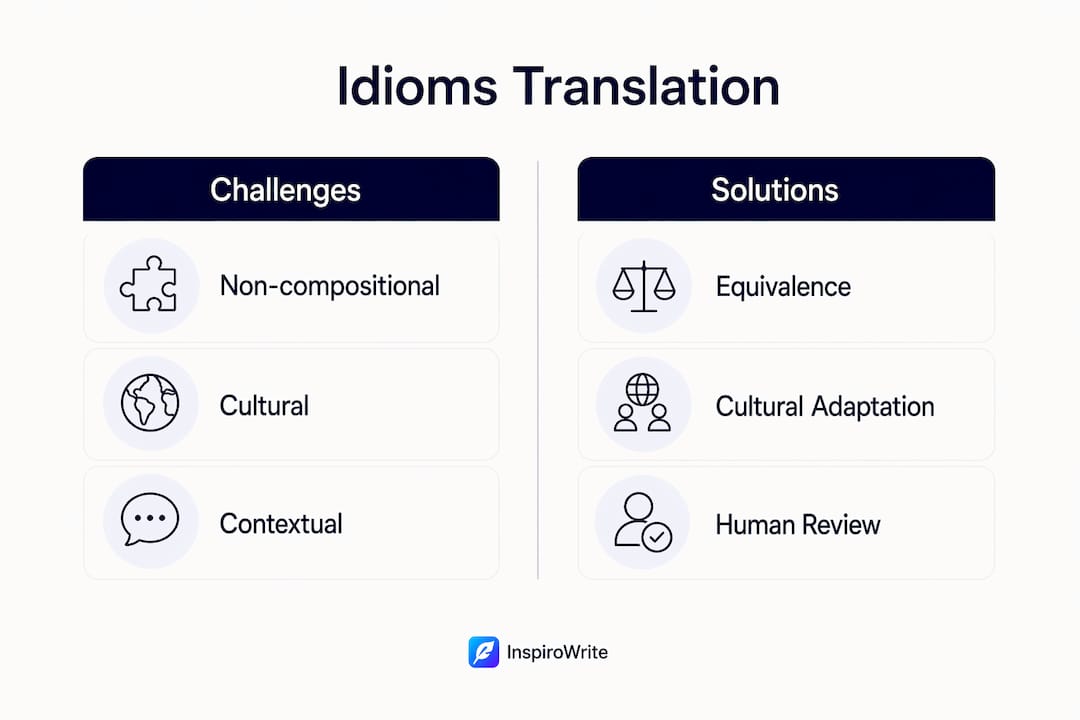
Idioms are non-compositional linguistic units whose meanings cannot be derived from the individual words they contain, which is precisely why idioms fail direct translation in every language pair. The English phrase "kick the bucket" has nothing to do with feet or containers. Its meaning, to die, exists entirely outside its literal words. Research confirms that literal translation fails in the vast majority of idiomatic cases, producing outputs that range from confusing to absurd. Tools like Grammarly flag idiomatic constructions as potential errors because even grammar software recognises that idioms operate by different rules. Understanding the challenges of idiom translation is not merely academic. It shapes how effectively you communicate across languages, cultures, and contexts.
Why idioms fail direct translation at a linguistic level
The core reason idioms resist literal translation is their non-compositionality. In standard language, you can decode a sentence by understanding each word individually. Idioms break that rule entirely. The phrase "spill the beans" does not mean someone has dropped legumes. It means to reveal a secret. No amount of dictionary work will get you there from the individual words alone.

Linguists describe this property as semantic opacity. The figurative meaning is locked inside the phrase as a fixed unit. You cannot swap out one word without destroying the meaning. Saying "spill the lentils" communicates nothing idiomatic in English. This fixed, multi-word structure is what makes idioms so resistant to word-for-word approaches.
Key linguistic features that cause idiomatic translation to break down include:
- Non-compositionality: The whole meaning does not equal the sum of its parts, as confirmed by expert linguistic consensus.
- Semantic opacity: The figurative sense is invisible at the word level, requiring cultural knowledge to decode.
- Fixed structure: Idioms resist grammatical modification. Changing tense, number, or word order often destroys the expression.
- Pragmatic function: Idioms carry tone, register, and social meaning beyond their literal content.
Consider the German idiom Tomaten auf den Augen haben, which translates literally as "to have tomatoes on your eyes." The actual meaning is to be oblivious to something obvious. A direct translation produces nonsense. The figurative meaning is entirely lost.
Pro Tip: When you encounter an unfamiliar idiom, resist the urge to translate word by word. Search for the phrase as a complete unit in a bilingual idiom database or corpus before attempting any translation.
The importance of idiomatic expressions in natural communication is hard to overstate. Native speakers use them constantly, often without noticing. For language learners, this invisibility makes idioms one of the most persistent barriers to fluency.
How do cultural differences shape idiomatic meaning?
Idioms are not random. They grow from the soil of a specific culture, reflecting its history, values, geography, and social norms. Idioms carry national mentality and worldview in a way that no direct substitution can replicate. This is why cultural context in idioms is not a secondary concern. It is the primary one.
The English idiom "it's raining cats and dogs" reflects nothing about British meteorology. It reflects a historical linguistic evolution rooted in old Norse and early modern English usage. A Spanish speaker translating it literally would produce "está lloviendo gatos y perros," which means nothing to a native Spanish reader. The culturally appropriate equivalent in Spanish is "llover a cántaros," meaning to rain in pitchers. The image is different, but the communicative function is identical.
This comparison illustrates a broader pattern across languages:
| English Idiom | Literal Meaning | Cultural Equivalent (Target Language) | Language |
|---|---|---|---|
| Kick the bucket | Strike a bucket with foot | Estirar la pata (stretch the leg) | Spanish |
| Bite the bullet | Chew on a bullet | Faire contre mauvaise fortune bon coeur | French |
| It's raining cats and dogs | Animals falling from sky | Llover a cántaros (rain in pitchers) | Spanish |
| Spill the beans | Drop legumes | Die Katze aus dem Sack lassen (let the cat out of the bag) | German |
The table above shows that even when two idioms share a communicative function, the cultural imagery behind them differs completely. Translating the image rather than the function is where most literal translations of idioms collapse.
Cultural differences that create idioms and language barriers include:
- Historical references: Many idioms reference events or practices that no longer exist, making their origins opaque even to native speakers.
- Geographic context: Agricultural, maritime, or urban cultures produce idioms tied to their physical environment.
- Social hierarchies: Idioms often encode attitudes toward authority, gender, or class that differ sharply between cultures.
- Religious background: Biblical and Quranic idioms appear across many languages but carry different resonance depending on the reader's cultural frame.
Intercultural awareness is not optional in translation. It is the mechanism by which the meaning behind idioms is preserved rather than discarded.
Why do machine translation systems struggle with idioms?
Machine translation systems, including the most advanced large language models, routinely fail at idiomatic language. The reason is structural. These systems are trained to identify patterns in text and produce statistically likely outputs. Idioms, by definition, violate the statistical relationship between words and meaning.
Research published in April 2026 found that large language models fail on idioms across Hindi, Bengali, and Thai corpora because they focus on literal imagery rather than figurative meaning. The study introduced the HIDE framework as a method to help models better identify and interpret idiomatic constructions. This is a significant development, but it also confirms how persistent the problem has been.
A separate April 2026 study examined how ChatGPT and Microsoft Copilot handle Standard Arabic idioms translated into English. The two systems produced noticeably different outputs, shaped by their respective tendencies toward "foreignisation" (keeping source-language flavour) or "domestication" (adapting to target-language norms). Neither approach consistently preserved idiomatic meaning.
The evaluation problem compounds this. Machine translation scores well on lexical similarity metrics like BLEU while completely losing figurative meaning. A translation can look accurate by the numbers and still be semantically wrong. This is a critical flaw in how AI translation quality is currently measured.
Here is how current machine translation approaches to idioms typically break down:
- Literal output: The system translates each word individually, producing a grammatically correct but meaningless sentence.
- Partial recognition: The system identifies that a phrase is idiomatic but selects an incorrect or outdated equivalent.
- Register mismatch: The system chooses an equivalent that carries the right meaning but the wrong tone, making formal text sound casual or vice versa.
- Cultural erasure: The system replaces a culturally specific idiom with a generic phrase, stripping the text of its character.
Human translators outperform AI in idiomatic contexts because they apply contextual insight and cultural adaptation that no current model replicates reliably. Machines cannot yet interpret language at both levels simultaneously, the literal and the figurative, which is precisely what idiomatic translation demands.
Pro Tip: If you use AI translation tools for texts containing idioms, always review the output manually. Check that the figurative meaning has been preserved, not just the surface words.
Understanding business jargon translation challenges follows the same logic. Professional contexts are saturated with idiomatic language, and automated tools frequently miss the mark.
What practical strategies help translators handle idioms?
Effective idiom translation requires a deliberate strategy, not a word-for-word reflex. The goal is to transfer communicative function and cultural resonance, not surface vocabulary. Research on Korean to Indonesian idiom translation found that the equivalence strategy succeeds in 55.5% of cases, compared to only 23.3% success with literal translation. That gap is the cost of ignoring cultural context.
Practical strategies for translators and language learners include:
- Use equivalence, not substitution. Find an idiom in the target language that performs the same communicative function. The imagery does not need to match. The effect does.
- Consult multilingual corpora. Databases like the British National Corpus or parallel text corpora allow you to see how idioms appear in authentic contexts across languages.
- Research cultural history. The primary difficulty in translating idioms lies in their non-compositional nature. Understanding the cultural origin of an idiom often reveals the correct equivalent faster than any dictionary.
- Use adaptation when no equivalent exists. If the target language has no matching idiom, rephrase the meaning in plain language rather than force a literal translation.
- Check common mistranslated phrases before finalising any translation that contains figurative language.
For language learners specifically, the most effective approach is exposure over analysis. Reading native texts, watching films without subtitles, and engaging with native speakers builds the intuitive recognition that no grammar rule can teach. Idioms are learned through context, not through dissection.
Subject matter expertise in translation matters here too. A translator who understands the domain, whether legal, medical, or literary, will recognise idiomatic usage that a generalist might miss entirely.
Key takeaways
Idioms fail direct translation because their meanings are culturally embedded and non-compositional, making the equivalence strategy the only reliable method for preserving communicative function across languages.
| Point | Details |
|---|---|
| Non-compositionality is the root cause | Idiomatic meaning cannot be decoded word by word; the phrase must be treated as a single unit. |
| Cultural context is non-negotiable | Idioms encode history, values, and social norms that literal translation erases entirely. |
| AI tools fail on figurative language | Large language models default to literal outputs and score well on flawed metrics like BLEU while losing meaning. |
| Equivalence outperforms literal translation | Research shows equivalence succeeds in 55.5% of cases versus 23.3% for literal approaches. |
| Human oversight remains indispensable | Cultural intuition and pragmatic sensitivity cannot yet be replicated by any current AI system. |
The uncomfortable truth about idiom translation
I have spent years working with translated texts across a range of languages, and the single most common mistake I see is confidence. Translators, both human and machine, often produce an output that looks right and move on. With idioms, that confidence is frequently misplaced.
The research on BLEU scores confirmed something I had suspected for a long time. A translation can pass every automated quality check and still communicate the wrong thing entirely. The figurative layer of language is invisible to metrics that count matching words. That is not a minor flaw. It is a fundamental limitation of how we currently evaluate translation quality.
What I find genuinely fascinating is that idioms are not obstacles to communication. They are the most efficient form of it. "Bite the bullet" conveys stoic endurance in three words. No paraphrase does the same job as efficiently. The challenge is not that idioms are difficult. The challenge is that their efficiency is entirely culture-specific.
My honest recommendation for language learners is to stop treating idioms as exceptions to learn and start treating them as evidence of how a culture thinks. When you understand why a culture uses a particular image to express a particular idea, the idiom stops being a puzzle and starts being a window.
Technology will keep improving. The HIDE framework and similar research efforts are genuine progress. But human cultural intuition remains the standard that AI is still working towards, not the baseline it has already reached.
— Mike
How Inspirowrite supports accurate idiomatic translation
Translating idioms correctly requires more than a dictionary and good intentions. It requires cultural knowledge, pragmatic sensitivity, and the ability to catch errors that automated metrics miss entirely.
Inspirowrite is built for exactly this kind of challenge. Its AI-powered translation and proofreading tools are designed to flag idiomatic constructions and support translators and language learners in producing accurate, contextually appropriate outputs. Crucially, Inspirowrite processes your content without storing or using it to train AI models, so your work stays private. Whether you are a student working on a translation assignment or a professional handling multilingual documents, Inspirowrite's translation tools deliver fast, reliable feedback that goes beyond surface-level corrections. Explore the platform and see the difference that culturally aware language support makes.
FAQ
What makes an idiom impossible to translate literally?
Idioms are non-compositional, meaning their figurative meaning cannot be derived from the individual words. Translating them word by word produces grammatically correct but semantically meaningless output.
Which translation strategy works best for idioms?
The equivalence strategy is the most effective method, succeeding in 55.5% of cases compared to 23.3% for literal translation. It involves finding a target-language idiom that performs the same communicative function.
Why do AI translation tools struggle with idiomatic expressions?
AI systems focus on literal word patterns and lack the cultural reasoning needed to interpret figurative meaning. Research from April 2026 confirms that models fail on idioms across multiple languages, even when surface-level metrics suggest accuracy.
How can language learners improve their understanding of idioms?
Learners should prioritise exposure through authentic native texts, films, and conversation rather than memorising definitions. Understanding the cultural history behind an idiom is more effective than analysing its individual words.
Does cultural background affect how idioms are translated?
Cultural background is the defining factor in idiomatic translation. Idioms reflect national mentality and social norms, which means the correct equivalent in a target language depends entirely on the cultural frame of the intended reader.