

TL;DR:
- Subject matter expertise in translation ensures accuracy, context, and risk mitigation beyond linguistic skills. AI tools cannot replace domain specialists, especially in high-stakes fields like legal and medical translation, where errors can have severe consequences. Incorporating subject matter experts improves project efficiency, reduces errors, and enhances overall business outcomes.
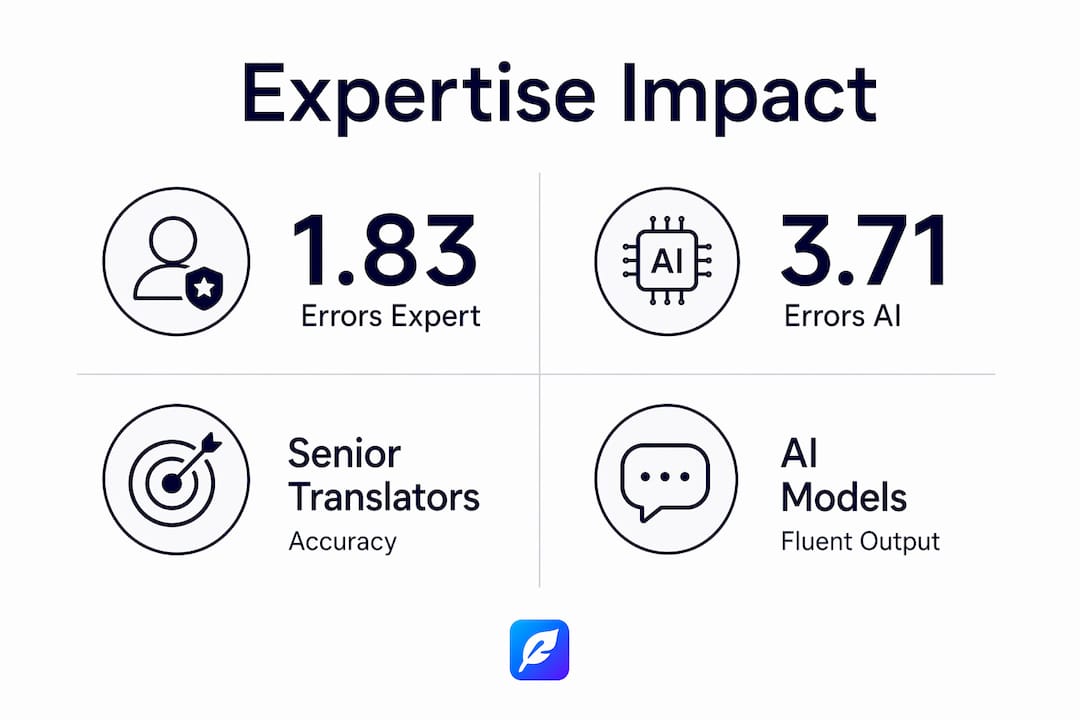
Subject matter expertise in translation is defined as the deep, domain-specific knowledge a translator brings to a text, beyond linguistic fluency, to produce output that is accurate, contextually appropriate, and professionally reliable. Tools like Grammarly or AI translation engines are useful aides, but they do not replace this expertise. Senior translators average 1.83 major errors per 200 sentences, compared to 3.30 for mid-level translators and 3.71 for AI models. That gap is not a minor technical detail. It is the difference between a contract that holds up in court and one that exposes your organisation to liability.
Why subject matter expertise matters in translation accuracy
The performance gap between expert translators and AI is measurable and consistent. AI models produce 3.71 major errors per 200 sentences, more than double the rate of senior specialists. This means that for every 200 sentences an AI translates, you are statistically receiving a document with nearly four significant mistakes, any one of which could alter meaning, misrepresent intent, or create compliance risk.

AI translation tools produce fluent output. That is precisely what makes them dangerous in specialised domains. A sentence can read perfectly in the target language while conveying entirely the wrong meaning. This phenomenon, known as a hallucination in machine learning, occurs when a model generates plausible but semantically incorrect text. AI handles patterns but lacks the judgement required for high-stakes domains like legal and medical translation, where a single misread term can alter obligations, dosages, or regulatory compliance.
Human experts catch what AI cannot because they understand the subject, not just the language. A translator specialising in pharmaceutical regulation knows that "contraindicated" and "not recommended" carry different legal weights in a drug label. A generalist translator, or an AI, may treat them as synonyms. The role of expertise in translation is therefore not just linguistic. It is interpretive, diagnostic, and protective.
| Translator type | Average major errors per 200 sentences | Common error types |
|---|---|---|
| Senior expert translator | 1.83 | Minor terminology variation |
| Mid-level translator | 3.30 | Context misreads, register errors |
| AI model | 3.71 | Hallucinations, semantic drift, cultural gaps |
Pro Tip: When commissioning a translation, always ask for the translator's domain credentials, not just language certifications. A legal translator should have demonstrable knowledge of the relevant jurisdiction's terminology and conventions.
Which translation types demand subject matter specialists?
Not every translation carries the same risk. A marketing brochure translated with minor stylistic errors is recoverable. A clinical trial protocol or a cross-border acquisition agreement is not. The importance of subject matter expertise scales directly with the consequences of error.
The fields where specialist knowledge is non-negotiable include:
- Legal contracts and regulatory filings: Misinterpreting modality or jurisdictional context are common errors that expose organisations to severe legal risk. "Shall" and "may" are not interchangeable in contract law, and a translator without legal training may not recognise the distinction.
- Medical and pharmaceutical documents: Patient safety depends on precision. Dosage instructions, contraindication lists, and informed consent forms require translators who understand clinical terminology and regulatory frameworks such as EMA or FDA guidelines.
- Financial and compliance documents: Prospectuses, audit reports, and regulatory submissions carry fiduciary and legal obligations. Errors here can trigger regulatory penalties or investor disputes.
- Technical manuals and engineering specifications: Incorrect translation of safety procedures or component tolerances can result in equipment failure or workplace injury.
Many organisations use a tiered workflow to manage cost and risk. Machine translation post-editing (MTPE) is appropriate for lower-risk content such as internal communications or product descriptions. Full expert translation is reserved for high-stakes documents. Between 33% and 50% of machine-generated output requires manual post-editing to meet professional standards, which means even MTPE workflows depend on human expertise to function reliably.
Pro Tip: Build a content classification matrix before any translation project. Assign each document type a risk level (low, medium, high) and map it to the appropriate workflow. This prevents over-spending on low-risk content and under-resourcing on critical documents.
You can explore common business translation errors to understand how context failures in legal and compliance materials create downstream problems that are expensive to correct.
How does subject matter expertise affect project delivery and business outcomes?
The benefits of subject matter specialists extend well beyond translation quality. Organisations using subject matter experts in project teams are 21% more likely to deliver on time and within budget, and 23 times more likely to acquire customers. Those figures reflect a structural advantage. When an SME is embedded in a translation project, decisions get made faster, ambiguities get resolved at the source, and the review cycle shortens significantly.
SMEs remove decision bottlenecks by providing clear answers to questions that would otherwise stall a project. A translator working on a patent application who cannot determine whether a technical term refers to a process or a product will either guess or pause. An SME resolves that in minutes. The downstream effect on delivery timelines is substantial.
Knowledge sharing is the practical challenge. SMEs are often busy professionals whose primary role is not translation support. The solution is structured access: scheduled review sessions, annotated glossaries, and documented decision logs that capture SME input for future projects. Here are four practices that integrate SME knowledge effectively into translation workflows:
- Create a domain-specific glossary before the project begins. Ask the SME to validate key terms and flag any that carry jurisdiction-specific or context-specific meaning. This prevents inconsistency across a large document set.
- Schedule a pre-translation briefing. A 30-minute call between the SME and lead translator at the project outset eliminates the most common sources of ambiguity before they become errors.
- Build SME review into the quality assurance stage, not as an afterthought. Position the SME review as a formal gate, not an optional final check.
- Document every SME decision. Capture terminology rulings and contextual clarifications in a shared log. This builds institutional knowledge that reduces SME dependency on future projects.
What practical methods ensure effective use of expertise in translation?
Subject matter expertise is a diagnostic skill, not just a translation skill. An SME reading a source text can identify implicit assumptions, ambiguous phrasing, and culturally loaded references that a generalist translator would carry across uncritically. This diagnostic function is the most underused aspect of SME involvement in translation projects.
Pairing SMEs with AI tools produces the best outcomes when the division of labour is clear. AI handles volume and speed. The SME determines whether the output is fit for purpose. Expert translators use AI with strict constraints, correcting only where necessary and deciding whether terms are appropriate for the audience and context. The judgement about when machine output is good enough, and when it requires a full human rewrite, is itself the most valuable form of subject matter knowledge.
| Workflow model | Best suited for | SME involvement | Risk level managed |
|---|---|---|---|
| Pure AI translation | Internal, low-stakes content | None required | Low |
| MTPE (machine translation post-editing) | Marketing, general business content | Light review | Low to medium |
| Full SME translation | Legal, medical, regulatory, technical | Central throughout | High |
Clear documentation practices are the connective tissue of any expert-driven translation workflow. A well-maintained style guide, a validated terminology database, and a structured review process reduce the cognitive load on both translators and SMEs. SMEs act as gatekeepers for project efficiency, providing clear decisions and alternative paths that prevent wasted effort.
Pro Tip: Use a translation memory tool such as SDL Trados or memoQ alongside SME-validated glossaries. This preserves approved terminology across projects and reduces the time SMEs spend on repetitive terminology queries.
For teams working across multiple document types, understanding multilingual business documents and their specific requirements helps you allocate SME resources where they create the most value.
Key takeaways
Subject matter expertise is the single most reliable predictor of translation quality, and no AI tool or generalist translator consistently matches the accuracy, judgement, and risk management that a domain specialist provides.
| Point | Details |
|---|---|
| Expert accuracy advantage | Senior translators produce 1.83 major errors per 200 sentences versus 3.71 for AI models. |
| AI fluency is a risk | Machine output reads well but carries semantic errors that only domain experts reliably catch. |
| High-stakes fields require specialists | Legal, medical, and regulatory translations carry risks that make SME involvement non-negotiable. |
| SMEs improve project delivery | Teams using subject matter experts are 21% more likely to deliver on time and within budget. |
| Diagnostic role is underused | SMEs identify misleading source text assumptions before translation begins, preventing errors at the root. |
Why I think the AI translation debate is asking the wrong question
Most discussions about AI and translation ask whether AI will replace human translators. That is the wrong question. The right question is: which parts of the translation process genuinely require human judgement, and which do not?
In my experience working across legal, technical, and commercial translation projects, the answer is consistent. AI handles volume competently. It fails at judgement. The moment a text carries legal obligation, clinical consequence, or cultural weight, the machine's fluency becomes a liability rather than an asset. A hallucinated term in a pharmaceutical insert does not look like an error. It looks like a translation. That is what makes it dangerous.
What I have also found is that the most effective translators are not those who resist AI, but those who use it as a first-pass tool and apply their domain knowledge to evaluate the output critically. The judgement to decide when machine output is good enough versus when it requires a full rewrite is the skill that separates a competent translator from an expert one. That judgement cannot be automated. It is built through years of domain immersion, reading case law, studying clinical trial protocols, or working inside the industry you translate for.
The misconception I encounter most often is that language skills plus AI tools equals professional translation. They do not. Language is the medium. Domain knowledge is the message. Without the second, the first produces output that sounds right but means something different. For students and early-career translators, the practical implication is clear: specialise deliberately. Pick a domain, read its primary literature, and build the knowledge base that makes your linguistic skills genuinely useful.
— Mike
How Inspirowrite supports translation quality at every stage
Inspirowrite combines AI-powered speed with a commitment to accuracy that respects the role of human expertise. For translators and professionals who need fast, reliable feedback on grammar, style, and translation quality, Inspirowrite delivers results in seconds without compromising your content's confidentiality. Your text is never used to train AI models, which matters when you are working with sensitive legal, medical, or commercial documents. Whether you are a student refining a translated assignment or a professional reviewing a multilingual business document, Inspirowrite gives you the tools to catch errors quickly and produce polished output. Explore Inspirowrite's privacy-first translation tools to see how fast, confidential proofreading fits into your workflow.
FAQ
What is subject matter expertise in translation?
Subject matter expertise in translation is the deep, domain-specific knowledge a translator applies beyond language skills to produce accurate, contextually appropriate output. It covers fields such as law, medicine, finance, and engineering, where terminology and context carry significant professional or legal weight.
Why does expertise reduce translation errors?
Senior expert translators average 1.83 major errors per 200 sentences, compared to 3.71 for AI models, because domain knowledge enables them to interpret context, resolve ambiguity, and catch semantic errors that fluency alone cannot prevent.
Can AI replace subject matter experts in translation?
AI cannot replace subject matter experts for high-stakes translation. AI lacks the judgement required for legal, medical, and regulatory content, and between 33% and 50% of machine-generated output requires human post-editing to meet professional standards.
Which industries most need specialist translators?
Legal, pharmaceutical, financial, and engineering sectors require specialist translators because errors in these fields carry direct legal liability, patient safety risks, or regulatory consequences that generalist translation cannot adequately manage.
How do SMEs improve translation project efficiency?
Organisations that involve subject matter experts in project teams are 21% more likely to deliver on time and within budget, primarily because SMEs resolve terminology ambiguities quickly and prevent the review cycles that stall generalist-led projects.