

Clarify your tiered AI policy this term, redesign at least one major assessment to make student thinking visible, and require a short AI‑use disclosure statement on every affected task. That combination does more for academic integrity than any detection software. The Center for Teaching Innovation at Cornell and APA's teaching resources both point the same direction: process beats policing. Tools like Inspirowrite can support the honest, disclosed use of AI once that policy exists.
TL;DR:
- Policies should clearly define tiered AI use and require AI‑use disclosure statements on all assessments where AI is permitted.
- Redesign assessments to include staged submissions or oral checks that reveal students' genuine thinking processes, reducing reliance on detection tools.
- Detection software is unreliable for proof of misconduct, as it often produces false positives and negatives; conversation and process documentation are more effective.
- Co-creating policies with students improves adherence, and involving them early helps identify edge cases and build ethical understanding.
- Privacy-respecting AI tools for low-risk tasks like proofreading can be permitted if disclosures are clear and the tools do not retain submitted data.
Table of Contents
- What does academic integrity mean when AI is involved?
- Immediate actions: a checklist for staff and administrators
- Ready-to-adapt policy clauses for your syllabus
- How do you design assessments that reveal genuine thinking?
- What can AI-detection tools actually tell you?
- How can students help shape a fairer AI policy?
- Rolling out the changes without overwhelming staff
- What does the research actually say?
- Beyond plagiarism: how AI reshapes contract cheating
- Where's the line between AI help and original thinking?
- Real cases: what happens when AI misuse gets caught
- What ethical questions does AI raise that plagiarism never did?
- Where is academic integrity policy heading next?
- Why detection‑first thinking is the wrong instinct
- Using a privacy-first writing tool without crossing the line
- Sources
- FAQ
What does academic integrity mean when AI is involved?
Academic integrity has always meant submitting work that honestly represents your own understanding, properly credits other people's ideas, and follows the rules your institution sets for a given task. Generative AI complicates all three of those without changing the definition itself. The problem isn't that AI exists. It's that most policies were written for a world where "did a human write this" was a simple yes or no question, and now it isn't.
A systematic review of the research on AI and academic integrity found that the overwhelming majority of published work describes the problem, while only a small fraction offers tested mitigation strategies. Institutions are being asked to police a behaviour that researchers themselves haven't finished figuring out how to prevent. That gap is exactly why policy language and assessment redesign matter more than waiting for a perfect detection tool to arrive.
The practical shift happening across universities right now is a move from asking "did the student use AI" to asking "can the student demonstrate the judgement behind this work." A Springer Nature perspective on the higher education integrity ecosystem frames this as aligning four things at once: governance rules, assessment design, institutional culture, and the individual student's own sense of ethical agency. Miss one of those four and the other three struggle to hold. A brilliant policy with no assessment redesign behind it just tells students what not to do, without ever checking whether they can do the thing honestly.
That's the standard vocabulary worth learning here: process‑based assessment, disclosure statements, tiered permissions, and integrity ecosystems. Keep these terms in mind, because they recur through every practical section below.
Immediate actions: a checklist for staff and administrators
Start with the changes that need no new budget and no committee approval.
- Publish a tiered AI policy on every syllabus this term, not next year. Cornell's teaching centre recommends three tiers: prohibited, permitted with attribution, and encouraged with attribution, stated per assignment rather than as a single blanket rule for the whole course.
- Require an AI‑use statement on any assignment where AI is permitted at all, even lightly. A single sentence naming the tool and its purpose is enough to start.
- Adjust one major assessment this term to include a staged submission (proposal, draft, final) or a short oral check‑in, rather than waiting for a full curriculum review.
- Book one staff CPD session and one student workshop before the next assessment deadline, focused specifically on what's permitted, not just what's banned.
- Treat detection software as a secondary signal, never a first resort, and write down the workflow you'll follow when a detector flags something.
- Ask students to verify every AI‑suggested citation manually. AI models fabricate references often enough that this single instruction, repeated in class, prevents a meaningful share of accidental integrity breaches.
Pro Tip: Run the AI‑use statement requirement on a low‑stakes assignment first. Students who practise disclosing AI use on a homework task are far more likely to disclose honestly on the assignment that actually counts.
None of this requires new software procurement. It requires someone in the department deciding, in writing, what "permitted" looks like for a given task, and then saying so out loud before students submit anything. The Cornell Center for Teaching Innovation guidance is explicit that ambiguity, not permissiveness, causes most disputes: students report they weren't sure what counted, not that they knowingly broke a clear rule.
Detection tools deserve a specific caution here too. Used as a first filter rather than supporting evidence, they generate false accusations that fall hardest on non‑native English writers and students with atypical prose styles, a problem covered in more depth further down. Document your escalation process before you need it, not after your first disputed case.
Ready-to-adapt policy clauses for your syllabus
Most staff don't need a philosophy of AI governance. They need wording they can paste into a syllabus this afternoon and adjust to their discipline. Cornell's teaching centre and USC's academic integrity office both publish templates along these lines, built around a three‑tier structure.
Tier one, prohibited use, for assessments testing a skill AI would simply replace: "No generative AI tool may be used at any stage of this assessment, including brainstorming, drafting, or editing. Submissions found to rely on undisclosed AI assistance will be referred to the academic integrity office."
Tier two, permitted with attribution, for tasks where AI can support but not replace the work: "You may use generative AI tools for grammar checking, brainstorming, or restructuring sentences, provided you disclose this in a short AI‑use statement attached to your submission. You remain fully responsible for the accuracy of all citations, data, and arguments."
Tier three, encouraged with attribution, typically for exploratory or lower‑stakes tasks: "You are encouraged to use generative AI to explore alternative arguments or generate a first draft for critique. Submit your AI‑use statement alongside a short reflection on what you changed and why."
A workable AI‑use statement asks four things: which tool, for what purpose, which prompts were central, and what the student changed afterwards. That last question matters more than the first three combined, because it's the only one that reveals judgement rather than just tool use.
Unacceptable behaviour needs its own explicit examples, since vague phrases like "misuse of AI" invite arguments about interpretation. Spell it out:
- Submitting AI‑generated text as entirely original work with no disclosure.
- Paying or asking someone else, human or AI‑powered service, to complete graded work in full (a form of contract cheating).
- Fabricating citations that an AI tool generated but the student never checked against a real source.
- Using AI to translate or paraphrase another student's or author's work and presenting it as independent analysis.
Enforcement has to be equitable, which means writing the escalation path into policy rather than improvising it case by case. A first suspected breach on a low‑stakes task might warrant a pedagogical conversation rather than a formal hearing. Reasonable accommodation also needs stating plainly: a student using an AI writing aid as an approved assistive technology for a documented disability is not the same case as undisclosed use, and policy language should distinguish the two explicitly rather than leaving it to a marker's discretion mid‑term.
Document every suspected breach the same way: the original submission, the AI‑use statement if one exists, the specific evidence (a style discrepancy, an unverifiable citation, an inability to explain the work in conversation), and the student's response before any decision is finalised. Consistency in documentation is what protects both the institution and the student if a case is contested later.
How do you design assessments that reveal genuine thinking?
The single most effective lever available to any department right now isn't a new tool. It's redesigning what gets submitted, so the process of thinking becomes visible alongside the finished product. The PMC piece on shaping integrity through assessment argues this directly: chasing AI‑generated text with better detectors is a losing race, but making evaluative judgement part of the deliverable is not.
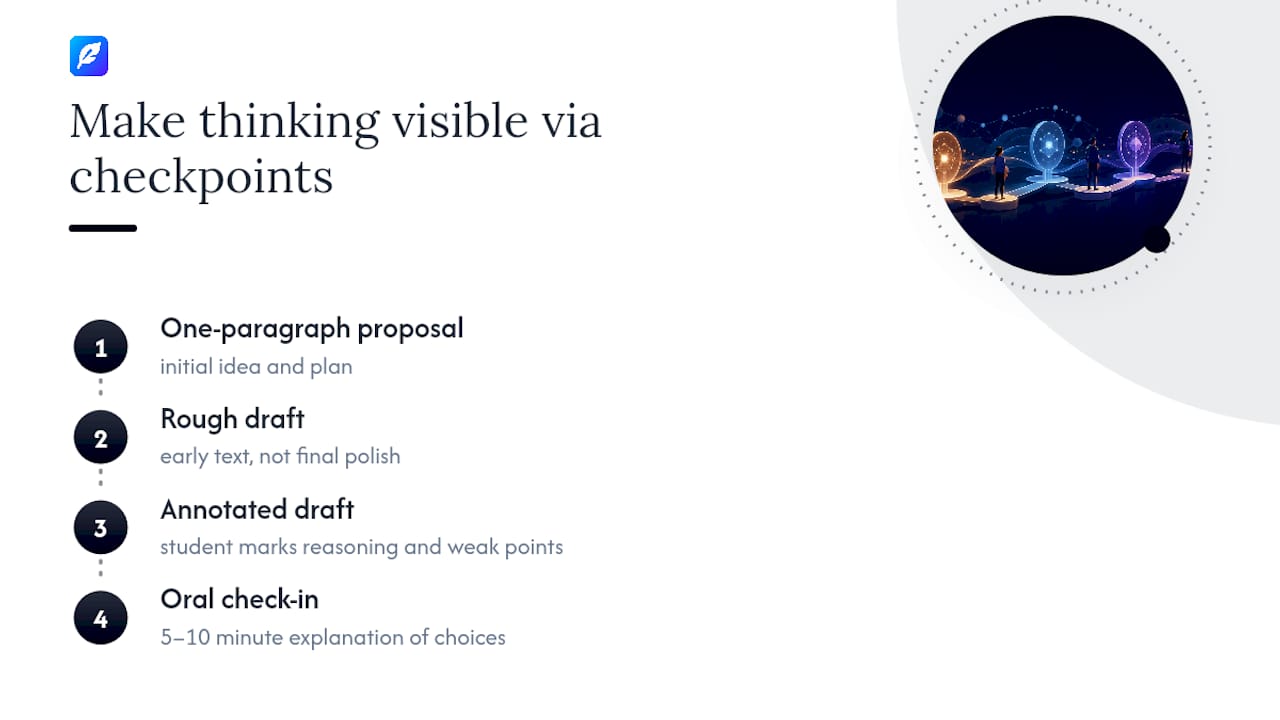
A staged workflow is the simplest version of this. Instead of one final essay, ask for four checkpoints: a one‑paragraph proposal, a rough draft, an annotated draft where the student marks up their own reasoning and weak points, and a short oral check‑in of five to ten minutes. None of these need to be separately graded at full weight.
Discipline shapes exactly what "process" looks like, and a one‑size template doesn't survive contact with a coding class or a chemistry lab.
For programming courses, ask for the test cases the student wrote before the solution, plus a short annotated version of the code explaining each function in the student's own words. A student who can write working code but can't explain why a particular loop terminates, or why a particular data structure was chosen, is showing exactly the gap AI‑generated code creates.
For laboratory sciences, request the raw data alongside the polished lab report, plus the lab notebook showing false starts and corrections. AI can write a plausible‑sounding discussion section from a data table. It cannot fabricate the messy, real‑time record of a student actually running the experiment.
For humanities and social science essays, an annotated draft works well: students highlight three or four sentences and explain, in the margin, why they made a particular argumentative choice there. This takes ten minutes to complete honestly and is nearly impossible to fake convincingly if the student didn't do the underlying thinking.
Reflective statements deserve their own grading logic rather than a simple pass/fail check. A weak reflective statement says "I used AI to help with grammar." A strong one identifies a specific change the student made after reviewing AI‑suggested text and explains, in their own reasoning, why the original suggestion was wrong or insufficient. Grade for that specificity. It's the clearest window available into whether a student engaged critically with what a tool produced, rather than pasting it in wholesale.
Pro Tip: Give reflective statements a small but real grade weighting, even just 5%. A statement worth zero marks gets treated as a formality; a statement worth something gets written honestly.
Marker workload is the real objection every department raises, and it's a fair one. The fix isn't grading everything at full depth. Checkpoints can be marked on a simple three‑point scale (complete, needs revision, missing) rather than with detailed written feedback at every stage, reserving full commentary for the final submission. Peer review of drafts, structured with a short rubric, also reduces staff load while adding another layer of process visibility. Instant feedback tools that give students structured comments on clarity and grammar before submission take some of that early‑stage burden off staff entirely, freeing marking time for the judgement‑based parts of a task that actually need a human reader.
What can AI-detection tools actually tell you?
Not as much as most policies assume. Detection software estimates a statistical likelihood that text resembles AI‑generated patterns; it does not prove authorship, and it was never built to be forensic evidence. The PMC analysis of assessment and generative AI is blunt about this: as GenAI‑augmented writing becomes normal, detector‑based governance becomes structurally misaligned with how students actually work, and needs to sit as a supplementary layer behind assessment design, not the primary line of defence.
Detectors fail in both directions, and each failure carries a different cost:
- False positives disproportionately flag non‑native English speakers and students with unusually formal or repetitive prose styles, sometimes simply because they write more predictably than average.
- False negatives miss AI‑generated text that's been lightly edited, paraphrased, or run through a second tool, which is now trivially easy to do.
- Version drift means a detector tuned for one AI model's outputs performs worse against a newer model within months, so confidence in any single tool decays quickly.
Detection tools flag statistical patterns, not proof of misconduct. No detector output should trigger a formal integrity hearing on its own; it should trigger a conversation.
Privacy adds a second layer of caution. Running student submissions through third‑party detection services means that text, often containing personal reflection or draft ideas, leaves institutional control and sits on an external server, sometimes indefinitely. Departments considering any AI tool in their workflow, detection or otherwise, should check exactly what happens to submitted text before adopting it; a checklist for verifying secure AI writing tools covers the specific questions worth asking a vendor before uploading anything.
The escalation ladder that actually works, and the one recommended in the PMC assessment analysis, has three rungs. First, a pedagogical check: a brief, non‑accusatory conversation asking the student to walk through their reasoning. Second, if concerns remain, a verification interview with a colleague present, focused on specific parts of the submission. Only at the third stage, if the first two raise genuine doubt, does a formal investigation begin. Skipping straight to stage three on the strength of a detector score alone is exactly the pattern that generates the most contested, reputationally damaging cases.
The strongest evidence in any of these conversations is rarely the detector score. It's the mismatch between a student's in‑class performance and their written submission, or their inability to explain a choice they supposedly made, that markers report as the real giveaway.
How can students help shape a fairer AI policy?
Policy written entirely by staff, with no student input, tends to produce rules students don't fully understand and therefore don't fully respect. A scoping review of student voices on generative AI and integrity found that students actively negotiate ethical boundaries around AI use rather than simply ignoring rules, and that co‑creating policy with them measurably improves both adherence and genuine ethical ownership of the outcome.
That evidence points to a concrete practice, not just a nice sentiment. A one‑hour consultation session, run early in a term before any policy is finalised, where students discuss draft tiered policy language and flag where it's ambiguous, catches problems staff rarely anticipate. Students often identify edge cases, like using AI to check grammar in a second language, that a purely staff‑written policy hadn't considered.
Practical steps for building this into a course:
- Run a short student workshop on responsible AI use before the first major assessment, not after a dispute arises.
- Share a draft AI‑use statement template and ask students, in small groups, to test it against a real assignment before it's finalised.
- Build in one open forum question each term: "where did our AI policy feel unclear this time?"
- Offer a template reflection prompt: "Describe one specific way you changed or rejected an AI suggestion, and explain your reasoning."
- Flag extra support explicitly for non‑native English speakers and disabled students, who face the highest risk of false‑positive detection flags and need to know in advance exactly how to raise a dispute.
Resources like AmmarAI's guidance for students on studying and writing honestly with AI give students a starting vocabulary for these conversations before they walk into a workshop, which makes staff‑led sessions run faster and less defensively.
Vulnerable students need a specific safeguard written into policy, not just goodwill. Anyone using an AI writing tool as a documented assistive technology should have a clear, separate route to disclose that use without it being treated identically to undisclosed misuse. Naming that distinction in the policy text itself, rather than leaving it to a marker's judgement in the moment, prevents an entirely avoidable dispute later.
Rolling out the changes without overwhelming staff
A realistic timeline matters more than an ambitious one that nobody actually follows. Spread the rollout across two terms rather than trying to redesign every assessment and retrain every staff member before the next intake.
- Weeks 1 to 4: publish the tiered policy, run one staff briefing session (60 to 90 minutes is enough), and pilot the AI‑use statement on a single low‑stakes assignment.
- Weeks 5 to 10: redesign one major assessment per course using a staged workflow, coordinate with the accessibility office to confirm disclosure routes for assistive technology users, and run the first student workshop.
- Weeks 11 to 16: collect early data (disclosure rates, staff confidence, dispute numbers) and adjust the policy wording where students or staff flagged genuine ambiguity.
- Second term: extend staged assessment design to a second course per department and formalise the escalation ladder in writing across the faculty.
Staff CPD works best as short, repeatable modules rather than one long session: a 30‑minute briefing on tiered policy language, a separate 30‑minute session on writing and grading reflective statements, and a third on the escalation ladder for suspected breaches. Student‑facing materials mirror the same structure, a one‑page guide to the tiered policy, an annotated exemplar showing what a strong AI‑use statement looks like, and a short module on why unverified AI citations are a genuine risk.
Coordination with IT and privacy or compliance teams matters most wherever detection software or third‑party AI tools enter the workflow, since student data protections apply the moment any submission leaves institutional systems. A role‑of‑feedback study on essay improvement is worth sharing with staff hesitant about formative feedback tools, since it shows measurable gains in student writing when feedback arrives early and often rather than only at final grading.
Track a small number of pilot metrics rather than trying to measure everything: disclosure rates on AI‑use statements, student satisfaction from a short end‑of‑term survey, and staff confidence in handling a suspected breach. All three are cheap to collect and tell you, within one term, whether the policy is actually working or just sitting unread on a syllabus PDF.
What does the research actually say?
The research base here is younger than most staff assume, and it's worth knowing exactly what it does and doesn't establish before citing it in a policy meeting. A systematic review of AI and academic integrity research found that the field has produced far more description of the problem than evidence for specific mitigation strategies, meaning much of the practical guidance circulating right now, including in this article, is grounded in institutional experience and smaller studies rather than large‑scale controlled trials.
That doesn't make the guidance weak, but it does mean the confidence level attached to different claims varies. The strongest evidence available concerns student behaviour and attitudes: the scoping review of student voices draws on real qualitative data showing students actively reason about AI's ethical boundaries rather than treating rules as arbitrary obstacles. The Springer Nature integrity ecosystem perspective is a conceptual argument rather than an empirical study, proposing that governance, assessment design, institutional norms and individual agency need to move together, but it's an influential framing that several other papers now build on. Separately, a study on responsible generative AI use concludes that training and support availability matter as much as enforcement, a finding that lines up with what CPD‑focused institutions report anecdotally.
| Source | What it establishes | Practical use |
|---|---|---|
| Systematic review, AI and integrity | Research gap: mitigation evidence lags behind problem description | Justifies piloting and measuring your own local approach |
| Springer Nature integrity ecosystem | Conceptual model aligning governance, design, norms, agency | Framework for structuring a full policy overhaul |
| PMC, shaping integrity | Detection‑led governance misaligns with GenAI‑era work | Rationale for prioritising assessment redesign |
| Student‑voice scoping review | Co‑creation improves adherence and ethical ownership | Evidence base for running student consultations |
| Support and ethics study | Training and resources matter as much as enforcement | Justifies CPD budget and rollout timeline |
None of this is settled science. It's the best available signal from a field still catching up with the technology it's studying, which is itself a reason to build feedback loops into your rollout rather than treating any single policy as final.
Beyond plagiarism: how AI reshapes contract cheating
Plagiarism detection was built for a world of copied text with a traceable source. Generative AI breaks that model in a specific way: it produces original phrasing, on demand, with no source to trace, which is functionally closer to contract cheating than to copy‑paste plagiarism.
Contract cheating traditionally meant paying a person or essay mill to complete graded work. AI tools have effectively automated that transaction and dropped its cost to close to nothing. A student no longer needs to find a ghostwriter or pay a fee. They can generate a full assignment in minutes, and because the output is original text rather than a copied passage, traditional plagiarism checkers, built to match strings against existing documents, often find nothing at all.
This matters for how institutions think about severity and intent. Historically, contract cheating was treated as a more serious breach than plagiarism because it involved deliberate deception and, often, payment. AI‑generated submissions blur that line: a student might use a tool for what feels like light editing help and end up submitting something functionally equivalent to a purchased essay, without ever framing it that way in their own mind. Policy language needs to name this explicitly rather than assuming students will recognise contract cheating in its new, frictionless form.
The practical response is the same one running through this entire guide: assessments that require a student to explain their reasoning in real time close this gap far more reliably than any text‑matching tool ever could, because neither a purchased essay nor an AI‑generated one comes with the student's own understanding attached.
Where's the line between AI help and original thinking?
There's no single sentence that settles this, but there is a workable test: did the student make the final judgement calls, or did the tool? Grammar correction, restructuring a clumsy sentence, or translating a phrase doesn't remove a student's ownership of their argument. Generating the argument itself, or the analysis behind it, does.
A useful way to frame this for students is the difference between AI as a mirror and AI as a ghostwriter. A mirror reflects back what you've already produced, corrected or rephrased. A ghostwriter produces the thinking for you. Grammar tools, rephrasing assistants, and translation software function as mirrors when used to polish a student's own argument. They become a ghostwriter the moment a student asks the tool to generate the argument, the analysis, or the conclusion from scratch.
Some commentators describe this using a rough guideline that AI‑assisted phrasing should account for a modest minority of the final text and the core argument, structure and evidence are the student's own, which many staff and institutions consider acceptable, permitted use, though this varies and is not universally agreed. There's no universal, formally agreed threshold across institutions, and the actual percentage matters far less than whether a student can explain and defend every claim in the submission. Treat any specific number as a rough guide for conversation, not a rule to cite in a hearing.
The clearest guidance for students is procedural, not philosophical: use AI early in the process for brainstorming or structure, do the analytical heavy lifting yourself, and use AI again late in the process only for polishing tone and grammar, disclosing each use honestly. A resource like Inspirowrite's guide to rewriting sentences with AI is a useful example of exactly this kind of low‑risk, mirror‑style use, since it improves phrasing without ever generating the underlying argument.
Real cases: what happens when AI misuse gets caught
The consequences institutions have actually applied vary widely, which itself tells you something about how unsettled this area still is. Some universities have expelled students for submitting fully AI‑generated dissertations with fabricated data and citations that didn't exist, a form of misconduct serious enough to warrant the same response as fabricated research in any era. Others have issued formal warnings or required resubmission where a student disclosed partial AI use but exceeded what the syllabus permitted, treating it closer to a first‑offence citation error than deliberate fraud.
The pattern across disputed cases is consistent: outcomes hinge on documentation, not suspicion. Cases where the institution had a clear, previously published tiered policy, a specific AI‑use statement requirement, and a documented escalation process tend to resolve cleanly, whether the finding goes against the student or not. Cases without that groundwork generate appeals, reputational damage for the department, and sometimes reversed decisions on procedural grounds, regardless of whether misconduct actually occurred.
Fabricated citations are a recurring feature worth flagging specifically, since AI models generate plausible‑looking references to sources that don't exist. Several disputed cases have hinged not on the AI‑generated prose itself but on a citation list nobody checked, which is precisely why Cornell's guidance stresses citation verification as a standalone instruction, separate from any general AI policy statement.
The consistent lesson from these cases is procedural: the strongest defensible finding, for the institution and for a wrongly accused student alike, always rests on documented process evidence gathered before the dispute began, not on a detector score produced after the fact.
What ethical questions does AI raise that plagiarism never did?
Old-fashioned plagiarism had a relatively clean ethical shape: someone else's words, presented as your own, without credit. AI introduces dilemmas that don't map cleanly onto that framework at all.
Authorship becomes genuinely ambiguous in a way copying never was. If a student writes a rough argument, an AI tool restructures it, and the student edits the result again, who's the author? Most ethical frameworks in academia assume a single accountable human author, and AI‑assisted work strains that assumption without a clean answer.
Equity is a second, less discussed dilemma. Students with paid access to more capable AI tools, or simply more experience prompting them effectively, gain an advantage that has nothing to do with their understanding of the subject. A policy that permits AI use without addressing unequal access risks rewarding resource advantage rather than learning.
Consent and data privacy raise a third dilemma specific to this technology: students submitting work to third‑party AI tools, or having their submissions run through AI detection software, often don't know where that text ends up, whether it's used to train future models, or how long it's retained. That's precisely why privacy‑respecting design, tools that process text without retaining it for model training, matters as an integrity issue and not just a technical one; a guide to what to check before using AI translation tools confidentially covers exactly this concern for anyone handling sensitive academic material.
Finally, there's a harder question institutions are only beginning to sit with: if AI genuinely improves the quality of a student's final work, is discouraging its use actually serving the student's education, or just preserving an assessment format built for a pre‑AI world? Neither a blanket ban nor unrestricted permission answers that question honestly. Only assessment redesign does.
Where is academic integrity policy heading next?
Expect three shifts to accelerate over the next few years, each building directly on what's already visible in current guidance.
Detection technology will keep improving marginally, but the gap between detector capability and model capability is likely to persist rather than close, since each new AI model shifts the target detectors are trained against. Institutions betting their entire integrity strategy on detection catching up are likely to be disappointed again.
Process‑based and oral assessment will spread from pilot programmes into standard practice, particularly as staff discover that staged submissions and short check‑ins scale better than feared once checkpoints are graded lightly rather than exhaustively. The Springer Nature integrity ecosystem model reads, in this sense, less like a proposal and more like a description of where institutions are already drifting.
AI literacy is likely to become a formal, assessed competency in its own right rather than an informal classroom norm, with students expected to demonstrate not just subject knowledge but judgement about when and how to use AI appropriately within that subject. That mirrors how information literacy and citation skills became formal curriculum content once the internet made information access trivial.
Institutional policy itself will keep changing faster than any single guide can fully capture, which is exactly why a living, regularly revisited policy document, reviewed each term against real disputes and student feedback, matters more than a perfect one written once and left untouched.
Why detection‑first thinking is the wrong instinct
Most institutions reach for detection software first because it feels like the fastest fix: buy a tool, scan the submissions, catch the cheats. It's the wrong instinct, and not because the tools are useless. It's because detection treats academic integrity as a policing problem when the evidence points to it being a design problem.
The uncomfortable implementation mistake I see repeated most often isn't a weak policy. It's a policy published without any accompanying training, sitting in a syllabus PDF that nobody discusses in class, followed by a punitive response the first time something goes wrong. Students experience that sequence as arbitrary, because from their side, it is: no explanation, no practice, straight to consequence. A close second mistake is treating disclosure statements as a formality worth zero marks, which teaches students, quite reasonably, that honesty here doesn't actually matter to their grade.
What's underrated is how cheap process‑based assessment is to pilot compared with how expensive it sounds. A staged submission doesn't require rebuilding a course. It requires one extra checkpoint, graded lightly, that makes a student's thinking visible before the final deadline arrives.
For a first pilot term, three numbers tell you almost everything: what percentage of students submit a genuine, specific AI‑use statement rather than a copy‑pasted formality; how staff rate their own confidence handling a suspected breach before and after training; and whether disputed cases actually drop once documentation improves. Track those three, and you'll know within one term whether the shift from detection to design is working, long before any national study catches up to confirm it.
— Mike
Using a privacy-first writing tool without crossing the line
Not every AI tool a student touches belongs on the "prohibited" side of your policy. Grammar correction, tone adjustment, and translation support sit squarely in low‑risk, mirror‑style territory, provided the student discloses the use and the tool itself doesn't retain or train on submitted text. That second condition matters more than most syllabus policies currently address, and some privacy-conscious tools fit this need.
Inspirowrite is built for that specific gap: instant proofreading and translation feedback that never uses submitted text to train underlying models, so students and staff can recommend it without worrying where an essay draft ends up afterwards. For a syllabus permitting AI‑assisted proofreading, wording like this works well: "You may use a privacy‑respecting grammar or translation tool for language polishing only; disclose this use in your AI‑use statement and note any changes made to the AI's suggestions." That single sentence covers permission, privacy expectation, and disclosure in one line.
For students juggling coursework in a second language, or staff reviewing multilingual submissions, that speed matters as much as the privacy guarantee; a look at the measurable benefits of instant essay feedback shows how much faster revision cycles improve final writing quality when feedback arrives in seconds rather than days. If you're updating a syllabus this term, visit the Inspirowrite landing page and try a sample document before deciding on your permitted‑use wording.
Sources
- AI & Academic Integrity | Center for Teaching Innovation (Cornell)
- Shaping integrity: generative AI and assessment (PubMed Central)
FAQ
What does academic integrity mean in an AI context?
It means the same thing it always has: submitting work that honestly reflects your own understanding and properly credits outside help, including AI. What's changed is that policies now need to spell out exactly what "properly credited AI help" looks like, tier by tier.
Is using AI against academic integrity?
Not automatically. Using AI without disclosure, or using it to generate work you present as entirely your own thinking, breaches most institutions' current policies. Using it with disclosure, within the limits your syllabus sets, is typically permitted and increasingly encouraged for low‑risk tasks like grammar polishing.
What is the 30% rule in AI?
There's no single, universally agreed standard here. Some educators use a rough guideline that AI‑assisted phrasing should account for a modest minority of a submission's final text, with the core argument and analysis remaining the student's own, but institutions differ, and the real test is whether the student can explain and defend every claim in the work.
How do you maintain academic integrity with AI in the classroom?
Publish a clear tiered policy, redesign at least one assessment to make process visible through staged submissions or oral checks, require AI‑use disclosure statements, and treat detection tools as a secondary check rather than the primary line of defence. Privacy‑respecting tools such as Inspirowrite support the permitted, disclosed side of that equation without adding new risk.
Can AI-detection tools reliably catch academic misconduct?
Detectors estimate statistical likelihood rather than proving authorship, and they generate both false positives and false negatives regularly enough that no institution should rely on a detector score alone to trigger formal action. Combine any detector flag with a pedagogical conversation and process evidence before escalating further.