

Yes, you can use AI translation tools safely for confidential drafts, but only if the tool explicitly excludes your text from model training and can prove it contractually. No, you should not paste unreleased marketing copy, client contracts, or internal proposals into free consumer translators just because they're quick. Before you use any tool, check for three things:
- An explicit no-training clause, not just a vague privacy policy
- A Data Processing Agreement (DPA) available on request
- A stated zero-retention policy for submitted text
If a vendor can't answer those three points in a sentence, treat the tool as public.
TL;DR:
- Use only translation tools that explicitly offer and provide a no-training clause, data processing agreement, and zero-retention policy in writing.
- Avoid using free consumer translation tools for confidential or high-risk documents such as contracts or internal proposals, as they often reserve rights to use submitted data for model training.
- Always anonymize sensitive information by replacing names and identifiers before submitting drafts, then restore them locally after translation.
- Verify technical safeguards like encryption, audit logs, role-based access, and SSO, and prioritize vendors that provide enforceable privacy commitments over marketing claims.
- For high-risk or protected health information, rely on services with signed business associate agreements, not general-purpose AI translation tools, to remain compliant with privacy regulations.
Table of Contents
- What "HIPAA compliant translation" means in this guide
- Why privacy matters more than most writers assume
- What to verify in a confidential AI translation tool
- How to keep translation work confidential day to day
- When you need more than a quick AI tool
- Where AI translation still falls short on rigorous compliance
- Legal exposure when AI translation touches protected health information
- How Inspirowrite fits the privacy-first checklist
- Key Takeaways
- Sources
- FAQ
What "HIPAA compliant translation" means in this guide
This article uses "hipaa compliant translation" the way most writers, students, and small business owners actually search for it: as shorthand for private, no-training AI translation and proofreading, not clinical patient-data handling. That's a different subject with different rules, different vendors, and different documentation (Business Associate Agreements, vetted medical linguists, PHI-specific encryption standards). If you're translating protected health information for a clinic or hospital system, this isn't the right guide, and you need a vendor built specifically for healthcare compliance.
For everyone else, here's what "confidential" actually covers:
- Allowed use cases: student essays, cover letters, marketing drafts, internal business emails, freelance client work, app copy
- Excluded use cases: patient records, clinical notes, anything containing protected health information
The distinction matters at procurement time. A business buying "healthcare translation services" for a hospital needs a BAA. A freelancer buying "translation services for HIPAA" as a mislabelled search term usually just needs a tool that won't leak their client's unreleased press release into someone else's chatbot output.
Why privacy matters more than most writers assume
Free translation widgets are built for scale, not discretion. Many reserve the right, buried in their terms of service, to use submitted content to improve their models. Once your text passes through that pipeline, you've lost control of it: it can be logged, indexed, or absorbed into training data you'll never see referenced again.
This isn't hypothetical for people handling sensitive documents. Contracts, unreleased marketing copy, internal proposals, unpublished manuscripts, salary negotiations in another language: none of these are medical, but all of them are commercially or personally damaging if they surface somewhere unexpected.
The regulatory pressure is real, even outside healthcare. The EDPB's Opinion 28/2024 found that AI models trained on personal data routinely create compliance exposure when businesses send that data through third-party tools with no signed agreement in place. U.S. businesses face a parallel version of this risk: state privacy statutes, client confidentiality clauses, and NDAs don't care whether the leak came from a hacker or a translation app's training pipeline.
- Freelancers risk breaching NDAs by using unvetted tools for client drafts
- Small businesses risk exposing pricing, hiring plans, or product roadmaps
- Students risk academic integrity flags if draft essays surface in unrelated contexts
What to verify in a confidential AI translation tool
Marketing copy says "secure." A signed document says something enforceable. Here's the checklist worth running through before you trust any tool with a confidential draft.
Contractual proof:
- A Data Processing Agreement (DPA) the vendor can produce on request, not just reference vaguely
- A written, explicit no-training or data-exclusion clause, stating your submissions never enter a training set
- A deletion policy with a stated timeframe, plus some evidence it's actually enforced
Technical proof:
- A zero-retention or hard-delete policy for text after processing completes
- Encryption in transit and at rest (TLS for transmission, AES-256 or equivalent for storage)
- Audit logs that record who accessed what, and when
- Role-based access control (RBAC) so team members only see what their role requires
- Single sign-on (SSO) for business accounts, reducing password sprawl and unauthorised access
Operational proof:
- A documented incident response process, so you know what happens if something goes wrong
- Confirmation that privacy features are standard, not paywalled behind a premium tier you'd have to negotiate for
Industry advisers consistently point buyers toward enterprise-grade features like DPAs, audit logs, RBAC, and SSO rather than consumer-grade interfaces, precisely because consumer tools rarely offer contractual recourse if something leaks.
When you contact a vendor, keep the question simple: "Can you send me your DPA and confirm in writing that submitted text is never used for model training?" A vendor that answers immediately, with a document, is behaving differently from one that redirects you to a generic FAQ page.
Pro Tip: Ask for the DPA before you ask about pricing. A vendor's response time on that single request tells you more about their actual privacy posture than anything on their homepage.
How to keep translation work confidential day to day
You don't need enterprise procurement muscle to protect your own drafts. A few habits go a long way.
Anonymise before you submit. Swap real names, company names, and identifying numbers for placeholders (Client A, Product X, 000000) before pasting text into any tool, then restore them locally once you have the translated output. It takes thirty seconds and removes the highest-risk elements entirely.
Favour tools with a stated zero-trace policy. Cloud translation services vary enormously here. Azure Translator's documentation, for instance, states plainly that text translation doesn't persist customer data, and that document translation only stores data temporarily during processing before a hard delete. That's the level of specificity worth looking for, whatever tool you choose.
Keep a human in the loop for anything customer-facing. AI translation is fast, but nuance, tone, and industry-specific phrasing still benefit from a second read, particularly for the kind of business jargon that doesn't translate literally. Run the AI draft first, then have a fluent colleague or the original author check tone before it goes out.
A simple freelance workflow looks like this: tokenise client and company names, run the draft through a privacy-first tool, restore the tokens locally, then do a final human pass on tone before delivery.
- Mask names, figures, and identifiers before submission
- Choose tools with documented zero-retention policies
- Reconcile and finalise edits in your own secure document, not the tool's interface
- Add a human review step for anything client-facing or public
Pro Tip: Keep a simple find-and-replace template for anonymising drafts. Reusing the same token pattern (Client A, Client B, Product 1) saves time and reduces the risk of mixing up restored names.
When you need more than a quick AI tool
Not every document belongs in a fast AI workflow, even a private one. Low-risk material, personal blog drafts, general study notes, casual correspondence, is fine for any privacy-first tool. Medium-risk material, business proposals, marketing copy under embargo, internal memos, needs a tool with a verified DPA and no-training guarantee at minimum.
High-risk material, signed contracts, M&A documents, anything touching multiple sensitive business functions at once, warrants a contracted service with a negotiated DPA and named point of contact, not a self-serve tool.
For small businesses, negotiating a DPA is usually just an email away: most established vendors have a template ready and will send it within a day or two. Weigh the extra step against the cost of a leak. Thirty minutes of procurement diligence is cheap insurance against a client relationship you can't rebuild.
Where AI translation still falls short on rigorous compliance
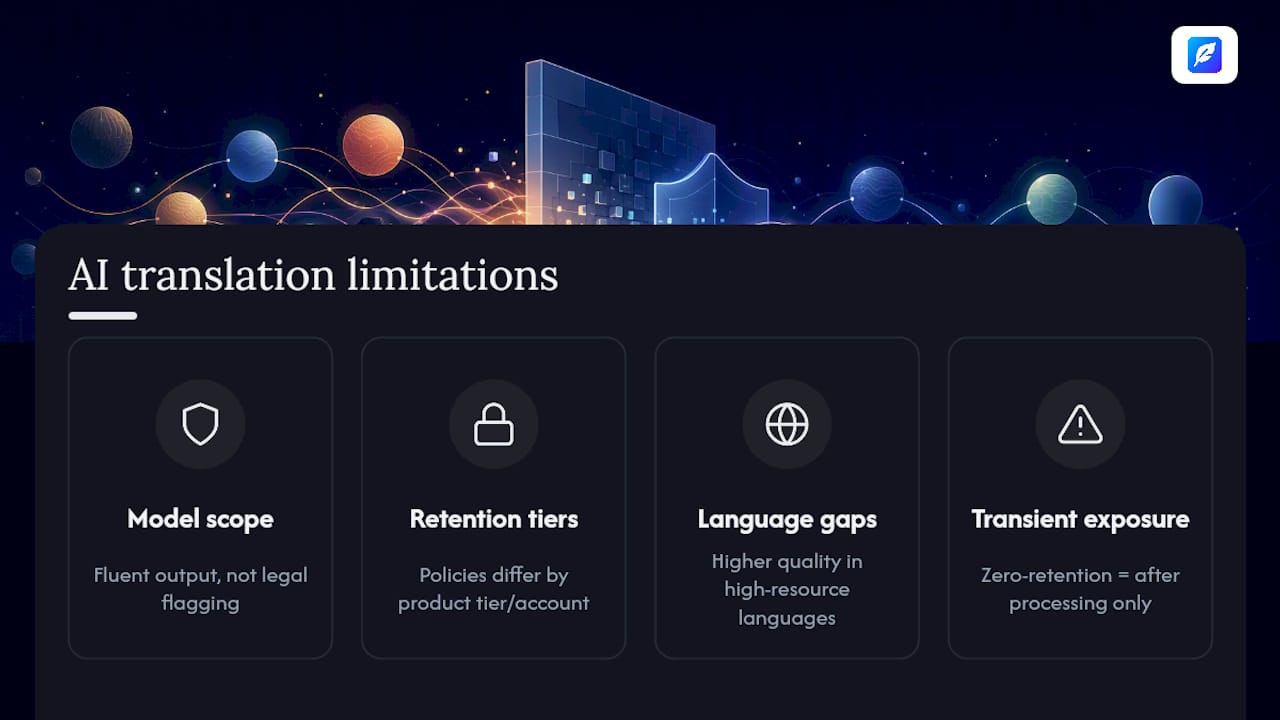
Even the most privacy-conscious AI translation tool has real limitations worth naming plainly. Automated translation engines are trained to produce fluent, plausible output, not to flag when a phrase carries legal or regulatory weight that a human reviewer would catch. That's a structural limitation, not a bug that gets patched.
Retention promises also vary by product tier within the same company. A vendor's free consumer product and its enterprise API can carry entirely different data-handling policies, so a no-training claim you saw on a blog post doesn't necessarily apply to the account you're actually using. Always verify the policy for the specific tier you're on.
Language coverage introduces another gap. Translation quality and safety review both tend to be strongest in high-resource languages (Spanish, French, Mandarin) and weaker in less common language pairs, where fewer training examples exist and errors are harder to catch automatically.
Finally, "zero-retention" describes what happens to your text after processing, not what happens during it. Text sitting briefly in server memory can still be exposed in the event of an active breach, even if the vendor's policy calls for a hard delete afterward. None of this makes privacy-first AI translation unsafe for its intended use. It does mean the marketing phrase "confidential" deserves the same scrutiny as any other vendor claim.
Legal exposure when AI translation touches protected health information
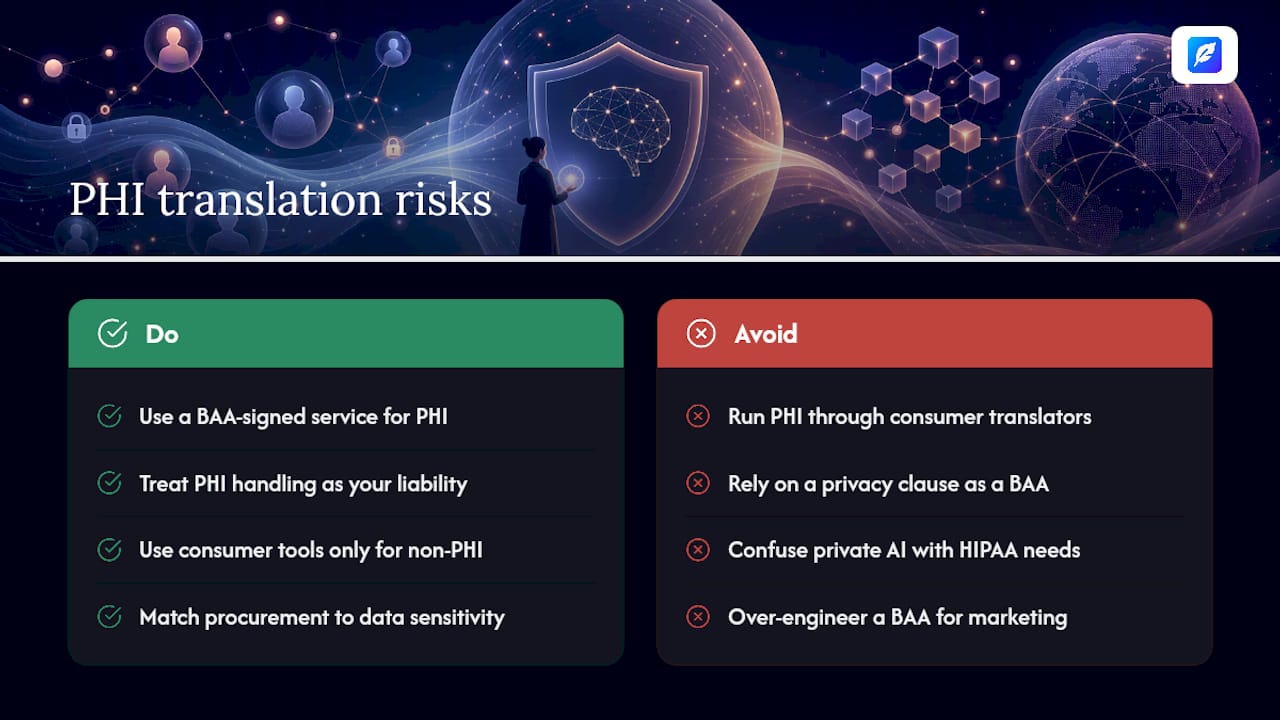
None of the tools discussed in this guide are built or licensed for protected health information, and that's worth stating without ambiguity. If a document contains PHI, a general-purpose AI translation tool, however privacy-conscious, is the wrong category of product entirely.
The liability question isn't really about the AI vendor. It's about the entity handling the PHI in the first place. A business or practitioner who runs patient data through a consumer-grade translator, rather than a service with a signed Business Associate Agreement, carries the compliance exposure themselves, regardless of what the tool's own privacy policy says. A no-training clause protects your business correspondence. It doesn't create a BAA, and it doesn't satisfy HIPAA's requirements for handling PHI.
This is why the distinction drawn earlier in this guide isn't just semantic. Readers searching "hipaa compliant translation" while actually meaning "private AI translation for my freelance business" face a completely different risk profile than a clinic translating discharge instructions. Confusing the two, using a consumer privacy-first tool for genuine PHI, or over-engineering a BAA-level procurement process for a marketing email, both waste time and, in the first case, create real legal risk.
Author note: balancing speed and privacy in everyday workflows
Most writers don't need to choose between fast and private. That framing sells more expensive tools than necessary. Where it gets risky is when convenience quietly becomes the default for anything sensitive, without anyone deciding that on purpose. My advice: default to privacy-first tools for anything client-facing, and don't let a vendor's marketing page substitute for an actual DPA in your inbox. Accessible pricing and genuine confidentiality aren't mutually exclusive. Ask for the paperwork before you believe the pitch.
— Mike
How Inspirowrite fits the privacy-first checklist
Inspirowrite was built around the same checklist covered in this guide, not retrofitted to match it after the fact. Submitted text isn't used to train AI models, processing is built for speed without sacrificing confidentiality, and the platform gives writers, students, and business teams the same kind of instant feedback you'd expect from a consumer tool, minus the trade-off of your draft ending up in someone else's training data.
For teams, Inspirowrite adds role-based access and API access so business customers can manage who sees what, rather than sharing a single login across a department. If you want the specifics in writing, the Inspirowrite privacy policy covers exactly how submitted content is handled and stored. For more on why this matters before you commit to any provider, our guide to the benefits of confidential translation tools walks through the trade-offs in more depth.
If you're evaluating options this week, the fastest next step is to run one of your own drafts through Inspirowrite and compare the output and turnaround against whatever you're using now.
Key Takeaways
Privacy-first AI translation works when a vendor pairs a written no-training commitment with verifiable technical controls, not marketing language alone.
| Point | Details |
|---|---|
| Verify contracts, not claims | Request a DPA and a written no-training clause before trusting any tool with confidential drafts. |
| Match risk to document type | Use quick AI tools for low-risk drafts; escalate contracts and proposals to services with signed DPAs. |
| Anonymise before submitting | Mask names, figures, and identifiers, then restore them locally after translation. |
| Confirm technical safeguards | Look for zero-retention policies, encryption in transit and at rest, audit logs, RBAC, and SSO. |
| Inspirowrite as a working example | Excludes submissions from model training and offers RBAC and API access for business teams. |
Sources
- data-privacy-security
- Is It Safe to Put Confidential Documents into a Translation Tool? - Translated
FAQ
Is "HIPAA compliant translation" the right term for general privacy needs?
Not technically. Most people searching this phrase actually want private, no-training AI translation for business or personal writing, not clinical PHI handling, which requires a Business Associate Agreement and specialised medical vendors.
What's the fastest way to check if a translation tool is private?
Ask the vendor directly for a Data Processing Agreement and a written statement confirming your text won't be used for model training; a fast, specific answer is the best signal.
Can I use free AI translators for business documents?
Free consumer tools often reserve rights to use submitted text for model improvement, so avoid them for contracts, unreleased copy, or anything covered by an NDA.
Does Inspirowrite use my text to train its models?
No. Inspirowrite excludes user submissions from model training by design, which is one of the core checklist items this guide recommends verifying with any provider.
What should a small business ask for before signing up with a translation vendor?
Request a signed DPA, confirmation of zero-retention or hard-delete policies, and evidence of encryption standards like TLS and AES-256 before handling any sensitive documents.