

TL;DR:
- Instant AI essay feedback speeds up revision cycles, provides targeted suggestions aligned with rubrics, and enhances learning outcomes. It offers scalable, objective, and formative insights that encourage iterative practice, especially benefiting non-native speakers and large classes. However, its effectiveness depends on careful integration with teacher oversight and appropriate task types.
Instant AI essay feedback improves revision speed, increases the number of draft cycles students complete, and raises measurable learning outcomes when paired with rubric alignment and active student engagement. The core benefits are:
- Speed: same-day turnaround enables multiple draft-revise cycles within a single study session
- Targeted correction: grammar, style, coherence, and structure suggestions tied to specific sentences
- Rubric alignment: AI can map comments to assignment criteria when a rubric is supplied
- Scalability: consistent first-pass feedback across an entire class without teacher burnout
- Motivation: objective, non-judgemental comments reduce defensiveness and encourage iteration
- Formative analytics: class-level diagnostics that help teachers plan targeted mini-lessons
A meta-analysis of computer-mediated feedback found an overall effect size of g = 1.602, with automated immediate feedback producing a strong g = 0.937. Those are not marginal gains. The UCL teaching toolkit on enhancing feedback independently recommends electronic delivery for faster essay return, framing timely feedback as a cornerstone of effective teaching practice. Inspirowrite is one privacy-first tool built around exactly these principles.
Table of Contents
- How instant AI essay feedback actually works
- 8 practical benefits of instant essay feedback, explained
- What the research says about effectiveness
- When instant feedback helps least
- How to use instant essay feedback effectively
- Privacy, data use, and academic integrity: UK considerations
- Key takeaways
- The feedback gap nobody talks about
- Inspirowrite: fast, private essay feedback for UK students and educators
- Useful sources and further reading
- FAQ
How instant AI essay feedback actually works
The process is straightforward: paste or upload a draft, and the system runs it through several analytical layers simultaneously. Most modern tools combine rule-based grammar checks, statistical style models, and large language models capable of evaluating coherence and argument structure. The output is a structured report with inline suggestions rather than a single score.
What separates a useful tool from a superficial one is rubric anchoring. When a teacher attaches assignment criteria, the AI maps its suggestions to specific descriptors: "your thesis lacks a counterclaim (Criterion 3: argumentation)" rather than a generic "add more detail." Research into rubric-based feedback pipelines confirms that rubric-anchored prompting produces feedback experts consistently prefer over standard prompting, and that students find it more revision-useful.
Human-in-the-loop workflows take this further. Systems like EvaluAId show that when teachers review and approve AI-generated comments before release, alignment with expert assessment standards improves and grader satisfaction rises. The EvaluAId research frames this not as AI replacing teacher judgement but as AI handling the first pass so teachers can focus on higher-order feedback.
Pro Tip: When setting up AI feedback for a class assignment, paste the full rubric into the prompt or upload it alongside the student draft. Even a brief rubric doubles the specificity of the suggestions returned.
8 practical benefits of instant essay feedback, explained
1. Same-day turnaround enables real revision cycles
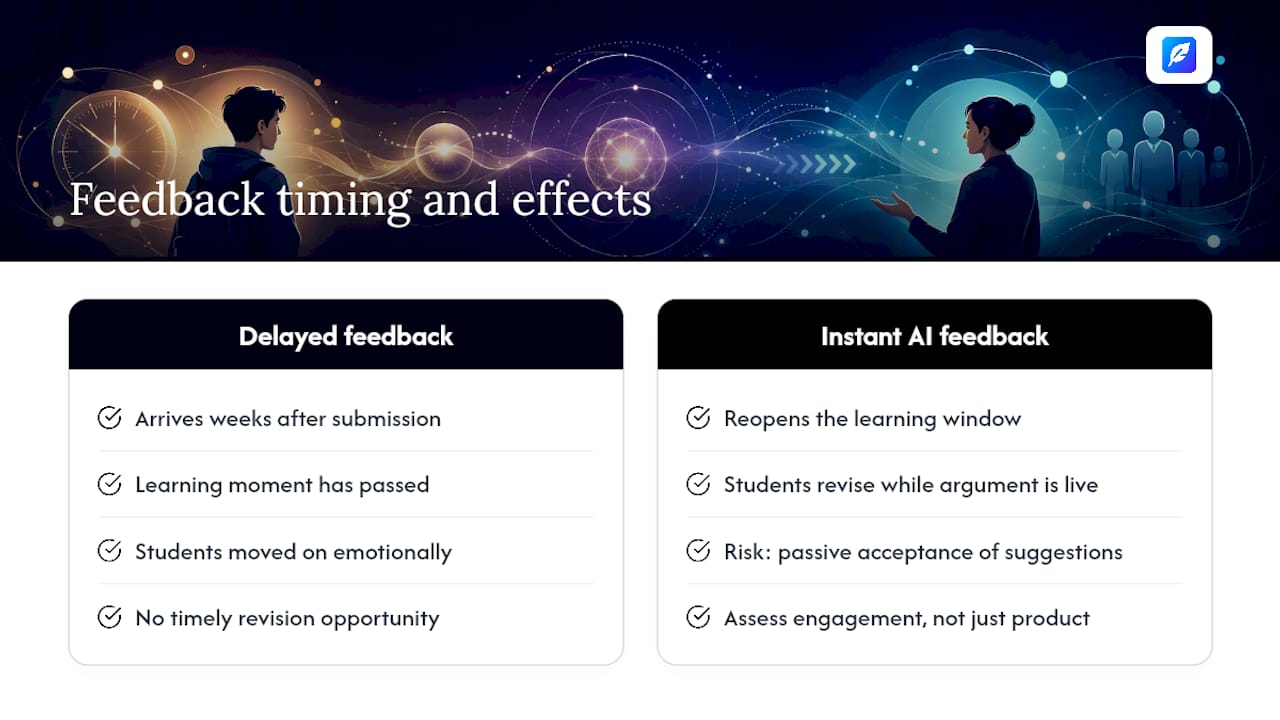
Traditional teacher feedback often arrives days or weeks after submission, by which point the student has mentally moved on. Instant feedback keeps the essay in working memory. Students can revise, resubmit, and revise again within a single afternoon. The cognitive case for this is well established: feedback absorbed while the task is still active produces larger learning gains than delayed feedback, because attention and motivation are both still engaged.
2. Grammar and style corrections are specific, not generic
A comment like "improve your sentence variety" is almost useless. Instant AI feedback flags the actual sentence, explains the issue (passive overuse, run-on construction, weak verb choice), and often suggests a rewrite. For students working on common grammatical errors, this specificity is what converts a vague awareness of a problem into a concrete fix.
3. Rubric-aligned comments shift students from guessing to revising
Without rubric alignment, students often cannot tell whether a suggestion improves their grade or just changes the style. When AI comments reference specific criteria, students know exactly which part of the mark scheme they are addressing. Classroom evidence from Edutopia shows that attaching rubrics to AI prompts improves feedback quality and that students engage more actively with the resulting comments.
4. Scalability means every student gets a first-pass review
A teacher with thirty students cannot give detailed written feedback on every draft before the final submission. AI can. Every student receives the same quality of first-pass correction regardless of class size, time of day, or how many other assignments the teacher is marking. This is particularly significant for under-resourced schools and large university modules.
5. Objective feedback reduces defensiveness
Students often read teacher comments through the lens of the relationship: "she always marks me down for this." AI feedback carries no personal history. Research commentary on classroom dynamics notes that students perceive AI feedback as more objective, which tends to reduce defensiveness and improve receptivity to correction. That shift from performance anxiety to iterative practice is one of the less-discussed but genuinely important advantages of rapid essay feedback.
6. Formative analytics give teachers diagnostic data
When AI processes an entire class's drafts, it can surface patterns: 60% of students are struggling with paragraph cohesion; 40% are misusing semicolons. That class-level view lets teachers plan a ten-minute targeted mini-lesson rather than repeating the same comment on thirty individual scripts.
"Timely feedback supports learning, helps teaching planning and contributes to a positive classroom culture." — UCL teaching toolkit: enhancing feedback
7. Iterative practice builds long-term writing skills
A student who submits three drafts of the same essay and acts on feedback each time is doing something qualitatively different from a student who submits once. Quick, rubric-aligned feedback shifts behaviour from one-off performance to iterative practice. Over a term, that habit compounds: students internalise the criteria, self-edit more accurately before submitting, and develop a clearer sense of what good writing looks like in their discipline.
8. L2 and non-native writers benefit disproportionately
For students writing in a second language, the gap between what they mean and what they write is often a grammar and fluency problem rather than a conceptual one. Instant feedback catches the surface errors that obscure the argument. The meta-analysis on computer-mediated feedback found that intermediate learners and academic writing tasks see the largest gains, which maps directly onto the profile of many UK university students writing in English as an additional language. For this group, tools that also handle language transfer issues in writing are especially valuable.
What the research says about effectiveness
Instant feedback works. The strongest evidence comes from a meta-analysis of computer-mediated feedback in L2 writing, which reported an overall effect size of g = 1.602. Automated feedback specifically returned g = 0.937 and immediate feedback g = 0.875. These are large effects by any standard in educational research.
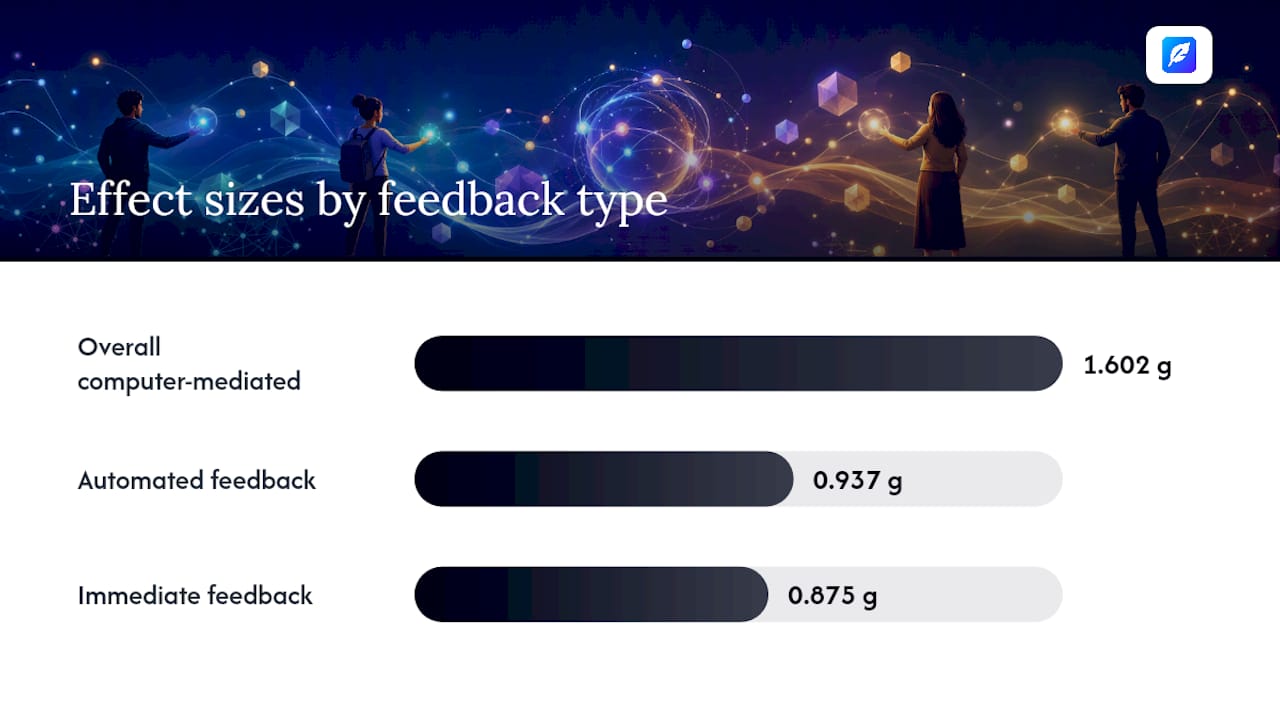
| Feedback type | Effect size (g) | Key moderator |
|---|---|---|
| Overall computer-mediated | 1.602 | Task genre, learner level |
| Automated feedback | 0.937 | Rubric alignment |
| Immediate feedback | 0.875 | Learner proficiency |
| Intermediate learners | Largest subgroup gain | Academic writing tasks |
Source: Meta-analysis of computer-mediated feedback effectiveness
The moderating factors matter as much as the headline numbers. Intermediate learners benefit most; beginners may lack the metalinguistic knowledge to act on detailed suggestions, and advanced writers may find the feedback too surface-level. Academic writing tasks show larger gains than creative or narrative tasks, which aligns with the structured, criteria-driven nature of most UK university assignments.
A UK classroom study on immediate AI feedback found that students rated AI feedback as useful and motivating, and that teachers could redirect their attention to higher-order planning. Crucially, the study did not find that AI feedback consistently outperformed teacher feedback for essay quality. The honest reading of the evidence is that AI feedback is a powerful complement to teacher feedback, not a replacement.
"Feedback provided during or shortly after writing improves revision quality, accuracy and fluency — but carries risks of overload and overreliance without careful pedagogic design." — Review: immediate feedback in L2/EFL writing
Chain-of-thought prompting research adds another layer: the quality of AI feedback depends heavily on how the prompt is constructed. Tools that use chain-of-thought reasoning or rubric-anchored prompting generate more revision-useful suggestions than those relying on simple completion prompts.
When instant feedback helps least
AI essay feedback is not equally useful in every context. Knowing where it falls short is as important as knowing where it excels.
Tasks where AI struggles:
- High-stakes summative assessments where nuanced examiner judgement is required
- Complex narrative or creative writing where plot coherence and voice are central
- Discipline-specific argumentation in fields like law or philosophy, where the logic of a claim requires domain expertise to evaluate
- Essays that require the reader to assess originality of thought rather than surface correctness
Risks to watch for:
- Feedback overload: too many simultaneous suggestions can paralyse rather than guide a student
- Learner dependency: students who only revise what the AI flags may stop developing independent self-editing skills
- Misaligned suggestions: without a rubric, AI may optimise for general readability rather than the specific assignment criteria
- Generic phrasing: if suggestions sound interchangeable across completely different essays, the tool is not reading the content closely enough
Pro Tip: Ask students to write one sentence explaining why they accepted or rejected each AI suggestion. This single step prevents passive acceptance and turns feedback into a metacognitive exercise.
Combining AI feedback with peer review and teacher moderation reduces most of these risks. AI handles the first pass; peers engage with argument and clarity; the teacher focuses on conceptual depth and disciplinary standards.
How to use instant essay feedback effectively
For students
- Set a specific revision goal before you submit: "I want to improve paragraph cohesion in sections 2 and 3" is more useful than "make it better."
- Attach the assignment rubric or paste the marking criteria into the prompt field.
- Read every suggestion critically. Accept changes you understand; query ones that feel wrong.
- Track your changes across drafts using a revision log or the tool's history feature.
- After revising, re-read the essay aloud to catch anything the AI missed.
Use an essay proofreading checklist alongside AI feedback to cover both automated and manual review.
For teachers
- Provide a rubric before students submit to the AI tool; this is the single highest-impact step.
- Require students to submit a brief revision log alongside their final draft, noting which AI suggestions they acted on and why.
- Use class-level diagnostics to identify shared weaknesses and plan targeted lessons.
- Reserve your own feedback time for high-order concerns: argument quality, disciplinary reasoning, originality.
- Run low-stakes formative submissions early in a module so students build the habit before high-stakes work.
Pro Tip: Scaffold iterative submissions by setting three low-stakes draft deadlines before the final submission date. Students who submit three drafts consistently produce stronger final essays than those who submit once, and the AI handles the surface-level feedback at each stage without adding to your marking load.
A simple classroom workflow: students submit Draft 1 to the AI tool with the rubric attached, receive instant feedback, revise to Draft 2, share Draft 2 with a peer reviewer, incorporate peer comments into Draft 3, then submit Draft 3 for teacher assessment. The teacher sees a polished draft and can focus entirely on higher-order feedback.
Privacy, data use, and academic integrity: UK considerations
Before uploading student work to any AI feedback tool, check three things: whether the platform processes data under UK GDPR, whether student drafts are stored and for how long, and whether text is used to train the underlying model. The last point is non-negotiable for most UK institutions. If a tool cannot confirm that student text is excluded from training data, it should not be used with identifiable student work.
Institutional checklist:
- Confirm a Data Processing Agreement (DPA) is in place between the tool provider and your institution
- Verify that student drafts are not retained beyond the session or can be deleted on request
- Anonymise work where possible before uploading (remove names, student IDs)
- Check your institution's acceptable-use policy for AI tools before deploying to a class
On academic integrity: there is a clear distinction between using AI feedback for formative revision (legitimate, and increasingly encouraged) and submitting AI-generated text as your own work (a breach of academic integrity under most UK university policies). Institutions should publish explicit guidance on where that line sits. The UCL teaching toolkit provides a useful pedagogic framework for thinking about feedback as a learning tool rather than a shortcut.
Pro Tip: Add a one-line AI use declaration to your assignment brief: "Students may use AI tools for formative feedback on drafts but must submit their own written work." This sets expectations clearly and reduces ambiguity for both students and markers.
This article provides general information about AI tools and UK data protection principles. Confirm current institutional policies and GDPR obligations with your institution's data protection officer or a qualified professional.
Key takeaways
Instant AI essay feedback delivers the largest gains when rubric alignment, iterative submission, and teacher oversight are all in place.
| Point | Details |
|---|---|
| Attach rubrics every time | Rubric-anchored prompting produces feedback experts prefer and students find more revision-useful. |
| Use multiple revision cycles | Students who submit three drafts consistently outperform those who submit once; AI handles surface feedback at each stage. |
| Reserve teacher time for depth | AI first-pass frees teachers to focus on argumentation, originality, and disciplinary reasoning. |
| Check privacy before uploading | Confirm no training-data use and a Data Processing Agreement before submitting student work. |
| Inspirowrite for UK institutions | Inspirowrite combines instant grammar and style feedback with a no-training-data policy, rubric upload, revision history, and team access. |
The feedback gap nobody talks about
There is a version of this conversation that treats instant AI feedback as either a silver bullet or a threat to genuine learning. Both framings miss the point.
The real problem in most UK classrooms and universities is not that feedback is bad. It is that feedback arrives too late to change anything. A student who receives detailed comments three weeks after submission has already moved on, emotionally and cognitively. The essay is done. The moment for learning has passed.
What instant feedback does is reopen that window. It gives students a reason to look at the draft again while the argument is still live in their minds. That is not a small thing. The meta-analysis effect sizes cited in this article are large precisely because timing is not a logistical nicety — it is a pedagogic variable.
The risk worth taking seriously is not that AI feedback is too good. It is that students will use it passively, accepting every suggestion without understanding why, and gradually outsource the thinking that writing is supposed to develop. The solution is not to avoid AI feedback. It is to design the workflow so that engagement with the feedback is the assessed behaviour, not just the final product.
Teachers who ask students to justify their revision decisions, who require a draft log, who use AI diagnostics to plan lessons rather than replace them — those are the educators who will get the most out of these tools. The technology is ready. The pedagogy is what needs the investment.
Inspirowrite: fast, private essay feedback for UK students and educators
Getting detailed, rubric-aligned feedback within seconds rather than waiting days is the concrete difference Inspirowrite offers. For UK students working to tight submission deadlines and educators managing large cohorts, that turnaround changes what is actually possible in a revision cycle.
Inspirowrite processes your text instantly and returns grammar corrections, style suggestions, tone adjustments, and structural comments without storing your drafts or using them to train its models. For institutions where GDPR compliance is non-negotiable, that confirmed opt-out from training-data use is the feature that makes deployment straightforward. Upload a rubric alongside your draft and the feedback maps directly to your assignment criteria. Revision history lets students and teachers track improvement across drafts, and team access means departments can share rubrics and review feedback quality at scale.
Try Inspirowrite free and see how quickly a first-pass review changes your next draft.
Useful sources and further reading
- UK classroom study on immediate AI feedback
- Study: feedback engagement and chain‑of‑thought prompting
- Meta‑analysis of computer‑mediated feedback effectiveness (L2 writing)
- EvaluAId: human‑AI collaborative rubric alignment for grading
- UCL teaching toolkit: enhancing feedback
- Edutopia: AI writing feedback in classrooms
- Review: immediate feedback in L2/EFL writing
- FABRIC / EssayCoT: rubric‑based feedback generation research
FAQ
What are the main benefits of instant essay feedback?
Instant essay feedback speeds up revision cycles, provides specific grammar and style corrections, and aligns comments to rubric criteria. Research shows automated immediate feedback produces a strong effect size (g = 0.937) in improving writing quality, particularly for academic tasks.
Which AI tools are best for essay feedback in the UK?
Inspirowrite is a strong option for UK students and educators: it delivers instant grammar, style, and structure feedback, supports rubric upload, and operates a confirmed no-training-data policy that satisfies UK GDPR requirements.
Does instant AI feedback replace teacher comments?
No. A UK classroom study found that AI feedback improves student motivation and workflow but does not consistently outperform teacher feedback for essay quality. The most effective approach combines AI first-pass feedback with teacher focus on higher-order concerns such as argumentation and originality.
What are the advantages of using an essay extender or AI writing tool for revision?
AI writing tools help students identify weak sections, expand underdeveloped arguments with targeted prompts, and improve fluency. The key advantage is speed: students can act on suggestions immediately rather than waiting for a marked draft to return.
How does essay type affect the usefulness of instant feedback?
Academic and structured essay types benefit most from instant feedback, as the criteria are explicit and rubric-alignable. Creative or narrative essays, and discipline-specific work in fields like law or philosophy, are harder for AI to evaluate accurately because quality depends on judgement and domain knowledge rather than surface correctness.