

TL;DR:
- Confidential translation tools ensure sensitive data is never stored or used to train AI by implementing strict controls. They improve compliance, security, and translation accuracy, especially for legal or medical content. Combining AI speed with human oversight delivers trusted and efficient multilingual communication.
Confidential translation tools are defined as software systems that translate content between languages while guaranteeing that sensitive data is never stored, shared, or used to train AI models. The benefits of confidential translation tools extend far beyond simple privacy. They combine data security, regulatory compliance under frameworks such as GDPR, HIPAA, and ISO 27001, and translation accuracy into a single workflow. For individuals handling personal documents and businesses managing legal or medical content, choosing secure translation software is no longer optional. It is a baseline requirement for responsible multilingual communication.

1. How confidential translation tools improve data privacy and compliance
Secure translation software protects sensitive content through several layered controls, not a single feature.
- Zero data retention: Translations are processed in real time and immediately deleted, leaving no stored records that could be exposed in a breach.
- Encryption in transit and at rest: Data is encrypted as it travels between your device and the translation engine, and again while temporarily held in memory.
- Role-based access controls: Only authorised team members can submit or retrieve translated content, reducing internal exposure risk.
- Audit logs: Every translation request is logged with a timestamp, user identity, and source location, creating a clear accountability trail.
- Compliance certifications: Tools aligned with ISO 27001, ISO 42001, GDPR, and HIPAA operate within certified secure environments that prevent unauthorised access.
The combination of these controls means that a confidential document translation workflow leaves no exploitable trace. Organisations in healthcare, law, and finance depend on this architecture to meet their regulatory obligations without sacrificing speed.
Pro Tip: Ask any vendor for written documentation of their retention policy and encryption standards before signing a contract. Vendors without explicit documentation on retention, encryption, and no-training guarantees should be treated as unsafe for confidential content.
2. Real-time translation benefits for business efficiency and customer satisfaction
Real-time confidential translation delivers measurable commercial results, not just a smoother user experience.
AI real-time translation tools increase customer satisfaction by 70% and deflect 80% of routine queries, freeing human agents to handle complex cases. That deflection rate translates directly into lower staffing costs and faster resolution times across multilingual support queues.
Enterprise-grade AI interpretation achieves sub-second latency across 50+ languages, reducing costs by 60–70% for routine meetings and webinars. For businesses running regular multilingual calls, that cost reduction alone justifies the switch from traditional interpretation services.
Real-time translation preserves emotional tone by eliminating the pauses and handoffs that break conversational flow. Trust erodes when a customer must wait for a human interpreter to relay a response. Confidential real-time tools remove that friction entirely. The advantages of private translation in customer-facing contexts are therefore both financial and relational.
3. How confidential translation tools ensure accuracy and linguistic quality
Privacy and accuracy are not in conflict. The best secure translation software delivers both simultaneously.
- Domain-specific glossaries: Legal, medical, and technical content requires consistent terminology. Confidential tools store approved glossaries locally, so the same term is never translated differently across documents.
- Translation memories: Previously approved translations are reused for identical or similar segments, reducing inconsistency and review time.
- AI models trained without user data: Inspirowrite, for example, explicitly guarantees that content submitted for translation is never used to train its AI models. This means your proprietary language does not end up shaping a public model.
- Ambiguity flagging: Quality tools surface uncertain translations for human review rather than silently guessing, which is critical for legally or diplomatically sensitive content.
- Human review for high-stakes content: AI translation errors can cause misinformation, legal liability, or safety risks, making human oversight non-negotiable for critical documents.
The importance of secure translation is therefore inseparable from the importance of accurate translation. A tool that protects your data but mistranslates a contract clause has failed at its core function. Pairing AI speed with subject matter expertise in translation is the standard that serious organisations apply.
Pro Tip: Build a two-tier review process. Use confidential AI translation for first drafts, then route high-stakes segments to a qualified human reviewer. This approach cuts turnaround time without sacrificing accuracy where it counts.
4. Practical features that confidential translation tools offer for secure workflows
Understanding how to ensure translation confidentiality in practice means knowing which specific features to look for and why each one matters.
| Feature | What it does | Why it matters |
|---|---|---|
| Configurable data retention | Sets automatic deletion timelines or instant deletion on demand | Meets GDPR and HIPAA data minimisation requirements |
| Role-based permissions | Restricts translation access by user role or department | Prevents internal data leaks from unauthorised staff |
| Multi-factor authentication | Requires a second verification step at login | Blocks credential-based attacks on translation accounts |
| Audit logs | Records who translated what, when, and from which location | Provides evidence of compliance during regulatory audits |
| Data residency controls | Keeps data within a specified geographic region | Satisfies regional data sovereignty laws such as UK GDPR |
Many tools claiming privacy still maintain temporary server logs or metadata that create retention liabilities without explicit guarantees. This is the hidden risk that organisations overlook when selecting a tool based on marketing copy alone. Checking for documented deletion controls and residency options is the practical step that separates genuinely safe translation tools from those that merely appear secure.
Secure translation software also integrates into enterprise systems such as CRM platforms, content management systems, and ticketing tools. That integration means confidential document translation happens within existing governance frameworks rather than outside them, which reduces the risk of staff bypassing controls by using unsanctioned tools.
5. When and how to choose confidential translation tools
Selecting the right tool depends on the sensitivity of your content, the volume of translations, and your regulatory environment.
- High-stakes content requires human support alongside AI. Legal contracts, medical records, and diplomatic communications carry consequences if mistranslated. Organisations combine human interpreters for sensitive content with AI for high-volume, lower-risk scenarios. Match the tool to the risk profile, not the budget alone.
- Routine, high-volume tasks suit automated confidential tools. Customer service queries, internal communications, and marketing copy in multiple languages are ideal candidates for fully automated secure translation. The 80% query deflection rate cited above applies precisely to this category.
- Demand explicit no-training guarantees in writing. A vendor's privacy page is not a contract. Request a data processing agreement that explicitly states your content will not be used to train or fine-tune any AI model.
- Classify your content before choosing a workflow. Build an internal data classification policy that labels content as public, internal, confidential, or restricted. Apply different translation workflows to each tier. This prevents confidential material from being processed by tools approved only for public content.
- Balance cost, speed, and security by use case. The 60–70% cost reduction from AI interpretation is real, but it applies to routine scenarios. High-risk content warrants the additional cost of human review. Treating all translation as equivalent is the most common and most expensive mistake organisations make.
- Evaluate multilingual business document types before selecting a tool. Different document categories carry different risk profiles. A non-disclosure agreement and a product description require entirely different levels of security and human oversight.
- Check for technical jargon translation capabilities. Regulated industries use precise terminology that general-purpose tools frequently mistranslate. Confidential tools with domain-specific glossary support handle this far more reliably.
Secure translation software should be treated as enterprise infrastructure, not a one-off purchase. Translation security functions as an operating model, not a single feature, and the organisations that treat it that way avoid the compliance failures that catch others off guard.
Key takeaways
The most effective approach to confidential translation combines zero data retention, encryption, role-based access, and human review for high-stakes content.
| Point | Details |
|---|---|
| Zero retention is the baseline | Translations must be processed and deleted in real time to eliminate exposure risk. |
| Real-time tools deliver measurable ROI | AI translation increases customer satisfaction by 70% and cuts interpretation costs by 60–70%. |
| Accuracy requires human oversight | AI errors in legal or medical content carry legal and reputational consequences; human review is non-negotiable. |
| Vendor documentation is mandatory | Always obtain written proof of no-training guarantees, encryption standards, and deletion controls. |
| Classify content before choosing a tool | Match the security level of your translation workflow to the sensitivity of the content being translated. |
Why translation security has become infrastructure, not a feature
The framing I see most often is wrong. Organisations treat confidential translation as a premium add-on, something to consider once the core translation problem is solved. That gets it backwards. Security is the foundation on which accurate, scalable translation is built.
I have watched businesses select general-purpose translation tools for internal communications, then discover months later that their content was being used to improve a public AI model. The reputational damage is real. The regulatory exposure under GDPR is real. And the fix, migrating workflows, retraining staff, and renegotiating vendor contracts, costs far more than selecting the right tool at the outset.
The hybrid model is where the field is heading. AI handles volume and speed. Human experts handle ambiguity, sensitivity, and legal precision. The organisations that get this right do not treat these as competing approaches. They treat them as complementary layers of the same system. Inspirowrite's approach of combining AI speed with a firm no-training guarantee reflects exactly this thinking.
Vendor transparency is the variable that most organisations underweight. A tool can claim ISO 27001 compliance and still maintain metadata logs that create liability. Demand the documentation. Read the data processing agreement. If a vendor cannot produce clear written answers to questions about retention, encryption, and training, that is your answer.
Treat translation security the way you treat network security: as infrastructure that requires governance, regular review, and clear ownership. The organisations that do this will scale their multilingual operations with confidence. Those that do not will eventually face a breach, a compliance failure, or both.
— Mike
Inspirowrite: private, accurate translation built for business
Confidential translation is not a niche requirement. It is the standard that any business handling sensitive multilingual content must meet.
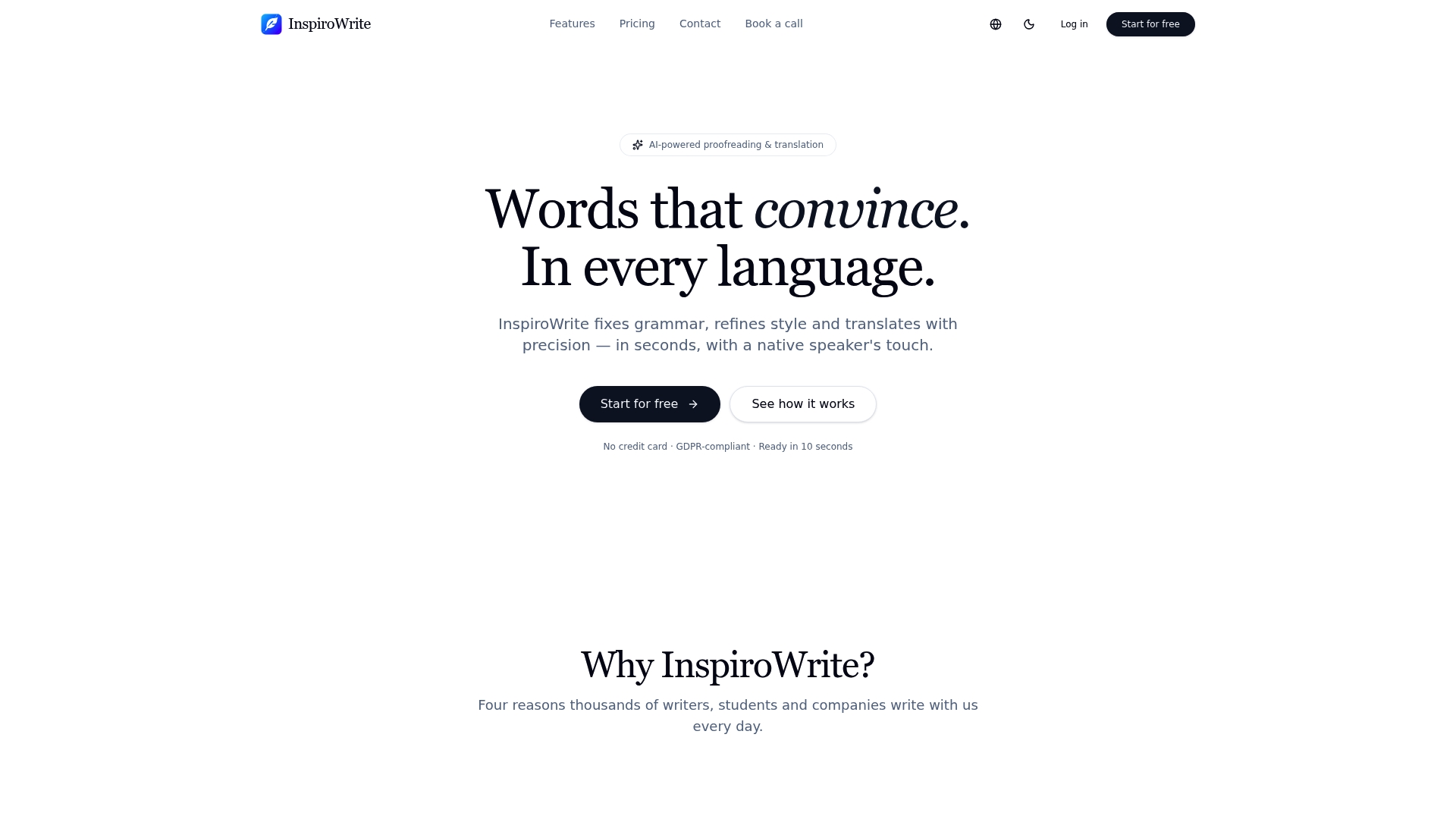
Inspirowrite delivers AI-powered translation that processes your content instantly and never uses it to train AI models. Your documents stay yours. The platform combines speed with a firm commitment to data confidentiality, making it a practical choice for businesses that cannot afford to compromise on either. Whether you are translating legal agreements, customer communications, or internal reports, Inspirowrite provides the accuracy and privacy controls that regulated environments demand. Explore Inspirowrite's translation tools and see how privacy-first translation works in practice.
FAQ
What are the main benefits of confidential translation tools?
Confidential translation tools protect sensitive data through zero retention policies, encryption, and role-based access, while delivering accurate multilingual output. They also support compliance with GDPR, HIPAA, and ISO 27001.
How do real-time translation tools improve customer service?
Real-time AI translation tools increase customer satisfaction by 70% and deflect 80% of routine queries, freeing human agents for complex cases.
What does zero data retention mean in secure translation software?
Zero data retention means translations are processed immediately and deleted without being stored, logged, or used to train AI models, eliminating exposure risk.
When should I use human translators instead of AI?
Use human translators for legal contracts, medical records, and any content where a mistranslation could cause legal liability or safety risks. AI handles high-volume, lower-risk content reliably.
How do I verify that a translation tool is genuinely confidential?
Request a written data processing agreement that explicitly states no-training guarantees, encryption standards, and deletion controls. Marketing claims alone are not sufficient evidence of genuine confidentiality.