

TL;DR:
- Translating technical jargon into clear business language bridges understanding and builds trust. Using frameworks like AWE and ARIA helps explain complex concepts effectively to non-technical audiences. Proper preparation, consistent glossaries, and AI tools support professionals in delivering precise, impactful communication.
Translating technical jargon in a business context means converting specialised, complex language into clear communication that any colleague, client, or stakeholder can act on. The gap between technical teams and business decision-makers costs organisations real money, delays projects, and erodes trust. Frameworks like AWE and ARIA, tools like Microsoft 365 Copilot and ChatGPT, and well-maintained translation glossaries each address a different part of this problem. Non-native English speakers face an additional layer of difficulty, because vocabulary gaps under pressure compound the challenge of business jargon translation at the best of times.
How do frameworks help translate technical jargon for business audiences?
The AWE framework is the most direct method for turning technical complexity into business language. AWE stands for Analogy, What it does (business impact), and Evidence. A case study applying AWE to a cloud migration project showed a 40% reduction in IT costs by reframing the technical process as "moving your filing cabinets to a managed storage facility." That single analogy shifted the conversation from server architecture to operational savings, which is exactly what a finance director needs to hear.

The ARIA framework takes a slightly different angle, focusing on the speaker's preparation rather than the message structure. ARIA stands for Audience, Reframe, Illustrate, Ask. Using ARIA keeps introductions brief and forces the speaker to lead with business value before any technical detail appears. For non-native English speakers, this is particularly useful because it provides a mental script that reduces the risk of losing your thread mid-sentence.
The AWE framework in practice
- Analogy: Map the technical concept to something your audience already understands. "An API is like a waiter taking your order to the kitchen and bringing back the result."
- What it does: State the business outcome directly. "This reduces manual data entry by your finance team."
- Evidence: Provide a metric or concrete result. "Our pilot cut processing time from three days to four hours."
The ARIA framework in practice
- Audience: Identify who is in the room and what they care about before you speak.
- Reframe: Replace technical terms with outcome language. "Latency" becomes "the delay your customers experience at checkout."
- Illustrate: Use a short story or visual comparison to anchor the concept.
- Ask: End with a question that confirms understanding, such as "Does that match what you were expecting to see?"
Pro Tip: Prepare two versions of every technical explanation: one for a technical peer and one for a non-technical stakeholder. Practising both versions before a meeting sharpens your ability to switch registers under pressure.
The goal of both frameworks is cognitive mapping, connecting unfamiliar concepts to familiar real-world experiences. Engineering communication experts are clear that analogy outperforms simplification. Simplification removes detail; analogy preserves meaning while changing the vehicle.
Which tools help non-native professionals simplify technical language?
Preparation is the single biggest advantage a non-native professional can build before a meeting or presentation. Pre-rehearsed translation phrases before meetings greatly improve communication clarity and confidence. Phrases like "The short version is..." or "In plain terms, this means..." give you a reliable bridge when vocabulary fails mid-sentence.
The right tools make this preparation faster and more consistent. Here is a practical toolkit:
- Microsoft 365 Copilot: Use structured prompts that specify role, source, goal, and format. Copilot can translate technical jargon into plain English tailored for C-suite audiences or non-technical teams. A prompt like "You are a business analyst. Summarise this technical specification for a CFO in three bullet points" produces focused, jargon-free output.
- ChatGPT: Useful for drafting analogies and testing whether a simplified explanation still holds its meaning. Paste your technical paragraph and ask it to rewrite for a non-specialist reader.
- A centralised TRANSLATING.md glossary: A shared glossary file prevents AI tools from guessing at term meanings and keeps definitions consistent across teams. Treat it like a codebase component: version it, update it alongside product releases, and assign an owner.
- Language-specific glossary rules: Glossary management requires attention to case sensitivity and regional conventions. The term "Dashboard" may carry different connotations in British English versus American English business contexts. Custom rules per language outperform a single global glossary.
- Inspirowrite: For non-native speakers who need fast, private proofreading and translation support, Inspirowrite provides AI-assisted feedback without storing your content for model training.
Pro Tip: Build your personal glossary of 20–30 terms you use most often in meetings. Write the technical term, the business translation, and a one-sentence analogy for each. Review it the morning before any important presentation.
Language transfer challenges affect non-native writers in ways that go beyond vocabulary. Sentence structure, register, and idiomatic phrasing all shift when moving between languages. A glossary addresses terminology, but a tool like Inspirowrite addresses the broader writing quality that surrounds those terms.
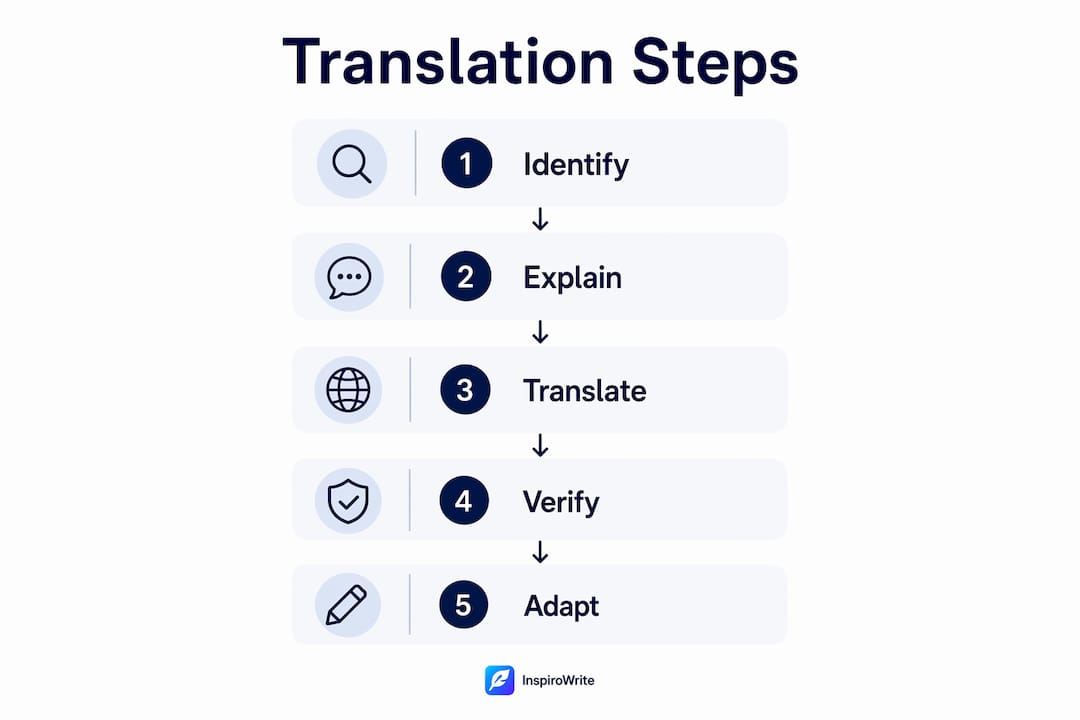
How to translate technical jargon step by step in business communications
A clear process removes the guesswork from jargon translation. The following steps apply equally to written reports, presentations, and verbal briefings.
- Identify the jargon. Read your draft or notes and highlight every term a non-specialist might not know. Common culprits include acronyms (SLA, API, KPI), product-specific names, and internal process labels.
- Classify your audience. A board presentation requires different language from a cross-functional team meeting. Use the ARIA framework's Audience step here: write down the two or three things your audience cares most about before you select your translations.
- Apply the 'What, Not How' rule. The 'What, Not How' approach focuses explanations on business impact rather than technical mechanisms. "We implemented a microservices architecture" tells a non-technical stakeholder nothing. "We restructured the system so each function can be updated independently, cutting release time from two weeks to two days" tells them everything they need.
- Draft your analogies using AWE. For each piece of jargon, write the analogy, the business impact statement, and the supporting evidence. Keep each AWE block to three sentences maximum.
- Review with a non-specialist. Send your draft to one person outside your technical team before the meeting. Their questions reveal exactly where your translation has failed.
- Refine with AI assistance. Paste your revised draft into Copilot or ChatGPT with a prompt specifying your audience. AI tools act as iteration partners, but human judgement determines when to simplify further and when to retain precision.
The table below maps common technical terms to their business translations using the 'What, Not How' principle.
| Technical term | Business translation | Business impact |
|---|---|---|
| API integration | Connecting two software systems | Eliminates manual data re-entry between platforms |
| Cloud migration | Moving data to managed off-site servers | Reduces hardware costs and improves access for remote teams |
| Agile sprint | A two-week work cycle with a defined output | Delivers working features faster with regular client checkpoints |
| SLA (Service Level Agreement) | A written commitment on response and fix times | Sets clear expectations and accountability with your supplier |
| LTV/CAC ratio | Revenue per customer versus cost to acquire them | Shows whether your sales spend is generating sustainable returns |
A healthy LTV/CAC ratio of 3 or above is the standard benchmark for software businesses. Translating that metric into plain language for a non-finance stakeholder requires the full AWE treatment: analogy, business impact, and evidence.
What are the common mistakes when translating industry-specific terms?
Most jargon translation failures share the same root cause: the speaker focuses on what they know rather than what the audience needs. The types of business translation errors that cause the most damage in professional settings fall into five clear patterns.
- Over-explaining the mechanism. Describing how a system works internally when the audience only needs to know what it does for them. This triggers disengagement within the first two minutes of a presentation.
- Ignoring audience knowledge levels. Pitching the same explanation to a CFO and a junior project manager produces cognitive overload in one and boredom in the other. The ARIA framework's Audience step exists precisely to prevent this.
- Inconsistent terminology. Using "dashboard," "control panel," and "reporting interface" interchangeably across a single document confuses readers and undermines credibility. A centralised glossary solves this directly.
- Literal translation of idioms. Phrases like "boil the ocean" or "move the needle" carry no meaning for non-native speakers and often no meaning for native speakers outside specific industries. Idioms fail direct translation in ways that are easy to miss when you are the one using them.
- Skipping the feedback loop. Sending a translated document without asking whether it landed clearly is the most common and most avoidable mistake. One follow-up question, "Did that make sense to you?", surfaces misunderstandings before they become decisions made on false assumptions.
Cultural and regional nuances compound all five of these errors. A term that reads as neutral in British English may carry a different weight in another regional context. Glossary rules that account for regional usage and written conventions are not optional for teams working across borders. They are the difference between a message that lands and one that misleads.
Key takeaways
Effective jargon translation requires frameworks, consistent glossaries, and audience awareness working together, not any single tool or technique applied in isolation.
| Point | Details |
|---|---|
| Use AWE and ARIA frameworks | Apply Analogy, What it does, Evidence and Audience, Reframe, Illustrate, Ask to structure every technical explanation. |
| Build a centralised glossary | Version and maintain a shared glossary to keep terminology consistent across teams and AI tools. |
| Apply 'What, Not How' | Focus every explanation on business impact, not internal technical mechanisms, to keep audiences engaged. |
| Prepare phrases in advance | Non-native speakers should rehearse bridging phrases before meetings to maintain fluency under pressure. |
| Use AI as an iteration partner | Tools like Copilot and ChatGPT improve drafts, but human judgement must guide when to simplify and when to retain precision. |
Why I think most professionals get jargon translation backwards
Most people treat jargon translation as a dumbing-down exercise. They strip out technical terms and replace them with vague generalities, then wonder why their audience still looks confused. The real goal is cognitive mapping, not simplification. You are not removing meaning; you are building a bridge between what you know and what your audience already understands.
I have seen this play out repeatedly in cross-functional meetings. A technical lead presents a perfectly accurate summary that lands with zero impact because it describes the system rather than the outcome. The moment you swap "we refactored the authentication module" for "we fixed the login problem that was locking out 200 customers a week," the room changes. That is not dumbing down. That is precision aimed at the right target.
The other thing I have learnt is that AI tools need human guidance to produce genuinely useful translations. Copilot and ChatGPT will give you a serviceable plain-English draft, but they cannot judge whether your CFO needs the three-sentence version or the three-bullet version. That judgement comes from knowing your audience, and no prompt replaces that knowledge. Use the frameworks, build the glossary, and let AI handle the drafting. Keep the judgement for yourself.
— Mike
Clear communication tools for business professionals
Translating complex language into clear business communication is a skill that improves with the right support. Inspirowrite provides AI-assisted proofreading and translation that delivers fast, private feedback on your drafts, without storing your content or using it to train AI models.
Whether you are a non-native speaker preparing a board presentation or a technical lead writing for a cross-functional audience, Inspirowrite helps you refine your writing in seconds. The platform flags grammar issues, suggests clearer phrasing, and supports translation accuracy across business documents. For professionals who need polished output quickly and confidentially, it is a practical addition to the toolkit described throughout this guide.
FAQ
What does it mean to translate technical jargon in business?
Translating technical jargon in a business context means converting specialised terms into plain language that non-technical stakeholders can understand and act on. The goal is cognitive mapping, not simplification, preserving meaning while changing the vocabulary.
What is the AWE framework for explaining technical concepts?
AWE stands for Analogy, What it does (business impact), and Evidence. It structures technical explanations so that each concept is first mapped to a familiar experience, then connected to a business outcome, then supported by a metric or result.
How can non-native speakers improve technical communication?
Non-native speakers benefit most from preparing bridging phrases before meetings, such as "The short version is..." or "In plain terms, this means...". Maintaining a personal glossary of frequently used terms with business translations also builds confidence and consistency.
Which AI tools help with business jargon translation?
Microsoft 365 Copilot and ChatGPT both support jargon translation when given structured prompts that specify audience, goal, and format. AI tools work best as iteration partners, with human judgement guiding when to simplify and when to retain technical precision.
Why does inconsistent terminology cause problems in business communication?
Using different words for the same concept across a document or presentation creates confusion and undermines credibility. A centralised glossary, versioned and maintained like a codebase component, prevents this and keeps terminology consistent across teams and tools.