

TL;DR:
- Professional document localization involves adapting content linguistically, culturally, and technically for specific regions. Choosing the correct method prevents costly mistakes, preserves credibility, and ensures compliance, especially in regulated industries.
Professional document localization is the process of adapting documents not only linguistically but also culturally and technically to communicate effectively with a specific regional audience. The industry recognises several distinct types of professional document localization, each suited to a different document function, audience, and compliance requirement. Choosing the wrong method costs money, damages credibility, and in regulated industries, can invalidate a document entirely. This guide maps every major localization method to its correct use case, so your organisation can make the right call from the outset.
1. Types of professional document localization: an overview
Professional localization covers five levels of adaptation, from raw translation through to full transcreation. Each level adds a layer of cultural, technical, or creative work beyond the previous one. The standard industry term for the full process is "localisation," which the ISO 17100 standard governs for translation quality and process management. Understanding where your document sits on this spectrum determines your budget, timeline, and vendor requirements.

2. Standard translation for internal documents
Standard translation converts text from one language to another without additional cultural or technical adaptation. It suits internal documents where accuracy matters but cultural resonance does not, such as internal manuals, routine business reports, and operational procedures.
Translation needs are classified as standard for internal use, certified for legal filings, and localisation for public-facing assets. That classification gives organisations a practical starting framework. Standard translation is the fastest and least expensive option, typically costing around $0.12 per word for professional services. That price point makes it viable for high-volume internal content where speed matters more than cultural polish.
- Best for: internal HR documents, operational manuals, internal reports
- Turnaround: same day to 48 hours for standard volumes
- Key risk: insufficient for legal filings or market-facing content
3. Certified translation for legal and official documents
Certified translation carries a formal statement of accuracy from a qualified translator or agency, making it acceptable to government bodies, courts, and immigration authorities. Certified translation services average £19–£31 per page with a turnaround of 24 to 72 hours or more. That cost reflects the additional accountability, documentation, and quality checks involved.
Vendors adhering to ISO 17100 provide the multi-step quality checks and formal accuracy statements required for compliance. ISO 17100 certification is the benchmark organisations should demand when selecting a vendor for legal or regulatory documents. Without it, a translated contract or immigration filing may be rejected outright.
- Best for: immigration documents, legal contracts, regulatory filings, academic certificates
- Key requirement: formal statement of accuracy and ISO 17100 compliance
- Key risk: using standard translation for documents that legally require certification
Pro Tip: Always ask your vendor for their ISO 17100 certification number before commissioning certified translations. A reputable agency will provide it without hesitation.
4. Linguistic localisation: adapting language nuances and tone
Linguistic localisation goes beyond word-for-word translation to adapt idioms, register, and tone for the target audience. A phrase that reads as professional in British English may sound cold or confusing in Brazilian Portuguese. This type of adaptation is critical for any document that a customer, partner, or regulator will read directly.
Professional localisation includes linguistic adaptation as a distinct layer, separate from technical or functional changes. That distinction matters because linguistic errors in public-facing documents erode trust faster than formatting problems. Linguistic localisation requires translators who are native speakers of the target language and familiar with its professional conventions.
Examples of linguistic localisation in practice:
- Adapting formal versus informal address forms (e.g., "vous" versus "tu" in French)
- Replacing British idioms with locally understood equivalents
- Adjusting tone from direct to indirect communication styles for East Asian markets
5. Cultural localisation: values, symbols, and market expectations
Cultural localisation adapts the meaning, imagery, and assumptions embedded in a document to match the values and expectations of the target market. A colour, symbol, or example that resonates positively in one culture may carry negative connotations in another. This layer of adaptation is non-negotiable for marketing materials, customer-facing reports, and any document that represents your brand.
Localisation supports six times more user engagement than simple translation for market-facing content. That figure reflects how strongly cultural alignment drives reader response. Cultural localisation requires subject-matter experts who understand the target market, not just the target language.
Common cultural adaptations include:
- Replacing culturally specific examples with locally relevant ones
- Adjusting imagery descriptions and references to align with local norms
- Revising case studies to feature recognisable local contexts
Pro Tip: Commission a cultural review from a local market consultant before finalising any customer-facing document. A single culturally inappropriate reference can undo months of brand-building.
6. Technical localisation: currencies, units, and formats
Technical localisation adapts the measurable and structural elements of a document: currencies, units of measurement, date formats, address formats, and telephone number conventions. A document quoting prices in US dollars with dates in MM/DD/YYYY format will confuse and alienate a European audience. Technical localisation is often overlooked but is one of the most concrete ways a document signals whether it was written for its audience or simply translated for them.
Technical adaptation of currencies, units, and date formats is a recognised and distinct localisation type. Organisations frequently underestimate the scope of technical changes required, particularly for documents that contain tables, specifications, or regulatory thresholds. A technical localisation checklist should cover every data point in the document, not just the running text.
7. Transcreation: creative rewriting for brand campaigns
Transcreation is creative rewriting that evokes the same emotional response in the target market as the original, rather than translating words directly. Transcreation is the highest investment level in brand campaigns, requiring copywriters with both linguistic fluency and creative skill. It applies to slogans, taglines, advertising copy, and any document where emotional resonance drives the desired outcome.
"Transcreation is not translation with a creative flourish. It is the complete reimagining of a message so that it lands with the same force, humour, or emotion in the target culture as it did in the source culture. The words may change entirely; the effect must not."
A product tagline that works brilliantly in English may be meaningless or even offensive when translated literally into Japanese. Transcreation solves that problem by treating the brief, not the source text, as the starting point. For a deeper look at how this process works in practice, the transcreation guide on the Inspirowrite blog covers the method in detail.
Pro Tip: Brief your transcreation team on the emotional goal of the content, not just the literal meaning. The best transcreators work from intent, not words.
8. Layout preservation in complex document localisation
Layout preservation is the practice of maintaining a document's visual structure, formatting, and design integrity throughout the translation process. Successful localisation decouples text from visual metadata to avoid formatting breaks in complex file types such as PDFs and DOCX files. Without this, a translated technical manual may arrive with broken tables, misaligned headers, and corrupted footnotes.
Text expansion is a significant challenge: German text, for example, runs approximately 30% longer than its English equivalent. That expansion can push text outside designed containers, break page layouts, and require costly redesigns if not planned for in advance. Organisations localising software documentation or formatted reports should build text expansion allowances into their design templates before translation begins.
Advanced localisation workflows use layout-preserving tools that handle complex formatted files without manual reformatting. This is particularly critical for regulated industries where document structure carries legal significance.
9. Translation memory and glossary management
Translation memory is a database that stores previously translated segments and reuses them automatically when the same or similar text appears again. Translation memories and approved glossaries prevent inconsistent terminology, preserving brand authority and compliance across translated documents. For organisations producing large volumes of multilingual content, translation memory reduces both cost and turnaround time significantly.
Glossary management complements translation memory by defining approved terms for key concepts, product names, and regulatory language. Without a controlled glossary, different translators will render the same term differently across documents. That inconsistency creates confusion for readers and, in regulated contexts, can constitute a compliance failure. The translation memory guide on the Inspirowrite blog explains how to build and maintain these assets effectively.
10. Choosing the right document localisation method
The right localisation method depends on four factors: document function, target audience, legal requirements, and budget. Matching document type with translation approach is the single most important decision in any localisation project. Using standard translation for marketing assets or localisation for legal contracts are both costly mistakes.
A practical decision path:
- Internal use only: standard translation is sufficient and cost-effective.
- Legal or regulatory submission: certified translation with ISO 17100 compliance is mandatory.
- Customer-facing or partner-facing content: linguistic and cultural localisation are required as a minimum.
- Brand campaigns and marketing copy: transcreation delivers the highest return.
- Complex formatted documents: add layout preservation to whichever method applies.
Avoiding misuse of localisation methods protects both legal standing and brand reputation. Organisations that treat all documents as equivalent translation tasks consistently overspend on internal content and underspend on the customer-facing materials that actually drive commercial outcomes. For a broader view of the document types involved, the multilingual business documents guide provides a useful reference.
Pro Tip: Build a document classification matrix for your organisation. Assign each document type a localisation level before any project begins. This removes ambiguity, speeds up briefing, and prevents expensive rework.
Key takeaways
Matching each document to its correct localisation method is the most cost-effective decision an organisation can make before commissioning any multilingual content.
| Point | Details |
|---|---|
| Standard vs certified translation | Use standard translation for internal documents and certified translation for any legal or regulatory submission. |
| Cultural localisation drives engagement | Market-facing documents require cultural adaptation, not just linguistic accuracy, to achieve meaningful reader response. |
| Layout preservation prevents rework | Plan for text expansion and format compatibility before translation begins, especially for complex formatted files. |
| ISO 17100 is the quality benchmark | Select vendors with ISO 17100 certification for any document requiring formal accuracy and compliance traceability. |
| Translation memory reduces long-term cost | Building and maintaining translation memories and glossaries cuts costs and protects terminology consistency across all languages. |
Why localisation strategy matters more than most organisations realise
The conversation about professional document localisation tends to focus on method selection, and that is understandable. But in my experience, the more consequential question is whether an organisation has a localisation strategy at all, or whether it is simply reacting to translation requests one document at a time.
Most companies I have observed fall into the reactive camp. They commission a certified translation when a regulator demands it, order a quick standard translation for an internal manual, and then wonder why their German marketing brochure reads like a technical specification. The problem is not the translators. The problem is that no one decided, in advance, what each document was supposed to do and who it was supposed to reach.
The organisations that get this right treat localisation as a content discipline, not a language service. They classify documents before briefing translators, maintain glossaries as living assets, and build layout-aware templates that accommodate text expansion. AI-assisted localisation is accelerating this shift, but the human judgement required to make cultural and creative decisions remains irreplaceable. The future belongs to organisations that combine both: AI speed with human cultural authority.
— Mike
How Inspirowrite supports your localisation work
Getting the language right is the foundation of every localisation project, and that is where Inspirowrite delivers immediate value.
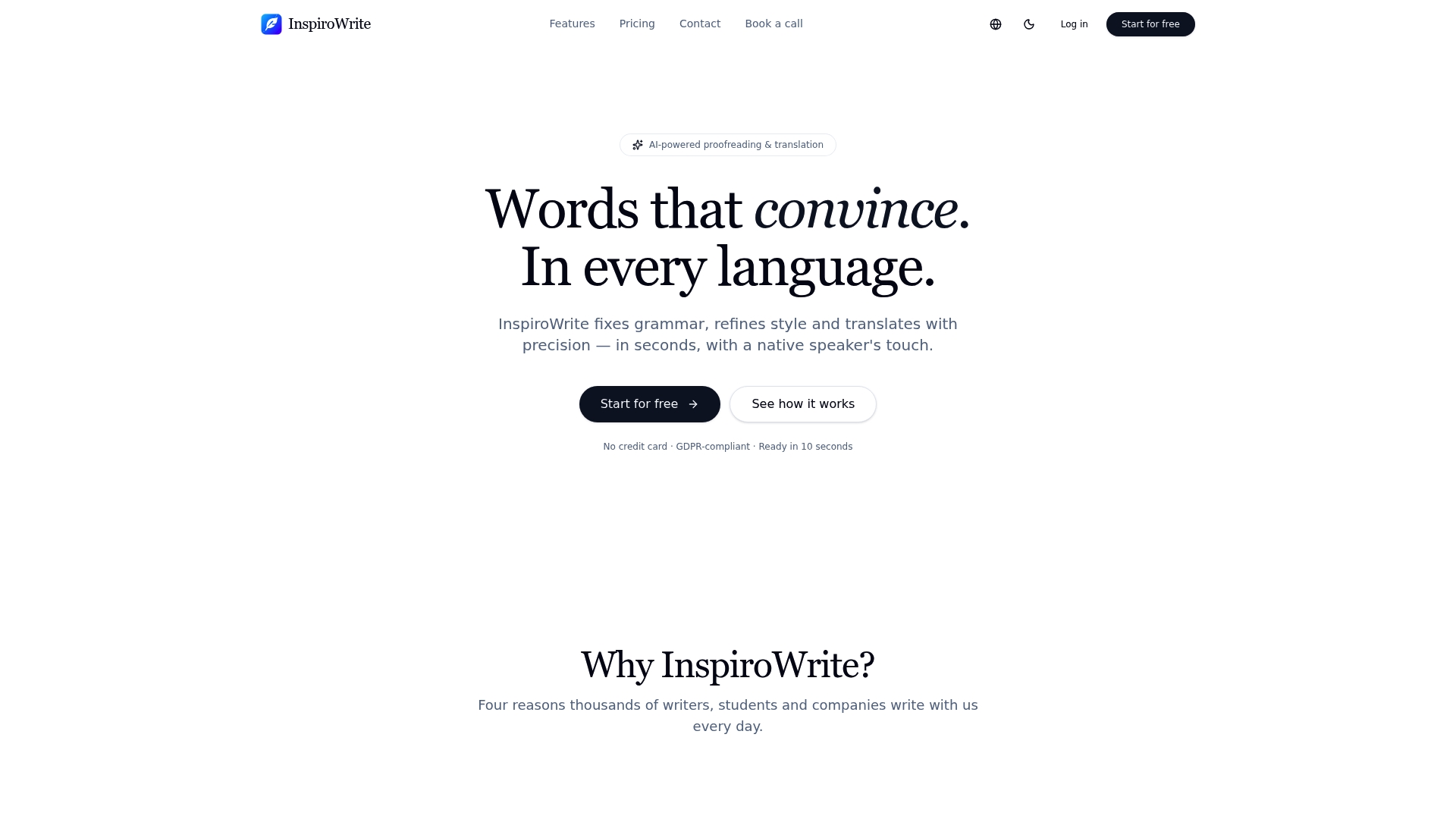
Inspirowrite is an AI-powered proofreading and translation tool built for businesses and writers who need fast, accurate results without compromising confidentiality. Your content is never used to train AI models, which matters when you are working with sensitive contracts, compliance documents, or proprietary marketing materials. Whether you are preparing text for certified translation or refining a transcreation brief, Inspirowrite helps you produce a clean, polished source document before it reaches your localisation team. Visit Inspirowrite to see how it fits into your document workflow.
FAQ
What is the difference between translation and localisation?
Translation converts text from one language to another. Localisation adapts the full document, including cultural references, technical formats, and layout, so it communicates effectively with a specific regional audience.
When is certified translation legally required?
Certified translation is required for documents submitted to government bodies, courts, immigration authorities, and regulated industries. ISO 17100 compliance is the standard to look for when selecting a certified translation vendor.
What is transcreation and when should I use it?
Transcreation is creative rewriting that preserves the emotional intent of the original content rather than its literal words. Use it for brand campaigns, slogans, and any content where audience response drives commercial outcomes.
How do translation memories reduce localisation costs?
Translation memories store previously approved translations and reuse them automatically. Reusing approved segments reduces per-word costs and keeps terminology consistent across all documents in a language pair.
What causes layout problems in translated documents?
Text expansion is the primary cause. German text, for example, runs approximately 30% longer than English. Planning for expansion in document templates before translation begins prevents costly reformatting after delivery.