

TL;DR:
- Good grammar clarifies ideas and helps readers understand arguments effectively.
- Argument quality influences essay grades more than sentence complexity or length.
Grammar is the system that organises language to communicate ideas clearly and effectively in essays. Without it, even the most original argument collapses into confusion. Understanding why grammar matters in essays goes beyond following rules. Grammar is the structural code that signals to your reader: "I know what I mean, and I want you to understand it too." This guide draws on recent research, including 2026 findings on argument quality versus grammatical complexity, to show students and writers how to use grammar as a tool for clarity and persuasion, not as an obstacle.
Why grammar matters in essays: clarity and persuasion
Grammar reduces the cognitive load your reader carries. When sentence structure is clear, the reader spends mental energy on your argument, not on decoding what you meant. The University of Reading describes grammar as a social code: a shared system that minimises ambiguity and allows complex ideas to move efficiently from writer to reader. That framing matters because it shifts grammar from a set of arbitrary rules into something purposeful.

Misplaced punctuation alone can change meaning entirely. Consider: "Let's eat, Grandma" versus "Let's eat Grandma." The comma is not decoration. It is the difference between a dinner invitation and something far more alarming. In academic essays, the stakes are less dramatic but equally real. A misplaced modifier or a missing comma can make a sentence mean the opposite of what you intended.
Grammar also holds logical relationships together. Subordinate clauses, conjunctions, and parallel structures all signal how ideas connect. When those signals are absent or wrong, the reader loses the thread of your argument. Strong grammar does not just make writing look polished. It makes the logic visible.
Pro Tip: Read your essay aloud before submitting. Your ear catches grammatical errors your eye skips, particularly run-on sentences and missing connectives.
Good grammar also shapes tone. Grammatical subtleties influence nuances like urgency, warmth, and confidence, qualities that matter in persuasive academic writing. A sentence written in the passive voice signals tentativeness. The same idea in the active voice signals authority.
Does complex grammar actually improve your essay grade?
The short answer is no. Argument quality is a significantly stronger predictor of high essay scores than formal grammatical complexity. Regression analysis confirms that argument quality influences essay grades more than sentence complexity. That finding should change how students spend their revision time.
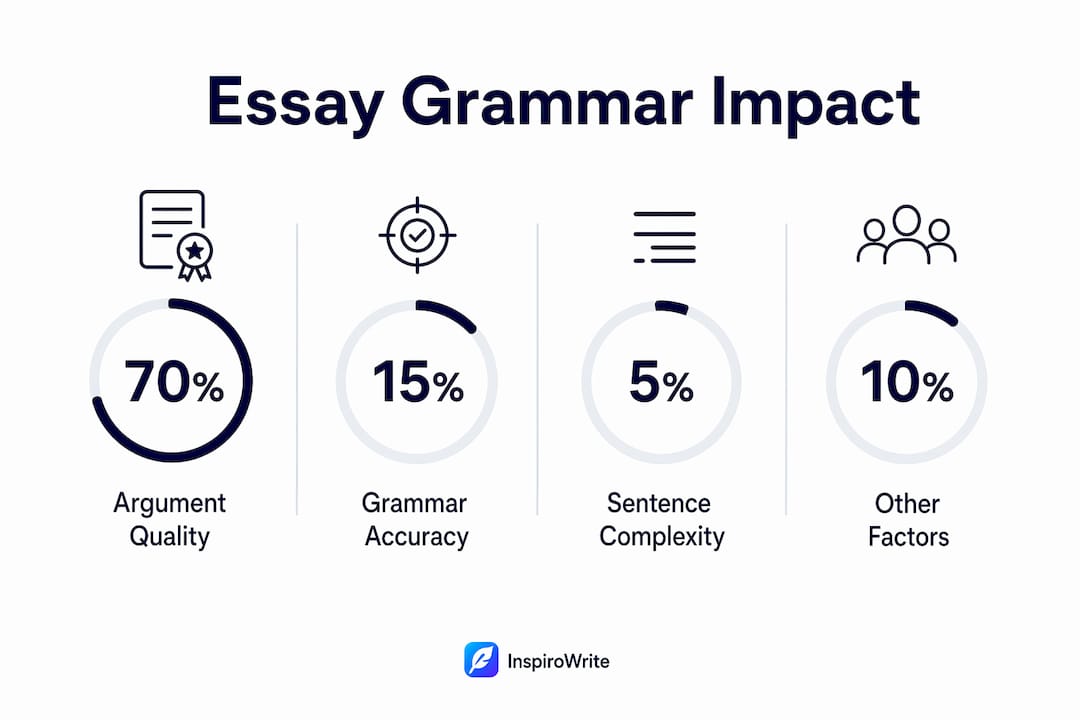
The distinction here is between two types of grammatical complexity. Formal complexity means long, multi-clause sentences with elaborate subordination. Meaning-based complexity means dense, information-rich phrases that pack precise ideas into well-structured sentences. Advanced academic writing favours the second type. A short, clear sentence that carries a precise claim outperforms a sprawling sentence that buries its point.
| Factor | Impact on essay grade |
|---|---|
| Argument quality | Strong predictor: clear claims and logical evidence raise scores significantly |
| Formal sentence complexity | Weak predictor: long, elaborate sentences do not reliably improve grades |
| Meaning-based complexity | Positive predictor: dense, precise phrasing signals academic maturity |
| Grammatical accuracy | Foundational: errors reduce credibility and distract from argument strength |
The table above shows that grammar accuracy and argument quality work together, but argument quality leads. A grammatically perfect essay with a weak argument scores lower than a clearly argued essay with minor grammatical imperfections. That does not mean grammar is unimportant. It means grammar serves the argument, not the other way around.
Pro Tip: When revising, ask yourself: "Does every sentence advance my argument?" If a sentence is grammatically complex but adds no new claim or evidence, cut or simplify it.
Meaning-based complexity, using dense noun phrases rather than lengthy subordinate clauses, marks academic maturity in writing. Practise packing precise information into shorter, well-chosen phrases rather than extending sentences with additional clauses.
Why grammatical competence is foundational for EFL writers
For writers working in English as a foreign language, grammar is not just a stylistic concern. Grammatical competence directly impacts the ability to produce coherent and communicative texts. Poor grammatical awareness leads to difficulties in sentence structure and logical flow, reducing writing quality in ways that argument planning alone cannot fix.
The challenge is specific. EFL writers often understand their argument clearly in their first language but struggle to encode it accurately in English. Subject-verb agreement errors, incorrect article use, and tense inconsistency are the most common barriers. Each one forces the reader to pause and reinterpret, which breaks the flow of even a well-reasoned argument.
Practical strategies for building grammatical competence include:
- Study sentence-level grammar first. Subject-verb agreement, tense consistency, and article use are the foundations. Errors in these areas appear in every sentence and compound quickly.
- Read academic texts in your subject area. Exposure to disciplinary writing builds intuitive grammar knowledge faster than grammar exercises alone.
- Use a student grammar guide as a reference. Checking rules in context, rather than memorising them in isolation, builds transferable skills.
- Identify your recurring errors. Keep a personal error log. Writers who track their own patterns fix them faster than those who rely on generic feedback.
- Practise writing short, clear sentences. Complexity comes later. Accuracy in simple sentences builds the foundation for complex ones.
Grammar teaching that focuses on communication, rather than rule memorisation, produces better writers. The goal is not to recite the rule for the subjunctive. The goal is to write a sentence that means exactly what you intend.
How to balance grammar accuracy with strong argumentation
Effective essay writing requires managing your time across three stages: planning, drafting, and revision. Planning time in timed essays, around 8 minutes out of 60, is crucial to avoid grammatically ambiguous or disjointed arguments. Writers who skip planning produce essays where grammar errors and logical gaps appear together, because both stem from unclear thinking at the outset.
A structured approach to balancing grammar and argument quality looks like this:
- Plan your argument before you write. Identify your central claim and the three or four points that support it. A clear argument structure reduces the chance of grammatically tangled sentences, because you know what each sentence needs to say.
- Draft for meaning first. Write your argument out without stopping to correct grammar. Interrupting your drafting to fix a comma disrupts your thinking and slows you down.
- Revise for clarity second. Once the argument is on the page, read each sentence and ask whether it says exactly what you mean. Simplify any sentence that requires more than one reading.
- Proofread for accuracy last. Final essay revisions should take around 10–15% of your total writing time. For a 60-minute essay, that is approximately 7 minutes. Reading aloud and printing the essay out both help catch errors that silent reading misses.
- Check your common grammatical errors against a reference list. Targeted checking is faster and more reliable than reading the whole essay hoping to spot problems.
AI writing tools can assist with grammar checking, but they require human oversight. AI can produce plausible but grammatically incorrect text, and grammar awareness is the skill that lets you spot the difference. Use AI tools as a first pass, then apply your own judgement to tone, precision, and meaning. Grammar is the skill that makes that judgement possible.
A well-structured essay proofreading checklist can make the revision stage faster and more thorough. Working through a checklist systematically catches more errors than a single read-through, and it builds the habit of treating revision as a distinct stage rather than an afterthought.
Key takeaways
Grammar is the structural foundation that makes argument quality visible: without it, even strong ideas fail to persuade.
| Point | Details |
|---|---|
| Grammar reduces reader effort | Clear sentence structure lets readers focus on your argument, not on decoding meaning. |
| Argument quality outranks complexity | Strong claims and logical evidence predict essay grades more reliably than elaborate sentences. |
| Grammatical competence is foundational for EFL writers | Errors in agreement, tense, and articles break logical flow and reduce writing quality. |
| Plan before you write | Eight minutes of planning in a 60-minute essay prevents grammatical and logical errors later. |
| Revise in stages | Draft for meaning, revise for clarity, then proofread for accuracy as three separate steps. |
Grammar as a tool, not a trophy
I have read thousands of essays over the years, and the ones that stay with me are never the ones with the most elaborate sentences. They are the ones where the writer clearly knew what they wanted to say and found the shortest, clearest path to saying it.
The obsession with grammatical complexity is one of the most persistent myths in academic writing. Students spend hours constructing multi-clause sentences, believing that length signals intelligence. It does not. Grammar as a universal structural foundation enables clear expression rather than serving as a tool for exclusion or performance. The writer who uses grammar to clarify their thinking communicates more effectively than the one who uses it to impress.
What I find genuinely concerning in the AI era is the assumption that grammar checking is now automated and therefore no longer a skill worth developing. Human oversight remains essential to ensure grammar supports clarity, meaning, and trustworthiness. AI tools miss tone. They miss the difference between a sentence that is technically correct and one that actually means what you intend. Grammar awareness is the skill that closes that gap.
My advice is simple. Treat grammar as the servant of your argument, not its master. Write clearly, argue precisely, and use grammar to make your logic visible. Your reader will thank you for it.
— Mike
How Inspirowrite supports better essay writing
Writers who want faster, more reliable grammar feedback have a practical option in Inspirowrite.

Inspirowrite is an AI-powered proofreading tool that delivers grammar and style feedback within seconds, without storing your content or using it to train AI models. That privacy commitment matters for students submitting original work and professionals handling sensitive material. Inspirowrite checks grammar accuracy, flags clarity issues, and supports writers in producing polished drafts quickly. Visit Inspirowrite to see how it can support your next essay from first draft to final submission.
FAQ
Why is grammar important in essays?
Grammar organises language so that your argument reaches the reader clearly and without ambiguity. The University of Reading describes grammar as a social code that reduces cognitive effort for readers, allowing them to focus on the strength of your ideas.
Does better grammar guarantee a higher essay grade?
No. Research shows that argument quality predicts essay grades more strongly than grammatical complexity. Grammar accuracy is foundational, but a well-argued essay with minor errors outperforms a grammatically perfect essay with a weak argument.
What are the most common grammar mistakes to avoid in essays?
Subject-verb agreement errors, tense inconsistency, misplaced modifiers, and incorrect article use are the most frequent problems. Keeping a personal error log and checking against a grammar reference list helps writers address their specific patterns.
How much time should I spend proofreading an essay?
Allocate around 10–15% of your total writing time to final revision. For a 60-minute essay, that is approximately 7 minutes. Reading aloud and printing the essay out both improve error detection compared to silent screen reading.
Does AI replace the need for grammar skills?
No. AI tools can produce plausible but grammatically incorrect text, and grammar awareness is the skill required to identify and correct those errors. Human oversight remains essential for preserving tone, precision, and intended meaning.