

The editorial feedback process is a structured five-step cycle that converts reader-facing notes into prioritised revision work. The single-line sequence: request → process/filter → implement → recheck → reflect. Follow it every time you receive notes and you will spend less time second-guessing, fewer edits will be wasted, and each revision round will move faster than the last.
What you can expect from a well-run process:
- Clearer priorities so you know what to fix first
- Fewer reactive edits that undo good work
- A documented rationale you can return to in later rounds
- A stronger manuscript without losing your voice
The two documents at the centre of this process are the editorial letter (sometimes called an edit memo) and the marked-up manuscript. Understanding the difference between them is where the work begins.
Table of Contents
- What does editorial feedback actually cover?
- How to receive feedback without losing your head
- What format will your feedback arrive in?
- What are the 5 steps of the editorial feedback cycle?
- How do you turn abstract notes into real revision tasks?
- How do you work with editors without damaging the relationship?
- What mistakes should you avoid when processing edits?
- Templates and checklists you can use straight away
- Which tools help you manage and implement editorial feedback?
- Key takeaways
- The feedback that changed everything
- Inspirowrite makes the final polish pass faster and safer
- Useful sources
- FAQ
What does editorial feedback actually cover?
Editorial feedback operates at two distinct levels, and conflating them is one of the most common causes of wasted revision time.

The editorial letter or edit memo is a strategic document. It explains systemic issues: structure, character arcs, pacing, thematic consistency, and the larger patterns an editor has spotted across the whole manuscript. It tells you not just what to change but why, which is what makes it so valuable. An edit memo prevents patchwork fixes by giving you the reasoning behind each major note.
Marginal comments and tracked changes are tactical. They sit at the scene or sentence level: a confusing transition, a weak verb, a line of dialogue that rings false. These are fixes you can implement once the structural work is done.
Typical deliverables you should expect from a professional editorial process:
- Editorial letter / edit memo — big-picture strategic guidance, usually 2–10 pages
- Annotated manuscript — tracked changes and marginal comments at scene and sentence level
- Annotated style sheet — consistency notes on names, spellings, and recurring stylistic choices
- Prioritised revision list — a ranked summary of the most critical changes
Who provides what matters too. A developmental editor handles structure and story architecture. A copy editor works at the sentence and paragraph level. A proofreader catches surface errors after the text is otherwise final. Knowing the difference between editing and proofreading prevents you from sending your manuscript to the wrong person at the wrong stage.
Practical note: A developmental edit on a full-length novel typically returns within four to eight weeks. Copy editing runs two to four weeks. Proofreading is usually one to two weeks. Build these into your project timeline before you start.
How to receive feedback without losing your head
The first thing most authors feel when they open a major critique is some version of dread, defensiveness, or grief. That is completely normal. The problem is acting on those feelings before they settle.

A deliberate waiting period after receiving a major critique is one of the most consistently recommended practices among professional editors. A pause of days, sometimes a week or more, separates emotional reactivity from strategic revision choices. Edits made while you are still raw tend to be reactive rather than considered.
Once you have waited, read the editorial letter once all the way through without making any notes. Just absorb it. On the second read, start categorising:
- Quick wins — small, clear fixes you can implement in under an hour
- Heavy lifts — structural changes that require planning and multiple passes
- Notes to query — anything ambiguous, contradictory, or that you disagree with
Pro Tip: If a note makes you want to argue back immediately, pay attention to that feeling. According to editorial practice, an instinctive urge to defend a point often marks a clarity problem in the manuscript itself. Use that defensiveness as a diagnostic signal: form a revision question from it rather than a rebuttal.
The critique sandwich — framing critical notes between positives — is a common editorial technique designed to sustain morale. Be aware of it. When an editor opens with praise, the critical note in the middle is still the one that needs your full attention. Overly soft framing can obscure required structural actions if you are not reading carefully.
What format will your feedback arrive in?
Knowing the delivery format tells you immediately what kind of work is ahead.
| Format | What it signals | First action |
|---|---|---|
| Editorial letter / edit memo | Structural, big-picture issues | Print it; read in full before opening the manuscript |
| Tracked changes in Word | Sentence and paragraph-level fixes | Open in a copy of the file; accept/reject pass by pass |
| Annotated PDF | Mixed-level comments; common in academic or magazine contexts | Export comments list; sort by page number |
| Margin comments (Google Docs, Scrivener) | Scene-level notes; often conversational | Resolve in order; reply to queries before closing |
| Audio or video walkthrough | Complex structural notes the editor wants to explain verbally | Transcribe key points; create a task list from the recording |
The practical implication: always start with the highest-level format first. If you have both an editorial letter and a tracked-changes file, read the letter before you touch the manuscript. Structural understanding should precede sentence-level decisions, or you risk polishing prose you will later cut.
For tracked changes specifically, always work in a copy of the original file. Never accept or reject changes in your only version.
What are the 5 steps of the editorial feedback cycle?
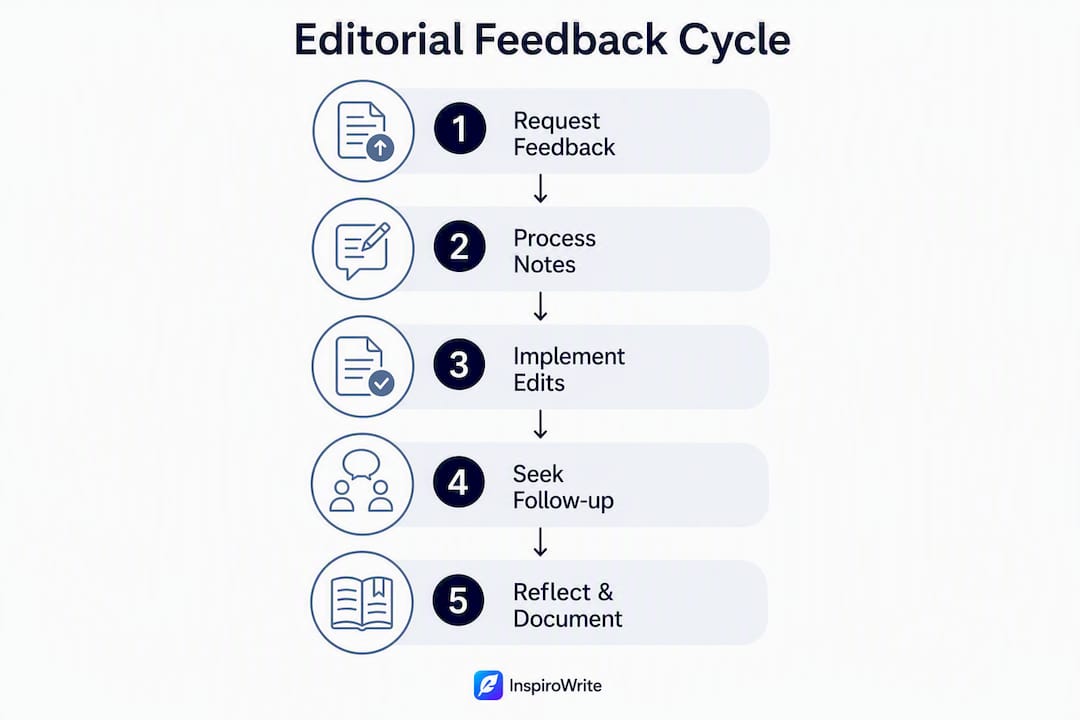
A five-step cycle gives you a repeatable structure for every round of feedback, whether you are working with a developmental editor, a writing group, or a beta reader.
Step 1: Request the right feedback
Effective feedback requests set scope, provide context, and ask targeted questions. Vague requests return vague notes. Before you send your manuscript, specify: what stage is the work at, what are you most uncertain about, and what is out of scope for this round. A developmental editor does not need to flag comma splices; a proofreader does not need to weigh in on plot structure.
Step 2: Process and filter
Triage every note into one of three categories: must-address, nice-to-have, or out-of-scope. This is the step most authors skip, and it is the one that saves the most time. Not every note deserves equal effort. When the same note appears in multiple places, that repetition signals a pattern problem and should move straight to the must-address column.
Step 3: Implement in the right order
A practical revision roadmap phases edits: structural first, scene-level second, thematic and emotional passes third, sentence-level polish last. This order is not arbitrary. Polishing a scene you later cut is wasted effort. Fix the architecture before you paint the walls.
Step 4: Seek follow-up feedback and validate
Once structural revisions are complete, share the revised manuscript with your editor or a trusted reader. The question is not "is this better?" but "does this solve the specific problem the note identified?" Targeted validation is faster and more useful than a full re-read.
Step 5: Reflect and document
After each round, spend 20 minutes writing down what you learned. What patterns kept appearing? What did you resist and then accept? What would you do differently in the first draft next time? This reflection compounds across projects.
Prioritisation matrix — impact vs effort:
| Priority | Impact | Effort | Do it when |
|---|---|---|---|
| Must-address | High | Any | Immediately, before other passes |
| Nice-to-have | Medium | Low | After structural work is complete |
| Nice-to-have | Medium | High | Only if time and scope allow |
| Out-of-scope | Low | Any | Decline or defer to next round |
A typical three-month revision cycle runs roughly: two weeks for triage and planning, six weeks for structural and scene-level passes, two weeks for sentence polish, and two weeks for validation and final checks.
How do you turn abstract notes into real revision tasks?
Abstract notes are the ones that feel true but give you nothing to act on. "The protagonist is passive." "The middle sags." "This doesn't land emotionally." The fix is to convert diagnosis into questions, then questions into tasks.
The technique: turn abstract notes into concrete questions that put you back in authorial control. "Protagonist is passive" becomes "What choice does my protagonist make in Act 1 that only they could make?" That question generates a scene goal, which generates a task.
Worked examples:
- "The middle sags" → Question: Where does the protagonist's external goal and internal need diverge? → Task: Map chapters 12–18 against the story's central tension; identify scenes with no consequence if removed.
- "The ending feels unearned" → Question: What has the protagonist sacrificed or learned that makes this ending inevitable? → Task: Audit the final three chapters for callbacks to Act 1 promises; add or strengthen two.
- "The voice feels inconsistent" → Question: Which chapters were written at different times or in different moods? → Task: Read chapters 5, 9, and 14 aloud; flag any paragraph that sounds like a different narrator.
Task template you can paste into any project tracker:
| Field | Example |
|---|---|
| Task | Rewrite chapter 12 opening scene |
| Source note | "Protagonist is passive in the first half" |
| Estimated time | 3 hours |
| Priority | Must-address |
| Acceptance criteria | Protagonist makes an active choice with a visible consequence |
Pro Tip: A critique framework that organises feedback by level — big picture, scene, sentence — and ends with priority revision tasks is far easier to act on than a stream-of-consciousness letter. If your editor's notes do not arrive in this shape, reorganise them yourself before you start revising.
How do you work with editors without damaging the relationship?
The author-editor relationship works best when both parties are clear about what is a suggestion and what is a requirement. Most editorial notes are suggestions. A few are requirements. Knowing which is which saves a lot of unnecessary friction.
When to send an author query versus making a change independently:
- Send a query when a note is ambiguous and acting on it could affect multiple scenes
- Send a query when you disagree with a note but want to understand the reasoning before deciding
- Make the change independently when the note is clear, tactical, and affects only one location
- Make the change independently when you agree and the fix is obvious
Author query template:
Context: [Briefly describe the scene or passage in question.] The note: [Quote the editor's comment exactly.] My question: [Ask the specific thing you need clarified.] Options I'm considering: [List two or three possible approaches.] My preferred outcome: [State what you would do if left to decide.]
This structure keeps queries short and gives the editor everything they need to respond efficiently. Editors who receive well-formed queries respond faster and more usefully than those who receive a paragraph of anxious explanation.
Pro Tip: Keeping a decision log — a simple document recording each note, your decision, and your rationale — reduces repeated queries across rounds and gives you a clear record if the same issue resurfaces in a later edit or in publication discussions. A shared spreadsheet works perfectly for this.
What mistakes should you avoid when processing edits?
The most expensive mistake is reacting immediately. Opening a critique and starting to rewrite within the hour almost always produces reactive changes that address the symptom rather than the root cause.
Common mistakes:
- Implementing sentence-level polish before structural fixes are complete
- Accepting every note without triage, which dilutes focus and can introduce new inconsistencies
- Conflating the editor's taste with the manuscript's actual needs
- Treating a single reader's confusion as proof the writing is unclear (one confused reader is data; three are a pattern)
Red flags in feedback to question:
- Repeated vague notes with no examples ("this doesn't work", "I'm not feeling it") and no indication of where or why
- Instructions that contradict the manuscript's established intent without acknowledging the trade-off
- Requests that add significant scope without adjusting the timeline or fee
- Notes that rewrite your voice rather than identify a problem for you to solve in your own way
Pushing back professionally means separating the observation from the prescription. An editor who says "this scene is confusing" is almost certainly right. An editor who says "rewrite it in third person" is offering one solution. You can accept the diagnosis and propose a different fix. Frame it as: "I agree the scene is unclear. Here is what I think is causing the confusion and how I plan to address it."
Templates and checklists you can use straight away
Editorial letter checklist
When you receive an editorial letter, work through it with this checklist before you touch the manuscript:
- Read the full letter once without annotating
- Identify the three most critical structural notes
- Mark every note that appears more than once (pattern = priority)
- Categorise each note: must-address / nice-to-have / out-of-scope
- Note any note you want to query before acting
- Confirm the revision deadline and agree on a check-in point
Revision plan template
| Task | Source note | Pass | Deadline | Owner | Acceptance criteria |
|---|---|---|---|---|---|
| Restructure Act 2 | "Middle sags" | Structural | Week 4 | Author | Each chapter has a clear consequence |
| Rewrite chapter 12 | "Protagonist passive" | Scene | Week 5 | Author | Protagonist makes active choice |
| Tighten dialogue in ch. 7 | "Dialogue feels on-the-nose" | Sentence | Week 8 | Author | Subtext present in at least 3 exchanges |
Prioritisation guidance
Batch tasks by pass type: do all structural tasks in one phase, all scene-level tasks in the next, and all sentence-level tasks last. This prevents you from context-switching between levels, which is where continuity errors creep in. For a final polish checklist you can adapt for manuscript use, the principles of systematic, level-by-level checking apply equally to long-form fiction and non-fiction.
Which tools help you manage and implement editorial feedback?
No single tool handles the entire five-step cycle. The practical approach is to use a small stack, each category matched to a specific step.
Document collaboration tools (Google Docs, Microsoft Word with Track Changes): essential for receiving and responding to marginal comments and tracked changes. Always work in a copy of the original file.
Project trackers (Notion, Trello, Airtable): use these for the triage and planning step. Create a board with columns for must-address, nice-to-have, out-of-scope, and done. Each note becomes a card with a deadline and acceptance criteria.
Version control (Scrivener's snapshot feature, or manual dated copies): take a snapshot before each major revision pass. If a structural change makes things worse, you need a clean rollback point.
Reading-aloud tools (NaturalReader, built-in macOS text-to-speech): invaluable for the sentence-level pass. Your ear catches rhythm problems and awkward phrasing that your eye skips over.
Sentence-level proofreading and rewriting aids: for the final polish pass, a fast, privacy-focused tool that handles grammar, style, and rephrasing without storing your manuscript text is the right choice. The role of proofreading in writing quality at this stage is to catch what revision passes leave behind, not to rewrite the work.
Pro Tip: When using any AI or cloud-based tool for manuscript text, check its data policy before you paste. Some tools use submitted text to train their models. For unpublished work, that is a meaningful privacy risk. Choose tools that explicitly state they do not use your content for training.
Key takeaways
The editorial feedback process works when you separate strategic revision from sentence-level polish and triage every note before you act on a single one.
| Point | Details |
|---|---|
| Triage before you revise | Sort every note into must-address, nice-to-have, or out-of-scope before opening the manuscript. |
| Structural edits come first | Fix architecture before scene, scene before sentence; polishing prose you later cut wastes time. |
| Use defensiveness as a signal | An urge to argue back often marks a real clarity problem in the manuscript, not a wrong note. |
| Keep a decision log | Recording each note and your rationale reduces repeated queries and protects your reasoning across rounds. |
| Inspirowrite for the polish pass | Inspirowrite's privacy-focused, instant sentence-level proofreading is built for the final pass without storing your manuscript text. |
The feedback that changed everything
There is a particular kind of editorial letter that arrives and feels, on first read, like a demolition notice. Every structural problem laid out in sequence, every scene that is not earning its place named directly. The instinct is to close the document and make a cup of tea.
What actually works is the opposite of what feels natural. The authors who come out of that kind of critique with a stronger book are not the ones who immediately start rewriting. They are the ones who wait, read the letter again three days later, and then spend an afternoon doing nothing but triage. Not writing. Just sorting.
The thing most writers underestimate about the editorial feedback process is that the letter is not a verdict. It is a map of where a reader got lost. An editor who has written you a thorough, critical letter has done something generous: they have told you exactly where the manuscript is not yet doing what you intended. That is not rejection. That is the most useful information a writer can receive.
The authors who struggle most are those who treat every note as equally urgent and start at page one. The ones who move fastest are those who identify the two or three structural issues that, once fixed, will resolve a dozen smaller notes downstream. Fix the root; the symptoms often disappear on their own.
Feedback is evidence of engagement. An editor who does not care does not write four pages of notes.
Inspirowrite makes the final polish pass faster and safer
Once your structural and scene-level revisions are complete, the sentence-level pass is where manuscripts either tighten into something publishable or stay slightly rough. That pass requires speed and precision, and it requires a tool you can trust with unpublished text.
Inspirowrite is built specifically for this moment. It delivers instant grammar correction, style and tone adjustment, rephrasing, and shortening, all without storing your manuscript text or using it to train AI models. For authors who have spent months on a book, that privacy guarantee is not a minor detail. Your unpublished work stays yours.
The practical workflow: complete your structural and scene passes first, then run individual paragraphs or sections through Inspirowrite for the polish pass. Use it to tighten overlong sentences, sharpen weak verbs, and catch the grammar errors that survive multiple read-throughs. The tool works in seconds, which means you can move through a chapter in a single sitting rather than losing an afternoon to manual line-editing.
Try Inspirowrite and see how quickly a final pass can move when the tool is doing the mechanical work.
Useful sources
These resources are worth bookmarking for deeper reading on the editorial process:
- What is a developmental editor's "edit memo" and why is it essential? — the clearest explanation available of what an edit memo is, what it contains, and why it is distinct from marginal comments. Read this before your first developmental edit.
- Understanding editorial letters: how to turn feedback into action — practical guidance on reading an editorial letter strategically, spotting pattern notes, and phasing your revision passes. Directly useful for Steps 2 and 3 of the cycle.
- How to evaluate and implement editing feedback — covers the cooling-off period, triage, and the decision log in detail. The most practically focused resource on the emotional and organisational side of receiving feedback.
FAQ
What is the editorial review process?
The editorial review process is a structured cycle in which a manuscript is assessed, annotated, and revised across multiple passes, typically moving from structural issues down to sentence-level polish. It usually involves an editorial letter and a marked-up manuscript as the two core deliverables.
What is editorial feedback?
Editorial feedback is a set of notes from an editor, beta reader, or reviewer that identifies what is and is not working in a manuscript, at the level of structure, scene, or sentence. It ranges from a strategic edit memo covering the whole book to marginal comments on individual lines.
What are the 5 steps of the editing process?
The five steps are: request feedback with clear scope and questions; process and filter notes into must-address, nice-to-have, and out-of-scope; implement revisions in order (structural first, sentence-level last); seek follow-up feedback to validate changes; and reflect to document lessons for future projects.
What is the 90/10 rule for authors?
The 90/10 principle in editorial contexts refers to the idea that roughly 10% of the manuscript's structural issues account for 90% of a reader's confusion or disengagement. Identifying and fixing that small number of root-cause problems resolves the majority of downstream notes, which is why triage and pattern-spotting matter more than fixing every note in sequence.