

TL;DR:
- Copy editing involves revising written texts to improve clarity, correctness, and consistency without changing the author's original voice.
- It follows a three-step process: initial assessment, detailed editing based on style guides, and final consistency verification.
- Copy editing is distinct from proofreading, which occurs after typesetting, focusing on surface errors, while copy editing addresses deeper content issues.
Copy editing is defined as the revision of written text to improve clarity, correctness, and consistency, without altering the author's original meaning or voice. The industry standard, The Chicago Manual of Style, identifies two core pillars: mechanical editing, which covers grammar, punctuation, spelling, and style, and substantive editing, which addresses clarity, concision, and sentence structure. Copy editing sits between the final draft and typesetting in the publishing process, making it a distinct and critical stage. HarperCollins describes copy editors as "gentle guardians of the author's voice," a phrase that captures the balance every editor must strike.
What does copy editing mean in practice?
Copy editing is the structured process of reviewing a manuscript to fix errors and improve readability before it reaches a designer or typesetter. It is not a single pass through a document. Professional copy editors follow a three-stage workflow: initial manuscript assessment, detailed language and style editing, and final consistency verification.
Stage 1: Initial manuscript assessment
The editor reads the full manuscript before marking a single change. This first read identifies recurring problems, such as inconsistent character names in fiction or conflicting terminology in academic writing. It also reveals the overall tone and register, which guides every decision that follows.
Stage 2: Detailed language and style editing
This is the core of the work. The editor addresses grammar, punctuation, spelling, sentence structure, and adherence to a chosen style guide. Common style guides include APA for academic writing, MLA for humanities, and Chicago for general publishing. Defensible editing choices grounded in these standards are what separate professional copy editing from informal revision. Every change must be justifiable by reference to a recognised rule or guideline.
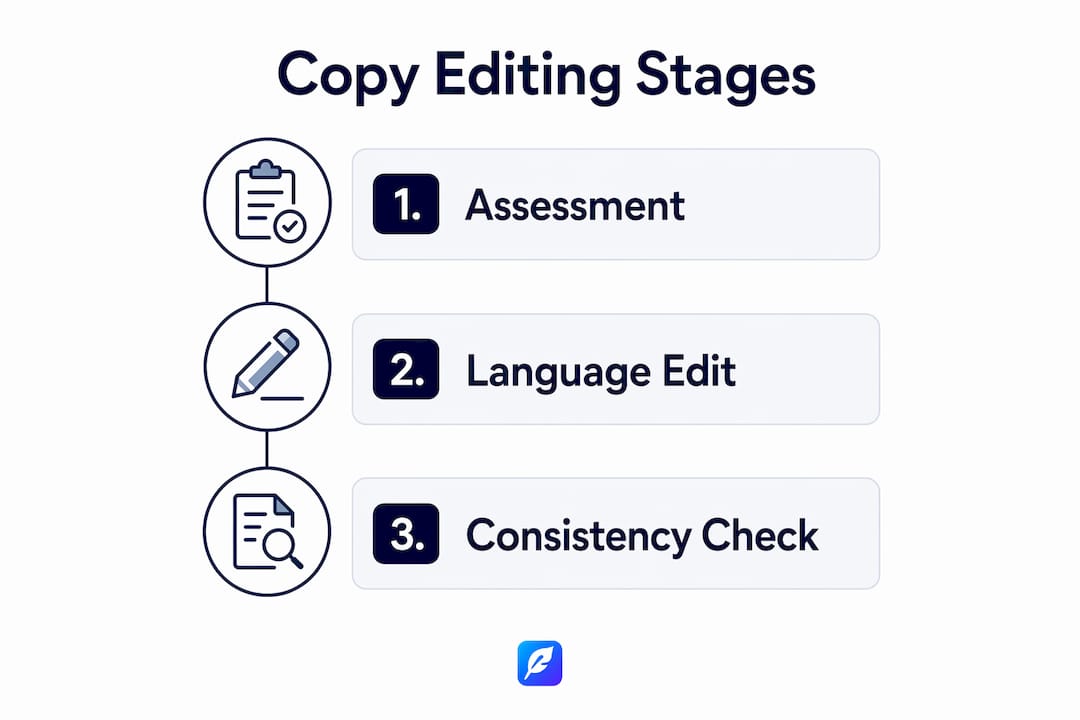
Stage 3: Final consistency verification
The editor checks that all changes are applied uniformly throughout the document. This includes verifying that headings follow the same capitalisation pattern, that hyphenation is consistent, and that any specialised terminology appears in the same form each time. Inconsistency at this stage undermines the credibility of the entire document.
Pro Tip: Never use the "Replace All" function in word-processing software without reviewing each instance manually. Automated replacement can introduce errors that are harder to spot than the originals, particularly with proper nouns or technical terms.
How does copy editing differ from proofreading?
Copy editing and proofreading are sequential but entirely distinct steps. Conflating them is one of the most common mistakes writers make, and it reliably leads to missed errors.
| Feature | Copy editing | Proofreading |
|---|---|---|
| Timing | After final draft, before typesetting | After typesetting or layout |
| Scope | Grammar, style, clarity, consistency | Surface errors, layout issues |
| Depth | Deep intervention across the text | Light final check |
| Goal | Prepare text for design | Confirm text is print-ready |
Copy editing is a deep-clean pre-publication step, whilst proofreading is the final surface check after the text has been formatted. Proofreading also catches errors introduced during the layout process itself, such as missing words caused by text reflow. Copy editing cannot catch those because it happens before layout exists.
Developmental editing and line editing are two further stages that writers often confuse with copy editing. Developmental editing addresses the big picture: structure, argument, narrative arc, and whether the content achieves its purpose. Line editing focuses on the rhythm and flow of individual sentences, often overlapping with substantive copy editing. Copy editing comes after both of these, once the content and style are settled.
Assigning the same person to copy edit and proofread the same document is a recognised risk. Familiarity with the text causes the brain to read what it expects rather than what is on the page. Mixing these roles creates fatigue and increases the chance of errors surviving to publication.
What levels of copy editing exist?
Copy editing is not a fixed intervention. The intensity varies depending on the manuscript's condition and the author's needs. Three levels are widely recognised in the publishing industry.
-
Light copy editing addresses mechanical issues only: spelling, grammar, punctuation, and basic style compliance. The editor makes no changes to sentence structure or content. This level suits manuscripts that are already well-written and simply need a final tidy before submission.
-
Medium copy editing goes further. The editor fact-checks key claims, flags passages that are unclear or potentially confusing, and queries the author where the meaning is ambiguous. This level is appropriate for non-fiction books, academic papers, and long-form journalism where accuracy and clarity are both critical.
-
Heavy copy editing involves rewriting sentences, restructuring paragraphs, and sometimes reorganising sections. The editor intervenes substantially in the text whilst still preserving the author's voice and intent. This level is used when a manuscript has strong ideas but weak execution, or when a non-native English speaker needs significant language support.
Choosing the right level matters for budget and timeline as much as for quality. A light edit on a manuscript that needs heavy intervention will not produce a publication-ready document. Commissioning editors and project managers typically assess the manuscript first and specify the level required before work begins.
What tools and techniques do copy editors use?
Professional copy editors use a combination of software and manual review. Neither alone is sufficient. Software catches patterns; human judgement catches meaning.

PerfectIt is a widely used consistency-checking tool that flags issues standard word processors miss, such as inconsistent hyphenation, capitalisation variations, and conflicting abbreviations. It does not rewrite text. It produces a report of potential inconsistencies, and the editor decides which to change and which to leave. That distinction matters: the tool surfaces candidates for review, not corrections.
Style guides remain the backbone of every copy editing decision. The Chicago Manual of Style, the APA Publication Manual, and the New Oxford Style Manual each provide rules for hundreds of recurring editorial questions. A copy editor working without a style guide is making arbitrary decisions, which creates inconsistency across a document and between projects.
Manual reading is irreplaceable. Human editorial judgement catches tonal inconsistencies, factual implausibilities, and structural weaknesses that no software currently detects. Understanding English writing conventions at a deep level is what separates a competent copy editor from an excellent one.
Pro Tip: Read the manuscript aloud during your final pass. The ear catches rhythm problems and missing words that the eye skips over, particularly in long documents where reading fatigue sets in.
Key takeaways
Copy editing is the structured revision of text for clarity, correctness, and consistency, applied after the final draft and before typesetting, using defined levels of intervention and established style guides.
| Point | Details |
|---|---|
| Two core components | Mechanical editing fixes errors; substantive editing improves clarity and sentence structure. |
| Three-stage workflow | Assessment, detailed editing, and consistency verification form the standard process. |
| Distinct from proofreading | Copy editing precedes layout; proofreading follows it. Mixing them increases missed errors. |
| Three levels of intensity | Light, medium, and heavy editing suit different manuscript conditions and author needs. |
| Tools support, not replace, judgement | Software like PerfectIt flags inconsistencies, but the editor makes every final decision. |
Why copy editing deserves more respect than it gets
Copy editing is consistently underestimated, and I think that is because the best copy editing is invisible. When it works, the reader never notices it. They simply find the text clear and easy to follow. The errors that were caught, the ambiguities that were resolved, the inconsistencies that were smoothed out: none of that is visible in the finished product.
What I have found, working across academic, commercial, and creative texts, is that writers often resist copy editing because they fear losing their voice. That fear is understandable but misplaced. A skilled copy editor does not rewrite your prose. They remove the obstacles between your ideas and your reader. The voice that survives a good copy edit is actually stronger, because it is no longer competing with confusion.
The hardest part of the job is not catching errors. It is making quick, defensible decisions under time pressure, on texts you did not write, in subject areas you may not know deeply. That requires a particular kind of confidence: the confidence to change something, explain why, and stand behind it. Style guides like Chicago and APA exist precisely to give editors that grounding.
Technology is changing the tools available, but it has not changed the core skill. Software can flag a potential inconsistency. Only a person who has read the whole manuscript can decide whether that inconsistency is an error or a deliberate stylistic choice. That judgement is what copy editing actually is.
— Mike
How Inspirowrite supports your editing process
Writers and students who want fast, reliable feedback on grammar, style, and clarity before a formal copy edit can use Inspirowrite to get their drafts into better shape quickly. Inspirowrite's AI-powered proofreading tool reviews your text in seconds and flags grammar errors, style inconsistencies, and unclear phrasing, without storing your content or using it to train AI models. That privacy guarantee matters for students submitting coursework and professionals handling sensitive documents.
Submitting a cleaner draft to a copy editor also reduces the time and cost of the edit itself. Inspirowrite helps writers fix grammar errors at the draft stage, so the copy editor can focus on the deeper work of clarity and consistency rather than correcting basic mistakes.
FAQ
What is the definition of copy editing?
Copy editing is the revision of written text to correct grammar, punctuation, spelling, and style, whilst also improving clarity and consistency. The Chicago Manual of Style identifies mechanical and substantive editing as its two core components.
How does copy editing differ from proofreading?
Copy editing happens after the final draft but before typesetting; proofreading happens after layout is complete. Copy editing is a deeper intervention, whilst proofreading is a final surface check for errors introduced during formatting.
What does a copy editor actually do?
A copy editor reviews a manuscript for errors, inconsistencies, and unclear passages, following a style guide such as APA, MLA, or Chicago. They preserve the author's voice whilst making the text as clear and correct as possible.
When should I use heavy copy editing?
Heavy copy editing suits manuscripts with strong ideas but significant language or structural problems, including texts written by non-native English speakers. It involves rewriting sentences and restructuring passages whilst keeping the author's intended meaning intact.
Can software replace a human copy editor?
Software tools like PerfectIt flag consistency issues that word processors miss, but they do not make editorial decisions. Human judgement is required to assess whether a flagged item is an error or a deliberate stylistic choice.