

TL;DR:
- Non-native writers develop a distinct interlanguage system that influences their grammar, syntax, and pragmatics. AI proofreading tools like Inspirowrite provide rule-based, private feedback to help address these systematic errors and improve writing clarity. Recognizing patterns in errors and using targeted feedback are essential steps for mastering second language writing skills.
Every non-native writer carries a hidden grammar. Not the grammar of their first language, and not yet the grammar of the language they are learning. Something in between. That in-between system is called interlanguage, and understanding how it shapes your writing is one of the most useful things you can do to improve it.
Table of Contents
- What is interlanguage in writing?
- How interlanguage shapes second language writing
- Common challenges non-native writers face
- How AI proofreading supports interlanguage writing development
- What linguists say about interlanguage and writing pedagogy
- How to diagnose and address interlanguage in your writing
- Limitations and ethical considerations when using AI for writing correction
- Inspirowrite: AI proofreading built for non-native writers
- FAQ
- Key takeaways
What is interlanguage in writing?
Interlanguage is a distinct linguistic system that second language learners develop as they acquire a new language. It draws on both the native language and the target language, yet belongs fully to neither. Larry Selinker coined the term in 1972, and his framework remains the foundation of second language acquisition (SLA) research today.
In writing, interlanguage shows up across every level of language:
- Grammar: Incorrect verb tenses, missing articles, or wrong auxiliary verbs
- Syntax: Sentence structures borrowed from the native language
- Lexicon: Word choices that are technically wrong but logically consistent with the learner's internal rules
- Pragmatics: Mismatches in tone, formality, or how ideas are sequenced for a reader
- Discourse: Difficulty managing information flow across sentences and paragraphs
The key point is that these are not random mistakes. They reflect a coherent, rule-governed system that the writer has built from available evidence.
How interlanguage shapes second language writing
Rod Ellis identifies three core features of interlanguage: permeability, dynamism, and systematicity. Each one directly affects how a non-native writer produces text.
- Permeability means the system is open to influence from both the native language and new input. A writer who learns a new grammatical rule may immediately apply it, sometimes correctly, sometimes not.
- Dynamism means the system keeps changing. The same writer may use a structure correctly one week and incorrectly the next, because their internal rules are still being revised through hypothesis testing.
- Systematicity means there is always an underlying logic. Errors follow patterns, which is why error analysis can reveal so much about where a writer actually is in their development.
Writing differs from speaking in a specific way here. Because writing gives you more processing time, written errors tend to reflect the underlying grammar more accurately than spoken ones do. A speaker under time pressure may produce errors from cognitive load alone. A writer's errors are more deliberate, which makes them better diagnostic evidence.
Two cognitive processes drive much of what you see on the page. Transfer brings native language patterns into the new language, sometimes helpfully, sometimes not. Overgeneralisation applies a target language rule too broadly, producing forms like "he goed" or "she writed." Both are signs of progress, not failure.

Common challenges non-native writers face
The most persistent writing challenges linked to interlanguage go beyond simple grammar slips.
- Information management errors: Research examining college essays found that many non-target-like structures are principled attempts to manage information across sentences, not careless mistakes.
- Pragmatic mismatches: A writer may be grammatically accurate but choose the wrong register, make requests too directly, or structure an argument in a way that feels odd to a native reader.
- Fossilisation: Some errors stop evolving. Fossilisation can result from cognitive and sociolinguistic factors and is not simply a matter of age or effort. Targeted feedback is one of the few things that reliably shifts it.
- Cultural framing: Different languages organise ideas differently. Arabic writers often use parallel structures that feel repetitive in English. East Asian writers may build to a conclusion rather than state it upfront, which can read as indirect to British readers.
- Confidence: Persistent errors, especially ones a writer cannot see themselves, erode confidence over time.
Pro Tip: Reframe every error as diagnostic data. Each mistake tells you exactly which rule your internal grammar has not yet fully acquired. That is useful information, not evidence of failure. Viewing errors as developmental milestones is one of the most well-supported ideas in SLA research.
How AI proofreading supports interlanguage writing development
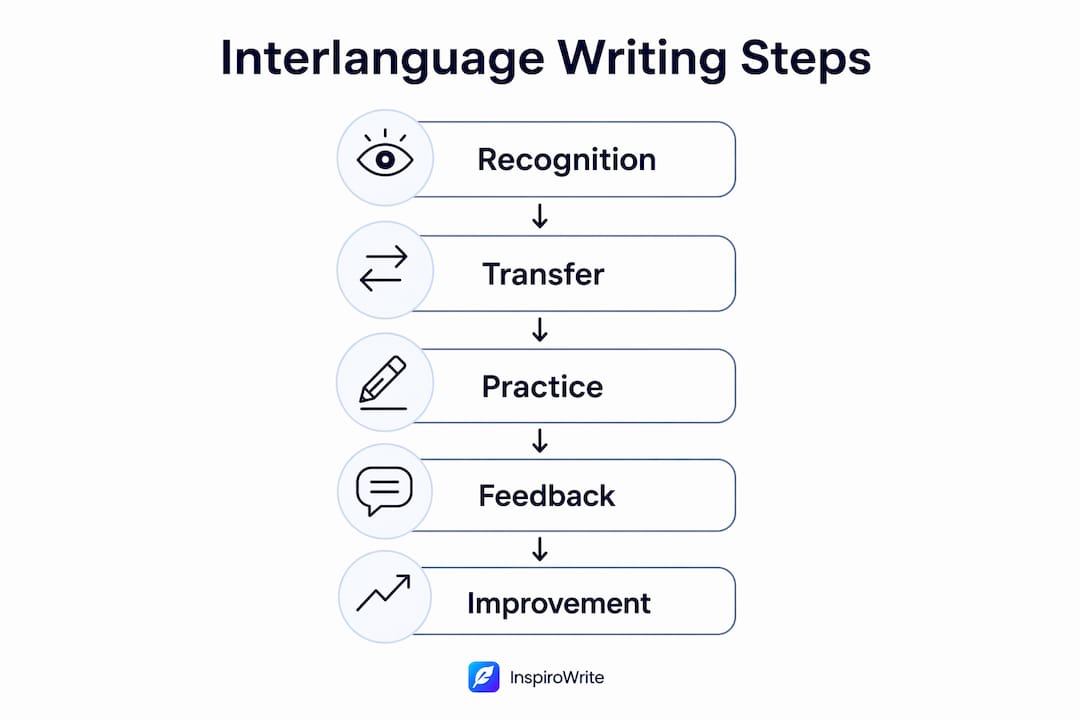
AI-powered proofreading tools address interlanguage writing challenges in ways that traditional spellcheckers cannot. They work at the level of grammar, style, and pragmatic appropriateness, not just surface spelling.
Inspirowrite is built specifically for this. Its AI proofreading and translation features give non-native writers immediate, rule-based feedback on the kinds of errors that interlanguage produces: verb agreement, article use, sentence structure, and register. Crucially, it does not store or use your content to train AI models, which matters when you are working on sensitive documents.
Practical ways to integrate AI assistance into your writing practice:
- Draft first, then check. Write without interruption, then run the full text through Inspirowrite to catch systematic patterns.
- Study the corrections. Do not just accept changes. Read each suggestion to understand which rule is being applied.
- Track recurring errors. If the same correction appears repeatedly, that is a fossilised pattern worth targeting directly.
- Use translation support carefully. When translating from your native language, AI can flag calques and unnatural phrasing that you would not catch yourself.
AI tools complement traditional learning by offering real-time feedback that a teacher or editor cannot provide at every draft stage. They also work at the speed of writing, which means the feedback arrives while the text is still fresh in your mind. For a guide on the types of AI learning tools available in 2026, the landscape is broader than most writers realise.
What linguists say about interlanguage and writing pedagogy
The pedagogical consensus on interlanguage has shifted considerably since Selinker's original 1972 paper. Errors are no longer treated as failures to be corrected and forgotten. They are treated as evidence of where a learner is in their development.
"Interlanguage is not a random hodgepodge collection of unsystematic errors but, clearly, neither is it a native language nor a target language; it is a separate transitional linguistic system that can be described in terms of evolving linguistic patterns and rules." — The Encyclopedia of Applied Linguistics, summarising Selinker's foundational claim
Research in applied linguistics consistently shows that explicit instruction beyond syntax, particularly pragmatic competence, is what separates intermediate writers from advanced ones. Knowing the grammar rules is necessary but not sufficient. Knowing how to deploy them in context, for a specific reader and purpose, is the harder skill.
Pro Tip: When reviewing your own writing, ask not just "is this grammatically correct?" but "does this read naturally for my intended audience?" Pragmatic accuracy is often what separates a competent writer from a confident one.
AI tools like Inspirowrite align with this framework by providing adaptive, learner-centred feedback that respects where a writer actually is, rather than applying a single native-speaker standard to every text.
How to diagnose and address interlanguage in your writing
Diagnosing your own interlanguage requires looking for patterns, not individual errors. A single mistake tells you little. Ten instances of the same mistake tell you exactly which rule your internal grammar has not yet consolidated.
Start by collecting a sample of your recent writing, at least three or four pieces. Read through and mark every correction you receive, whether from a teacher, editor, or AI tool. Group them by type: verb forms, article use, word order, register, punctuation. The category with the most entries is your current interlanguage frontier.
From there, targeted practice works better than general grammar review. If your errors cluster around the English article system, study that specifically. If they cluster around information structure, read published writing in your target genre and pay attention to how paragraphs open and close. Pair this with second language writing resources that address these patterns directly.
Limitations and ethical considerations when using AI for writing correction
AI proofreading tools are genuinely useful, but they have real limits that writers should understand before relying on them.
Current AI systems handle grammar and style well. They handle pragmatics and cultural context less reliably. A tool may correct a sentence to be grammatically standard without flagging that it sounds too blunt for a formal British context, or too indirect for a direct-communication culture. The common grammatical errors that AI catches most reliably are the rule-based ones. Subtler issues of voice and register still benefit from human review.
There is also an ethical dimension. Over-reliance on AI correction can slow the development of your own internal grammar, because you stop noticing errors yourself. The goal is to use AI feedback to build your own competence, not to outsource the thinking entirely. Privacy is a separate concern: some tools use submitted text to train their models, which creates risk for confidential or commercially sensitive writing. Inspirowrite's privacy-first approach addresses this directly by keeping your content confidential.
Inspirowrite: AI proofreading built for non-native writers
Writers who struggle with interlanguage errors need feedback that is fast, specific, and private. That is exactly what Inspirowrite delivers.
Unlike generic grammar checkers, Inspirowrite is designed for the real challenges non-native writers face: systematic errors, pragmatic mismatches, and translation-influenced phrasing. Results arrive in seconds, and your content is never used to train AI models, so you can work on sensitive documents without concern. Whether you are a student polishing an essay, a professional writing for a British audience, or a translator checking the naturalness of a rendered text, Inspirowrite gives you the specific, rule-based feedback that moves your writing forward. Read the privacy policy to see exactly how your content is protected, then try it on your next draft.
FAQ
What is interlanguage in simple terms?
Interlanguage is the evolving language system a learner develops between their native language and the language they are learning. It has its own rules and changes as the learner gains proficiency.
How does interlanguage affect writing specifically?
Writing gives learners more processing time than speaking, so written errors tend to reflect the underlying interlanguage grammar more clearly. Errors in writing often reveal patterns in grammar, syntax, and pragmatic competence.
What is fossilisation in interlanguage writing?
Fossilisation occurs when certain errors stop evolving and become fixed in a writer's output. It can result from cognitive and sociolinguistic factors, and targeted feedback is one of the most effective ways to address it.
Can AI tools help with interlanguage writing errors?
Yes. AI proofreading tools like Inspirowrite provide real-time, rule-based feedback on the systematic errors that interlanguage produces, covering grammar, style, and pragmatic appropriateness.
Is interlanguage the same as making mistakes?
No. Interlanguage errors are systematic and reflect the learner's current internal rules, not random carelessness. Recognising this distinction is central to modern SLA pedagogy and to building writer confidence.
Key takeaways
Interlanguage is a systematic, rule-governed linguistic system that every second language writer develops, and understanding it is the first step to improving writing accuracy and style.
| Point | Details |
|---|---|
| Interlanguage is rule-governed | Errors in L2 writing follow patterns that reflect the writer's current internal grammar, not random mistakes. |
| Writing reveals interlanguage clearly | Written errors are better diagnostic evidence than spoken ones because writing allows more processing time. |
| Fossilisation requires targeted feedback | Some errors stop evolving without deliberate intervention; pattern-based correction is the most effective approach. |
| Pragmatics matters as much as grammar | Advanced writing requires pragmatic competence, not just grammatical accuracy, to read naturally for a target audience. |
| Inspirowrite supports interlanguage development | Inspirowrite provides fast, privacy-conscious AI proofreading that addresses the systematic errors and pragmatic mismatches typical of interlanguage writing. |