

TL;DR:
- Text expansion in translation refers to the natural increase in text length when converting from English into other languages due to linguistic differences. It mainly affects user interfaces and documents, requiring early planning and flexible design strategies. The term also describes software tools that expand abbreviations, which is a different concept related to typing efficiency.
Text expansion in translation is defined as the increase in length that occurs when source text is converted into another language, resulting in translated strings that occupy more space than the original. This is not a translation error. It is a natural consequence of linguistic and grammatical differences between languages, and it affects everything from software interfaces to printed brochures. Tools like Inspirowrite and localisation platforms such as SimpleLocalize handle this challenge daily. Understanding the meaning of text expansion is the first step to building multilingual content that holds together visually and structurally.
What does text expansion mean in translation?
Text expansion in translation is defined as the difference in character count or rendered width between a source string and its translation. The source language is almost always English, and English is one of the most compact written languages in common use. When text moves from English into German, French, Spanish, or Russian, the translated version routinely takes up more space.
This is a layout and localisation engineering problem, not a sign of poor translation quality. Expansion causes overflow, truncation, and misalignment because interfaces and documents are designed around English text lengths. A button that fits neatly in English can break its container entirely in Finnish.
Text expansion is also commonly confused with a separate productivity concept by the same name. The productivity version refers to software that expands a short abbreviation into a longer preset phrase. The two meanings are entirely distinct, and the distinction matters when you are researching the topic.
Why does text expansion happen during translation?
Linguistic structure is the root cause of text expansion. Different languages use different grammatical mechanisms, and those mechanisms add length.
The main causes break down as follows:
- German compound words and grammar: German builds long compound nouns from multiple root words. "Rindfleischetikettierungsüberwachungsaufgabenübertragungsgesetz" is a real German word. Even everyday compounds add length. German translations from English expand by 30–40% on average.
- French articles and prepositions: French requires more articles and prepositions than English. A short English phrase often needs additional connecting words in French, pushing expansion to around 20–25%.
- Spanish agreement suffixes: Spanish adjectives and verbs carry gender and number agreement suffixes that English omits entirely. Spanish typically expands by 15–25%.
- Russian case suffixes: Russian marks grammatical role through suffixes on nouns, adjectives, and pronouns. These additions push Russian translations to around 15–25% longer than English originals.
- Finnish agglutination: Finnish stacks meaning onto single words through suffixes, but the resulting words are long. Finnish can expand by up to 50% compared to English source text.
Pro Tip: Measure expansion by rendered width, not just character count. Glyph shaping, typographic effects, and vertical line height all affect how much space text actually occupies on screen or in print.
The linguistic causes of expansion are structural, not stylistic. A skilled translator cannot simply shorten a German sentence to match English length without losing meaning or sounding unnatural. Designers and writers need to plan for this from the start.
What are typical expansion rates and why do they matter for design?
Knowing the numbers gives you a practical planning framework. The table below shows typical expansion ranges from English into common target languages.
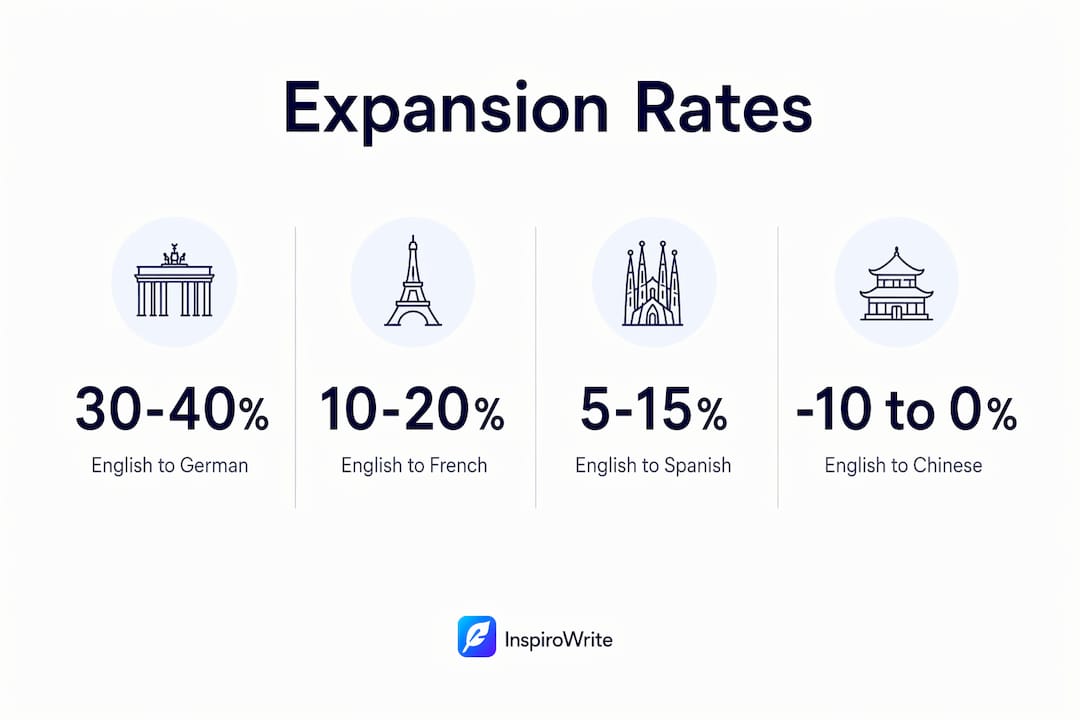
| Target language | Typical expansion from English |
|---|---|
| German | +30–40% |
| French | +20–25% |
| Spanish | +15–25% |
| Russian | +15–25% |
| Finnish | Up to +50% |
| Chinese, Japanese, Korean | Contraction (shorter text) |
Chinese, Japanese, and Korean (CJK languages) often produce shorter translations than the English source. That sounds like good news, but contraction creates its own layout problems, including awkward white space and misaligned grids.
"Treating expansion and contraction symmetrically in UI design yields more reliable layouts for multilingual projects." — DTP Services localisation guide
UI text expansion hits compact components first. Buttons, tabs, navigation labels, and headings have the least room to absorb extra characters. A navigation tab reading "Settings" in English becomes "Paramètres" in French, which is 40% longer. If the tab has a fixed width, the label clips or wraps, and the interface breaks.
Document design faces the same pressure. A one-page English brochure can become a page and a half in German if text boxes are fixed. Print layouts, PDF exports, and slide decks all require extra space planning when multiple languages are involved. Understanding multilingual document challenges before you begin design saves significant rework later.
How can writers, translators, and designers manage text expansion?
Managing text expansion is a workflow problem as much as a design problem. The most effective approach combines early testing, flexible design, and clear communication with translators.
-
Run pseudo-localisation before real translation. Pseudo-localisation simulates longer strings by padding or replacing source text with extended placeholder characters. This reveals which UI components will break before a single real translation is produced. It is a readiness test, not a quality check.
-
Design flexible containers. Avoid fixed widths on buttons, labels, and text boxes. Use minimum and maximum width rules in CSS or layout software. Allow text to wrap where wrapping is acceptable, and test wrapping behaviour with long strings early.
-
Set and document string length constraints. Documented maximum string lengths per component type give translators a clear target. Share these constraints before translation begins. A translator who knows a button label must stay under 20 characters will find a shorter equivalent rather than a literal translation that overflows.
-
Brief translators on context. A translator who knows a string appears on a button behaves differently from one who thinks it is body copy. Context reduces back-and-forth and produces better first drafts.
-
Test with real translations, not just pseudo-localisation. Pseudo-localisation catches most problems, but real languages introduce unexpected combinations. Always validate with actual translated strings before release.
Pro Tip: Address expansion at the design stage, not after translation. Fixing layout issues post-translation multiplies the cost because every language requires a separate fix. Catching the problem once in the source design costs a fraction of the effort.
Writers working on multilingual content face a related challenge: source text written in dense, idiomatic English is harder to translate concisely. Plain, direct sentences translate more cleanly and expand less dramatically. Understanding business jargon translation challenges helps writers produce source text that gives translators room to work efficiently.

Text expansion in translation vs. text expansion as a productivity tool
The phrase "text expansion" carries two completely different meanings depending on context. Knowing which one applies to your situation saves time and confusion.
Text expansion in translation refers to the increase in string length when source text is converted into another language. It is a localisation and design concern. The audience is translators, localisation engineers, designers, and writers working on multilingual content.
Text expansion as a productivity tool refers to software that expands a short abbreviation into a longer preset text snippet. You type "addr" and the tool inserts your full postal address. Tools in this category include PhraseVault and similar text expander applications. The audience is anyone who types repetitive text and wants to save keystrokes.
The two meanings share a name but solve entirely different problems:
- Translation text expansion is something that happens to your text and must be planned for.
- Productivity text expansion is something you choose to use to write faster.
When you search for "what does text expansion mean translation," you are almost certainly looking for the localisation definition. The productivity definition appears in the same search results, which is why the distinction is worth stating clearly. If you are researching writing efficiency tools, a text expander application is the relevant concept. If you are working on a multilingual product or document, the localisation definition applies.
Key takeaways
Text expansion in translation is a structural linguistic phenomenon, not a quality problem, and planning for it at the design stage is the most cost-effective approach.
| Point | Details |
|---|---|
| Core definition | Text expansion is the increase in string length when translating from English into another language. |
| Expansion rates vary | German expands by 30–40%, Finnish by up to 50%, while CJK languages often contract. |
| Design impact | Buttons, tabs, and headings are the first components to break under text expansion. |
| Best practice | Use pseudo-localisation and flexible containers before real translations begin. |
| Two meanings exist | Translation expansion and productivity text expanders share a name but are entirely different concepts. |
The case for treating expansion as a design requirement, not an afterthought
Text expansion is one of those problems that looks minor until it isn't. I have reviewed multilingual projects where the English version looked polished and the German version was a visual disaster, not because the translation was poor, but because nobody told the designer that German runs long.
The most persistent misconception I encounter is that expansion is the translator's fault. It isn't. A translator's job is accuracy and fluency, not fitting text into a box that was designed for a different language. Blaming the translator for expansion is like blaming a chef for a plate that is too small. The plate is the problem.
What actually works is treating expansion as a design requirement from day one. That means pseudo-localisation in the testing phase, flexible containers in the build, and documented string limits shared with translators before work begins. Writers also carry responsibility here. Source text written in plain, direct sentences expands less dramatically than dense, idiomatic prose. The more subject matter expertise a translator brings, the better they can find compact equivalents. But they need room to work, and that room starts with good source writing.
The teams that handle expansion well treat it the same way they treat accessibility: not as a bolt-on concern, but as a requirement built into the process from the start.
— Mike
Multilingual writing made clearer with Inspirowrite
Managing text expansion starts with writing source content that translates well. Vague, jargon-heavy English produces longer, harder-to-fit translations. Clear, direct writing gives translators the flexibility to find compact equivalents in any target language.
Inspirowrite is an AI-powered proofreading and translation tool built for writers and non-native speakers who need fast, accurate results without sacrificing privacy. Your content stays confidential and is never used to train AI models. Whether you are preparing source text for localisation or reviewing a translated draft, Inspirowrite delivers feedback within seconds. Visit Inspirowrite to see how it supports cleaner multilingual writing from the first draft onwards.
FAQ
What is the text expansion definition in translation?
Text expansion in translation is the increase in character count or rendered width that occurs when source text, typically English, is converted into another language. It is a localisation and layout concern, not a measure of translation quality.
How much does text typically expand from English to German?
German translations from English expand by approximately 30–40% on average. This is caused by German compound words, longer grammatical structures, and the absence of the compact phrasing that English relies on.
Does text always expand when translated?
No. Languages such as Chinese, Japanese, and Korean often produce shorter translations than the English source. However, contraction creates its own layout challenges, including white space gaps and alignment issues.
What is pseudo-localisation and how does it help?
Pseudo-localisation simulates longer strings in a UI before real translation begins. It detects which components will overflow or clip, allowing designers to fix layout problems once rather than after every language is translated.
How is text expansion in translation different from a text expander tool?
Text expansion in translation is a linguistic phenomenon where translated strings become longer than the source. A text expander tool is productivity software that converts a short abbreviation into a preset longer phrase. The two concepts share a name but are entirely unrelated.