

TL;DR:
- Second language writing involves producing text in a language beyond one's native tongue, requiring management of cognitive, linguistic, and cultural challenges. Effective improvement strategies include writing directly in the target language, reading extensively, and using tools for targeted revision. While difficult, writing in a second language can also enhance creativity and clarity, offering unique artistic advantages.
Second language writing is defined as the study and practice of producing written communication in a language beyond one's mother tongue, encompassing cognitive, linguistic, and sociocultural dimensions. Formally recognised as an interdisciplinary field, it draws on cognitive process theories, genre theory, and discourse analysis to understand how writers compose in an additional language. The field is distinct from general writing instruction because it must account for cross-linguistic interference, limited vocabulary, and unfamiliar rhetorical conventions. For students, educators, and non-native speakers alike, understanding what is second language writing is the first step towards producing clearer, more confident prose.
What are the core components of writing in a second language?
Second language writing is an interdisciplinary field that integrates cognitive, linguistic, and sociocultural processes. That breadth is what makes it genuinely complex, and genuinely fascinating. A writer composing in their native language draws on automatic processes built over decades. A writer working in a second language must consciously manage grammar, vocabulary, audience expectations, and cultural conventions all at once.

The cognitive demands are considerable. Planning an argument, selecting vocabulary, and monitoring grammar simultaneously places a heavy load on working memory. This is why second language writers often produce shorter, less developed drafts than native speakers, not because they have less to say, but because the mental effort of composing leaves fewer resources for developing ideas.
Sociocultural factors add another layer of difficulty. Effective L2 writing integrates audience awareness and sociocultural literacy, meaning writers must understand not just grammar but the rhetorical norms of their target culture. An academic essay written in the style expected in China or Brazil may read as disorganised or repetitive to a British reader, even when the English is technically correct.
Common challenges for second language writers include:
- Vocabulary gaps. Writers default to simpler words, which can make prose feel flat or imprecise.
- Cross-linguistic interference. Sentence structures from the native language bleed into the second language, producing awkward phrasing.
- Article and preposition errors. Many languages lack direct equivalents for English articles such as a, an, and the, making these persistent stumbling blocks.
- Genre unfamiliarity. Cover letters, academic abstracts, and opinion pieces follow conventions that vary significantly across cultures.
- Audience misjudgement. Writers may pitch their register too formally or too casually for the expected readership.
Pro Tip: Keep a dedicated vocabulary notebook organised by topic rather than alphabetically. Grouping words by theme, such as "academic argument" or "describing data," builds the mental clusters you need when composing under pressure.
How has second language writing instruction evolved?
Teaching approaches to second language composition have changed substantially over the past four decades. Early instruction focused on the product: the finished text. Teachers corrected errors and expected students to produce polished writing from the outset. That model placed enormous pressure on writers and produced little genuine improvement in fluency.
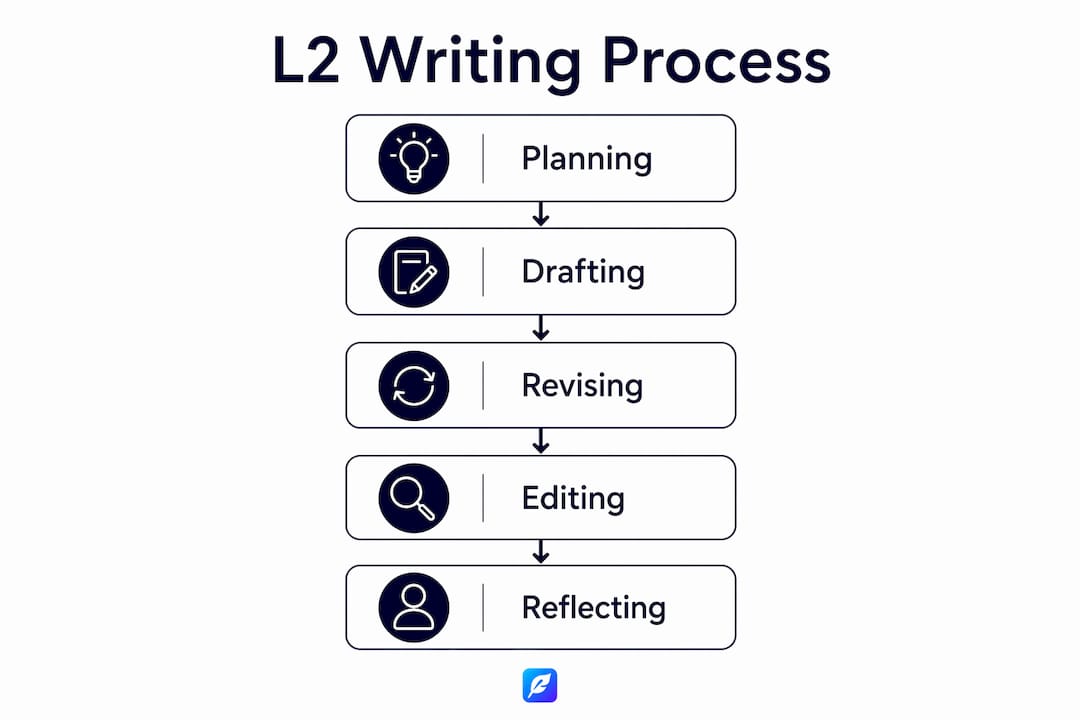
Process-oriented pedagogy shifted the focus to drafting, revising, and reflecting. Writers were encouraged to treat early drafts as thinking tools rather than finished products. Reader-oriented approaches then added the dimension of audience: who is reading this, and what do they expect?
Current research from 2026 shows that effective L2 writing pedagogy now synthesises all three orientations, combining product, process, and reader awareness into a single instructional framework. That synthesis reflects how professional writers actually work.
The table below compares the three main pedagogical orientations:
| Orientation | Primary focus | Key classroom activity |
|---|---|---|
| Product-oriented | Accuracy of the final text | Error correction and model texts |
| Process-oriented | Drafting and revision cycles | Peer review and multiple drafts |
| Reader-oriented | Audience and communicative purpose | Genre analysis and real-world writing tasks |
AI-mediated scaffolding has become a significant part of this picture. Research confirms that AI scaffolding improves student agency and skill in writing instruction. Tools that provide instant grammar feedback, suggest vocabulary alternatives, and flag stylistic inconsistencies give writers the kind of immediate response that a human tutor cannot always provide. The key is using these tools to support revision rather than to replace the act of composing.
Instruction also adapts to the specific learner. A Mandarin speaker writing in English faces different challenges from a Spanish speaker. Effective teaching identifies those specific interference patterns and addresses them directly, rather than applying a one-size-fits-all grammar syllabus.
What are the best strategies for second language writing improvement?
The most effective strategies for improving second language writing share one principle: prioritise doing over perfecting. Writers who wait until they feel ready rarely write enough to improve. Writers who write regularly, even badly, build fluency faster.
-
Write directly in the target language. Writing directly in the second language prevents the rigid, unnatural phrasing known as translationese. Translating mentally from your native language first produces sentences that are grammatically plausible but stylistically foreign. Writing directly, even if the first attempts feel clumsy, builds genuine linguistic muscle memory.
-
Read extensively in the target language. Reading exposes you to natural sentence rhythms, idiomatic phrases, and genre conventions. A writer who reads widely in English will absorb patterns that no grammar textbook can fully teach. Focus on the genre you want to write: academic papers if you are a student, business reports if you work in a professional context.
-
Use a "meaning first, correctness second" workflow. A meaning-first writing workflow boosts productivity and preserves creative momentum. Draft the full piece without stopping to correct errors. Once the ideas are captured, return to edit grammar, vocabulary, and style. Constant early-stage correction disrupts the flow of thought and produces shorter, less developed texts.
-
Embrace imperfect early drafts. Fear of error-filled drafts is one of the most common psychological barriers for L2 writers. Letting early writing be wrong is not a failure. It is a recognised part of the learning process. Writers who permit themselves to produce messy first drafts write more, revise more, and improve faster.
-
Seek professional editing and peer feedback. Multilingual writers like Joseph Conrad and Vladimir Nabokov produced celebrated literature in their second languages, partly because they worked with editors and engaged deeply with feedback. Peer review and professional proofreading catch the errors that self-editing misses.
-
Use grammar and style tools during revision. AI-powered tools that flag grammatical errors, suggest clearer phrasing, and check for consistency are particularly valuable for L2 writers during the editing phase. Resources such as the Inspirowrite blog's guide to common grammar mistakes offer targeted advice for non-native speakers.
Pro Tip: Set a timer for 20 minutes and write without stopping or correcting. This timed freewriting practice forces you to prioritise meaning over mechanics, which is exactly the habit that builds fluency.
Why are articles and prepositions so difficult for L2 writers?
Articles and prepositions represent two of the most persistent problem areas in second language composition, particularly for writers whose native languages lack direct equivalents. Understanding why they are difficult is the first step to addressing them.
English articles (a, an, the) signal whether a noun is specific or general, known or unknown to the reader. Articles and prepositions are frequent and persistent errors for L2 English writers because many languages, including Russian, Japanese, and Mandarin, have no article system at all. Writers from these language backgrounds must learn a grammatical concept that has no equivalent in their mental model of language.
Prepositions present a different challenge. Most languages have prepositions, but the mappings between languages rarely align. In English, you are "interested in" something, "good at" something, and "responsible for" something. These combinations, known as collocations, must be memorised individually because no rule predicts them reliably.
Common error patterns and targeted responses:
- Missing or incorrect articles. Read sentences aloud and ask whether the noun refers to something specific or general. Practise with English writing conventions guides that focus on article usage in context.
- Wrong preposition choice. Build a personal list of common verb-preposition and adjective-preposition combinations. Review them weekly rather than cramming before a deadline.
- Omitted prepositions. Some languages allow noun phrases to stand without a preposition where English requires one. Awareness of this pattern helps writers catch omissions during revision.
- Overuse of literal translation. Translating prepositional phrases directly from the native language produces errors that feel natural to the writer but read as foreign to native speakers.
Grammar tools that flag article and preposition errors in real time are particularly useful here. They catch patterns that the writer's own eye misses, precisely because those errors feel correct based on the native language. Pairing tool-based feedback with targeted study of grammatical errors produces faster improvement than either approach alone.
Key takeaways
Second language writing is an interdisciplinary discipline that requires writers to manage cognitive load, linguistic accuracy, and cultural conventions simultaneously, and the most effective path to improvement combines direct target-language practice, structured revision, and targeted grammar support.
| Point | Details |
|---|---|
| Definition of the field | Second language writing integrates cognitive, linguistic, and sociocultural processes, not just grammar correction. |
| Biggest cognitive challenge | Managing planning, vocabulary, and grammar simultaneously reduces the mental resources available for developing ideas. |
| Most effective pedagogy | A synthesis of product, process, and reader-oriented instruction outperforms any single approach. |
| Best personal strategy | Write directly in the target language and draft fully before editing to build fluency and preserve creative momentum. |
| Hardest grammar points | Articles and prepositions require targeted study because many native languages offer no equivalent structures. |
Second language writing and the creative advantage
I have worked with L2 writers long enough to notice something that surprises most people: writing in a second language can make you a better writer, not just a different one. The deliberate word choice that second language composition demands produces prose that is often more precise and less cluttered than the writing of native speakers who have never had to think carefully about their phrasing.
Writing in a second language enhances creativity by requiring more conscious word selection and fostering multicultural perspectives that native writers rarely access. That is not a consolation prize. It is a genuine advantage. Writers like Conrad and Nabokov did not write in English despite it being their second language. They wrote with a freshness and precision that their native-speaker contemporaries often lacked.
The mistake I see most often is treating L2 writing as a deficiency to be corrected rather than a skill to be developed. Educators should view L2 writing as a sophisticated communicative skill, not merely a language problem. That shift in perspective changes everything: the writer stops apologising for their errors and starts building on their strengths.
My practical advice is this. Write more than you think you need to. Read in your target language every day. Get your drafts in front of a skilled editor or a reliable grammar tool before you submit them. And resist the urge to translate. The writers who improve fastest are the ones who commit to thinking in their second language, even when it is uncomfortable.
— Mike
How Inspirowrite supports second language writers
Second language writers face a specific set of challenges: grammar errors that feel invisible, phrasing that sounds unnatural, and the constant pressure to produce polished work quickly. Inspirowrite addresses all three.
Inspirowrite is an AI-powered proofreading and translation tool built for writers who need fast, accurate feedback without sacrificing privacy. Your content stays confidential and is never used to train AI models. For L2 writers, that means you can paste a draft, receive detailed grammar and style suggestions within seconds, and revise with confidence. Whether you are a student submitting an essay or a professional preparing a report, Inspirowrite delivers the kind of immediate, specific feedback that accelerates improvement. Start with Inspirowrite and see the difference in your next draft.
FAQ
What is second language writing in simple terms?
Second language writing is the practice of composing written text in a language other than your native tongue. It encompasses the cognitive, linguistic, and cultural challenges involved in producing clear, effective writing in an additional language.
Why is writing in a second language harder than speaking?
Writing demands greater accuracy and permanence than speech. L2 writers must manage grammar, vocabulary, genre conventions, and audience expectations simultaneously, without the real-time feedback that conversation provides.
What are the most common errors in second language writing?
Articles and prepositions are the most persistent errors for L2 English writers, alongside vocabulary gaps and cross-linguistic interference from the native language.
How can I improve my second language writing quickly?
Write directly in the target language, use a meaning-first drafting workflow, and revise with a grammar tool or professional editor. Reading extensively in the target language accelerates progress significantly.
Does writing in a second language affect creativity?
Writing in a second language can enhance creativity by requiring more deliberate word choice and introducing multicultural perspectives. Writers like Conrad and Nabokov demonstrate that a second language can become a creative asset rather than a limitation.